
Animal
Madagascar hissing cockroach
The Madagascar hissing cockroach is a big, shiny brown insect with no wings. It can make a loud hissing sound, like a tiny snake!
The Madagascar hissing cockroach is one of the largest cockroaches in the world, up to 10 centimeters long, and it has no wings. It lives on the floor of rainforests on the island of Madagascar, where it eats fallen leaves and fruit. It makes a hissing sound by pushing air out of the breathing holes on its body.
Gromphadorhina portentosa, a wingless cockroach of the family Blaberidae, is endemic to Madagascar's lowland rainforests, where it recycles decaying plant matter. It hisses by forcing air through modified abdominal spiracles, using distinct hisses in fights, courtship and alarm. Females carry the egg case internally and give birth to live nymphs.
Photo: Almabes at English Wikipedia, public domain, via Wikimedia Commons
Meet the hissing cockroach
The Madagascar hissing cockroach is a big insect.
It is shiny and brown, and it has no wings. When it is surprised, it makes a loud hiss!
The Madagascar hissing cockroach is a shiny brown, oval insect with a single pair of antennae and no wings at all. It is one of the largest cockroaches in the world, growing 5 to 10 centimeters long, about as long as your finger.
Its most famous trick is its hiss. It is believed to be the only insect that can hiss, and it does it by pushing air out of tiny breathing holes along its body. Males have two big bumps, like horns, behind the head.
Gromphadorhina portentosa belongs to the family Blaberidae (order Blattodea, class Insecta). Animal Diversity Web lists it among the largest cockroaches, with adults 5.1 to 10.2 centimeters long and males larger than females. It is wingless, unlike many cockroaches, and males bear a pair of large tubercles, the pronotal humps, behind the head; in females these are much smaller.
The San Francisco Zoo describes it as shiny brown and oval with a single pair of antennae, and notes that it is believed to be the only insect that can hiss. It is also an excellent climber that can scale smooth glass.
Quick facts
- Group
- Invertebrate
- Length
- 5.1 to 10.2 cm
- Lifespan in the wild
- 2 to 5 years
Where it lives
Hissing cockroaches come from Madagascar.
Madagascar is a big island near Africa. They live on the floor of warm, wet forests.
In the wild, hissing cockroaches live only on Madagascar, a large island off the east coast of Africa. They live in lowland tropical rainforests, crawling through the dry leaf litter on the forest floor and hiding in rotting logs.
Many hissing cockroaches also live in zoos, schools and homes around the world, where people keep them as pets and for teaching.
The species is endemic to Madagascar, where Animal Diversity Web places it mainly in tropical lowland rainforest from sea level to about 1,000 meters, living in dry litter on the forest floor. The San Francisco Zoo adds rotting logs, leaf litter and other detritus.
It is widely kept in zoos, classrooms and the pet trade, so it is seen far beyond Madagascar, but these captive animals are not part of its natural range.
Continent
Did you know?
Hissing cockroaches can climb up glass.
Hissing cockroaches are excellent climbers and can even walk up smooth glass.
The species is an excellent climber that can scale smooth glass (San Francisco Zoo).
Where can you find this animal?
- Lives here naturally · Countries and seas named by a scientific source
- Sightings recorded · Records of wild sightings (GBIF)
Lives here naturally · Countries and seas named by a scientific source
Found in the wild only on the island of Madagascar, mainly in lowland rainforest. Pets and zoo animals elsewhere are not shown.
Places: Madagascar.
Source: https://animaldiversity.org/accounts/Gromphadorhina_portentosa/ · checked October 2026
Sightings recorded · Records of wild sightings (GBIF)
Counts of GBIF records of wild observations (human and machine) and preserved specimens. Records include introduced populations, vagrants, escaped or released animals and misidentifications, so a country with records is not necessarily part of the native range.
Wild sightings have been recorded in Madagascar, United States, Canada, Germany, Colombia and UK.
Source: gbif · checked October 2026
Range maps show where scientists say an animal lives, often country by country. An animal may live in only part of a country shown, and sightings records can include animals that wandered far from home.
What it eats
Hissing cockroaches eat old leaves and fallen fruit.
They help clean up the forest floor.
Hissing cockroaches are detritivores. That means they eat dead and decaying things, mostly old plant material such as fallen leaves and fruit that lie on the forest floor.
By eating these leftovers, they help break them down and return nutrients to the soil. That makes them important recyclers in Madagascar's rainforests.
Animal Diversity Web classifies the species as a detritivore whose most frequent food is decaying plant material, including fallen fruit, because it is so readily available; it also lists leaves, seeds, lichens, fungi and other detritus.
Its ecosystem role is nutrient cycling: by consuming large amounts of decaying plant and animal matter, it returns nutrients to Madagascar's forests. Animal Diversity Web notes that it has no known adverse effects on people.
Did you know?
Males push each other but do not get hurt.
Male hissing cockroaches compete by hissing and shoving, and the bigger, louder male usually wins without anyone getting hurt.
Male contests involve hissing, pushing and stilting; the larger male that hisses more usually wins, and fights do not appear to injure the males.
A cockroach up close
A hissing cockroach has long feelers and six spiky legs.
Along its sides are tiny breathing holes. It pushes air out of them to hiss.
Like all insects, the hissing cockroach has a head, a thorax and an abdomen, with six legs. Its long antennae help it smell and feel its way.
Its back is covered in hard, overlapping plates. Along each side of the abdomen is a row of tiny breathing holes called spiracles. Insects breathe through spiracles, and this cockroach can also force air out of two special ones to make its hiss.
The body is protected by overlapping, sclerotized plates. The hiss is produced by forcibly expelling air through a pair of modified abdominal spiracles, breathing pores that are part of the insect's respiratory system; the San Francisco Zoo notes that this way of making sound is more typical of the breathing sounds of vertebrates.
Male antennae carry specialized sense organs that detect the scent of females (Animal Diversity Web). In the photograph, the antennae, the dark plates over the thorax, the banded abdominal segments, a dark spot on each segment that appears to be a spiracle, and the spiny legs are visible.
Live babies
The mother keeps her eggs inside her body.
The babies hatch inside her and then come out. Babies look like small grown-ups.
Hissing cockroaches do not lay their eggs in a nest. The mother keeps a long, yellowish egg case inside her body for about two months. When the eggs hatch, she gives birth to 15 to 40 tiny babies, called nymphs.
Nymphs look like small adults. They do not turn into something completely different, as caterpillars do. Instead they grow by molting, shedding their hard outer skin six times over 6 to 7 months. They can live for up to five years.
The species is ovoviviparous: females carry the ootheca, a long yellowish egg case, internally and release nymphs after the eggs hatch. Animal Diversity Web gives an average gestation of about 2 months and broods of 15 to 40 nymphs, with breeding year-round.
Development is incomplete metamorphosis. Nymphs resemble adults but lack reproductive organs; they molt six times over 6 to 7 months and mature at about 7 months. Typical lifespan is 2 to 5 years, both in the wild and in captivity.
Talking in hisses
Hissing cockroaches talk to each other by hissing.
A loud hiss can scare away animals that want to eat them.
Hissing cockroaches use their hiss to send messages. Scientists have found four kinds of hiss: a loud alarm hiss that sounds like a snake and startles hungry animals, two courtship hisses that males use with females, and a hiss that males use when they compete.
Adult males guard a small territory, sometimes just a rock, and push rivals away. The bigger male that hisses more usually wins, and the males do not seem to get hurt. Females and young ones are more social and do not fight.
Four hisses with different social functions and amplitude patterns have been described: a male combat hiss, two courtship and mating hisses, and an alarm hiss that may startle predators (Animal Diversity Web). Males also use a long-distance calling sound to attract females.
Adult males defend territories of less than a square meter, sometimes sitting on one rock for months. Contests involve hissing, pushing and stilting, standing tall on the legs; the larger male that hisses more usually wins, and fights do not appear to injure the males. Females and nymphs are more social. Likely predators include arachnids, ants, tenrecs and ground-feeding birds.
Did you know?
This cockroach can hiss like a snake.
The Madagascar hissing cockroach is believed to be the only insect that can hiss.
The San Francisco Zoo describes it as believed to be the only insect that can hiss, producing sound by expelling air through modified spiracles.
A forest recycler
Hissing cockroaches are not in danger.
In the wild they live only in Madagascar's forests.
The San Francisco Zoo says hissing cockroaches are common in the wild and not endangered. They have never been checked by the IUCN, the group that keeps the world's list of threatened animals.
In the wild they live only in Madagascar's forests. Many people get to meet hissing cockroaches in zoos and classrooms, where they help children learn about insects.
The species has not been evaluated for the IUCN Red List and has no special CITES status (Animal Diversity Web). The San Francisco Zoo describes it as common and not endangered in the wild.
As a Malagasy endemic of lowland forest-floor litter, its wild populations occur only in Madagascar's forests; Animal Diversity Web notes that little conservation work has been done on it. It is widely sold in the pet trade and kept for education. A mite, Androlaelaps schaeferi, commonly lives on it; Animal Diversity Web reports that the mite shares the cockroach's food rather than feeding on its blood.
Did you know?
Baby hissing cockroaches are born alive.
A mother hissing cockroach keeps her egg case inside her body and gives birth to 15 to 40 live babies.
Females are ovoviviparous, carrying the ootheca internally for about two months before releasing 15 to 40 nymphs.
Amazing facts
-
This cockroach can hiss like a snake.
The Madagascar hissing cockroach is believed to be the only insect that can hiss.
The San Francisco Zoo describes it as believed to be the only insect that can hiss, producing sound by expelling air through modified spiracles.
-
Hissing cockroaches can climb up glass.
Hissing cockroaches are excellent climbers and can even walk up smooth glass.
The species is an excellent climber that can scale smooth glass (San Francisco Zoo).
-
Males push each other but do not get hurt.
Male hissing cockroaches compete by hissing and shoving, and the bigger, louder male usually wins without anyone getting hurt.
Male contests involve hissing, pushing and stilting; the larger male that hisses more usually wins, and fights do not appear to injure the males.
-
Baby hissing cockroaches are born alive.
A mother hissing cockroach keeps her egg case inside her body and gives birth to 15 to 40 live babies.
Females are ovoviviparous, carrying the ootheca internally for about two months before releasing 15 to 40 nymphs.
Words to know
- spiracle
- a tiny breathing hole on the side of an insect's body
- detritivore
- an animal that eats dead and decaying plants and animals
- nymph
- a young insect that looks like a small adult
- molt
- to shed an old outer skin so the body can grow
- territory
- an area an animal guards from others
- endemic
- found naturally in only one place in the world
Discovery challenge
-
How does this cockroach hiss?
How does the Madagascar hissing cockroach make its hiss?
Which mechanism produces the hiss of Gromphadorhina portentosa?
- It rubs its wings together
- It pushes air out of breathing holes
- It claps its legs
Show the answer
It pushes air out of breathing holes
It pushes air out of tiny breathing holes on its body.
It forces air out of special breathing holes, called spiracles, on its abdomen.
Air is forcibly expelled through a pair of modified abdominal spiracles; the species is wingless, so it cannot use wings.
-
Where do hissing cockroaches live in the wild?
Where do Madagascar hissing cockroaches live in the wild?
What is the natural range of Gromphadorhina portentosa?
- Antarctica
- Greenland
- Madagascar
Show the answer
Madagascar
They live on the island of Madagascar.
They live wild only on Madagascar, an island off the east coast of Africa.
It is endemic to Madagascar, mainly in lowland rainforest.
-
Does a hissing cockroach have wings?
Does the Madagascar hissing cockroach have wings?
Which describes the wings of Gromphadorhina portentosa?
- It has no wings
- It has four big wings
- It has two small wings
Show the answer
It has no wings
No! It has no wings at all.
Unlike many cockroaches, it has no wings.
It is wingless in both sexes, unlike many cockroach species.
-
How are baby hissing cockroaches born?
How do Madagascar hissing cockroaches have their young?
What is the reproductive mode of Gromphadorhina portentosa?
- The mother keeps the eggs inside, and live babies come out
- The mother lays eggs in a bird's nest
- Babies grow from seeds
Show the answer
The mother keeps the eggs inside, and live babies come out
The babies hatch inside their mother and then come out.
The mother carries her egg case inside her body and gives birth to 15 to 40 nymphs.
Ovoviviparity: the ootheca is carried internally and nymphs are released after hatching.
Places where you might see it
Explore next
-
 Watch
 Country
Madagascar
Madagascar is the fourth-largest island in the world, in the Indian Ocean off southeastern Africa. It split from other land more than 60 million years ago, so many of its plants and animals, such as its lemurs, live nowhere else. About 32.7 million people lived there in 2025.
-
 Watch
3D
Animal
Ring-tailed lemur
The ring-tailed lemur is a primate that lives only on Madagascar, a big island off the coast of Africa. It has a striped tail with 13 black and white rings, sunbathes with its arms spread wide, and lives in groups where the females are in charge.
-
 Watch
Animal
Aye-aye
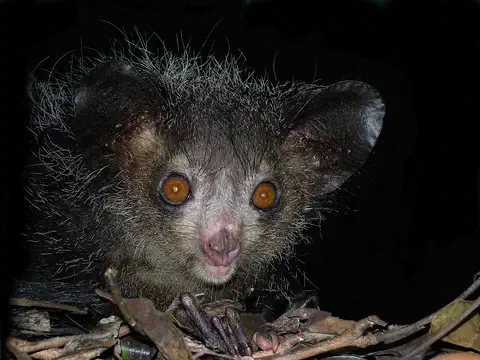
The aye-aye is a lemur from Madagascar, and the largest primate that is active at night. It taps on branches with its long, skinny middle finger, listens with its enormous ears for hidden grubs, then bites into the wood and hooks them out.
-
 Watch
Animal
Panther chameleon
The panther chameleon is a lizard famous for its brilliant colors. It lives on the island of Madagascar, grips branches with tong-shaped feet and a curling tail, looks two ways at once, and catches insects with a lightning-fast tongue. Males change their colors to send messages.
-
 Watch
3D
Animal
Housefly
The housefly is a small gray fly with two big red eyes and one pair of see-through wings. It cannot chew, so it soaks up liquid food with a mouth like a sponge. Houseflies started out in central Asia and now live almost everywhere that people live. Their eggs hatch in less than a day, and the young grow up fast.
-
 Watch
Animal
American lobster
The American lobster is a big crustacean that lives on the rocky sea floor of the northwest Atlantic Ocean. It has two very different claws, one for crushing and one for tearing, and it must climb out of its hard shell again and again to grow.
-
 Watch
3D
Animal
Antarctic krill
Antarctic krill are small, shrimp-like crustaceans about 6 centimeters long that live in the icy Southern Ocean around Antarctica. They gather in enormous swarms, and almost all the bigger animals of the Antarctic, from penguins to blue whales, depend on them for food.
-
 Watch
Animal
Army ant
Army ants hunt together in giant swarms and never build a permanent nest. This page is about the best-studied kind, Eciton burchellii, of Central and South American forests. Each night of its traveling phase the colony moves, and the workers link their legs to build a living camp around their queen and young.
For parents & teachers
What children will learn
- Describe how the Madagascar hissing cockroach makes its hiss and what it uses hisses for.
- Explain incomplete metamorphosis, where nymphs grow by molting.
- Describe the cockroach's role as a forest recycler in Madagascar.
- Locate Madagascar and explain what endemic means.
Recommended ages: 3 to 17 · About 15 minutes
Talk about it
- Why might a loud hiss help a cockroach that cannot fly away?
- How is a nymph's way of growing different from a caterpillar's?
- What would happen to a forest floor if nothing ate fallen leaves and fruit?
Try at home or in class
- Blow air through a drinking straw with your lips almost closed to hear how pushing air through a small hole makes a hissing sound.
- Find Madagascar on a globe or map and measure how far it is from the coast of Africa.
Key vocabulary: spiracle, detritivore, nymph, molt, territory, endemic
Where these facts come from
- GBIF Backbone Taxonomy and GBIF Occurrence Search , Global Biodiversity Information Facility (CC0 1.0 (backbone); occurrence counts are facts derived from records under CC0, CC BY and CC BY-NC)
- Gromphadorhina portentosa (Madagascan hissing cockroach) , Animal Diversity Web, University of Michigan Museum of Zoology
- Madagascar Hissing Cockroach , San Francisco Zoo & Gardens
- Wikidata , Wikimedia Foundation (CC0 1.0)
- Wikimedia Commons , Wikimedia Foundation (Per file: Public domain, CC0, CC BY or CC BY-SA only (credited on each page))
Checked, not yet human-reviewed. Last updated October 27, 2026. Spotted a mistake? Tell us.