Animal
Aye-aye
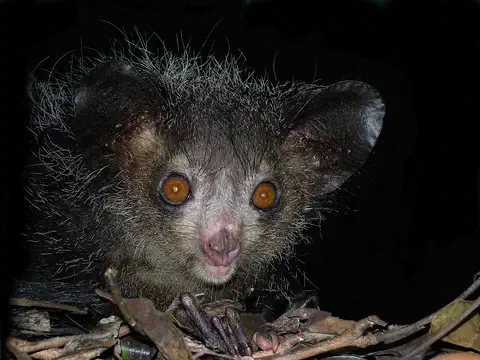
The aye-aye is a lemur that wakes up at night. It has huge ears, big eyes and one very long, thin finger.
The aye-aye is a lemur from Madagascar, and the largest primate that is active at night. It taps on branches with its long, skinny middle finger, listens with its enormous ears for hidden grubs, then bites into the wood and hooks them out.
Daubentonia madagascariensis, the only living member of its family, finds wood-boring larvae by tap foraging: it taps with a thin third finger, listens for tunnels, gnaws in with ever-growing incisors and hooks the prey out. The IUCN lists it as Endangered because of habitat loss and hunting.
Photo: Frank Vassen from Brussels, Belgium, CC BY 2.0, via Wikimedia Commons
Meet the aye-aye
The aye-aye is a kind of lemur.
It has dark, shaggy fur and a big, bushy tail. Its ears are huge and its eyes are bright. It is awake at night and sleeps in the day.
The aye-aye is a lemur, a kind of primate that lives only on the island of Madagascar. It is the largest primate in the world that is active at night. Its body is about 40 centimeters long, and its bushy tail is even longer.
The aye-aye looks unusual. It has a short face, big eyes, enormous ears and thick dark fur with long white guard hairs. Its front teeth never stop growing, like a rodent's, and its middle finger is long and very thin.
Daubentonia madagascariensis is the sole living representative of the family Daubentoniidae and the world's largest nocturnal primate. Fossils from Egypt and Kenya dating to about 34 million years ago suggest its ancestors originated in Africa before reaching Madagascar.
Britannica gives a head-and-body length of about 40 centimeters and a bushy tail of 55 to 60 centimeters; the Duke Lemur Center gives adult weights of 2.5 to 2.8 kilograms. The aye-aye's ever-growing incisors are unique among primates, and its large ears and slender third finger work together in a foraging method called tap foraging.
Quick facts
- Group
- Mammal
- Length
- up to 0.4 m
- Weight
- 2.5 to 2.8 kg
Where it lives
Aye-ayes live on Madagascar.
Madagascar is a big island near Africa. Aye-ayes live in forests around the island. In the day they sleep in a leafy nest.
Aye-ayes live only in Madagascar, a big island off the east coast of Africa. They are found in small, scattered pockets around almost the whole coast, from sea level up into the mountains.
They can live in rainforest, dry forest, scrubby forest, mangrove swamps and even near farms beside the forest. The only habitat where they seem never to live is the spiny desert of the south. During the day, an aye-aye sleeps in a big ball-shaped nest of leaves in the fork of a tree.
The IUCN describes fragmented, low-density populations across almost all of coastal Madagascar, with confirmed records from Montagne des Français in the north to Andohahela National Park in the south and from Montagne d'Ambre to Tsingy de Bemaraha in the west. Aye-ayes were also introduced to two islands off the northeast coast: Nosy Mangabe, where nine were released in the mid-1960s and still survive, and Ile Roger, where they may since have died out.
Aye-ayes occur from sea level to high elevations in primary rainforest, deciduous forest, secondary growth, dry scrub and mangroves, and in plantations next to native forest; only the southern spiny desert seems to lack them. Their presence is often detected from feeding marks rather than sightings.
Continent
Did you know?
Aye-ayes have an extra bone like a thumb.
Besides its five fingers, an aye-aye has a bony pseudo-thumb on each hand.
Britannica describes a distinct bony pseudo-thumb that occurs in no other primate.
Where can you find this animal?
- Lives here naturally · Countries and seas named by a scientific source
- Sightings recorded · Records of wild sightings (GBIF)
Lives here naturally · Countries and seas named by a scientific source
Scattered, low-density pockets in forests around almost the whole coast of Madagascar, from sea level to high mountains; absent from the southern spiny desert.
Places: Madagascar.
Source: iucn-red-list · checked October 2026
Sightings recorded · Records of wild sightings (GBIF)
Counts of GBIF records of wild observations (human and machine) and preserved specimens. Records include introduced populations, vagrants, escaped or released animals and misidentifications, so a country with records is not necessarily part of the native range.
Wild sightings have been recorded in Madagascar, France and Zimbabwe.
Source: gbif · checked October 2026
Range maps show where scientists say an animal lives, often country by country. An animal may live in only part of a country shown, and sightings records can include animals that wandered far from home.
Tap, listen, dig
Aye-ayes eat grubs that hide inside wood.
The aye-aye taps on a branch with its long finger. It listens with its big ears. Then it bites a hole and pulls out the grub!
An aye-aye's favorite food is insect grubs that tunnel inside trees. To find them, it walks along a branch tapping fast with its middle finger and cups its huge ears forward to listen. When the sound tells it a tunnel is below, it tears off bark with its strong teeth.
Then it pokes its thin, bendy finger into the hole and hooks the grub out with the tip. This is called tap foraging. Aye-ayes also eat seeds and nuts, scoop pulp out of fruit, and sometimes raid coconut, lychee and mango farms.
The diet is highly specialized: mostly invertebrates, especially wood-boring larvae, with nuts, seeds and fruit. The Duke Lemur Center describes tap foraging: rapid tapping with the third finger while the ears are cupped forward to detect echoes from hollow tunnels, then gnawing through bark with the incisors and hooking the larva out with the flexible finger's tip.
The IUCN notes that presence in many areas seems to depend on the seeds of ramy trees (Canarium), a primary food resource. Britannica adds that the third finger also digs out fruit pulp. Aye-ayes raid coconut, lychee and mango plantations, which brings them into conflict with farmers.

A very special body
The aye-aye's front teeth keep on growing.
Its middle finger is long and skinny, like a twig. Its ears are big enough to hear tiny sounds inside wood.
Every part of an aye-aye's head and hands helps it find food. Its huge ears pick up the echo of a hidden tunnel. Its front teeth keep growing all its life, like a rodent's, and it uses them to tear off bark. Its middle finger is so thin it looks like a bone, and the aye-aye uses it to feel and hook.
When an aye-aye is excited or upset, its long white guard hairs stand up, and it can look twice its real size.
The Duke Lemur Center lists continually growing incisors (unique among primates), very large ears and a skeletal-looking middle finger used as a primary sensory organ. Britannica adds a short face, large eyes, claws on all fingers and toes except the flat-nailed, opposable big toes, and a pseudo-thumb: a distinct bony digit found in no other primate.
The coat is thick, coarse and dark, with long, mostly white guard hairs. When an aye-aye is agitated or excited they stand on end, making it look up to twice its size; this may have evolved to deter predators, but keepers also see it during play.
Growing up
An aye-aye mother has one baby at a time.
The baby stays close to her and drinks her milk. It learns to tap on wood by watching her.
Aye-ayes can have babies at any time of year, not just in one season. A mother is pregnant for about five and a half months and has just one baby, weighing only about 90 to 140 grams.
The baby stays with its mother for a long time and learns from her how to tap-forage. Mothers have a new baby only every two or three years.
Breeding is non-seasonal. The Duke Lemur Center gives an average gestation of 172 days; Wikidata's value is about 165 days (158 to 172). A single infant of about 90 to 140 grams is born.
The IUCN reports that the infant is nurtured for 18 to 24 months before weaning, and the Duke Lemur Center notes that wild infants can be weaned as early as 7 months but keep nursing while they stay with their mothers and have no younger sibling. The Duke Lemur Center gives sexual maturity in females at about 2 years, while the IUCN reports that wild females begin breeding at 3 or 4 and give birth every 2 to 3 years.
A night-time life
Aye-ayes are busy at night.
They climb through the trees looking for food. Most of the time, each aye-aye is on its own.
Aye-ayes are nocturnal, which means they are active at night. They can spend up to 80 percent of the night feeding and traveling through the trees, and they also walk on the ground more than most lemurs.
Most aye-ayes live on their own. A male roams a big area of about 100 to 200 hectares, much bigger than a female's. Several aye-ayes may use the same nest on different days. When a male and female meet, the female is in charge and gets first choice of food.
Aye-ayes are nocturnal, mostly solitary foragers that spend up to 80 percent of the night feeding and traveling. The IUCN notes they move along the ground more than any other lemur except the ring-tailed lemur, and that they are not strictly solitary: some forage in tandem.
The Duke Lemur Center gives male home ranges of 100 to 200 hectares and female ranges of 30 to 50 hectares; female ranges do not overlap each other but always overlap at least one male's, and the IUCN cites ranges exceeding 600 hectares. Nests are reused by different individuals on different days. Females are dominant over males, with preferential access to food.
Did you know?
Aye-ayes can eat an egg and leave the shell almost whole.
Aye-ayes at the Duke Lemur Center tap eggs, bite a small hole and scoop out the yolk with their thin finger.
Captive aye-ayes use the tap-gnaw-probe sequence on eggs, leaving the shell intact apart from a small hole.
Helping aye-ayes
Aye-ayes need their forests.
People in Madagascar are protecting forests where aye-ayes live. Scientists are learning how to help them.
The aye-aye is endangered. Madagascar has lost much of its forest, and people cut down some of the very trees aye-ayes need for food, to build boats and houses. Some aye-ayes are killed because they raid crops.
Aye-ayes are shy and hard to spot, so nobody knows exactly how many there are. They live in at least 16 protected areas, and scientists now know they are spread more widely than once thought.
The IUCN assessed the aye-aye as Endangered in 2018 (published 2020), suspecting a decline of at least 50 percent over three generations (36 years), and it appeared on the list of the world's 25 most endangered primates from 2016 to 2020. Madagascar lost 37 percent of its forest cover between 1973 and 2014, and trees that are dietary staples, such as Intsia bijuga and Canarium, are cut preferentially for boats, houses and coffins.
Aye-ayes are also killed as crop pests and, in some areas, because of local beliefs that they bring bad luck. Population size is unknown, genetic diversity is suspected to be the lowest of any lemur, and climate change may shrink the range by 43 percent from 2000 to 2080. They occur in at least 16 protected areas.
IUCN Red List
How is the aye-aye doing in the wild?
- Least Concern
- Near Threatened
- Vulnerable
- Endangered (this animal)
- Critically Endangered
- Extinct in the Wild
- Extinct
Endangered
At very high risk of disappearing from the wild.
See the IUCN Red List assessment · The IUCN Red List of Threatened Species 2022.2
Amazing facts
-
An aye-aye's front teeth never stop growing.
An aye-aye's front teeth keep growing all its life, like a rodent's. No other primate has teeth like that.
Continually growing incisors are unique among primates; the aye-aye uses them to tear away bark over larval tunnels.
-
Aye-ayes can poof up their fur to look bigger.
When an aye-aye is excited, its long white hairs stand up and it can look twice its real size.
Raising its guard hairs can make an aye-aye appear twice its size, possibly a defense, though it is also seen in play.
-
Aye-ayes have an extra bone like a thumb.
Besides its five fingers, an aye-aye has a bony pseudo-thumb on each hand.
Britannica describes a distinct bony pseudo-thumb that occurs in no other primate.
-
Aye-ayes can eat an egg and leave the shell almost whole.
Aye-ayes at the Duke Lemur Center tap eggs, bite a small hole and scoop out the yolk with their thin finger.
Captive aye-ayes use the tap-gnaw-probe sequence on eggs, leaving the shell intact apart from a small hole.
Words to know
- lemur
- a kind of primate that lives only on Madagascar and nearby islands
- nocturnal
- active at night and resting during the day
- tap foraging
- finding food by tapping on wood and listening for hollow tunnels
- larva
- a young insect, like a grub, before it changes into an adult
- incisors
- the sharp front teeth used for biting and gnawing
- endangered
- at risk of disappearing from the wild
Discovery challenge
-
What does an aye-aye do with its long, thin finger?
What does an aye-aye use its long, thin middle finger for?
What is the aye-aye's slender third finger used for when it forages?
- Tapping wood and hooking out grubs
- Swimming
- Digging burrows to sleep in
Show the answer
Tapping wood and hooking out grubs
It taps on wood, then pulls grubs out of holes.
It taps on branches to find grub tunnels, then hooks the grubs out of the hole.
Percussive tapping to locate larval tunnels, then probing and hooking the larva out after gnawing through the bark.
-
When is an aye-aye awake?
When are aye-ayes active?
Which describes the aye-aye's daily activity pattern?
- At night
- In the middle of the day
- Only in winter
Show the answer
At night
Aye-ayes are awake at night and sleep in the day.
They are nocturnal: active at night and asleep in a leafy nest by day.
Nocturnal, spending up to 80 percent of the night feeding and traveling and resting in nests by day.
-
Where do aye-ayes live?
On which island do wild aye-ayes live?
To which island is the aye-aye native?
- Madagascar
- Sumatra
- Tasmania
Show the answer
Madagascar
Aye-ayes live on Madagascar.
They live only on Madagascar, an island off the east coast of Africa.
Native to Madagascar, in fragmented pockets around almost the whole coast.
-
What is special about an aye-aye's front teeth?
What is unusual about an aye-aye's front teeth?
Which feature of the aye-aye's incisors is unique among primates?
- They keep growing all its life
- It has no front teeth
- They fall out every year
Show the answer
They keep growing all its life
Its front teeth keep growing, so they never wear out.
They keep growing all its life, like a rodent's teeth.
They grow continually, a trait found in no other primate.
Places where you might see it
Explore next
-
 Watch
3D
Animal
Ring-tailed lemur
The ring-tailed lemur is a primate that lives only on Madagascar, a big island off the coast of Africa. It has a striped tail with 13 black and white rings, sunbathes with its arms spread wide, and lives in groups where the females are in charge.
-
 Watch
 Country
Madagascar
Madagascar is the fourth-largest island in the world, in the Indian Ocean off southeastern Africa. It split from other land more than 60 million years ago, so many of its plants and animals, such as its lemurs, live nowhere else. About 32.7 million people lived there in 2025.
-
 Watch
3D
Animal
Madagascar hissing cockroach
The Madagascar hissing cockroach is one of the largest cockroaches in the world, up to 10 centimeters long, and it has no wings. It lives on the floor of rainforests on the island of Madagascar, where it eats fallen leaves and fruit. It makes a hissing sound by pushing air out of the breathing holes on its body.
-
 Watch
Animal
Aardvark
The aardvark is a shy night digger of African savannas. It sniffs out ant and termite nests, rips them open with its spade-like claws and laps up the insects with a sticky tongue about 30 centimeters long. Its name means 'earth pig' in Afrikaans.
-
 Watch
Animal
African buffalo
The African buffalo is a huge, cow-like grazer with heavy, curving horns. It lives in herds that can number in the thousands, and a herd will rush to protect a calf in danger. It lives across much of Africa south of the Sahara, from open savannas to rainforests.
-
 Watch
Animal
African forest elephant
The African forest elephant is a separate species from the bigger bush elephant. It lives in the rainforests of central and western Africa, eats lots of fruit and spreads the seeds of forest trees in its dung. It is Critically Endangered.
-
 Watch
3D
Animal
African wild dog
The African wild dog, or painted dog, has a patchy coat unlike any other dog's, big round ears and only four toes on its front feet. It lives in close packs that hunt together, share food and care for the pups. It is endangered: the IUCN estimated in 2025 that only about 1,676 adults are left in the wild.
-
 Watch
Animal
Alpaca
Alpacas are small, woolly members of the camel family from the high Andes Mountains of South America. People bred them from wild vicuñas thousands of years ago, mainly for their soft, warm fleece. Every alpaca lives with people.
For parents & teachers
What children will learn
- Explain how the aye-aye's ears, teeth and fingers work together in tap foraging.
- Describe what nocturnal means and how the aye-aye's night-time life works.
- Locate Madagascar and explain that lemurs live naturally only there.
- Describe the threats to aye-ayes and why their numbers are hard to count.
Recommended ages: 3 to 17 · About 15 minutes
Talk about it
- Why might it be useful for an animal's teeth to keep growing?
- How could scientists find out where aye-ayes live if they almost never see one?
- How might farmers and aye-ayes share land when aye-ayes raid coconut and mango trees?
Try at home or in class
- Tap along a cardboard tube or a hollow box and then a solid block of wood: can you hear the difference, like an aye-aye listening for a tunnel?
- Hide a raisin inside a paper cup with a lid, then try to get it out with one finger only.
Key vocabulary: lemur, nocturnal, tap foraging, larva, incisors, endangered
Where these facts come from
- The IUCN Red List of Threatened Species , International Union for Conservation of Nature (IUCN terms of use (no redistribution of Red List data or range maps))
- GBIF Backbone Taxonomy and GBIF Occurrence Search , Global Biodiversity Information Facility (CC0 1.0 (backbone); occurrence counts are facts derived from records under CC0, CC BY and CC BY-NC)
- Wikidata , Wikimedia Foundation (CC0 1.0)
- Daubentonia madagascariensis (Aye-aye), global assessment , IUCN Red List of Threatened Species
- Aye-aye , Duke Lemur Center
- Aye-aye , Encyclopaedia Britannica
- Wikimedia Commons , Wikimedia Foundation (Per file: Public domain, CC0, CC BY or CC BY-SA only (credited on each page))
Checked, not yet human-reviewed. Last updated October 24, 2026. Spotted a mistake? Tell us.