
Animal
Rock ptarmigan
The rock ptarmigan is a grouse of cold, rocky places. It is white in winter and speckled brown and gray in summer. Feathers on its feet work like snowshoes.
The rock ptarmigan is a hardy grouse of the high Arctic and of rocky mountain tops in North America, Europe and Asia. It turns white in winter and mottled brown or gray in summer, so it blends in all year. It grows thick feathers on its feet for winter, and it eats buds, twigs, leaves and berries of small tundra plants.
Lagopus muta is a resident or altitudinally migrant grouse of rocky, sparsely vegetated tundra and alpine summits across the northern hemisphere. BirdLife International assessed it as Least Concern for the IUCN Red List (assessed 5 June 2025, published 2025), with an unknown trend and a very preliminary estimate of 11.5 to 14.3 million mature birds; local threats include ski developments, over-hunting and a warming climate.
Photo: Daisuke Tashiro, CC BY-SA 2.0, via Wikimedia Commons
Meet the rock ptarmigan
The rock ptarmigan is a plump bird that lives where it is cold and rocky.
In winter it is white. In summer it is speckled brown and gray, with white wings.
The rock ptarmigan is a hardy grouse of bare, rocky ground in the high Arctic and on mountain tops. In winter it turns white except for its black tail, so it is hidden against the snow. In summer its back is mottled, brown in females and gray in males, while its belly and wings stay white.
It is a little smaller than the willow ptarmigan, with a narrower beak. It is about 33 to 38 centimeters long and weighs about 450 to 750 grams.
Lagopus muta is a grouse (family Phasianidae). Audubon calls it a hardy grouse of barren high-Arctic ground, camouflaged by white winter and mottled brown summer plumage; the male molts later in spring than the female, so early in the breeding season he stays conspicuously white while she becomes almost invisible on the tundra. The BTO says summer upperparts are mottled brown in females and gray in males, and the RSPB that summer birds have white bellies and wings and winter birds are white except for the tail and eye-patch.
ADF&G notes that winter males have a black mask from bill to eye against a bright red, fleshy eyebrow, that both sexes have black tail feathers tipped with white, and that the much narrower bill and smaller body separate it from the willow ptarmigan. Audubon gives 33 to 38 centimeters, 60 to 66 centimeters wingspan and 450 to 750 grams; the RSPB 34 to 36 centimeters, 54 to 60 centimeters and 400 to 600 grams.
Quick facts
- Group
- Bird
- Length
- 0.33 to 0.38 m
- Wingspan
- 0.6 to 0.66 m
- Weight
- 0.45 to 0.75 kg
- Lifespan in the wild
- 2 years
Rocks, ridges and mountain tops
Rock ptarmigan live on the tundra and on high mountains.
They like rocky places with only a few small plants.
Rock ptarmigan live on rocky tundra with few plants, and on high, open mountain tops. They are rarely found among tall shrubs or below the tree line. In winter they look for windy ridges and slopes where the snow is thin, because they need to reach plants on the ground.
They live across the far north, from Alaska, Canada and Greenland to Iceland, Scandinavia and Russia, and on mountains farther south such as the Alps, the mountains of Japan and the Scottish Highlands.
The IUCN describes rocky tundra with fairly sparse vegetation and alpine summits, rarely areas of high shrubs or below the tree line; in winter birds use less snowy regions or windswept ridges and slopes because they depend on ground vegetation for food (de Juana et al. 2016). Audubon describes dry, open tundra with rock outcrops and arid ridges mixed with dwarf willow, birch and sedge meadows, and on islands such as the Aleutians all open habitats; ADF&G says it is the only Alaskan ptarmigan on the Aleutian Islands.
In the UK, the BTO says the small population is restricted to the high tops of Scotland's mountains, where birds are resident but may be forced lower by prolonged snow. The IUCN country list includes Alpine countries, Spain (with Andorra), Japan, China, Mongolia and Kazakhstan.
Continents


Where can you find this animal?
- Lives here naturally · Countries and seas named by a scientific source
- Sightings recorded · Records of wild sightings (GBIF)
Lives here naturally · Countries and seas named by a scientific source
Rocky tundra and high mountain tops where rock ptarmigan live all year, across the far north and on mountains farther south. Ptarmigan live only in the far north or high in the mountains of most countries shown. Andorra, Liechtenstein and Svalbard and Jan Mayen are also in the range but have no separate map shape. The IUCN also lists Tajikistan, which is not shaded here, and introduced birds in th
Places: Austria, Canada, China, Finland, France, Germany, Greenland, Iceland and 12 more places.
Source: iucn-red-list · checked October 2026
Sightings recorded · Records of wild sightings (GBIF)
Counts of GBIF records of wild observations (human and machine) and preserved specimens. Records include introduced populations, vagrants, escaped or released animals and misidentifications, so a country with records is not necessarily part of the native range.
Wild sightings have been recorded in France, Norway, Iceland, United States, Sweden, Canada, UK, Austria and 19 more places.
Source: gbif · checked October 2026
Range maps show where scientists say an animal lives, often country by country. An animal may live in only part of a country shown, and sightings records can include animals that wandered far from home.
Buds, catkins and berries
Rock ptarmigan eat buds, leaves, flowers and berries.
The chicks eat little bugs and spiders.
Rock ptarmigan eat almost only plants. In winter they nip buds and twigs of willow and dwarf birch from the ground; in the Alps their winter food is mostly berry bushes. In spring and summer they eat leaves, flowers and young shoots, and later berries and seeds.
In winter they sometimes follow caribou or musk oxen and feed where those animals have scraped away the snow. Young chicks eat many insects, spiders and snails at first.
The IUCN gives winter food taken from the ground, mainly buds and twigs of species including willow (Salix), with berry-bearing shrubs such as Vaccinium and Empetrum the main winter foods in the Alps and other southern areas, and a varied spring and autumn diet of leaves, flowers, berries and seeds. ADF&G says Alaskan birds eat mostly dwarf-birch buds and catkins from October to March (crowberry tips in the Aleutians), plants and insects by late June, and berries and seeds from mid-August, and must eat one-tenth to one-fifth of their body weight in food each day.
Audubon notes that adults are almost entirely vegetarian, swallow grit to help digest rough plants, sometimes follow caribou or musk-ox herds in winter to feed where the snow has been scraped away, and that young chicks feed heavily on insects, spiders and snails at first.
Did you know?
In spring the male stays white longer than the female.
Male rock ptarmigan molt later in spring, so they stay white while the brown females almost vanish on the tundra.
The male molts later than the female, staying conspicuously white early in the breeding season (Audubon).
Built for the cold
In winter, the rock ptarmigan grows thick feathers on its feet.
They work like snowshoes.
Rock ptarmigan are made for cold places. In winter they grow thick feathers on their feet, which act like snowshoes, and their white feathers hide them against the snow.
Over each eye is a bright red, fleshy patch called a comb. In spring, a male raises his red combs to show off. In winter, males also have a black stripe from the beak to the eye.
The BTO says the species is especially adapted for cold: in winter it develops thick feathers on its feet that act as snowshoes, and white plumage that camouflages it against snow. In central and northern Alaska winter plumage comes in early in October and birds are mostly white until early to mid-June (ADF&G).
Winter males have a black mask from bill to eye contrasting with the bright red, fleshy eyebrow (ADF&G); in courtship the male raises his red combs above the eyes (Audubon). About one female in five has a partial black stripe before and behind the eye (ADF&G).
A nest in the open
The mother makes a nest on the ground, often beside a big rock.
The chicks leave the nest soon after they hatch.
The female makes a shallow scrape on the ground, often out in the open beside a big rock, and lines it with a little moss, lichen, grass and feathers. She usually lays about 5 to 8 eggs, pale buff with brown spots, and keeps them warm by herself for about three weeks.
The downy chicks leave the nest with their mother within a day of hatching and find their own food. They grow fast, doubling or tripling their weight in ten days, and can fly fairly well at 10 to 15 days old.
Laying is generally in June (from late May in Scotland, mid-June on Spitsbergen), with five to eight eggs typical and up to twelve (IUCN); Audubon gives 4 to 13, usually 7 to 9, and ADF&G six to twelve, varying between birds and years. The nest is a shallow depression lined with a little plant material and feathers, usually in the open and sheltered by a large stone or shrub (IUCN; Audubon). Incubation is by the female only: about 21 days (Audubon), 20 to 22 days (ADF&G) or 21 to 23 days (BTO).
Chicks leave the nest with the female within a day, feed themselves, double or triple their weight and grow working flight feathers in about ten days (ADF&G), make short flights at 7 to 10 days and fly fairly well at 10 to 15 days, and become independent at about 10 to 12 weeks (Audubon). The BTO gives breeding typically at 1 year.
Display flights and winter flocks
In spring, the male flies up high and glides down, calling.
In fall, ptarmigan gather in big flocks.
In spring, each male defends a patch of ground with a display flight: he flaps very fast, glides up high, then flutters down to the ground while calling. When he courts a female, he raises his red combs, fans his tail and walks in circles around her, dragging one wing on the ground. His call is a snoring kurr-kurr.
In September, rock ptarmigan in Alaska gather in flocks of 20 to more than 250 birds. Many move to lower ground for the winter, and they spend winter days eating, hiding from predators and burrowing into the snow.
Audubon describes a territorial display flight of rapid flapping, a high glide and a fluttering descent with a staccato call, and a courtship display in which the male raises his red combs, fans his tail and circles the female dragging one wing; courting males give a snoring 'kurr-kurr', females clucking and purring notes. ADF&G says males are usually monogamous within a season, though some are found with two females.
In Alaska, flocks of 20 to over 250 gather in September, flocks of mostly females move to low-elevation wintering areas, and winter flocks appear nomadic, spending the day eating, avoiding predators, snow burrowing and waiting out storms (ADF&G). The IUCN says most populations make limited, largely altitudinal movements depending on local conditions and weather.
Did you know?
Rock ptarmigan eat lots of food every day.
In Alaska, a rock ptarmigan must eat one-tenth to one-fifth of its body weight in food each day.
ADF&G says rock ptarmigan must eat the equivalent of one-tenth to one-fifth of their body weight each day.
Listen to a rock ptarmigan
Listen to the sound at the start of this page.
It is a real rock ptarmigan singing in the mountains of Scotland.
At the start of this page you can play a real recording of a rock ptarmigan's display song. Lawrence Shove recorded it in the mountains of Glenshee, Scotland, in April 1967, and the British Library keeps it with its other wildlife recordings.
The recording was made in April; in Scotland, rock ptarmigan start laying their eggs from late May. Audubon describes the courting male's voice as a snoring kurr-kurr. Does this song sound like snoring to you?
The recording on this page was made by Lawrence Shove in the mountains of Glenshee, Scotland, in April 1967 (British Library, shelfmark W1CDR0001418, shared on Wikimedia Commons); the archive describes it as the display song of a ptarmigan. Audubon describes the courting male's 'snoring kurr-kurr' and a staccato call given in the territorial display flight.
Did you know?
Rock ptarmigan chicks grow very fast.
Rock ptarmigan chicks double or triple their weight in their first ten days.
ADF&G says chicks double or triple their weight and grow working flight feathers in about ten days.
Least concern, but pressured locally
There are many rock ptarmigan in the world.
But warmer weather is a problem for them in some places.
The rock ptarmigan is listed as least concern. A very rough estimate puts the number of adult birds at 11.5 to 14.3 million, and it is still very common across the wild north.
In some places it has problems. Ski resorts take over its mountain homes, and birds can fly into ski-lift cables. Too much hunting, too many grazing reindeer in Sweden and a warming climate have also been blamed for drops in numbers. In the United Kingdom it is on the Red List of birds of conservation concern.
BirdLife International assessed Lagopus muta as Least Concern for the IUCN Red List (assessed 5 June 2025, published 2025): an extremely large range and population, with an unknown trend not thought to be falling fast enough to approach the thresholds. The very preliminary estimate of 11.5 to 14.3 million mature individuals builds on 4 million in the USA and Canada (Partners in Flight 2024) and 619,000 to 1.7 million in Europe (BirdLife International 2021).
Local pressures named by the IUCN include habitat degradation and over-hunting (especially in spring), loss of habitat to ski facilities and collisions with cables around ski stations, disturbance in wintering areas, overgrazing by reindeer in Sweden, a 30% decline in a decade in the Swiss Alps attributed to climatic change, and the spread of woody shrubs across the warming Arctic. The BTO says the UK Red-lists it for a severe decline in breeding numbers and a warming climate, though it is still legally hunted there.
IUCN Red List
How is the rock ptarmigan doing in the wild?
- Least Concern (this animal)
- Near Threatened
- Vulnerable
- Endangered
- Critically Endangered
- Extinct in the Wild
- Extinct
Least Concern
Not at risk of disappearing from the wild right now.
Amazing facts
-
In winter, rock ptarmigan sometimes eat where caribou have dug in the snow.
In winter, rock ptarmigan sometimes follow caribou or musk oxen and feed where those animals have scraped away the snow.
Audubon notes that in winter they may follow caribou or musk-ox herds, feeding where the snow has been scraped away.
-
Rock ptarmigan chicks grow very fast.
Rock ptarmigan chicks double or triple their weight in their first ten days.
ADF&G says chicks double or triple their weight and grow working flight feathers in about ten days.
-
In spring the male stays white longer than the female.
Male rock ptarmigan molt later in spring, so they stay white while the brown females almost vanish on the tundra.
The male molts later than the female, staying conspicuously white early in the breeding season (Audubon).
-
Rock ptarmigan eat lots of food every day.
In Alaska, a rock ptarmigan must eat one-tenth to one-fifth of its body weight in food each day.
ADF&G says rock ptarmigan must eat the equivalent of one-tenth to one-fifth of their body weight each day.
Words to know
- tundra
- a cold, treeless land in the far north or high on mountains
- comb
- a fleshy red patch over a grouse's eye
- camouflage
- colors or patterns that help an animal blend into its surroundings
- catkin
- a dangling cluster of tiny flowers on trees and shrubs such as birches
- molt
- to shed old feathers and grow new ones
- alpine
- high on mountains, above where trees grow
Discovery challenge
-
What color is a rock ptarmigan in winter?
What color does a rock ptarmigan turn in winter?
What is the rock ptarmigan's winter plumage?
- White, with a black tail
- Bright blue
- Orange
Show the answer
White, with a black tail
White, like snow!
White, except for its black tail and, in males, a black stripe by the eye.
White except the tail and eye-patch (RSPB; ADF&G).
-
Where do rock ptarmigan live?
Which kind of place do rock ptarmigan prefer?
Which habitat does the rock ptarmigan prefer?
- Rocky tundra and mountain tops
- Tropical rainforest
- Sandy beaches
Show the answer
Rocky tundra and mountain tops
Cold, rocky places!
Rocky tundra with few plants, and high mountain tops.
Rocky tundra with sparse vegetation or alpine summits (IUCN).
-
What do the feathers on its feet do in winter?
How do the thick winter feathers on a rock ptarmigan's feet help it?
What do the rock ptarmigan's winter foot feathers act as?
- They work like snowshoes
- They help it swim
- They help it climb trees
Show the answer
They work like snowshoes
Like snowshoes!
They act like snowshoes on the snow.
Snowshoes (BTO).
-
How fast do the chicks learn to fly?
At what age can rock ptarmigan chicks fly fairly well?
When do rock ptarmigan chicks fledge?
- In about two weeks
- After one year
- After six months
Show the answer
In about two weeks
In about two weeks!
At about 10 to 15 days old.
10 to 15 days (BTO; Audubon).
Places where you might see it
-
 Watch
 Country
Iceland
Iceland is an island country in the North Atlantic, close to the Arctic Circle. It sits on the border between two giant plates of Earth's crust and has about 200 volcanoes, many hot springs and huge glaciers, and about 396,500 people lived there in mid-2026.
-
 Watch
 Country
Japan
Japan is an island country in East Asia. Most of its land is steep mountains and forest, Mount Fuji is its tallest peak, and about 124 million people live there, many of them in big cities such as Tokyo.
Explore next
-
 Watch
Animal
Willow ptarmigan
The willow ptarmigan is a plump grouse of the Arctic tundra and northern mountains in North America, Europe and Asia. It changes its feathers twice a year, from mottled brown in summer to white in winter, so it is camouflaged all year. In winter, thick feathers on its feet work like snowshoes, and it lives mostly on willow buds and twigs.
-
 Watch
Animal
Muskox
Muskoxen are shaggy Arctic grazers with long coats that nearly reach the ground and a super-warm underwool called qiviut. Herds protect their calves by standing in a ring with their horns facing out. Despite the name, they are more closely related to goats and sheep than to oxen.
-
 Watch
3D
Animal
Reindeer
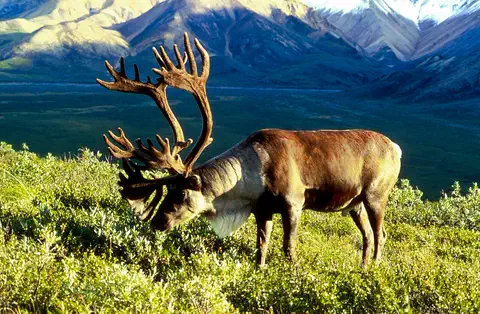
Reindeer, called caribou in North America, are deer of the Arctic tundra and northern forests. They are the only deer in which females grow antlers too. Some herds walk thousands of kilometers a year, and people in northern Europe and Asia have herded reindeer for a very long time.
-
 Watch
Animal
Golden eagle
The golden eagle is one of the largest and fastest birds of prey in North America, and it lives across much of the Northern Hemisphere. It soars over mountains and open country on wings more than two meters wide and dives at tremendous speed to catch rabbits, hares and ground squirrels.
-
Watch
Country
Iceland
Iceland is an island country in the North Atlantic, close to the Arctic Circle. It sits on the border between two giant plates of Earth's crust and has about 200 volcanoes, many hot springs and huge glaciers, and about 396,500 people lived there in mid-2026.
-
Watch
Country
Japan
Japan is an island country in East Asia. Most of its land is steep mountains and forest, Mount Fuji is its tallest peak, and about 124 million people live there, many of them in big cities such as Tokyo.
-
 Watch
Animal
Adélie penguin
The Adélie penguin is a medium-sized penguin, about 70 centimeters tall, with a black back, a white front and a bright white ring around each eye. It breeds in summer on rocky, ice-free ground all around Antarctica, building nests of pebbles, and spends the winter far out at sea among the pack ice.
-
 Watch
Animal
African fish eagle
The African fish eagle is a big eagle of Africa's lakes, rivers and coasts, with a white head, chest and tail and a chestnut-brown body. It snatches fish from the surface of the water, and its loud, ringing call is one of the best-known sounds of Africa.
For parents & teachers
What children will learn
- Locate the Arctic and mountain regions where rock ptarmigan live.
- Explain how seasonal feather changes and feathered feet help rock ptarmigan survive.
- Describe what rock ptarmigan eat through the year.
- Name some local pressures on rock ptarmigan, such as ski developments and a warming climate.
Recommended ages: 3 to 17 · About 15 minutes
Talk about it
- Why might a male stay white longer in spring than a female?
- Why would a bird that eats plants look for windy ridges in winter?
- How could ski resorts and mountain birds share the same mountains?
Try at home or in class
- Seasons collage: make two pictures of the same rocky hillside, one in summer and one in winter, and hide a paper ptarmigan of the right color in each.
- Snowshoe test: press a finger and then a flat hand into a tray of flour. Which sinks less, and why?
Key vocabulary: tundra, comb, camouflage, catkin, molt, alpine
Where these facts come from
- GBIF Backbone Taxonomy and GBIF Occurrence Search , Global Biodiversity Information Facility (CC0 1.0 (backbone); occurrence counts are facts derived from records under CC0, CC BY and CC BY-NC)
- Wikidata , Wikimedia Foundation (CC0 1.0)
- The IUCN Red List of Threatened Species , International Union for Conservation of Nature (IUCN terms of use (no redistribution of Red List data or range maps))
- Lagopus muta (BirdLife International, assessed 5 June 2025, published 2025) , IUCN Red List of Threatened Species
- Lagopus muta: population, ecology and threats text , IUCN Red List of Threatened Species
- Lagopus muta: IUCN Red List global assessment record (BirdLife International 2025), IUCN checklist on GBIF , GBIF
- Rock Ptarmigan (Guide to North American Birds, text by Kenn Kaufman) , National Audubon Society
- Rock Ptarmigan (Lagopus muta) species profile , Alaska Department of Fish and Game
- Ptarmigan (BirdFacts) , British Trust for Ornithology
- Ptarmigan bird facts , RSPB
- File:Lagopus muta japonica Mount Tsubakuro.jpg (Mount Tsubakuro, Japan, 1 June 2014, Daisuke Tashiro) , Wikimedia Commons
- File:Ptarmigan (Lagopus mutus) (W1CDR0001418 BD38).ogg (Lawrence Shove, Glenshee, Scotland, April 1967, British Library) , Wikimedia Commons
- Wikimedia Commons , Wikimedia Foundation (Per file: Public domain, CC0, CC BY or CC BY-SA only (credited on each page))
Checked, not yet human-reviewed. Last updated November 1, 2026. Spotted a mistake? Tell us.