
Animal
Staghorn coral
Staghorn coral is an animal that builds a stony home shaped like deer antlers. It lives on reefs in warm, clear seas, and fish hide among its branches.
Staghorn coral is a reef-building coral of Florida, the Bahamas and the Caribbean. Each colony is made of many tiny polyps that build a branching skeleton like a stag's antlers, and tiny algae living inside them give it food and color. Once one of the most common Caribbean corals, it is now critically endangered.
Acropora cervicornis is a fast-growing branching scleractinian coral that, with elkhorn and star corals, built Caribbean reefs over the last 5,000 years. White band disease from the 1980s cut its populations by about 97 percent, and warming seas now threaten it most. It is listed as Critically Endangered on the IUCN Red List (2022) and Threatened under the US Endangered Species Act.
Photo: Joeschmitty at English Wikipedia, CC BY 2.5, via Wikimedia Commons
Meet the staghorn coral
Staghorn coral looks like a rock or a plant. But it is made of tiny animals!
The tiny animals are called polyps. They build a hard home with branches like deer antlers. The branches are golden brown with white tips.
A coral may look like a rock or a plant, but staghorn coral is an animal, or rather thousands of them. Each colony is made of many tiny polyps, soft little animals related to sea anemones, which grow together. Every polyp in a colony is an exact copy of the others.
The polyps build a hard skeleton of stone underneath them. In staghorn coral it grows into antler-like branches, which is how it got its name: a stag is a male deer. The branches are usually golden tan or pale brown with white tips, about 2.5 to 7.5 centimeters thick.
Acropora cervicornis (Lamarck, 1816) is a stony coral (order Scleractinia, family Acroporidae). NOAA Fisheries calls it one of the most important corals in the Caribbean: with elkhorn coral and the star corals, it built Caribbean coral reefs over the last 5,000 years, and it was once so abundant that a whole reef zone is named for it.
A colony is a group of genetically identical polyps. Its antler-like branches, typically 1 to 3 inches (about 2.5 to 7.5 centimeters) thick, usually stem from a central trunk and angle upward. NOAA describes colonies at least 4 feet (1.2 meters) tall and 6 feet (1.8 meters) across.
Quick facts
- Group
- Invertebrate
- Length
- 1.8 to 2.4 m
- Height
- up to 1.2 m
Where it lives
Staghorn coral lives in warm, clear, shallow seas.
It grows on reefs in Florida, the Bahamas and the Caribbean Sea.
Staghorn coral lives on coral reefs in Florida, the Bahamas and the Caribbean, in the western Atlantic Ocean. It likes clear, shallow water, usually about 5 to 18 meters deep, with few nutrients.
It can grow on many kinds of reef, from patch reefs to limestone ridges. Where it does well, its branches tangle together into dense thickets that give fish and other reef animals lots of places to hide. Its northern limit is Palm Beach County, Florida, where it is rare.
NOAA Fisheries places staghorn coral in clear, shallow water of about 15 to 60 feet (roughly 5 to 18 meters) on reefs throughout the Bahamas, Florida and the Caribbean, with its northern limit in Palm Beach County, Florida. It occupies spur-and-groove, bank, patch and transitional reefs as well as limestone ridges, terraces and hardbottom.
NOAA has designated four critical habitat areas for the species off Florida, Puerto Rico and the US Virgin Islands. Thickets, once widespread, remain a prominent feature at only a handful of known places. The map shades the Atlantic Ocean, not the exact reefs.
Its habitat

Where can you find this animal?
- Lives here naturally · Countries and seas named by a scientific source
- Sightings recorded · Records of wild sightings (GBIF)
Lives here naturally · Countries and seas named by a scientific source
Clear, shallow coral reefs (about 5 to 18 m) of Florida, the Bahamas and the Caribbean, north to Palm Beach County, Florida. Shading is by ocean, not the exact reefs.
Places: Atlantic Ocean.
Source: https://www.fisheries.noaa.gov/species/staghorn-coral · checked October 2026
Sightings recorded · Records of wild sightings (GBIF)
Counts of GBIF records of wild observations (human and machine) and preserved specimens. Records include introduced populations, vagrants, escaped or released animals and misidentifications, so a country with records is not necessarily part of the native range.
Wild sightings have been recorded in United States, Puerto Rico, Colombia, Belize, Bahamas, Mexico, Cuba, Panama and 22 more places.
Source: gbif · checked October 2026
Range maps show where scientists say an animal lives, often country by country. An animal may live in only part of a country shown, and sightings records can include animals that wandered far from home.
Food from sunlight and plankton
Tiny plants called algae live inside the coral.
They use sunlight to make food and share it with the coral. The coral's tiny tentacles also catch even tinier floating animals.
Staghorn coral gets most of its food from tiny algae that live inside its cells. The algae use sunlight to make food, and they share it with the coral. They also give the coral its golden-brown color.
The polyps catch food too. Each one has little tentacles that grab plankton, tiny living things drifting in the water.
NOAA Fisheries explains that the coral gets food from photosynthetic algae living inside its cells, which also give it its color, and that its polyps capture plankton with their tentacles. It thrives in clear, low-nutrient water.
This partnership is also its weak point. Coral bleaching is the loss of the algae from coral tissue, and without them the coral can starve or become more vulnerable to disease. NOAA describes ocean warming, which makes corals release these algae, as the greatest threat to the species.
Did you know?
Some staghorn corals can be hundreds of years old.
NOAA reports that staghorn coral colonies can live up to hundreds of years.
NOAA gives a lifespan of up to hundreds of years for colonies.
Branches of living stone
Each branch is covered in tiny polyps.
The polyps build stone under themselves, so the branches grow longer and longer. Staghorn coral grows fast for a coral!
Every branch is covered in tiny polyps sitting in little stony cups. As they build more skeleton, the branches grow. Staghorn coral is one of the fastest-growing corals: when healthy, its branches can grow up to about 20 centimeters in a year.
The bushy branches do important jobs. They make a complex home for fish and other reef animals, and when staghorn coral is plentiful, its thickets help protect shorelines from big waves and storms.
Each colony is a framework of calcium carbonate skeleton covered by a thin layer of living polyps. NOAA Fisheries notes that, when healthy, staghorn coral can add up to 8 inches (about 20 centimeters) of branch length a year, making it one of the fastest-growing corals.
Its bush-like growth form creates complex habitat for fish and other reef organisms, and abundant staghorn coral helps protect shorelines from large waves and storms. Ocean acidification makes it harder for the coral to build its skeleton, and NOAA reports that colonies can live up to hundreds of years.
Spawning and broken branches
Once a year, after a full moon, staghorn coral lets out eggs and sperm into the sea.
Babies swim and then settle down to start new corals. A broken branch can grow into a new coral too!
Staghorn coral can make new colonies in two ways. Once a year, after the full moon in late summer, colonies release eggs and sperm into the water. This is called broadcast spawning. Each colony makes both eggs and sperm, but usually does not fertilize itself.
The fertilized eggs grow into tiny larvae that drift, then settle on a hard surface and start new colonies. Staghorn coral can also grow from broken pieces: a branch snapped off by a storm can reattach and grow into a new colony.
NOAA Fisheries describes staghorn coral as a simultaneous hermaphrodite that usually does not self-fertilize. It broadcast-spawns once a year after the full moon in late summer; larvae settle on hard surfaces and form new colonies, and colonies reach reproductive maturity at about 7 inches (18 centimeters) tall.
It also spreads asexually when broken fragments reattach to hard surfaces. Successful sexual reproduction is now very rare, which makes it hard for populations to grow, and restoration programs take advantage of fragmentation by growing branches in nurseries.
A home for reef life
Little fish hide between the branches of staghorn coral.
Fish that eat seaweed help the coral by keeping the reef clean.
A thicket of staghorn coral is like a busy apartment building for the reef. Its branches give fish, especially young fish, and many other animals safe places to hide and live.
The coral needs help from its neighbors too. Fish and other animals that eat algae keep the reef clean, leaving space for coral to grow. When too many of these grazers are fished out, seaweed can take over a reef.
NOAA Fisheries notes that staghorn thickets provide important habitat for other reef animals, especially fish, and that the bush-like growth form creates complex structure.
Herbivores that graze algae keep space open for corals. Unsustainable fishing that removes them can shift reefs from coral-dominated to algae-dominated states ("phase shifts"), and land-based pollution, including sediments, nutrients and toxicants, harms the clear, low-nutrient water staghorn coral needs.
Did you know?
A whole part of the reef was named after staghorn coral.
Staghorn coral used to be so common on Caribbean reefs that a whole reef zone was named after it.
Its former dominance gave its name to a Caribbean reef zone (NOAA).
Saving staghorn coral
There is much less staghorn coral than there used to be.
People are growing baby corals in underwater gardens and planting them on reefs. You can help by saving energy and keeping the sea clean.
Staghorn coral is critically endangered. In the 1980s a disease called white band disease killed about 97 percent of it. Today the biggest danger is warming seas, which can make corals lose their algae and bleach. In 2024 NOAA confirmed a fourth global coral bleaching event, the biggest so far.
People are working hard to help. Scientists grow staghorn branches in underwater nurseries and plant them back on reefs, and protect important reef areas. NOAA says families can help by saving energy, using less water and choosing sunscreen without oxybenzone, which is toxic to corals.
Acropora cervicornis is listed as Critically Endangered on the IUCN Red List (global assessment by Crabbe and colleagues, assessed in 2021 and published in 2022) and as Threatened throughout its range under the US Endangered Species Act; it is also on CITES Appendix II. NOAA reports a 97 percent decline from white band disease beginning in the 1980s, leaving mostly isolated colonies.
NOAA Coral Reef Watch confirmed the fourth global coral bleaching event on April 15, 2024; from January 2023 to September 2025 bleaching-level heat stress affected about 84.4 percent of the world's reef area, more than the 68.2 percent of the 2014 to 2017 event, and the event likely ended in 2025. Recovery work includes critical habitat, nursery-grown outplants, heat-resilience research and rescue of corals after ship groundings and storms.
IUCN Red List
How is the staghorn coral doing in the wild?
- Least Concern
- Near Threatened
- Vulnerable
- Endangered
- Critically Endangered (this animal)
- Extinct in the Wild
- Extinct
Critically Endangered
At extremely high risk of disappearing from the wild.
Amazing facts
-
A broken piece of staghorn coral can grow into a whole new coral.
When a branch of staghorn coral breaks off, it can reattach to the reef and grow into a new colony.
Fragmentation is a natural form of asexual reproduction, and restoration nurseries use it to grow new colonies (NOAA).
-
Staghorn coral grows fast for a coral.
Healthy staghorn coral branches can grow up to about 20 centimeters in a single year.
Up to 8 inches of branch extension a year makes it one of the fastest-growing corals (NOAA).
-
Some staghorn corals can be hundreds of years old.
NOAA reports that staghorn coral colonies can live up to hundreds of years.
NOAA gives a lifespan of up to hundreds of years for colonies.
-
A whole part of the reef was named after staghorn coral.
Staghorn coral used to be so common on Caribbean reefs that a whole reef zone was named after it.
Its former dominance gave its name to a Caribbean reef zone (NOAA).
Words to know
- coral
- a sea animal made of tiny polyps that often build a stony skeleton
- polyp
- one of the tiny animals that make up a coral colony
- colony
- a group of living things that live joined together
- algae
- tiny plant-like living things that make food from sunlight
- bleaching
- when corals lose their algae and turn white
- spawning
- releasing eggs and sperm into the water
Discovery challenge
-
What is staghorn coral made of?
What is a staghorn coral colony made of?
What makes up a colony of Acropora cervicornis?
- Tiny animals called polyps
- Sand and shells
- Seaweed
Show the answer
Tiny animals called polyps
It is made of tiny animals called polyps.
Many tiny polyps, all copies of one another, build the colony's stony branches.
Genetically identical polyps that secrete a shared calcium carbonate skeleton.
-
Why is it called staghorn coral?
Where does staghorn coral get its name?
What feature gives Acropora cervicornis its common name?
- Its branches look like deer antlers
- It makes a sound like a horn
- It lives near deer
Show the answer
Its branches look like deer antlers
Its branches look like the antlers of a deer.
A stag is a male deer, and the coral's branches look like a stag's antlers.
Its antler-like branching, like the antlers of a stag (a male deer).
-
What lives inside the coral and makes food from sunlight?
What gives staghorn coral most of its food and its color?
Which partner's loss is called coral bleaching?
- Tiny algae
- Tiny snails
- Fish eggs
Show the answer
Tiny algae
Tiny algae live inside and make food from sunlight.
Algae living in its cells make food from sunlight and give it its golden color.
Photosynthetic algae; their loss is bleaching, which can starve the coral.
-
How are people helping staghorn coral?
How are scientists helping staghorn coral recover?
Which recovery method uses staghorn coral's ability to regrow from fragments?
- Growing it in nurseries and planting it on reefs
- Painting the reef white
- Moving it to lakes
Show the answer
Growing it in nurseries and planting it on reefs
They grow baby corals and plant them on the reef.
They grow branches in underwater nurseries and plant them back on reefs.
Nursery propagation and outplanting of fragments, alongside critical habitat protection.
Experiments to try
Explore next
-
 Watch
Animal
Grooved brain coral
The grooved brain coral is a reef-building coral of the Caribbean, the Bahamas, southern Florida and Bermuda. Its tiny polyps live in long, winding valleys, which give the dome-shaped colony the look of a brain. A coral disease that spread from Florida since 2014 has hit it hard, and it is now critically endangered.
-
 Watch
Animal
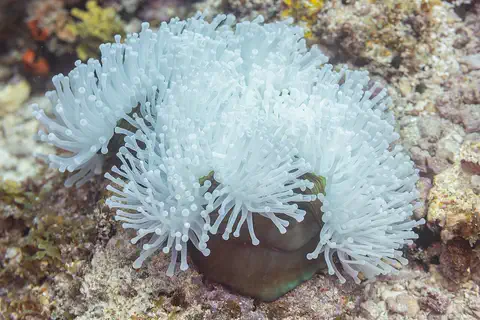
Magnificent sea anemone
The magnificent sea anemone is a large sea anemone of warm Indian and Pacific Ocean reefs. Its body is a soft column topped with hundreds of finger-shaped tentacles, and it often perches on top of rocks in plain view. Many kinds of clownfish live safely among its stinging tentacles.
- Watch What If? Lab What if coral reefs could be regrown? Scientists grow broken pieces of coral in underwater nurseries, then plant them back on damaged reefs. Follow how coral gardens work, how scientists search for corals that cope with heat, and what happens when fish come back to a restored reef.
-
 Watch
Animal
Giant clam
The giant clam, Tridacna gigas, is the largest clam alive. Its shell can grow more than a meter long. It sits on sunny coral reefs in the Indian and Pacific Oceans and gets most of its food from tiny algae living in its body. It is Critically Endangered.
-
 Watch
Animal
Crown-of-thorns starfish
The crown-of-thorns starfish is a large sea star of Indian and Pacific Ocean reefs, with up to 21 arms and hundreds of sharp, toxic spines. It eats living coral by pushing its stomach out over it. Usually it is a normal part of the reef, but sometimes huge numbers appear, called outbreaks, and they can eat much of a reef's coral.
-
 Watch
Animal
American lobster
The American lobster is a big crustacean that lives on the rocky sea floor of the northwest Atlantic Ocean. It has two very different claws, one for crushing and one for tearing, and it must climb out of its hard shell again and again to grow.
-
 Watch
3D
Animal
Antarctic krill
Antarctic krill are small, shrimp-like crustaceans about 6 centimeters long that live in the icy Southern Ocean around Antarctica. They gather in enormous swarms, and almost all the bigger animals of the Antarctic, from penguins to blue whales, depend on them for food.
-
 Watch
Animal
Army ant
Army ants hunt together in giant swarms and never build a permanent nest. This page is about the best-studied kind, Eciton burchellii, of Central and South American forests. Each night of its traveling phase the colony moves, and the workers link their legs to build a living camp around their queen and young.
For parents & teachers
What children will learn
- Explain that corals are colonies of tiny animals that build stony skeletons.
- Describe how algae inside coral provide food and what bleaching is.
- Describe how staghorn coral reproduces by spawning and fragmentation.
- Understand why staghorn coral is critically endangered and how people help it recover.
Recommended ages: 3 to 17 · About 15 minutes
Talk about it
- How can an animal look like a rock or a plant?
- Why might a coral that depends on algae need clear, shallow water?
- What everyday actions can help coral reefs far away?
Try at home or in class
- Build a staghorn coral from pipe cleaners, then add small paper fish hiding among the branches.
- Measure 20 centimeters with a ruler to see how much a healthy staghorn branch can grow in a year.
Key vocabulary: coral, polyp, colony, algae, bleaching, spawning
Where these facts come from
- The IUCN Red List of Threatened Species , International Union for Conservation of Nature (IUCN terms of use (no redistribution of Red List data or range maps))
- GBIF Backbone Taxonomy and GBIF Occurrence Search , Global Biodiversity Information Facility (CC0 1.0 (backbone); occurrence counts are facts derived from records under CC0, CC BY and CC BY-NC)
- Staghorn Coral , NOAA Fisheries
- Current Global Bleaching: Status Update , NOAA Coral Reef Watch
- Wikidata , Wikimedia Foundation (CC0 1.0)
- Wikimedia Commons , Wikimedia Foundation (Per file: Public domain, CC0, CC BY or CC BY-SA only (credited on each page))
Checked, not yet human-reviewed. Last updated October 27, 2026. Spotted a mistake? Tell us.