
Animal
Grooved brain coral
The grooved brain coral is round and covered in wiggly lines. It looks like a giant brain! It is made of tiny animals that live on warm reefs.
The grooved brain coral is a reef-building coral of the Caribbean, the Bahamas, southern Florida and Bermuda. Its tiny polyps live in long, winding valleys, which give the dome-shaped colony the look of a brain. A coral disease that spread from Florida since 2014 has hit it hard, and it is now critically endangered.
Diploria labyrinthiformis is a massive, meandroid scleractinian coral of the tropical western Atlantic, recognized by polyp-bearing valleys separated by wide ridges with a groove along each crest. It grows slowly, about 3.5 mm a year, and is highly susceptible to stony coral tissue loss disease; the IUCN listed it as Critically Endangered in 2022.
Photo: Pauline Walsh Jacobson, CC BY 4.0, via Wikimedia Commons
Meet the grooved brain coral
The grooved brain coral looks like a big, round brain.
But it is not a brain, and it is not a rock. It is made of lots of tiny animals called polyps. They live in the wiggly valleys all over it.
The grooved brain coral is a dome-shaped coral covered in winding valleys and ridges, like a giant brain or a maze. It can be tan, yellow or gray.
It is really a colony of tiny animals called polyps, which live in the valleys and build the stony skeleton underneath them. The ridges between the valleys are wide and have a groove running along the top, which is how this brain coral got its name. Big colonies can be 1 to 2 meters across.
Diploria labyrinthiformis (Linnaeus, 1758) is a stony coral (order Scleractinia). Animal Diversity Web describes distinct, U-shaped polyp-bearing valleys 5 to 10 millimeters wide and up to 6 millimeters deep, separated by wider ridges up to 15 millimeters across whose concave tops have edges 2 to 4 millimeters higher than the middle, forming the groove that names it.
Septa (radiating skeletal plates) set at right angles give the valleys a double-comb look. Colonies are tan, yellow or gray and can reach 1 to 2 meters in diameter, growing to longer lengths in shallow water.
Quick facts
- Group
- Invertebrate
- Length
- 1 to 2 m
Where it lives
Grooved brain coral lives on reefs in warm, clear seas.
It grows in the Caribbean Sea, near the Bahamas, Florida and Bermuda.
Grooved brain coral lives on reefs in the Caribbean, the Bahamas, southern Florida and Bermuda, in the western Atlantic Ocean. Brain corals of its genus are especially common on Bermuda's reefs.
Like staghorn coral, it has tiny algae living inside it that need sunlight, so it lives where light reaches the reef, down to about 50 meters deep. It grows best in water of about 25 to 29 °C and can cope with areas where there is a lot of sediment.
ADW gives the range as the Caribbean, the Bahamas, southern Florida and Bermuda, where members of the genus Diploria are especially abundant thanks to lower juvenile mortality than other corals. Because it depends on photosynthetic symbionts, its depth limit is about 50 meters.
ADW notes an optimum temperature of 25 to 29 °C for adult scleractinian corals, a minimum of 18 °C, and tolerance of high-sediment areas. The map shades the Atlantic Ocean, not the exact reefs.
Its habitat

Where can you find this animal?
- Lives here naturally · Countries and seas named by a scientific source
- Sightings recorded · Records of wild sightings (GBIF)
Lives here naturally · Countries and seas named by a scientific source
Reefs of the Caribbean, the Bahamas, southern Florida and Bermuda, down to about 50 m. Shading is by ocean, not the exact reefs.
Places: Atlantic Ocean.
Source: https://animaldiversity.org/accounts/Diploria_labyrinthiformis/ · checked October 2026
Sightings recorded · Records of wild sightings (GBIF)
Counts of GBIF records of wild observations (human and machine) and preserved specimens. Records include introduced populations, vagrants, escaped or released animals and misidentifications, so a country with records is not necessarily part of the native range.
Wild sightings have been recorded in Colombia, United States, Puerto Rico, Mexico, Cuba, Belize, Panama, Bahamas and 17 more places.
Source: gbif · checked October 2026
Range maps show where scientists say an animal lives, often country by country. An animal may live in only part of a country shown, and sightings records can include animals that wandered far from home.
Sunlight by day, plankton by night
Tiny algae inside the coral use sunlight to make food.
At night, the polyps stretch out little tentacles to catch tiny floating animals.
Grooved brain coral gets food in two ways. Single-celled algae live inside its cells and use sunlight to make food, which gives the coral energy to grow and build its skeleton. In return, the algae get a safe home.
The polyps also hunt. ADW reports that they pull their tentacles in during the day and stretch them out at night to catch tiny animals drifting in the water, such as small crustaceans and worms.
ADW describes the species as a suspension feeder on small invertebrates and zooplankton, with zooxanthellae (symbiotic algae) inside its cells that photosynthesize and supply nutrients and energy for calcification and growth; the algae receive protection and use coral waste.
Polyps retract their tentacles by day and extend them to feed at night. Grazing by the long-spined sea urchin, Diadema antillarum, may benefit the coral by reducing the growth of large algae around it.
Did you know?
A brain coral grows only a tiny bit each year.
Grooved brain coral grows only about 3.5 millimeters a year, about the thickness of a few coins.
Growth is about 3.5 mm per year (ADW); how long colonies live is unknown.
A maze made of stone
The coral's wiggly lines are valleys and ridges.
The polyps live down in the valleys. The ridges have a little groove on top.
Look closely at a grooved brain coral and you will see two kinds of wiggly lines. The valleys, about 5 to 10 millimeters wide, are where the polyps live. The ridges between them are wider, up to 15 millimeters, with a groove along the top.
This coral grows slowly, only about 3.5 millimeters a year. Nobody knows how long a colony can live.
The meandroid colony is built of long valleys shared by many polyps, each valley U-shaped in cross section, with costae (crests of the septa) running across the valley walls. ADW gives a growth rate of about 3.5 millimeters per year.
How long colonies live is unknown (ADW). A similar species, the symmetrical brain coral (Pseudodiploria strigosa), has also been treated for tissue-loss disease in Florida (NOAA Florida Keys National Marine Sanctuary).
Spawning and settling
Each coral makes both eggs and sperm.
Once a year it lets them out into the sea. The babies swim, then settle on the reef and start a new coral.
Each grooved brain coral colony is a hermaphrodite: it makes both eggs and sperm. ADW gives the usual spawning season as late May to late June, after the eggs and sperm have grown for 10 to 11 months.
The fertilized eggs become tiny swimming larvae called planulae. They settle on a hard surface, become the first polyp, and that polyp copies itself again and again to build a new colony. In 2020, rescued colonies at The Florida Aquarium spawned on May 20, and scientists raised their babies.
ADW describes the species as hermaphroditic with an annual gametogenic cycle of 10 to 11 months and a typical spawning season of late May to late June, with an average of four mature eggs and six spermatic cysts per fertile mesentery. Planula larvae settle on suitable substrate and bud secondary polyps asexually to form the colony.
Williamson and colleagues (Frontiers in Marine Science, 2022) report that eight colonies rescued from the Marquesas and Key West, held at The Florida Aquarium, spawned on May 20, 2020; their pooled gametes produced larvae that settled on ceramic plugs and were given symbiotic algae as recruits.
A home on the reef
Small fish and other animals live around brain corals.
Sea urchins help by eating seaweed that could cover the coral.
Brain corals are homes for other reef animals, and they help build the reef that many fish depend on. Reefs built by corals like this one are popular with divers.
Some animals eat corals, including some snails, worms, sea urchins, sea stars and fish such as parrotfish. Other neighbors help: long-spined sea urchins eat the large algae that could crowd and shade the coral.
ADW notes that brain corals provide homes for other organisms and that grooved brain coral contributes to reefs that support ecotourism. It lists common coral predators: gastropods, polychaetes, echinoids, asteroids, pycnogonids and fishes such as parrotfish.
Grazing by Diadema antillarum may benefit the coral by reducing macroalgae, an example of how reef herbivores help corals compete for space and light.
Did you know?
Rescued brain corals had babies in an aquarium.
In 2020, grooved brain corals rescued from the Florida Keys spawned at The Florida Aquarium, and scientists raised their young.
Eight rescued colonies from the Marquesas and Key West spawned on May 20, 2020 (Williamson and colleagues, 2022).
A coral disease and a rescue
Many grooved brain corals have gotten sick.
Scientists are rescuing corals, helping them have babies, and treating sick ones.
Grooved brain coral is critically endangered. Since 2014, a disease called stony coral tissue loss disease has spread across Florida's reef and into the Caribbean, killing the living tissue of many kinds of coral. In surveys near Miami in 2015 and 2016, 83 percent of grooved brain coral colonies were infected.
People are fighting back. Scientists treat sick corals with medicine, rescue corals to keep them safe in aquariums, and raise baby corals from them to return to the reef one day.
Diploria labyrinthiformis is listed as Critically Endangered on the IUCN Red List (global assessment by Goergen and colleagues, assessed in 2021 and published in 2022). Stony coral tissue loss disease was first reported off Miami-Dade County in 2014 and has spread along Florida's Coral Reef and to reefs in the Caribbean; Florida DEP reports that it has affected over half of Florida's Coral Reef and more than 20 of about 45 reef-building coral species.
Precht and colleagues documented 83 percent infection in grooved brain coral colonies in Miami-Dade in 2015 and 2016, with populations estimated at under 25 percent of their original numbers (as cited by Williamson and colleagues, 2022). In laboratory tests, eight-month-old recruits developed lesions within 48 hours of exposure. Responses include antibiotic treatment of diseased colonies and the Florida Coral Rescue, which keeps rescued corals as a living genetic archive.
IUCN Red List
How is the grooved brain coral doing in the wild?
- Least Concern
- Near Threatened
- Vulnerable
- Endangered
- Critically Endangered (this animal)
- Extinct in the Wild
- Extinct
Critically Endangered
At extremely high risk of disappearing from the wild.
Amazing facts
-
Brain coral polyps come out to eat at night.
Grooved brain coral polyps pull their tentacles in during the day and stretch them out at night to feed.
Tentacles are retracted by day and extended at night for suspension feeding (ADW).
-
A brain coral grows only a tiny bit each year.
Grooved brain coral grows only about 3.5 millimeters a year, about the thickness of a few coins.
Growth is about 3.5 mm per year (ADW); how long colonies live is unknown.
-
Sea urchins can help brain corals.
Long-spined sea urchins eat algae that could crowd brain corals.
Grazing by Diadema antillarum may benefit the coral by reducing macroalgae (ADW).
-
Rescued brain corals had babies in an aquarium.
In 2020, grooved brain corals rescued from the Florida Keys spawned at The Florida Aquarium, and scientists raised their young.
Eight rescued colonies from the Marquesas and Key West spawned on May 20, 2020 (Williamson and colleagues, 2022).
Words to know
- coral
- a sea animal made of tiny polyps that often build a stony skeleton
- polyp
- one of the tiny animals that make up a coral colony
- colony
- a group of living things that live joined together
- hermaphrodite
- a living thing that makes both eggs and sperm
- spawning
- releasing eggs and sperm into the water
- disease
- an illness that harms living things
Discovery challenge
-
Why is it called a brain coral?
Why is it called a grooved brain coral?
Which feature gives Diploria labyrinthiformis its common name?
- Its wiggly ridges look like a brain
- It can think
- It lives inside fish
Show the answer
Its wiggly ridges look like a brain
Its wiggly lines make it look like a brain. It cannot think!
Its maze of valleys and ridges looks like a brain, and each ridge has a groove along the top.
Its brain-like meandroid surface, with a groove along the crest of each ridge.
-
Where do the tiny polyps live?
Where on the coral do the polyps live?
In which part of the colony are the polyps found?
- In the valleys
- On the sand nearby
- Inside fish
Show the answer
In the valleys
They live down in the wiggly valleys.
The polyps live in the valleys, which are 5 to 10 millimeters wide.
In the U-shaped, polyp-bearing valleys between the grooved ridges.
-
Does a brain coral grow fast or slow?
About how fast does a grooved brain coral grow?
What growth rate does ADW give for D. labyrinthiformis?
- About 3.5 millimeters a year
- About 1 meter a year
- About 1 meter a day
Show the answer
About 3.5 millimeters a year
It grows very slowly, just a tiny bit each year.
About 3.5 millimeters a year, very slow for a coral colony that can reach 2 meters.
About 3.5 mm per year.
-
What has made many brain corals sick?
What has harmed many grooved brain corals since 2014?
Which disease outbreak first reported in 2014 has severely affected D. labyrinthiformis?
- A coral disease
- Too much snow
- Hungry whales
Show the answer
A coral disease
A coral sickness. Scientists are helping.
Stony coral tissue loss disease has spread from Florida into the Caribbean since 2014.
Stony coral tissue loss disease; 83 percent of colonies were infected in Miami-Dade surveys in 2015 to 2016.
Explore next
-
 Watch
Animal
Staghorn coral
Staghorn coral is a reef-building coral of Florida, the Bahamas and the Caribbean. Each colony is made of many tiny polyps that build a branching skeleton like a stag's antlers, and tiny algae living inside them give it food and color. Once one of the most common Caribbean corals, it is now critically endangered.
-
 Watch
Animal
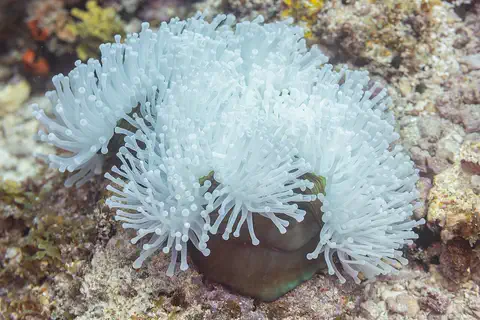
Magnificent sea anemone
The magnificent sea anemone is a large sea anemone of warm Indian and Pacific Ocean reefs. Its body is a soft column topped with hundreds of finger-shaped tentacles, and it often perches on top of rocks in plain view. Many kinds of clownfish live safely among its stinging tentacles.
-
 Watch
Animal
Christmas tree worm
The Christmas tree worm is a small sea worm that lives in a tube inside living coral on Caribbean reefs. Only its two colorful, spiral crowns show. They catch tiny floating food and help it breathe, and the worm pulls them in with a flash if anything comes too close.
-
 Watch
Animal
American lobster
The American lobster is a big crustacean that lives on the rocky sea floor of the northwest Atlantic Ocean. It has two very different claws, one for crushing and one for tearing, and it must climb out of its hard shell again and again to grow.
-
 Watch
3D
Animal
Antarctic krill
Antarctic krill are small, shrimp-like crustaceans about 6 centimeters long that live in the icy Southern Ocean around Antarctica. They gather in enormous swarms, and almost all the bigger animals of the Antarctic, from penguins to blue whales, depend on them for food.
-
 Watch
Animal
Army ant
Army ants hunt together in giant swarms and never build a permanent nest. This page is about the best-studied kind, Eciton burchellii, of Central and South American forests. Each night of its traveling phase the colony moves, and the workers link their legs to build a living camp around their queen and young.
-
 Watch
3D
Animal
Atlantic blue crab
The Atlantic blue crab is a swimming crab with bright blue claws and back legs shaped like paddles. It lives along the Atlantic coast of the Americas, especially in bays where rivers meet the sea, like the Chesapeake Bay. A mother crab carries up to two million eggs in a spongy orange mass under her body.
-
 Watch
3D
Animal
Atlantic ghost crab
The Atlantic ghost crab is a sand-colored crab of beaches along the Atlantic coast of the Americas. It is so pale that it almost disappears on the sand, like a ghost. It digs deep burrows, comes out mostly at night, and runs very fast on its long legs.
For parents & teachers
What children will learn
- Explain that a brain coral is a colony of tiny polyps living in valleys.
- Describe how the coral gets food from algae and plankton.
- Describe the coral's slow growth and yearly spawning.
- Understand the threat of coral disease and how scientists are responding.
Recommended ages: 3 to 17 · About 15 minutes
Talk about it
- Why might a coral that grows only a few millimeters a year be hard to replace?
- How are scientists' coral rescues like saving seeds in a seed bank?
- What can people do to help keep coral reefs healthy?
Try at home or in class
- Press a fork into a ball of play dough to make a maze of valleys and ridges like a brain coral.
- Mark 3.5 millimeters on a ruler, then work out how many years something growing that fast would take to grow 1 meter.
Key vocabulary: coral, polyp, colony, hermaphrodite, spawning, disease
Where these facts come from
- The IUCN Red List of Threatened Species , International Union for Conservation of Nature (IUCN terms of use (no redistribution of Red List data or range maps))
- GBIF Backbone Taxonomy and GBIF Occurrence Search , Global Biodiversity Information Facility (CC0 1.0 (backbone); occurrence counts are facts derived from records under CC0, CC BY and CC BY-NC)
- Diploria labyrinthiformis (grooved brain coral) , Animal Diversity Web, University of Michigan Museum of Zoology
- Susceptibility of Caribbean Brain Coral Recruits to Stony Coral Tissue Loss Disease (Williamson et al., 2022) , Frontiers in Marine Science
- Stony Coral Tissue Loss Disease Response , Florida Department of Environmental Protection
- Coral Disease , NOAA Florida Keys National Marine Sanctuary
- Wikidata , Wikimedia Foundation (CC0 1.0)
- Wikimedia Commons , Wikimedia Foundation (Per file: Public domain, CC0, CC BY or CC BY-SA only (credited on each page))
Checked, not yet human-reviewed. Last updated October 27, 2026. Spotted a mistake? Tell us.