
Animal
Crown-of-thorns starfish
The crown-of-thorns starfish is a big, spiky sea star with lots of arms. It lives on coral reefs and eats coral.
The crown-of-thorns starfish is a large sea star of Indian and Pacific Ocean reefs, with up to 21 arms and hundreds of sharp, toxic spines. It eats living coral by pushing its stomach out over it. Usually it is a normal part of the reef, but sometimes huge numbers appear, called outbreaks, and they can eat much of a reef's coral.
Acanthaster planci and its close relatives are corallivorous sea stars of Indo-Pacific reefs. Each can grow to about 80 cm across and a female can release over 200 million eggs a year, so populations can explode. Outbreaks have been a major cause of coral loss on the Great Barrier Reef since 1962, where AIMS calls the local species Acanthaster cf. solaris.
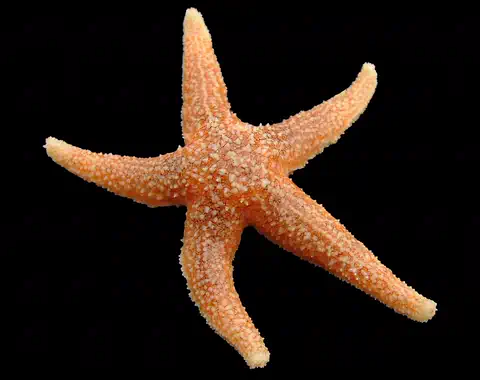
Photo: The Cosmonaut, CC BY-SA 2.5 CA, via Wikimedia Commons
Meet the crown-of-thorns starfish
The crown-of-thorns starfish is a sea star. It is big and covered in spikes.
Most sea stars have five arms. This one can have more than 20! It crawls over coral reefs and eats coral.
The crown-of-thorns starfish gets its name from the many sharp spines that cover the top of its body. It is one of the bigger sea stars: it can grow up to about 80 centimeters across, wider than a car tire. Instead of the usual five arms, it can have up to 21.
Even though it is big, it can be hard to find. It likes to hide under ledges and in nooks and crannies of the reef. It is a normal, native part of Indian and Pacific Ocean reefs, but when its numbers grow very large, it can harm them.
The Australian Institute of Marine Science (AIMS) describes crown-of-thorns starfish (COTS) as large, coral-eating sea stars with up to 21 arms and hundreds of toxin-tipped spines, growing to about 80 centimeters in diameter. They are native to the Great Barrier Reef and occur naturally across the Indo-Pacific.
Genetic studies show at least four species: AIMS lists North and South Indian Ocean species (Acanthaster planci and A. mauritiensis), a Red Sea species and a Pacific species, called Acanthaster cf. solaris, found on the Great Barrier Reef. The World Register of Marine Species now accepts A. mauritiensis and the Red Sea A. benziei (named in 2022) but still treats the Pacific form as A. planci.
Quick facts
- Group
- Invertebrate
- Length
- up to 80 cm
Where it lives
Crown-of-thorns starfish live on coral reefs in warm seas.
They live in the Indian Ocean and the Pacific Ocean, including Australia's Great Barrier Reef.
Crown-of-thorns starfish live on coral reefs across the Indian and Pacific Oceans, from the Red Sea all the way to the west coast of the Americas. They are native to Australia's Great Barrier Reef, not brought there by people.
Scientists have found that the starfish in different parts of this huge area are actually several closely related species. The one in the photo on this page was photographed in the Andaman Sea, off Thailand, in the northern Indian Ocean.
AIMS states that crown-of-thorns starfish occur naturally on coral reefs from the Red Sea to the west coast of the Americas and are native, not introduced, on the Great Barrier Reef. Under the species split AIMS describes, A. planci in the strict sense is the North Indian Ocean species, A. mauritiensis the South Indian Ocean species, and A. cf. solaris the Pacific species.
Because the World Register of Marine Species still includes the Pacific form in A. planci, the map shades the Indian and Pacific Oceans, the range of the group as a whole, apart from the separate Red Sea and southwestern Indian Ocean species. Shading is by ocean, not the exact reefs.
Its habitat

Where can you find this animal?
- Lives here naturally · Countries and seas named by a scientific source
- Sightings recorded · Records of wild sightings (GBIF)
Lives here naturally · Countries and seas named by a scientific source
Coral reefs of the Indian and Pacific Oceans, from the northern Indian Ocean to the west coast of the Americas. The Red Sea (A. benziei) and southwestern Indian Ocean (A. mauritiensis) crown-of-thorns are separate species; some scientists also treat the Pacific form as A. cf. solaris. Shading is by ocean, not the exact reefs.
Places: Indian Ocean and Pacific Ocean.
Source: https://web.archive.org/web/20260824231019/https://www.aims.gov.au/research-topi · checked October 2026
Sightings recorded · Records of wild sightings (GBIF)
Counts of GBIF records of wild observations (human and machine) and preserved specimens. Records include introduced populations, vagrants, escaped or released animals and misidentifications, so a country with records is not necessarily part of the native range.
Wild sightings have been recorded in Australia, Mexico, United States, New Caledonia, Fiji, Indonesia, Thailand, Philippines and 43 more places.
Source: gbif · checked October 2026
Range maps show where scientists say an animal lives, often country by country. An animal may live in only part of a country shown, and sightings records can include animals that wandered far from home.
A coral eater with an outside stomach
Crown-of-thorns starfish eat coral.
They push their tummy out of their mouth and onto the coral. Then they slurp up the coral's soft parts like soup!
Adult crown-of-thorns starfish eat living hard coral. Like other sea stars, they feed in a surprising way: they push their stomach out through their mouth, spread it over the coral, and cover it with juices that turn the coral's soft tissue into a kind of soup. Then they pull their stomach back in.
They prefer fast-growing branching and plate corals, such as Acropora corals. One adult can eat up to about 10 square meters of coral in a year, an area about as big as a small bedroom floor.
AIMS describes extra-oral digestion: the starfish everts its stomach through the mouth over its coral prey, releases digestive enzymes that turn coral tissue into a soup, then retracts the stomach. Adults generally prefer fast-growing branching and plate corals of the genus Acropora, and a single adult can consume up to 10 square meters of coral a year.
The diet changes with age. Larvae feed on phytoplankton while drifting, and young starfish on the reef feed mostly on crustose coralline algae, hard pink algae that encrust reefs, before switching to coral.
Did you know?
Baby crown-of-thorns starfish eat pink algae, not coral.
Young crown-of-thorns starfish eat pink coralline algae for six months to a year before they start eating coral.
Juveniles graze crustose coralline algae before switching to corals at about 6 to 12 months (AIMS).
Spines and slime
The starfish is covered in sharp spines. They help keep it safe.
The spines can sting, so people should never touch one. Look, but don't touch!
The sharp spines on top of the crown-of-thorns starfish can be up to 4 centimeters long, and they keep many hungry animals away. The spines are also covered in a toxic slime that can cause a lot of pain to any animal, or person, that touches them.
That is why divers and swimmers must never touch a crown-of-thorns starfish.
AIMS describes spines up to 4 centimeters long covered in plancitoxins, which can cause liver damage, and notes that threatened starfish also release saponins, compounds that destroy red blood cells. Together these toxins can cause great pain to any animal, or human, that touches them.
This armor deters many predators but not all. The number of arms, up to 21, varies between individuals, and the arms radiate from a broad central disc.
Millions of eggs
Crown-of-thorns starfish lay lots and lots of eggs.
The babies drift in the sea, then turn into tiny starfish with five arms. They eat pink algae, then grow up and eat coral.
Crown-of-thorns starfish spawn in the summer months: females and males release eggs and sperm into the water at the same time. A large female can release more than 200 million eggs in a year!
The larvae drift as plankton for 10 to 30 days, eating tiny floating plants. Then they change into tiny starfish with just five arms and settle on the reef, where they hide and eat pink coralline algae. Within six months to a year they switch to eating coral, and within two years they can start to reproduce.
AIMS describes summer spawning with simultaneous release of eggs and sperm, and a large female can release over 200 million eggs a year. Larvae drift as plankton for 10 to 30 days, feeding on phytoplankton, then metamorphose into a small, five-armed starfish.
Cryptic juveniles feed mostly on crustose coralline algae; within six months to a year they change to the adult form and begin eating coral, and within two years they can be mature. AIMS links outbreaks partly to increased survival of these larvae.
Outbreaks and predators
Sometimes there are lots and lots of these starfish on one reef. Then they eat a lot of coral.
Some animals eat crown-of-thorns starfish, like big sea snails and some fish.
Most of the time, crown-of-thorns starfish are a normal part of the reef. But every so often their numbers explode in what scientists call an outbreak. On the Great Barrier Reef, outbreaks usually start near Cairns or farther north and take about ten years to spread south. They can kill up to 90 percent of the corals on the reefs they reach, though reefs can recover.
A few brave animals eat these spiky starfish: the giant triton snail, the humphead wrasse, the starry pufferfish and the titan triggerfish. Shrimp, crabs and worms eat young ones.
AIMS reports that outbreaks have been a major source of coral loss on the Great Barrier Reef since 1962, generally starting offshore from Cairns or farther north and taking about a decade to spread south, killing up to 90 percent of corals on affected reefs. Monitoring since the 1970s shows affected reefs do recover, but more frequent heatwaves, bleaching and severe cyclones leave less time for recovery.
Predators include the giant triton, humphead maori wrasse, starry pufferfish and titan triggerfish; shrimp, crabs and worms eat juveniles. Using eDNA in fish gut and feces samples, AIMS found many more predators, including coral trout, rock cods and tropical snappers.
Did you know?
It eats by pushing its tummy out of its body!
A crown-of-thorns starfish pushes its stomach out through its mouth to digest coral, then pulls it back in.
Extra-oral digestion turns coral tissue into a soup that the everted stomach absorbs (AIMS).
Protecting the reef
Too many crown-of-thorns starfish in one place can hurt a reef.
Scientists count the starfish and help protect special reefs.
Crown-of-thorns starfish have not been assessed for the IUCN Red List. On the Great Barrier Reef, the worry is the opposite: too many of them at once.
Scientists think outbreaks happen more often when extra nutrients in the water feed the tiny plants their larvae eat, and when people remove the fish and other animals that eat the starfish. To protect important reefs, divers carefully remove starfish there, and scientists keep watch. In its 2025-26 report, the Australian Institute of Marine Science said a new wave of outbreaks was starting in the northern Great Barrier Reef.
Acanthaster planci has not been evaluated for the IUCN Red List (GBIF's Red List copy: Not Evaluated). AIMS says outbreaks have always occurred on the Great Barrier Reef, but human activity may have changed their frequency, likely through at least two factors: more larval survival as added nutrients boost phytoplankton, and removal of predators, especially of juveniles.
The Great Barrier Reef Marine Park Authority runs a culling program in which divers inject starfish with bile salts or vinegar on reefs chosen for their tourism value, their role in supplying coral larvae to nearby reefs and their role in spreading starfish. In its 2025-26 report, AIMS recorded no severe outbreaks, established outbreaks on five reefs, and a fifth wave of outbreaks emerging in the northern Great Barrier Reef.
Did you know?
This sea star can have more than 20 arms.
Most sea stars have five arms, but a crown-of-thorns starfish can have up to 21.
Up to 21 arms in adults, although newly settled juveniles have five (AIMS).
Amazing facts
-
This sea star can have more than 20 arms.
Most sea stars have five arms, but a crown-of-thorns starfish can have up to 21.
Up to 21 arms in adults, although newly settled juveniles have five (AIMS).
-
It eats by pushing its tummy out of its body!
A crown-of-thorns starfish pushes its stomach out through its mouth to digest coral, then pulls it back in.
Extra-oral digestion turns coral tissue into a soup that the everted stomach absorbs (AIMS).
-
One mother starfish can lay millions and millions of eggs.
A large female can release more than 200 million eggs in a year.
Fecundity above 200 million eggs a year for a large female underlies rapid population growth (AIMS).
-
Baby crown-of-thorns starfish eat pink algae, not coral.
Young crown-of-thorns starfish eat pink coralline algae for six months to a year before they start eating coral.
Juveniles graze crustose coralline algae before switching to corals at about 6 to 12 months (AIMS).
Words to know
- sea star
- a sea animal with arms around a central body, also called a starfish
- echinoderm
- a group of spiny-skinned sea animals, such as sea stars and sea urchins
- outbreak
- a sudden rise to very large numbers
- larva
- a young stage that looks very different from the adult
- coralline algae
- hard, pink algae that grow like a crust on reefs
- predator
- an animal that hunts and eats other animals
Discovery challenge
-
What do grown-up crown-of-thorns starfish eat?
What is the main food of adult crown-of-thorns starfish?
Which corals do adult crown-of-thorns starfish generally prefer?
- Living coral
- Seaweed only
- Sand
Show the answer
Living coral
They eat living coral.
They eat living hard coral, especially fast-growing branching and plate corals.
Living hard corals, especially fast-growing branching and plate Acropora.
-
How does it eat coral?
How does a crown-of-thorns starfish eat coral?
What feeding method does the crown-of-thorns starfish use?
- It pushes its stomach out over the coral
- It bites with sharp teeth
- It sucks coral through a straw-like nose
Show the answer
It pushes its stomach out over the coral
It pushes its tummy out and turns coral into soup.
It pushes its stomach out through its mouth and digests the coral's tissue outside its body.
Extra-oral digestion: the everted stomach releases enzymes over the coral.
-
What do baby crown-of-thorns starfish eat on the reef?
What do young crown-of-thorns starfish eat before they eat coral?
What is the main food of juvenile crown-of-thorns starfish after settlement?
- Pink coralline algae
- Fish
- Coral right away
Show the answer
Pink coralline algae
They eat pink algae on the reef.
They eat pink coralline algae for six months to a year, then switch to coral.
Crustose coralline algae, until the switch to coral at about 6 to 12 months.
-
Should you touch a crown-of-thorns starfish?
Why should divers never touch a crown-of-thorns starfish?
What makes the spines of the crown-of-thorns starfish harmful?
- No, its spines have toxins that hurt
- Yes, it is soft and fluffy
- Yes, it likes to be held
Show the answer
No, its spines have toxins that hurt
No! Its spines are sharp and can hurt. Look, but don't touch.
Its sharp spines are covered in toxic slime that can cause a lot of pain.
Spines up to 4 cm carry plancitoxins, and threatened starfish release saponins.
Places where you might see it
Explore next
-
 Watch
Animal
Humphead wrasse
The humphead wrasse is the biggest fish in the wrasse family, up to about 2.3 meters long. Adults have thick lips, a forehead hump and wavy lines on the face. They eat shellfish, sea urchins and even toxic crown-of-thorns starfish, and many change from female to male. Too many have been caught, so it is endangered.
-
 Watch
Animal
Staghorn coral
Staghorn coral is a reef-building coral of Florida, the Bahamas and the Caribbean. Each colony is made of many tiny polyps that build a branching skeleton like a stag's antlers, and tiny algae living inside them give it food and color. Once one of the most common Caribbean corals, it is now critically endangered.
-
 Watch
Animal
Blue sea star
The blue sea star is easy to spot on Indian and Pacific Ocean reefs: bright blue, with five smooth, tube-shaped arms. It cleans up the reef by eating dead animals, tiny creatures and the thin film that grows on rocks, and it can grow back an arm it loses.
-
 Watch
Animal
Common starfish
The common starfish is the most familiar starfish of the north-east Atlantic coasts. It has five arms, an eye spot at the tip of each one, and many tube feet. It can pull open a mussel shell and push its own stomach inside to eat.
-
 Watch
 Country
Australia
Australia is a country and the smallest continent, surrounded by ocean in the Southern Hemisphere. Much of its middle is dry and flat, most people live near the coast, and its animals include kangaroos, koalas and the platypus, a mammal that lays eggs.
-
 Watch
Animal
Giant clam
The giant clam, Tridacna gigas, is the largest clam alive. Its shell can grow more than a meter long. It sits on sunny coral reefs in the Indian and Pacific Oceans and gets most of its food from tiny algae living in its body. It is Critically Endangered.
-
 Watch
Animal
American lobster
The American lobster is a big crustacean that lives on the rocky sea floor of the northwest Atlantic Ocean. It has two very different claws, one for crushing and one for tearing, and it must climb out of its hard shell again and again to grow.
-
 Watch
3D
Animal
Antarctic krill
Antarctic krill are small, shrimp-like crustaceans about 6 centimeters long that live in the icy Southern Ocean around Antarctica. They gather in enormous swarms, and almost all the bigger animals of the Antarctic, from penguins to blue whales, depend on them for food.
For parents & teachers
What children will learn
- Describe the crown-of-thorns starfish's arms, spines and unusual way of eating.
- Explain how a native animal can still harm a reef when its numbers explode.
- Describe the life cycle from drifting larva to coral-eating adult.
- Discuss the possible human causes of outbreaks and how they are managed.
Recommended ages: 3 to 17 · About 15 minutes
Talk about it
- How can an animal that belongs on the reef become a problem for it?
- Why might protecting fish help corals?
- What does it mean when scientists say a species is really several species?
Try at home or in class
- Mark out 10 square meters (about 3 by 3.3 meters) on the floor to see how much coral one starfish can eat in a year.
- Draw a crown-of-thorns starfish with 21 arms, then a young one with five.
Key vocabulary: sea star, echinoderm, outbreak, larva, coralline algae, predator
Where these facts come from
- GBIF Backbone Taxonomy and GBIF Occurrence Search , Global Biodiversity Information Facility (CC0 1.0 (backbone); occurrence counts are facts derived from records under CC0, CC BY and CC BY-NC)
- Crown-of-thorns starfish (archived 24 August 2026) , Australian Institute of Marine Science (AIMS), via the Internet Archive
- Annual Summary Report of Coral Reef Condition 2025/26 (archived 7 October 2026) , Australian Institute of Marine Science (AIMS), via the Internet Archive
- Acanthaster Gervais, 1841 (genus record and accepted species) , World Register of Marine Species (WoRMS)
- Wikidata , Wikimedia Foundation (CC0 1.0)
- Wikimedia Commons , Wikimedia Foundation (Per file: Public domain, CC0, CC BY or CC BY-SA only (credited on each page))
Checked, not yet human-reviewed. Last updated October 27, 2026. Spotted a mistake? Tell us.