
Animal
Takahē
The takahē is a big blue and green bird from New Zealand. It cannot fly. It has a huge red beak and eats grass.
The takahē is a large bird from New Zealand that cannot fly. It is the biggest living rail in the world, with blue and green feathers, a huge red beak and strong red legs. People thought it had died out, until it was found again in the mountains of Fiordland in 1948. In 2023 there were about 500 takahē, in wild grasslands and in safe sanctuaries, and the number is growing.
Porphyrio hochstetteri, the South Island takahē, is a flightless rail endemic to New Zealand and the largest living member of its family. Thought extinct after 1898, it was rediscovered in the Murchison Mountains of Fiordland in 1948. BirdLife International and Handbook of the Birds of the World assessed it as Endangered for the IUCN Red List (assessed 2020, published 2020), with an increasing wild population; New Zealand's Department of Conservation counted around 500 birds in total in 2023.
Photo: Sandy Austin from Auckland, New Zealand, CC BY 2.0, via Wikimedia Commons
Meet the takahē
The takahē is a big, round bird with blue and green feathers.
It has a huge red beak and red legs. It cannot fly.
The takahē is the biggest rail in the world. Rails are a family of birds with short wings, big feet and long toes that mostly live on the ground. A takahē is about 50 centimeters long and weighs about 2 to 3.5 kilograms.
Its head, neck and chest are deep blue, and its back and wings shine turquoise and olive green. It has a huge red beak and stout red legs. Takahē have wings, but they cannot fly: they use them only for display, when courting a mate or showing aggression.
New Zealand Birds Online calls the South Island takahē the largest living rail in the world: an 'enormous gallinule' about 50 centimeters long and 2 to 3.5 kilograms (the Department of Conservation gives 2.3 to 3.8 kilograms). The head, neck and underparts are deep blue, the wings and back olive green, and the undertail white. The huge, conical bright-red bill, paler toward the tip, extends onto the forehead as a red frontal shield; the stout legs are red, orange underneath. Juveniles are duller, with a blackish-orange bill and dull pink-brown legs.
The wings are used only in courtship display or aggression (Department of Conservation). Another species, the North Island takahē (moho, Porphyrio mantelli), is extinct (Department of Conservation); New Zealand Birds Online says it was taller and more slender.
Quick facts
- Group
- Bird
- Length
- 0.5 m
- Weight
- 2 to 3.5 kg
- Lifespan in the wild
- 16 to 18 years
Tussock grass in the mountains
Takahē live only in New Zealand.
In the wild, they live in high, grassy mountains. When snow comes, they walk into the forest.
Takahē live only in New Zealand. Long ago they lived all over the South Island. Today wild takahē live in tussock grasslands in the Murchison Mountains of Fiordland, at Gouland Downs in Kahurangi National Park and in the Greenstone Valley.
When winter snow covers the grass, they move into the beech forest next to it. Other takahē live in sanctuaries: islands and fenced reserves with no predators, such as Tiritiri Matangi Island near Auckland, where this page's photo was taken.
The species is endemic to New Zealand (IUCN), from sea level to 1,200 meters. Subfossils show it was once widespread in the South Island; by its rediscovery in 1948 it was confined to the Murchison Mountains in Fiordland, about 650 square kilometers (IUCN). In Fiordland it prefers alpine tussock grassland and red tussock river flats, moving into adjacent beech forest when snow covers them (New Zealand Birds Online).
The Department of Conservation lists wild birds in the Murchison Mountains, at Gouland Downs in Kahurangi National Park and in the Greenstone Valley in the Upper Whakatipu. Since the 1980s, birds have also been released to predator-free islands and fenced 'mainland islands' in the North and South Islands, including Mana, Kapiti, Tiritiri Matangi and Motutapu, where they live on regenerating pasture with scattered shrubs. IUCN does not count these managed groups as wild.
Continent
Its habitats


Where can you find this animal?
- Lives here naturally · Countries and seas named by a scientific source
- Sightings recorded · Records of wild sightings (GBIF)
Lives here naturally · Countries and seas named by a scientific source
New Zealand only. Wild in the Murchison Mountains (Fiordland), at Gouland Downs (Kahurangi National Park) and in the Greenstone Valley; managed groups on predator-free islands and fenced reserves in the North and South Islands. Up to 1,200 meters.
Places: New Zealand.
Source: iucn-red-list · checked October 2026
Sightings recorded · Records of wild sightings (GBIF)
Counts of GBIF records of wild observations (human and machine) and preserved specimens. Records include introduced populations, vagrants, escaped or released animals and misidentifications, so a country with records is not necessarily part of the native range.
Wild sightings have been recorded in New Zealand.
Source: gbif · checked October 2026
Range maps show where scientists say an animal lives, often country by country. An animal may live in only part of a country shown, and sightings records can include animals that wandered far from home.
A grass eater
Takahē eat grass.
They bite off the soft bottoms of tussock grass leaves.
Takahē are plant eaters. In the mountains they mostly eat the soft, starchy bottoms of tussock grass leaves, plus sedges and grass seeds when they can find them.
In winter, when deep snow covers the grass, they go into the forest and dig up the underground stems of a fern. On the islands, where there is plenty of grass all year, they nibble shorter grasses from the tips down. Sometimes they also catch a big insect, such as a moth, beetle or wētā.
Fiordland takahē feed mainly on the leaf bases of tussock grasses (Chionochloa), sometimes taking sedges, rushes and Aciphylla; grass seeds are stripped from the stem while still attached (New Zealand Birds Online). IUCN describes them as feeding primarily on juices from the bases of snow tussock. In winter forest they grub the starchy rhizomes of the fern Hypolepis millefolium and of the sedge Carex coriacea.
On islands and lowland reserves, smaller pasture grasses grazed from the tips down are the staple, so the diet varies less with the seasons. Large insects (moths, beetles, wētā) are taken opportunistically, and ducklings or lizards very rarely (New Zealand Birds Online). The Department of Conservation notes that the fibrous diet means a takahē can produce up to 9 meters of droppings a day.
Did you know?
The takahē is the biggest rail bird in the world.
The takahē is the largest rail living anywhere in the world.
Porphyrio hochstetteri is the world's largest living rail (Department of Conservation; New Zealand Birds Online).
Big beak, strong legs
The takahē has a huge red beak.
Its strong red legs carry it everywhere, because it cannot fly.
A takahē's red beak is big and cone-shaped, and the red continues up onto its forehead like a shiny shield. Its legs are thick and red, with orange underneath.
Takahē can call loudly. Their main sounds are a loud shriek, a quiet hooting call to keep in touch, and a soft booming sound when they are alarmed. Pairs also call to defend their home ground.
The bill is huge and conical with a red frontal shield, the legs are stout and red, and the wings are used only for display (New Zealand Birds Online; Department of Conservation). The Department of Conservation describes the plumage as grading from a dark royal blue head, neck and breast to peacock-blue shoulders and iridescent turquoise and olive green on the wings and back.
New Zealand Birds Online lists three main calls: a loud shriek, a quiet hooting contact call and a muted boom that signals alarm. In this page's photo, taken on Tiritiri Matangi Island in January 2009, the bird walks to the left along a path; it wears colored bands on both legs.
Usually two eggs in a grass bowl
Takahē build a nest of dry grass on the ground.
The mother usually lays two eggs. Mom and dad take turns keeping them warm.
Takahē nest on the ground, in a big bowl of dead grass stems hidden under tussock grass or thick bushes. In Fiordland they lay from late October to January; lower down, nesting starts in September.
The female usually lays two eggs, two days apart. Both parents keep the eggs warm for about 30 days. After about a week the chicks climb out of the nest and follow their parents, who feed them tussock shoots with the tough outer leaves peeled off. Young takahē stay with their parents until just before the next breeding season, and some stay for a second year.
The nest is a substantial ground bowl of dead grass stems, sheltered under large tussock or dense shrubs. Fiordland birds lay from late October to January, lower-altitude birds from September (New Zealand Birds Online). Clutches are 1 to 3 eggs, usually 2, laid two days apart; the eggs are pale buff with reddish-purple blotches, about 74 by 48 millimeters and 95 grams when fresh. Both sexes share incubation (about 30 days) and chick rearing equally, and the chicks hatch two days apart.
Chicks leave the nest after about a week and follow their parents, which peel tussock shoots for them; a pair may lay again if the first clutch fails. Young stay until just before the next breeding season, or for a second year. Birds can breed at the end of their first year but usually start in their second (IUCN). Lifespans differ by source: IUCN gives probably 14 to 20 years, the Department of Conservation 16 to 18 in the wild and 20 to 22 at sanctuary sites, and New Zealand Birds Online a maximum longevity of 15 years.
Families with a home
Takahē live in pairs or small families.
Each family has its own patch of grass.
Takahē live in pairs or small family groups. A pair defends its own territory by calling, or by fighting if it has to, and comes back to the same place each year.
A family needs a lot of space to find enough food: the Department of Conservation says territories can be anywhere from 4 to 100 hectares, depending on how much good food grows there.
Takahē live in pairs or small family groups; pairs defend breeding territories by calling or, if necessary, fighting, and return to the same areas each year. Unusual breeding trios or larger groups, with two females laying, have been seen (New Zealand Birds Online). Territories range from 4 to 100 hectares depending on the availability and quality of food (Department of Conservation).
In Fiordland, natural hazards include avalanches and cold weather. Introduced stoats prey on takahē; their impact is low in most years, but when conditions let stoat numbers rise sharply they have a greater impact on takahē survival (New Zealand Birds Online).
Did you know?
People thought the takahē was gone for nearly 50 years!
The takahē was thought to be extinct for nearly 50 years before it was found again in 1948.
After four specimens collected between 1849 and 1898, the takahē was presumed extinct until 1948 (Department of Conservation; New Zealand Birds Online).
Back from the brink
Takahē almost disappeared.
People trap stoats, care for eggs and chicks, and move takahē to safe islands. Now the number of takahē is growing.
The takahē is endangered. It once lived across the South Island, but hunting, the loss of its habitat, predators brought by people, such as stoats, and competition for food (red deer eat the same tussock grass) led to its decline. In 2007 a stoat plague, a sudden rise in stoat numbers, halved the Murchison Mountains population.
The Department of Conservation runs a takahē recovery program: trapping stoats, controlling deer, breeding takahē at the Burwood Takahē Centre near Te Anau and moving birds to safe islands and new wild places. The total population reached 300 in 2016 and about 500 in 2023.
BirdLife International and Handbook of the Birds of the World assessed Porphyrio hochstetteri as Endangered (criterion D) for the IUCN Red List (assessed 19 March 2020, published 2020): only 50 to 249 mature individuals are counted as wild, because birds in intensively managed sites, small islands and the then-new Kahurangi population are excluded, and the trend is increasing. The total was 418 birds with about 130 breeding pairs in 2019 (Department of Conservation, cited by IUCN), and around 500 in 2023 (Department of Conservation); New Zealand classifies it as Nationally Vulnerable.
IUCN names stoat predation as a key threat: a stoat 'plague' in 2007-2008 cut the Fiordland population by over 40% (the Department of Conservation says it halved). Red deer competing for tussock drove the post-1940s decline. Responses include the 500-square-kilometer Murchison Mountains Special (Takahē) Area, deer control since the 1960s, stoat trapping since 2002, the Burwood Takahē Centre (from 1985), island transfers to limit inbreeding, and new wild populations at Gouland Downs (2018) and Greenstone Station (2023).
IUCN Red List
How is the takahē doing in the wild?
- Least Concern
- Near Threatened
- Vulnerable
- Endangered (this animal)
- Critically Endangered
- Extinct in the Wild
- Extinct
Endangered
At very high risk of disappearing from the wild.
Found again in 1948
For a long time, people thought takahē were all gone.
Then, in 1948, a team found takahē living high in the mountains.
Only four takahē were collected in Fiordland between 1849 and 1898. After that, people thought the bird was extinct for nearly 50 years.
In 1948, Geoffrey Orbell, a doctor from Invercargill, and his team found the last wild takahē in the tussock grasslands of the Murchison Mountains, above Lake Te Anau. This rediscovery started New Zealand's longest-running program to save an endangered species. Ngāi Tahu, the iwi (Māori tribe) of most of the South Island, value takahē as a taonga, a treasure, and work with the Department of Conservation to protect them.
Four specimens were collected in Fiordland between 1849 and 1898, after which the takahē was considered extinct until its rediscovery in the Murchison Mountains, west of Lake Te Anau, in 1948 (New Zealand Birds Online). The Department of Conservation credits Geoffrey Orbell, a physician from Invercargill, and his party, and calls the recovery effort New Zealand's longest-running endangered species program.
Methods changed over time: from 1985 wild eggs were incubated and chicks puppet-reared at Burwood, and yearlings released; in 2010 puppet rearing stopped in favor of chicks raised by captive parents. Ngāi Tahu, the iwi of most of the South Island, regard takahē as a taonga and act as kaitiaki (guardians) alongside the Department of Conservation.
Did you know?
Takahē parents peel grass for their chicks.
Takahē parents feed their chicks tussock shoots after peeling off the tough outer leaves.
Parents provide tussock shoots to chicks with the tougher outer leaves peeled off (New Zealand Birds Online).
Amazing facts
-
People thought the takahē was gone for nearly 50 years!
The takahē was thought to be extinct for nearly 50 years before it was found again in 1948.
After four specimens collected between 1849 and 1898, the takahē was presumed extinct until 1948 (Department of Conservation; New Zealand Birds Online).
-
The takahē is the biggest rail bird in the world.
The takahē is the largest rail living anywhere in the world.
Porphyrio hochstetteri is the world's largest living rail (Department of Conservation; New Zealand Birds Online).
-
Takahē parents peel grass for their chicks.
Takahē parents feed their chicks tussock shoots after peeling off the tough outer leaves.
Parents provide tussock shoots to chicks with the tougher outer leaves peeled off (New Zealand Birds Online).
-
A takahē family may need a very big patch of grass.
A takahē family's territory can be as big as 100 hectares, depending on how much good food grows there.
Territories range from 4 to 100 hectares depending on food availability and quality (Department of Conservation).
Words to know
- flightless
- not able to fly
- rail
- a family of birds with short wings, big feet and long toes that mostly live on the ground
- tussock
- a thick clump of tall grass
- frontal shield
- a bare, hard patch on a bird's forehead that joins onto its beak
- rediscovered
- found again after people thought it was gone
- sanctuary
- a safe place where wild animals are protected
Discovery challenge
-
Can a takahē fly?
Can a takahē fly?
Can Porphyrio hochstetteri fly?
- No, it walks everywhere
- Yes, very high
- Yes, but only at night
Show the answer
No, it walks everywhere
No! It walks on its strong red legs.
No. It has wings but uses them only for display, when courting or showing aggression.
No; the wings are used only in courtship display or aggression (Department of Conservation).
-
What does a takahē eat most?
What do wild takahē mostly eat?
What is the main food of takahē in Fiordland?
- Grass
- Fish
- Fruit
Show the answer
Grass
Grass! It eats the soft bottoms of tussock grass leaves.
Grass: mostly the soft, starchy bottoms of tussock grass leaves.
Grass: the leaf bases of tussock grasses (Chionochloa), with fern rhizomes in winter.
-
In which year were takahē found again?
In which year was the takahē rediscovered?
In which year was the takahē rediscovered in the Murchison Mountains?
- 1948
- 1898
- 2018
Show the answer
1948
1948, high in the mountains.
1948, in the Murchison Mountains of Fiordland.
1948, by Geoffrey Orbell's party; 1898 was the last of the four earlier specimens, 2018 the Kahurangi release.
-
Which animal is a big danger to takahē?
Which introduced predator is a key threat to takahē?
Which introduced mammal does IUCN name as a key predator of takahē?
- The stoat
- The penguin
- The kea
Show the answer
The stoat
The stoat. People trap stoats to keep takahē safe.
The stoat. In 2007 a stoat plague halved the Murchison Mountains takahē.
The stoat (Mustela erminea); a 2007-2008 plague cut the Fiordland population by over 40% (IUCN).
Places where you might see it
-
 Watch
 Country
New Zealand
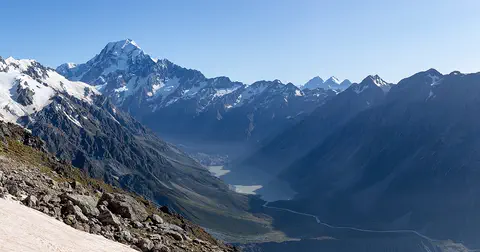
New Zealand, also called Aotearoa, is an island country in the South Pacific. Its two main islands have snowy mountains, glaciers, volcanoes and deep fiords, and about 5.36 million people lived there in 2026.
-
 Watch
Natural wonder
South Island
The South Island of New Zealand sits where two of Earth's tectonic plates meet. Their collision built the Southern Alps, which rise to nearly 4,000 meters close to the sea. Glaciers carved its fiords and lakes, and its southwest is a World Heritage area full of rare birds.
-
 Watch
Natural wonder
Southern Alps / Kā Tiritiri o te Moana
The Southern Alps / Kā Tiritiri o te Moana stretch hundreds of kilometers along New Zealand's South Island. Two of Earth's plates push together here, along the Alpine Fault, and NASA says the mountains should keep rising over time.
Explore next
-
 Watch
Animal
Kākāpō
The kākāpō is a large, moss-green parrot from New Zealand with an owl-like face. It cannot fly, it is active at night, and it eats only plants. It nearly died out, but careful work by New Zealand's Department of Conservation has grown the population to 325 birds (September 2026).
-
 Watch
Animal
Kea
The kea is a big, olive-green parrot found only on the South Island of New Zealand. It lives in mountain forests and alpine meadows, digs for food with its long, curved beak, nests on the ground and is famous for being curious, playful and clever.
-
 Watch
3D
Animal
Stoat
The stoat is a small, slender hunter with a long body, short legs and a black-tipped tail. It lives across the northern parts of Europe, Asia and North America, and in snowy places some stoats turn white in winter.
-
 Watch
Animal
Red deer
The red deer is one of the largest deer in the world. It lives in forests, hills and moors across Europe and into western Asia and North Africa. Males, called stags, grow huge branching antlers every year and roar to win mates in autumn.
-
Watch
Country
New Zealand
New Zealand, also called Aotearoa, is an island country in the South Pacific. Its two main islands have snowy mountains, glaciers, volcanoes and deep fiords, and about 5.36 million people lived there in 2026.
-
Watch
Natural wonder
South Island
The South Island of New Zealand sits where two of Earth's tectonic plates meet. Their collision built the Southern Alps, which rise to nearly 4,000 meters close to the sea. Glaciers carved its fiords and lakes, and its southwest is a World Heritage area full of rare birds.
-
 Watch
Animal
North Island brown kiwi
The North Island brown kiwi is a flightless bird that lives only in New Zealand's North Island. It has shaggy brown feathers, no tail, and a long bill with nostrils near the tip, so it can sniff out worms and grubs in the dark. The father keeps the huge egg warm for 75 to 90 days.
-
Watch
Natural wonder
Southern Alps / Kā Tiritiri o te Moana
The Southern Alps / Kā Tiritiri o te Moana stretch hundreds of kilometers along New Zealand's South Island. Two of Earth's plates push together here, along the Alpine Fault, and NASA says the mountains should keep rising over time.
For parents & teachers
What children will learn
- Locate New Zealand's South Island, Fiordland and the Hauraki Gulf.
- Explain what flightless means and how introduced predators such as stoats threaten takahē.
- Describe how a species thought extinct was rediscovered and helped to recover.
- Compare a wild population with birds kept in sanctuaries.
Recommended ages: 3 to 17 · About 15 minutes
Talk about it
- Why might a bird that cannot fly be in more danger from stoats than a bird that can?
- How can deer eating tussock grass harm takahē?
- Why do you think scientists move takahē between islands?
Try at home or in class
- Measure 50 centimeters with a tape measure and find something at home as long as a takahē.
- Draw a takahē territory map: mark tussock grass, shrubs for shelter and a hidden nest.
Key vocabulary: flightless, rail, tussock, frontal shield, rediscovered, sanctuary
Where these facts come from
- GBIF Backbone Taxonomy and GBIF Occurrence Search , Global Biodiversity Information Facility (CC0 1.0 (backbone); occurrence counts are facts derived from records under CC0, CC BY and CC BY-NC)
- Wikidata , Wikimedia Foundation (CC0 1.0)
- The IUCN Red List of Threatened Species , International Union for Conservation of Nature (IUCN terms of use (no redistribution of Red List data or range maps))
- Porphyrio hochstetteri (BirdLife International and Handbook of the Birds of the World, assessed 19 March 2020, published 2020) , IUCN Red List of Threatened Species
- Porphyrio hochstetteri: range, population, habitat, threats and conservation text , IUCN Red List of Threatened Species
- Porphyrio hochstetteri: IUCN Red List global assessment record (BirdLife International 2020), IUCN checklist on GBIF , GBIF
- South Island takahe | Takahē , New Zealand Birds Online
- Takahē , New Zealand Department of Conservation
- File:Porphyrio hochstetteri -Tiritiri Matangi Island-8.jpg (Tiritiri Matangi Island, New Zealand, 28 January 2009, Sandy Austin) , Wikimedia Commons
- Wikimedia Commons , Wikimedia Foundation (Per file: Public domain, CC0, CC BY or CC BY-SA only (credited on each page))
Checked, not yet human-reviewed. Last updated November 1, 2026. Spotted a mistake? Tell us.