
Animal
Victoria crowned pigeon
The Victoria crowned pigeon is a big blue pigeon with a lacy crown of feathers on its head. It lives in the rainforests of New Guinea. It walks on the forest floor and eats fallen fruit.
The Victoria crowned pigeon is a huge blue pigeon from the lowland rainforests of northern New Guinea and nearby islands. On its head is a fan of lacy feathers with white tips, like a crown. It walks on the forest floor in small groups, eating fallen fruit and seeds, and flies up into the trees to sleep.
Goura victoria is a very large, ground-feeding pigeon (family Columbidae) of lowland forests in northern New Guinea and nearby islands. BirdLife International assessed it as Near Threatened (C1) for the IUCN Red List (assessed 12 August 2020, published 2021): a moderately small population of 10,000 to 19,999 mature birds, assumed to be declining because of selective logging and oil-palm development.
Photo: NasserHalaweh, CC BY-SA 4.0, via Wikimedia Commons
Meet the Victoria crowned pigeon
The Victoria crowned pigeon is a very big blue pigeon.
It has red eyes and a lacy crown of feathers on its head.
The Victoria crowned pigeon is a giant among pigeons. Its feathers are blue, with a maroon-brown chest and a white patch on each wing. Its eyes are red, set in a dark patch, and on top of its head is a crest of long, lacy blue feathers tipped with white.
It is about 67 to 73 centimeters long and can weigh up to about 2.5 kilograms. The Virginia Zoo says it is named after Queen Victoria and for the crown of feathers on its head.
Goura victoria is one of the crowned pigeons (genus Goura, family Columbidae), which Zoo Barcelona calls the largest of all living pigeons, weighing up to 2.5 kilograms. Zoo Barcelona describes blue plumage with a brown chest, a conspicuous white wing patch, red eyes framed by black and a crest of long, delicate blue feathers spotted with black and white, larger than in other crowned pigeons.
The Cincinnati Zoo gives a length of 2.2 to 2.4 feet (about 67 to 73 centimeters). The Virginia Zoo says the species is named after Queen Victoria and its feather crown, calls it the largest pigeon species, and notes that it has 16 tail feathers where most pigeons have 12.
Quick facts
- Group
- Bird
- Length
- 0.67 to 0.73 m
- Weight
- 2.5 kg
Lowland rainforests of New Guinea
Victoria crowned pigeons live in warm, wet forests on the island of New Guinea.
They like flat, low land near rivers and swamps.
Victoria crowned pigeons live in the lowland forests of northern New Guinea, an island shared by Indonesia and Papua New Guinea, and on some nearby islands. They live in swamp forests, forests of sago palms and drier forests, mostly on very low, flat land, and only sometimes up to about 600 meters.
The biggest populations live in the basins of two great rivers, the Sepik in Papua New Guinea and the Mamberamo in Indonesia. One study found them only in large, unbroken forest, not in small patches.
The IUCN describes a range on Biak-Supiori (where it may have been introduced), the Yapen islands and northern New Guinea from Geelvink Bay in Papua, Indonesia, to Astrolabe Bay, plus an isolated area around Collingwood Bay in easternmost Papua New Guinea; the gap between Astrolabe and Collingwood Bays is probably natural (no coastal plain), though some think it may reflect a historic loss. The main populations are in the Sepik and Mamberamo basins, and it remains locally common in remote, undisturbed lowland alluvial forest.
Habitats are lowland forest, including swamp forest, sago forest and drier forest, mostly in the extreme lowlands but sometimes to 600 meters. A 2014 study found it only in continuous forest, not in forest fragments (Sam et al. 2014, cited by the IUCN).
Continent
Its habitat

Where can you find this animal?
- Lives here naturally · Countries and seas named by a scientific source
- Sightings recorded · Records of wild sightings (GBIF)
Lives here naturally · Countries and seas named by a scientific source
Lowland rainforest of northern New Guinea, from Geelvink Bay in Indonesia's Papua to Astrolabe Bay in Papua New Guinea, an isolated area around Collingwood Bay, and the islands of Yapen and Biak-Supiori. Only this small part of each country shown is crowned pigeon country.
Places: Indonesia and Papua New Guinea.
Source: iucn-red-list · checked October 2026
Sightings recorded · Records of wild sightings (GBIF)
Counts of GBIF records of wild observations (human and machine) and preserved specimens. Records include introduced populations, vagrants, escaped or released animals and misidentifications, so a country with records is not necessarily part of the native range.
Wild sightings have been recorded in Papua New Guinea, Indonesia, United States, Denmark, Malaysia, Netherlands, Philippines, Poland and 1 more places.
Source: gbif · checked October 2026
Range maps show where scientists say an animal lives, often country by country. An animal may live in only part of a country shown, and sightings records can include animals that wandered far from home.
Fallen fruit and seeds
Victoria crowned pigeons eat fruit that falls from the trees.
They also eat seeds and some small bugs.
Victoria crowned pigeons find their food on the forest floor. They eat fallen fruit, especially figs, along with berries, seeds and tender shoots. Now and then they also eat insects, snails and other small animals.
They feed in small groups, walking slowly over the ground and picking up food with their beaks.
The IUCN says it feeds on the ground on fallen fruit, berries and seeds in small groups of 2 to 10 birds. Zoo Barcelona describes a mainly plant-based diet of fallen fruits, seeds, berries and tender shoots, with some small invertebrates; the Virginia Zoo mentions fallen fruit (particularly figs), seeds and insects, and the Cincinnati Zoo fruits, seeds, insects and snails.
The IUCN names selective logging and oil-palm plantations as continuing pressures on its lowland forest habitat.
Did you know?
Crowned pigeons are the biggest pigeons.
Crowned pigeons are the largest pigeons alive today.
Zoo Barcelona calls crowned pigeons the largest of all living pigeons.
A crown of lace
The crown on its head is made of soft, lacy feathers.
The tips of the feathers are white.
The pigeon's crown is made of long, delicate feathers that spread out in a fan. Each one has a white tip, which makes the crest look like lace. Its body is blue, with a maroon chest and a big white patch on the wing.
It spends its days walking on the forest floor, but it can also fly. When disturbed, it flies up from far away and lands high in the trees.
Zoo Barcelona describes a crest of long, delicate blue feathers spotted with black and white, a brown chest and a conspicuous white wing patch, and says the crest is larger than in other crowned pigeons. The Virginia Zoo notes 16 tail feathers rather than the 12 of most pigeons.
The IUCN says the species flushes at a considerable distance (about 40 meters) and perches high in the middle storey of the forest, which makes it hard for hunters without shotguns to reach.
One egg at a time
The parents build a big nest of sticks and leaves in a tree.
The mother lays just one white egg.
Victoria crowned pigeons build a big platform nest of leaves and twigs on a branch, some way above the ground. They lay just one white egg, which is kept warm for about 30 days.
The parents look after their chick for some months after it hatches. In zoos, young birds can start breeding when they are about 15 months old. Pairs usually stay together for life.
Zoo Barcelona describes large nest platforms of leaves and twigs built in branches some distance above the ground, a single white egg and an incubation of 30 days. The IUCN, citing captive studies (King and Nijboer 1994), says birds start breeding from 15 months old, lay a single egg and tend the young bird for some months after hatching.
The Virginia Zoo describes the species as monogamous, typically mating for life. The IUCN gives a generation length of 10.8 years.
Small flocks on the forest floor
Victoria crowned pigeons walk around in small groups.
At night they fly up into the trees to sleep.
Victoria crowned pigeons spend their days walking on the forest floor in small flocks of about two to a dozen birds, looking for fallen fruit. They do not migrate; they stay in the same area all year.
At night they fly up into the treetops to roost. If something frightens them during the day, they also fly up into the trees.
The IUCN describes small feeding groups of 2 to 10 birds that roost in trees, and lists the species as not a migrant. Zoo Barcelona describes flocks of two to a dozen in lowland mangroves and rainforests, sedentary birds that are essentially terrestrial but spend the night high in the treetops.
The IUCN notes that birds flush at about 40 meters and perch high in the mid-storey, and that the species may persist close to villages and hunters in some areas while disappearing from others.
Did you know?
Victoria crowned pigeons have extra tail feathers.
Most pigeons have 12 tail feathers, but the Victoria crowned pigeon has 16.
Sixteen tail feathers instead of the usual 12 (Virginia Zoo).
Near threatened: forests and hunting
There are fewer Victoria crowned pigeons than before.
Cutting down their forests is a problem. They are protected by law.
The Victoria crowned pigeon is listed as near threatened. There are thought to be 10,000 to 19,999 adults, and their numbers are probably falling. Logging and new oil-palm plantations are taking away their lowland forests, and logging roads let more hunters in. People also hunt them for meat and feathers, and some are caught to sell.
They are protected by law in both Papua New Guinea and Indonesia, and international trade in them is controlled.
BirdLife International assessed Goura victoria as Near Threatened (C1) for the IUCN Red List (assessed 12 August 2020, published 2021). The population is precautionarily placed at 10,000 to 19,999 mature individuals; declines are assumed from selective logging and oil-palm development in lowland forest, but are not suspected to be rapid because hunting is no longer thought to be a significant threat.
The IUCN names hunting for meat and feathers, collection of nestlings, snares, commercial trade for aviaries, and logging roads that open access to hunters. It is listed on CITES Appendix II and protected by law in Papua New Guinea and Indonesia; proposed actions include more lowland protected areas, monitoring trade, captive breeding and using the species as a flagship for ecotourism.
IUCN Red List
How is the victoria crowned pigeon doing in the wild?
- Least Concern
- Near Threatened (this animal)
- Vulnerable
- Endangered
- Critically Endangered
- Extinct in the Wild
- Extinct
Near Threatened
Not at risk yet, but it could be soon.
Amazing facts
-
This pigeon is named after a queen.
The Virginia Zoo says the Victoria crowned pigeon is named after Queen Victoria and its crown of feathers.
The Virginia Zoo notes that the species is named after Queen Victoria and its feather crown.
-
Victoria crowned pigeons have extra tail feathers.
Most pigeons have 12 tail feathers, but the Victoria crowned pigeon has 16.
Sixteen tail feathers instead of the usual 12 (Virginia Zoo).
-
Crowned pigeons are the biggest pigeons.
Crowned pigeons are the largest pigeons alive today.
Zoo Barcelona calls crowned pigeons the largest of all living pigeons.
-
These pigeons fly up high when something scares them.
A Victoria crowned pigeon flies off when people are still about 40 meters away and lands high in the trees.
It flushes at about 40 meters and perches high in the mid-storey (IUCN).
Words to know
- crest
- a tuft or fan of feathers on top of a bird's head
- lowland
- low, flat land, not far above the level of the sea
- roost
- to perch somewhere to rest or sleep, often in a tree
- oil palm
- a palm tree grown on big farms for the oil in its fruit
- logging
- cutting down trees for wood
- near threatened
- close to being at risk of dying out in the wild
Discovery challenge
-
What is on the Victoria crowned pigeon's head?
What makes the Victoria crowned pigeon's 'crown'?
What forms the Victoria crowned pigeon's crown?
- A fan of lacy feathers
- A bony helmet
- A red comb of skin
Show the answer
A fan of lacy feathers
Lacy feathers!
Long, delicate feathers with white tips, spread like a fan.
A crest of long, delicate blue feathers spotted with black and white (Zoo Barcelona).
-
Where does it find its food?
Where does a Victoria crowned pigeon find most of its food?
Where does the Victoria crowned pigeon forage?
- On the forest floor
- In the sea
- In flowers high in the air
Show the answer
On the forest floor
On the ground!
It picks up fallen fruit, berries and seeds from the forest floor.
On the ground, eating fallen fruit, berries and seeds (IUCN).
-
How many eggs does it lay?
How many eggs does a Victoria crowned pigeon lay at a time?
What is the Victoria crowned pigeon's clutch size?
- One
- Six
- Twelve
Show the answer
One
Just one!
Just one white egg.
A single egg (IUCN; Zoo Barcelona).
-
On which island does it live?
On which big island does the Victoria crowned pigeon live?
To which island region is Goura victoria native?
- New Guinea
- Iceland
- Madagascar
Show the answer
New Guinea
New Guinea!
Northern New Guinea and a few nearby islands.
Northern New Guinea, Yapen and Biak-Supiori (IUCN).
Places where you might see it
-
 Watch
 Country
Papua New Guinea
Papua New Guinea covers the eastern half of New Guinea, the world's second largest island, plus many smaller islands. Its tall mountains, rainforests and coral reefs are home to about 40 kinds of birds-of-paradise. More than 800 languages are spoken there, and the 2024 census counted 10,185,363 people.
-
 Watch
 Country
Indonesia
Indonesia is a country of about 17,500 islands in Southeast Asia, spread across the Equator between the Indian and Pacific oceans. It has more than 100 active volcanoes, rainforests full of wildlife, and about 286 million people (2025).
Explore next
-
 Watch
3D
Animal
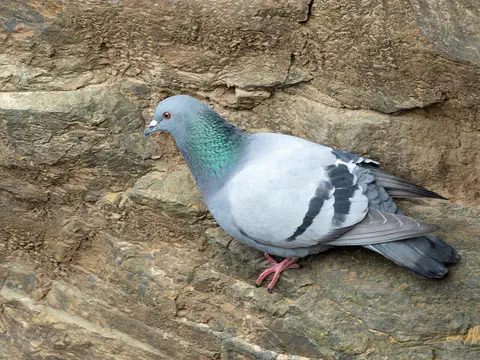
Rock pigeon
The rock pigeon, also called the rock dove, is the pigeon you see in city squares. Its wild ancestors nest on sea cliffs and mountain ledges, and city pigeons use buildings as if they were cliffs. Pigeons are famous for finding their way home from far away.
-
 Watch
Animal
Mourning dove
The mourning dove is a slender, gray-brown dove with black spots on its wings and a long, pointed tail edged in white. It lives in open country, farms, towns and backyards from Canada to Central America and the Caribbean. It eats almost nothing but seeds, and its low, mournful coo gives it its name.
-
 Watch
3D
Animal
Southern cassowary
The southern cassowary is a large flightless bird of the rainforests of northern Australia and New Guinea. It has a vivid blue neck, red wattles and a tall helmet called a casque. By eating fallen fruit and spreading the seeds in its droppings, it helps the rainforest grow. Cassowaries are wild and strong, so people watch them from a safe distance.
-
 Watch
Animal
Greater bird-of-paradise
The greater bird-of-paradise is a rainforest bird of southern New Guinea and the Aru Islands. Males have a yellow head, a green throat, long tail wires and huge golden flank plumes, which they show off in group dances high in tall trees to win a female.
-
 Watch
Animal
Goodfellow's tree-kangaroo
Goodfellow's tree-kangaroo is a kangaroo that climbs trees instead of hopping across grassland. It lives in the rainforests of New Guinea, from the hills up into the mountains, and eats mostly leaves. With its chestnut fur, golden back stripes and ringed tail, it is one of the most striking tree-kangaroos, and it is Endangered because of hunting and forest loss.
-
Watch
Country
Papua New Guinea
Papua New Guinea covers the eastern half of New Guinea, the world's second largest island, plus many smaller islands. Its tall mountains, rainforests and coral reefs are home to about 40 kinds of birds-of-paradise. More than 800 languages are spoken there, and the 2024 census counted 10,185,363 people.
-
Watch
Country
Indonesia
Indonesia is a country of about 17,500 islands in Southeast Asia, spread across the Equator between the Indian and Pacific oceans. It has more than 100 active volcanoes, rainforests full of wildlife, and about 286 million people (2025).
-
 Watch
Animal
Nicobar pigeon
The Nicobar pigeon is a large, heavy pigeon with shimmering green feathers, a cape of long neck feathers called hackles and a short white tail. It nests on small, quiet islands from India's Nicobar Islands to the Solomon Islands, and flies to bigger islands nearby to find fallen fruit and seeds. DNA tests showed it is the closest living relative of the dodo.
For parents & teachers
What children will learn
- Locate New Guinea and the lowland forests where Victoria crowned pigeons live.
- Describe the crowned pigeon's crest, colors and size.
- Describe how crowned pigeons raise a single chick.
- Name threats to lowland rainforest, such as logging and oil-palm plantations.
Recommended ages: 3 to 17 · About 15 minutes
Talk about it
- Why might a bird that feeds on the ground sleep in the trees?
- How do logging roads make it easier for people to reach wild animals?
- What could people buy or choose to help protect rainforests?
Try at home or in class
- Paper crown: cut a fan of long paper feathers, dot a white tip on each one and wear it like a crowned pigeon's crest.
- Pigeon compare: next time you see a city pigeon, compare its size with a Victoria crowned pigeon of about 70 centimeters, using a tape measure.
Key vocabulary: crest, lowland, roost, oil palm, logging, near threatened
Where these facts come from
- GBIF Backbone Taxonomy and GBIF Occurrence Search , Global Biodiversity Information Facility (CC0 1.0 (backbone); occurrence counts are facts derived from records under CC0, CC BY and CC BY-NC)
- Wikidata , Wikimedia Foundation (CC0 1.0)
- The IUCN Red List of Threatened Species , International Union for Conservation of Nature (IUCN terms of use (no redistribution of Red List data or range maps))
- Goura victoria (BirdLife International, assessed 12 August 2020, published 2021) , IUCN Red List of Threatened Species
- Goura victoria: range, population, ecology, threats and conservation text , IUCN Red List of Threatened Species
- Goura victoria: IUCN Red List global assessment record (BirdLife International 2021), IUCN checklist on GBIF , GBIF
- Victoria crowned pigeon , Zoo Barcelona
- Victoria Crowned Pigeon , Cincinnati Zoo and Botanical Garden
- Victoria Crowned Pigeon , Virginia Zoo
- File:Columbidae Goura victoria 4.jpg (Zoo Frankfurt, 11 November 2017, NasserHalaweh) , Wikimedia Commons
- Wikimedia Commons , Wikimedia Foundation (Per file: Public domain, CC0, CC BY or CC BY-SA only (credited on each page))
Checked, not yet human-reviewed. Last updated November 1, 2026. Spotted a mistake? Tell us.