
Animal
Greater bird-of-paradise
The greater bird-of-paradise lives in the rainforests of New Guinea. The male has a yellow head, a green throat and big, fluffy yellow plumes. He dances to show them off!
The greater bird-of-paradise is a rainforest bird of southern New Guinea and the Aru Islands. Males have a yellow head, a green throat, long tail wires and huge golden flank plumes, which they show off in group dances high in tall trees to win a female.
Paradisaea apoda is a lekking bird-of-paradise of the lowland and hill forests of southern New Guinea and the Aru Islands. Males gather in tall emergent display trees and perform wing poses, pumps and bows while females choose a mate. The IUCN (2024) lists it as Least Concern, but with a decreasing trend.
Photo: Andrea Lawardi, CC BY 2.0, via Wikimedia Commons
Meet the greater bird-of-paradise
The greater bird-of-paradise is a fancy rainforest bird.
The male has a yellow head, a green throat and a brown body. Long, fluffy yellow feathers flow from his sides. The female is plain brown.
The greater bird-of-paradise is one of about 45 kinds of birds-of-paradise, a family of forest birds from New Guinea and nearby islands. The male is up to 43 centimeters long, with a brown body, a yellow head, a green throat, two long wire-like tail feathers and enormous yellow plumes on his sides.
The female is smaller, about 35 centimeters, and maroon-brown all over. Like other birds-of-paradise, the male uses his showy feathers in courtship dances.
Paradisaea apoda is one of the seven plumebirds (genus Paradisaea), 29 to 46 centimeters long, whose central tail feathers are elongated into wires or twisted ribbons and whose filmy flank plumes can be raised forward over the back, hiding the wings (Britannica). Britannica notes the family's male plumage is rivaled in color and bizarre shape only by a few pheasants and hummingbirds.
The species is strongly sexually dimorphic. Males reach about 43 centimeters and have a brown body, yellow head, green throat, twin tail wires and yellow flank plumes; females are about 35 centimeters and maroon-brown (Mulyani et al. 2025, citing Pratt and Beehler 2015). Wikidata gives an adult weight of about 250 grams.
Quick facts
- Group
- Bird
- Length
- 0.35 to 0.43 m
- Weight
- 0.25 kg
Where it lives
This bird lives on the big island of New Guinea and on some small islands nearby.
It lives in warm, wet rainforests, high up in the tall trees.
Greater birds-of-paradise live in the rainforests of southern New Guinea, a huge island north of Australia, and on the nearby Aru Islands. New Guinea is shared by two countries: the western half is part of Indonesia, and the eastern half is Papua New Guinea.
They live in lowland and hill forests, from sea level up to about 950 meters. The males gather in very tall trees that stick up above the rest of the forest.
The IUCN (2024) lists Indonesia and Papua New Guinea as range countries. Mulyani and colleagues (2025), citing Pratt and Beehler, describe the range as humid lowland and hill rainforest from 0 to 950 meters, from the southern Jayawijaya Mountains and the southern lowlands of Papua (from Timika eastward) to the Fly and Strickland Rivers in Papua New Guinea, plus the Aru Islands.
Britannica notes the species was also introduced to the island of Little Tobago, in Trinidad and Tobago. The IUCN's 2024 assessment does not list it there, and that population is not shown on this page's map.
Continent
Did you know?
Many males dance, but the female picks only one.
At one dance tree, up to seven males showed off, but scientists saw only one male win a mate.
In 303 minutes of observation at one lek, mounting was recorded only twice, both times by the same male, though the authors caution that the sample was too small to measure mating success.
Where can you find this animal?
- Lives here naturally · Countries and seas named by a scientific source
- Sightings recorded · Records of wild sightings (GBIF)
Lives here naturally · Countries and seas named by a scientific source
Lowland and hill rainforest of southern New Guinea, from the southern lowlands of Papua (Indonesia) east to the Fly and Strickland Rivers in Papua New Guinea, and the Aru Islands. Birds live only in this southern part of each country shown.
Places: Indonesia and Papua New Guinea.
Source: iucn-red-list · checked October 2026
Sightings recorded · Records of wild sightings (GBIF)
Counts of GBIF records of wild observations (human and machine) and preserved specimens. Records include introduced populations, vagrants, escaped or released animals and misidentifications, so a country with records is not necessarily part of the native range.
Wild sightings have been recorded in Papua New Guinea, Indonesia, Namibia, United States, Denmark, Greece, Guinea, Trinidad & Tobago and 1 more places.
Source: gbif · checked October 2026
Range maps show where scientists say an animal lives, often country by country. An animal may live in only part of a country shown, and sightings records can include animals that wandered far from home.
A food mystery
Scientists are still finding out what this bird likes to eat.
The tall trees where the males dance may also give them food.
Here is a surprise: scientists still know very little about exactly what the greater bird-of-paradise eats. The forests where it lives are hard to reach, and much of the land is looked after by local communities, so long studies take time and permission.
Researchers studying these birds in Papua noticed that the tall trees where males dance may also be places where they find food. Scientists also think that plenty of food in the forest helps birds-of-paradise grow such fancy feathers.
Diet is one of the open questions. Mulyani and colleagues (2025) list food composition among the ecological details that remain unknown for this species, along with nesting behavior and female roosting trees. They note that the southern lowland forests of Papua are difficult to reach and that much of the land is managed by local communities under customary rights, so long-term research requires dialogue and permission.
Their study and earlier work suggest display trees may also serve as food sources, and they cite research linking the extravagant plumage and displays of birds-of-paradise to high food availability (Irestedt et al. 2009). Any precise diet list for this species should be treated with caution until field studies catch up.
Did you know?
There are about 45 kinds of birds-of-paradise.
There are about 45 kinds of birds-of-paradise, and almost all of them live in New Guinea and nearby islands.
The family Paradisaeidae has about 45 species, centered on New Guinea; manucodes and riflebirds also reach Australia (Britannica).
Feathers made for showing off
The male's long yellow plumes are for showing off.
He lifts them up and shakes them when he dances. Two long, thin feathers trail from his tail like wires.
The male's flank plumes grow from his sides. When he displays, he can raise these filmy feathers and bring them forward over his back, hiding his wings. Two of his tail feathers are long and thin, like wires.
Why so fancy? In birds-of-paradise, females choose their mates, and over a very long time their choices have favored males with brighter colors and bigger plumes. Scientists call this sexual selection. Females, who raise the young, are plain brown.
In Paradisaea, the filmy flank plumes can be raised and brought forward over the back during display, and the central tail feathers are elongated into wires (Britannica). Britannica attributes the evolution of these exotic plumes and colors to sexual selection: the brightness of a male's coloration can signal fitness and influences female choice. Specialized feathers in the family include iridescent gorgets, velvety ruffs and filamentous plumes.
Female birds-of-paradise generally have cryptic coloring suited to nesting, the other side of the same sexual dimorphism.
Growing up
The mother bird builds the nest by herself.
She raises one or two chicks with no help from the father. Young males watch the grown-ups to learn how to dance.
In birds-of-paradise, the males do not help with the family. After mating, the plain female builds the nest and raises one or two young on her own. For the greater bird-of-paradise, scientists still have not described its nest in detail.
Young males take time to learn. In a study in Papua, young males watched an adult male dance, sometimes hanging upside down to see, and then tried the dance themselves, though not as completely as the adult. This suggests they perfect their dance through practice.
Britannica notes that after mating, female birds-of-paradise generally build the nest and raise one or two young unaided. For P. apoda specifically, clutch size, nest sites, breeding rhythm and breeding success are still poorly known (Mulyani et al. 2025). In South Papua, breeding peaked around July and August in 2023, though displaying birds were seen in May of the previous year.
A study at a lek in central mainland Papua (journal of Natural Resources and Environmental Management, IPB University) recorded an adult male displaying in front of sub-adult males even with no females present, while the sub-adults watched, some upside down. The sub-adults also danced, less completely, which the authors interpret as learning by watching and practice.
Dancing in the treetops
The males dance together in one tall tree.
They call loudly, spread their wings, hop and bow. The females watch and choose the best dancer.
Male greater birds-of-paradise gather to dance in one tall tree. This display place is called a lek. A male arrives early in the morning and calls loudly, "cow, cow!" Other males answer and join him, and females come to watch.
The males lift their wings and tails, jump around flapping, and bow low with their wings almost hugging the branch. Sometimes two males dance face to face. Each female chooses one male; in one study, only one male was seen to win a mate.
Mulyani and colleagues (2025) watched a lek tree in South Papua for seven days, a 27-meter emergent Gironniera tree. Lekking ran from about 6:00 to 10:00 in the morning and 2:00 to 4:15 in the afternoon. The sequence: a host male arrives and calls; other males answer and arrive; silent females gather nearby; males begin dancing; females approach and choose; mating; then females and finally males depart.
Display elements included the wing pose (wings and tail held up), the pump (wings and tail extended while jumping rapidly), the bow (head lowered, wings almost embracing the branch) and the dance (jumping while flapping). Calls varied from "cow... cow" to "kaek" and "koak." Mounting was seen only twice, both times by the same male; the authors note their sample was too small to measure how often lekking males succeed.
Did you know?
Scientists still do not know everything this bird eats.
Even for such a famous bird, scientists still do not know exactly what it eats or where females build their nests.
Diet composition, nest sites, clutch size and breeding success remain poorly documented for P. apoda (Mulyani et al. 2025).
Helping birds-of-paradise
Birds-of-paradise need tall trees to dance in.
When forests are cut down, they lose their dance trees. People are working to protect these birds and their forests.
The greater bird-of-paradise is not in danger right now: scientists list it as Least Concern. But its numbers seem to be going down. Forests are being cleared, new roads make it easier for people to reach the birds, and some people still hunt them illegally, even though they are protected by law in Indonesia.
The males' loud, repeated calls at dance trees make them easy to find. Protecting the tall dance trees, and bringing birdwatchers who pay to see the dances, could help both the birds and local communities.
BirdLife International's 2024 assessment for the IUCN Red List lists P. apoda as Least Concern with a decreasing trend. Tree cover within its mapped range fell by about 2.5 percent over three generations, suggesting a population decline of 1 to 19 percent (best estimate under 5 percent). The species was found in three of seven trade datasets, a high prevalence in trade.
It is protected under Indonesian law and listed on CITES Appendix II, yet Mulyani and colleagues report indications of continued illegal hunting, made easier by roads and by the males' loud, predictable calls. They recommend protecting lek trees, retaining big trees in logged forest, involving local people and developing birdwatching tourism.
IUCN Red List
How is the greater bird-of-paradise doing in the wild?
- Least Concern (this animal)
- Near Threatened
- Vulnerable
- Endangered
- Critically Endangered
- Extinct in the Wild
- Extinct
Least Concern
Not at risk of disappearing from the wild right now.
See the IUCN Red List assessment · The IUCN Red List of Threatened Species 2021.3
Amazing facts
-
Young males watch the grown-ups dance, sometimes upside down!
In one study, young males watched an adult dance, some hanging upside down, and then practiced the moves themselves.
Sub-adult males observed adult displays, some from an upside-down position, then performed incomplete versions, suggesting learning through observation and practice.
-
Many males dance, but the female picks only one.
At one dance tree, up to seven males showed off, but scientists saw only one male win a mate.
In 303 minutes of observation at one lek, mounting was recorded only twice, both times by the same male, though the authors caution that the sample was too small to measure mating success.
-
Scientists still do not know everything this bird eats.
Even for such a famous bird, scientists still do not know exactly what it eats or where females build their nests.
Diet composition, nest sites, clutch size and breeding success remain poorly documented for P. apoda (Mulyani et al. 2025).
-
There are about 45 kinds of birds-of-paradise.
There are about 45 kinds of birds-of-paradise, and almost all of them live in New Guinea and nearby islands.
The family Paradisaeidae has about 45 species, centered on New Guinea; manucodes and riflebirds also reach Australia (Britannica).
Words to know
- lek
- a place where males gather to display and females come to choose a mate
- plumes
- long, showy feathers
- courtship
- behavior that helps an animal attract a mate
- sexual selection
- when mate choice makes certain features, like bright feathers, more common over time
- emergent tree
- a very tall tree that sticks up above the rest of the forest
- dimorphism
- when males and females of a species look different
Discovery challenge
-
Why does the male bird-of-paradise dance?
Why do male greater birds-of-paradise dance at a lek?
What is the main function of the male's lek display?
- To find food
- To attract a female
- To scare away rain
Show the answer
To attract a female
He dances so a female will choose him.
Males show off their plumes and moves, and females choose a mate.
Courtship: females choose among displaying males, driving sexual selection on plumage and performance.
-
Who builds the nest?
In birds-of-paradise, who builds the nest and raises the young?
How is parental care divided in birds-of-paradise, according to Britannica?
- The father alone
- Both parents together
- The mother alone
Show the answer
The mother alone
The mother does it all by herself.
After mating, the female builds the nest and raises one or two young on her own.
Females generally nest and raise one or two young unaided; males contribute only at the lek.
-
Where does this bird live?
On which island do wild greater birds-of-paradise live?
Which describes the native range of Paradisaea apoda?
- New Guinea and the Aru Islands
- Madagascar
- Iceland
Show the answer
New Guinea and the Aru Islands
It lives in the rainforests of New Guinea.
It lives in southern New Guinea, shared by Indonesia and Papua New Guinea, and on the Aru Islands.
Southern lowland and hill forest of New Guinea, from Papua to the Fly and Strickland Rivers, and the Aru Islands.
-
What color are the male's long side feathers?
What color are the male's long flank plumes?
Which describes the male's flank plumes?
- Yellow
- Bright blue
- Black and white stripes
Show the answer
Yellow
They are long and yellow.
His flank plumes are yellow, and he lifts them when he dances.
Yellow, filmy flank plumes that can be raised forward over the back in display.
Places where you might see it
Explore next
-
 Watch
Animal
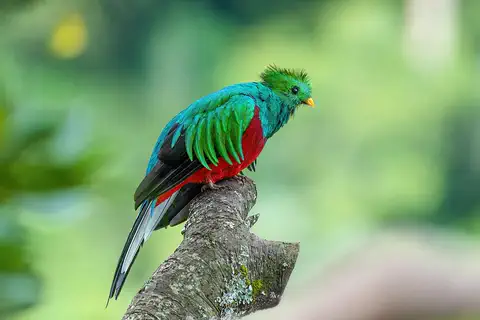
Resplendent quetzal
The resplendent quetzal is a glittering green and red bird of the cloud forests of southern Mexico and Central America. Males grow long, flowing plumes, up to about 90 centimeters. Quetzals eat mostly small fruits related to avocados, and the bird is the national emblem of Guatemala.
-
 Watch
 Country
Indonesia
Indonesia is a country of about 17,500 islands in Southeast Asia, spread across the Equator between the Indian and Pacific oceans. It has more than 100 active volcanoes, rainforests full of wildlife, and about 286 million people (2025).
-
 Watch
Animal
Great hornbill
The great hornbill is a very large bird of Asia's forests, with a long tail, broad black-and-white wings and an enormous curved yellow bill topped by a helmet called a casque. It eats mostly figs, and the female seals herself inside a tree hole to raise her chick.
-
 Watch
Animal
Adélie penguin
The Adélie penguin is a medium-sized penguin, about 70 centimeters tall, with a black back, a white front and a bright white ring around each eye. It breeds in summer on rocky, ice-free ground all around Antarctica, building nests of pebbles, and spends the winter far out at sea among the pack ice.
-
 Watch
Animal
African fish eagle
The African fish eagle is a big eagle of Africa's lakes, rivers and coasts, with a white head, chest and tail and a chestnut-brown body. It snatches fish from the surface of the water, and its loud, ringing call is one of the best-known sounds of Africa.
-
 Watch
Animal
African penguin
The African penguin is a penguin of warm, sunny coasts. It lives only in South Africa and Namibia, nests in burrows and under bushes, and hunts sardines and anchovies in the cold sea. Its numbers have fallen so far that it is now Critically Endangered, and people are working hard to protect it.
-
 Watch
Animal
American crow
The American crow is an all-black bird found across much of North America, from fields and beaches to city centers. It eats almost anything, lives in close family groups, gathers in huge winter roosts, and a University of Washington study found that wild crows can recognize and remember a human face.
-
 Watch
Animal
American flamingo
The American flamingo is a tall, bright pink wading bird of the Caribbean. It gets its color from pigments in the tiny water animals and algae it eats, and it feeds by filtering water through its bent bill with its head upside down. Flamingos live and nest in huge, noisy groups.
For parents & teachers
What children will learn
- Describe the male and female greater bird-of-paradise and why they look so different.
- Explain what a lek is and how females choose mates.
- Understand that scientists still have open questions, even about famous animals.
- Know why tall display trees and forests matter for the species.
Recommended ages: 3 to 17 · About 15 minutes
Talk about it
- Why might females be plain brown while males are so colorful?
- How could young males learn to dance? How do you learn a new dance?
- Why might it be hard for scientists to study birds in remote rainforests?
Try at home or in class
- Make up a three-move 'display dance' (wing pose, pump, bow) and teach it to someone by showing, not telling.
- Measure 43 centimeters and 35 centimeters on paper to compare a male and a female.
Key vocabulary: lek, plumes, courtship, sexual selection, emergent tree, dimorphism
Where these facts come from
- The IUCN Red List of Threatened Species , International Union for Conservation of Nature (IUCN terms of use (no redistribution of Red List data or range maps))
- GBIF Backbone Taxonomy and GBIF Occurrence Search , Global Biodiversity Information Facility (CC0 1.0 (backbone); occurrence counts are facts derived from records under CC0, CC BY and CC BY-NC)
- Wikidata , Wikimedia Foundation (CC0 1.0)
- Paradisaea apoda (Greater Bird-of-paradise), Red List assessment (BirdLife International 2024) , IUCN Red List of Threatened Species
- Lek habitat and behavior of the greater bird-of-paradise in South Papua, Indonesia (Mulyani et al. 2025) , Biodiversitas Journal of Biological Diversity
- The Display Behavior of Sub-Adult Greater Bird-of-Paradise (Paradisaea apoda): A Learning Process from an Adult? , Journal of Natural Resources and Environmental Management, IPB University
- Bird-of-paradise , Encyclopaedia Britannica
- Wikimedia Commons , Wikimedia Foundation (Per file: Public domain, CC0, CC BY or CC BY-SA only (credited on each page))
Checked, not yet human-reviewed. Last updated October 27, 2026. Spotted a mistake? Tell us.