
Animal
Emperor penguin
The emperor penguin is the biggest penguin of all. It lives on the ice in Antarctica, and the dads keep the eggs warm on their feet.
The emperor penguin is the largest penguin in the world. It lives around Antarctica, and it is the only animal that breeds during the dark, freezing Antarctic winter. Fathers keep the egg warm on their feet for about two months, huddled together against the storms.
Aptenodytes forsteri, the largest of the 18 living penguin species, breeds on Antarctic sea ice through the polar winter. Layered plumage, fat reserves, heat-exchanging blood vessels and cooperative huddling let males fast for about four months through courtship and incubation. Populations are projected to decline as the climate warms.
Photo: Christopher Michel, CC BY 2.0, via Wikimedia Commons
Meet the emperor penguin
The emperor penguin is the biggest penguin in the world.
It has a black back, a white tummy and yellow patches by its ears. It cannot fly, but it is a super swimmer.
The emperor penguin is the biggest of all 18 kinds of penguin. An average emperor stands about 1.1 meters tall, as tall as a six-year-old child, and a well-fed adult can weigh as much as 40 kilograms.
Emperors cannot fly. They spend their lives on the ice and in the freezing ocean, where they are expert divers. Some emperors live for more than 40 years, though most wild ones do not live that long.
Aptenodytes forsteri is the largest of the 18 living penguin species; the Australian Antarctic Division reports adults of up to 40 kilograms at the start of the breeding season, and National Geographic gives an average standing height of about 45 inches (1.14 meters). Its closest relative is the king penguin; both belong to the genus Aptenodytes.
Body mass swings enormously through the year as birds fatten and then fast for breeding and molting. Some emperors live more than 40 years, although most wild birds do not live that long.
Quick facts
- Group
- Bird
- Height
- 1.14 m
- Weight
- 22 to 40 kg
Where it lives
Emperor penguins live in Antarctica, where the winter is freezing cold.
They live on thick ice that floats on the sea. They swim in the icy ocean to find food.
Emperor penguins live only around Antarctica. They spend their lives on the frozen sea and in the icy Southern Ocean around the continent.
They breed in colonies on 'fast ice', sea ice that is frozen tight to the coast, often between islands or stranded icebergs. A colony can have a few hundred pairs or more than 20,000. Females may have to walk about 80 kilometers across the ice to reach open water.
The IUCN's global assessment lists Antarctica as the only country or territory where the species is resident; stray birds turn up occasionally as far as New Zealand, South America and the Falkland Islands. Colonies are scattered around the continent, and most sit on fast ice locked between islands or grounded icebergs.
Colony sizes range from a few hundred to more than 20,000 pairs. When the sea ice is extensive, National Geographic notes, females leaving the colony may have to travel some 50 miles (about 80 kilometers) to reach open water, so feeding trips are long.
Continent
Its habitat

Where can you find this animal?
- Lives here naturally · Countries and seas named by a scientific source
- Sightings recorded · Records of wild sightings (GBIF)
Lives here naturally · Countries and seas named by a scientific source
Sea ice and coastal waters all around Antarctica. Stray birds very occasionally reach South America, the Falkland Islands and New Zealand.
Places: Antarctica and Southern Ocean.
Source: iucn-red-list · checked October 2026
Sightings recorded · Records of wild sightings (GBIF)
Counts of GBIF records of wild observations (human and machine) and preserved specimens. Records include introduced populations, vagrants, escaped or released animals and misidentifications, so a country with records is not necessarily part of the native range.
Wild sightings have been recorded in Antarctica, New Zealand, Australia, France, Fr. Southern Lands, United States, Canada, Argentina and 12 more places.
Source: gbif · checked October 2026
Range maps show where scientists say an animal lives, often country by country. An animal may live in only part of a country shown, and sightings records can include animals that wandered far from home.
What it eats
Emperor penguins eat fish, krill and squid.
They dive deep under the ice to catch them. They swallow their food whole.
Emperor penguins hunt in the sea. One of their most important foods is a small fish called the Antarctic silverfish, and they also catch other fish, shrimp-like krill and squid.
They are amazing divers. Most dives go 150 to 250 meters deep and last 3 to 6 minutes, but one emperor dived to 565 meters, and the longest dive recorded lasted 22 minutes. An adult eats about 2 to 3 kilograms of food a day.
Emperors forage near the top of the Southern Ocean food web on a seasonally changing diet in which Antarctic silverfish (Pleuragramma antarcticum) is a key item, with other fish, Antarctic krill and squid. Most prey is small, which the Australian Antarctic Division notes makes it easier to warm ice-cold food to body temperature for digestion.
Adults eat about 2 to 3 kilograms a day and up to 6 kilograms when fattening before the molt or breeding; each chick needs about 42 kilograms of food from each parent. Typical dives reach 150 to 250 meters and last 3 to 6 minutes, with records of 565 meters and 22 minutes.
Did you know?
A new chick is tiny, but it grows fast.
A newly hatched emperor chick weighs only about 150 to 200 grams, while its parents weigh 22 to 30 kilograms.
Chicks hatch at about 150 to 200 grams and cannot regulate their body temperature for about 50 days, so they ride in the brood pouch.
Built for the cold
Emperor penguins have thick layers of feathers and fat.
They keep the penguin warm in freezing wind. Their feet have strong claws for walking on ice.
Emperor penguins are wrapped in several layers of small, overlapping feathers that work like a windproof coat. It takes a wind of more than 110 kilometers an hour to ruffle them. Under the skin is a thick layer of fat.
Their bills and flippers are small for their size, so less heat escapes. Special blood vessels in the legs, flippers and bill pass warmth back toward the heart, and their noses save heat from each breath. Strong claws grip the ice.
Insulation comes from several layers of scale-like feathers and large fat reserves; the Australian Antarctic Division notes that winds above about 110 kilometers an hour are needed to ruffle the plumage. Relatively small bills and flippers reduce heat-losing surface area.
In a countercurrent heat exchanger, arteries and veins run side by side, so warm blood flowing out to the feet, flippers and bill is pre-cooled by blood returning to the heart, which is warmed in turn. Nasal chambers recover much of the heat in exhaled air, special fats keep the feet from freezing, and strong claws grip the ice.
A winter on Dad's feet
The mother penguin lays one egg. Then the dad holds it on his feet.
He keeps it warm under a flap of skin all winter. The mother goes to the sea to eat. Then she comes back to feed the chick.
Emperors start breeding in autumn, around April, when the sea ice freezes thick again. The female lays one egg and passes it to the male, who balances it on his feet under a warm fold of skin called a brood pouch. Then she walks to the sea to feed.
The eggs take 65 to 75 days to hatch, and the male eats nothing the whole time. By the time the chick hatches he has fasted for about four months. The mother returns in July to take over, and by December the fluffy chick is almost as big as its parents.
The cycle begins in April as the sea ice reforms. After courtship the female lays a single egg and transfers it to the male's feet, where a brood pouch keeps it at about 38 °C while the air can fall below −35 °C. Females leave in late May or early June; incubation takes 65 to 75 days.
By hatching the males have fasted for about four months and lost nearly half their body mass. Females return in July and find their mates by call. Chicks weigh only about 150 to 200 grams, need about 50 days to control their own temperature, and are nearly adult-sized by December, when they begin to shed their down and grow real feathers.

The great huddle
Emperor penguins stand close together to stay warm.
This is called a huddle. They take turns standing in the warm middle and on the cold outside.
In winter storms, the male emperors crowd together in a huddle, up to 10 penguins in every square meter. Huddling cuts the heat they lose by as much as half, and inside it can be as warm as 24 °C.
Emperors are the only penguins that do not defend a territory, because their urge to huddle is so strong. They share the cold too: birds on the windy edge peel off and shuffle along the side, egg on their feet, to the sheltered end, so everyone takes a turn in the middle.
Huddling is the emperor's key social adaptation. At densities of up to 10 birds per square meter it can halve heat loss and lets incubating males survive their long fast; temperatures inside a huddle have reached +24 °C. The Australian Antarctic Division links this huddling instinct to the fact that emperors are the only penguins that defend no territory.
Birds rotate continuously: those on the windward edge move down the flanks to the leeward side, so each takes turns in the warm center, and the whole huddle creeps downwind, as much as 200 meters during a 48-hour blizzard. Mates recognize each other by their calls among thousands of birds.
Did you know?
Emperor penguin dads keep their egg warm on their feet.
Emperor fathers balance the egg on their feet under a warm fold of skin for 65 to 75 days, eating nothing.
Males incubate for 65 to 75 days in midwinter, keeping the egg at about 38 °C, and fast for about four months in total.
Penguins in a changing climate
Emperor penguins raise their babies on sea ice.
The world is getting warmer, and that changes the ice. Scientists study the penguins to learn how to help them.
The emperor penguin is listed as Near Threatened. Emperors raise their chicks on sea ice, and the breeding season can only begin once the ice is thick enough to hold them.
Scientists expect the number of emperor penguins to fall over the coming decades as the climate warms and changes the sea ice. Researchers at the Australian Antarctic Division are studying how these changes affect the penguins.
The IUCN's 2019 global assessment lists the emperor penguin as Near Threatened. The Australian Antarctic Division notes that populations are projected to undergo a moderately rapid decline over the next three generations because of projected climate change, which will alter the fast ice on which colonies breed.
The IUCN also lists human intrusion and disturbance from work and other activities. Researchers study how climatic change influences emperor populations and how future change may affect the species.
IUCN Red List
How is the emperor penguin doing in the wild?
- Least Concern
- Near Threatened (this animal)
- Vulnerable
- Endangered
- Critically Endangered
- Extinct in the Wild
- Extinct
Near Threatened
Not at risk yet, but it could be soon.
Amazing facts
-
Emperor penguin dads keep their egg warm on their feet.
Emperor fathers balance the egg on their feet under a warm fold of skin for 65 to 75 days, eating nothing.
Males incubate for 65 to 75 days in midwinter, keeping the egg at about 38 °C, and fast for about four months in total.
-
Inside a penguin huddle it can be warm and cozy.
Inside a huddle of emperor penguins, the temperature can reach 24 °C, even in an Antarctic winter.
Huddle temperatures of up to +24 °C have been recorded, and huddling can cut heat loss by about half.
-
Emperor penguins can dive very, very deep.
The deepest emperor penguin dive recorded was 565 meters, and the longest dive lasted 22 minutes.
Recorded maxima are 565 meters and 22 minutes, although most foraging dives reach 150 to 250 meters.
-
A new chick is tiny, but it grows fast.
A newly hatched emperor chick weighs only about 150 to 200 grams, while its parents weigh 22 to 30 kilograms.
Chicks hatch at about 150 to 200 grams and cannot regulate their body temperature for about 50 days, so they ride in the brood pouch.
Words to know
- colony
- a large group of animals that live and breed together
- huddle
- a tight crowd of animals standing close to stay warm
- brood pouch
- a warm fold of skin that covers a penguin's egg or chick
- sea ice
- ocean water that has frozen
- flipper
- a flat, stiff wing used for swimming
- molt
- when a bird loses its old feathers and grows new ones
Discovery challenge
-
Who keeps the emperor penguin egg warm all winter?
Which parent keeps the egg warm during the winter?
Which parent incubates the emperor penguin egg?
- The mother
- The father
- Nobody
Show the answer
The father
The dad keeps the egg on his feet.
The father holds the egg on his feet under a fold of skin while the mother feeds at sea.
Only males incubate, fasting for 65 to 75 days of incubation and about four months in all.
-
Why do emperor penguins stand close together?
Why do emperor penguins huddle?
What does huddling achieve for emperor penguins?
- To stay warm
- To hide from the sun
- To play games
Show the answer
To stay warm
Standing close keeps them warm.
Huddling keeps them warm and can cut the heat they lose by half.
It can halve heat loss, conserving fat reserves during the long incubation fast.
-
Where do emperor penguins live?
Where do emperor penguins live in the wild?
Where do emperor penguins breed?
- Around Antarctica
- In hot deserts
- In rainforests
Show the answer
Around Antarctica
They live on the ice around Antarctica.
They live on the sea ice and in the ocean around Antarctica.
In colonies on fast ice scattered around the Antarctic coast.
-
What do emperor penguins eat?
Which food is very important to emperor penguins?
Which is a key prey species for emperor penguins?
- Grass
- Fish and krill
- Nuts
Show the answer
Fish and krill
They eat fish, krill and squid from the sea.
They catch fish such as the Antarctic silverfish, plus krill and squid.
Antarctic silverfish is among the most frequently eaten prey, with other fish, krill and squid.
Experiments to try
- Watch What If? Lab What if birds forgot how to build nests? Nests keep eggs and chicks safe from predators and the weather, and birds build them in amazing ways: from twigs, grass, mud, hair and even spider silk. Imagine every bird forgetting how to build one. Then meet the birds that already manage without, from cliff-ledge murres to emperor penguins.
- Watch Try it What If? Lab What if icebergs were made of wood? An iceberg floats with about nine-tenths of it hidden under the water. Swap the ice for wood in our model and watch the block bob up much higher, then find out why how much shows depends on density.
- Watch What If? Lab What if penguins could fly? Penguins are birds whose wings became stiff flippers for swimming. Their ancestors flew, but today's penguins are superb divers instead. Imagine a penguin that could fly: what would it need to change, and what might it lose underwater?
Explore next
-
 Watch
3D
Animal
King penguin
The king penguin is the second-largest penguin in the world. It lives in huge, noisy colonies on windy islands in the Southern Ocean and dives deep to catch lantern fish. Its babies grow a thick coat of brown fluff and take more than a year to raise.
-
 Watch
Animal
Adélie penguin
The Adélie penguin is a medium-sized penguin, about 70 centimeters tall, with a black back, a white front and a bright white ring around each eye. It breeds in summer on rocky, ice-free ground all around Antarctica, building nests of pebbles, and spends the winter far out at sea among the pack ice.
-
 Watch
3D
Animal
Antarctic krill
Antarctic krill are small, shrimp-like crustaceans about 6 centimeters long that live in the icy Southern Ocean around Antarctica. They gather in enormous swarms, and almost all the bigger animals of the Antarctic, from penguins to blue whales, depend on them for food.
-
 Watch
Animal
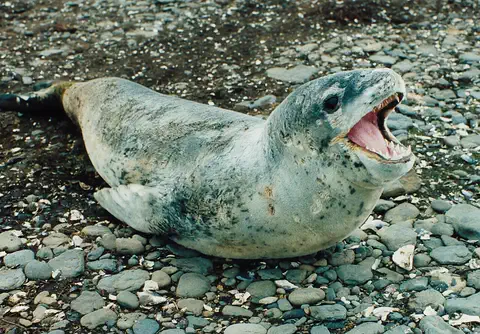
Leopard seal
The leopard seal is a large, slender seal of the icy seas around Antarctica, named for the dark spots on its gray coat. It is a fast, powerful hunter with a big head and long teeth, and it eats everything from tiny krill to fish, penguins and young seals.
- Watch What If? Lab What if birds forgot how to build nests? Nests keep eggs and chicks safe from predators and the weather, and birds build them in amazing ways: from twigs, grass, mud, hair and even spider silk. Imagine every bird forgetting how to build one. Then meet the birds that already manage without, from cliff-ledge murres to emperor penguins.
-
 Watch
3D
Animal
Common murre
The common murre is a seabird of cold northern oceans that looks a little like a flying penguin. It dives deep to chase fish, nests in huge crowds on cliff ledges, and its chicks flutter down from the cliff to the sea before they can even fly.
-
 Watch
Animal
Chinstrap penguin
The chinstrap penguin is named for the thin black band that runs under its chin from ear to ear, like a helmet strap. It breeds in huge colonies on the Antarctic Peninsula and nearby islands, raises two chicks each summer and dives for krill close to shore.
-
 Watch
3D
Animal
Atlantic puffin
The Atlantic puffin is a small seabird of the North Atlantic, often called the clown of the sea because of its huge, colorful bill. It spends most of its life far out on the ocean and comes ashore only in summer to nest in burrows on islands and cliff tops. Underwater, its small wings work like flippers.
For parents & teachers
What children will learn
- Describe how emperor penguins' bodies keep them warm in Antarctica.
- Explain the emperor penguin breeding cycle and the father's role.
- Explain how huddling helps a group survive the cold.
- Understand why scientists expect a warming climate to affect emperor penguins.
Recommended ages: 3 to 17 · About 15 minutes
Talk about it
- Why might it help for every penguin to take a turn on the cold edge of the huddle?
- Emperor colonies sit on sea ice. Why might changes in the ice matter to them?
- Why might small flippers and a small bill help an emperor penguin stay warm?
Try at home or in class
- Balance a small ball or potato on your feet and try to shuffle across the room without dropping it, like a penguin dad.
- Put a few warm water bottles close together and one alone, then check after 20 minutes which ones stayed warmer.
Key vocabulary: colony, huddle, brood pouch, sea ice, flipper, molt
Where these facts come from
- The IUCN Red List of Threatened Species , International Union for Conservation of Nature (IUCN terms of use (no redistribution of Red List data or range maps))
- GBIF Backbone Taxonomy and GBIF Occurrence Search , Global Biodiversity Information Facility (CC0 1.0 (backbone); occurrence counts are facts derived from records under CC0, CC BY and CC BY-NC)
- Wikidata , Wikimedia Foundation (CC0 1.0)
- Aptenodytes forsteri (Emperor Penguin), Red List global assessment 2019 , IUCN Red List of Threatened Species
- Emperor penguin , Australian Antarctic Division
- Emperor penguin breeding cycle , Australian Antarctic Division
- Emperor Penguin , National Geographic
- Wikimedia Commons , Wikimedia Foundation (Per file: Public domain, CC0, CC BY or CC BY-SA only (credited on each page))
Checked, not yet human-reviewed. Last updated October 27, 2026. Spotted a mistake? Tell us.