
What If? Lab
What if rivers made electricity everywhere?
Rushing river water can spin wheels and make electricity! What if every river made electricity? Let's find out with Olly!
Falling and flowing water can spin a turbine, and a turbine can spin a generator to make electricity. That's hydropower, one of the oldest ways people have used energy. Imagine every river making electricity, then discover how dams work, why fish need a way past them, and how small water wheels can power a single farm.
Hydroelectric plants turn the energy of moving water into electricity; how much depends on the flow and the head, the height the water falls. In 2025 hydropower provided about 5.6% of U.S. utility-scale electricity (EIA). This thought experiment asks what 'everywhere' would require and what it would cost rivers and fish, without arguing for any policy.
The big question
Rivers rush and splash. Moving water is strong!
People use it to make electricity. What if every river everywhere made electricity?
Stand by a river and you can feel its power: water rushing over rocks, pushing sticks along, roaring down waterfalls. People learned long ago to put that push to work.
Today, moving water makes electricity in many places. So why not everywhere? Could every river light up homes? To find out, we'll look at how dams make electricity, what they mean for fish, and how tiny water wheels can work on small streams.
Hydropower converts the energy of moving water into electricity. The U.S. Energy Information Administration (EIA) explains that the volume of the flow and the change in elevation, called the head, determine how much energy is available.
This thought experiment pictures hydropower on every river. It follows three threads: large dams and how they work, the effects of dams on fish and rivers, and small diversion and micro-hydro systems. It describes engineering trade-offs, not what anyone should build.
Explore the idea
Make a prediction
Which river could make the most electricity?
Which kind of river could make the most electricity?
Which site would offer the most hydroelectric potential?
- Lots of water falling a long way
- A slow, flat river
- A dry riverbed
-
Established fact
Moving water can spin a turbine to make electricity.
Hydropower plants use moving water to spin turbines that power generators; more flow and a bigger drop give more electricity.
Hydroelectric output depends on flow and head; water drives turbines connected to generators (EIA).
-
Established fact
Hydropower makes some of America's electricity.
In 2025, hydropower made about 5.6% of the electricity from large U.S. power plants.
In 2025, hydroelectricity was about 5.6% of U.S. utility-scale generation and 23.1% of utility-scale renewable generation (EIA).
-
Established fact
Dams can block fish, so some have fish ladders.
Dams can block migrating fish and change rivers; fish ladders and elevators help fish get past.
Dams may obstruct fish migration and alter temperature, chemistry, flow and silt; ladders and elevators aid passage (EIA).
-
An idea scientists discuss
Not every river could make lots of electricity.
Rivers everywhere couldn't all make much electricity, and dams everywhere would affect many more fish and rivers.
Universal hydropower would face very uneven site potential and cumulative ecological effects; the balance would depend on choices this lab does not make.
-
Established fact
More water falling farther makes more electricity.
How much electricity moving water can make depends on how much water flows and how far it falls.
Flow volume and head determine the energy available; the greater both are, the more a plant can produce (EIA).
-
An idea scientists discuss
Slow, flat rivers might make only a little electricity.
If every river made electricity, steep rivers might make lots while slow, flat ones made very little.
Because output scales with flow and head, 'everywhere' would mean very uneven returns from site to site.
-
Established fact
Water rushing through a dam spins a turbine that makes electricity.
At a hydropower plant, water flows through a pipe called a penstock and spins a turbine, which powers a generator.
Water flows through a penstock, turns turbine blades and drives a generator (EIA).
-
Established fact
Most dams don't make electricity at all.
Of more than 90,000 dams in the United States, fewer than 3% make electricity. Most are used for other things, like flood control and water supply.
Fewer than 3% of more than 90,000 U.S. dams produce power; others serve recreation, farm ponds, flood control, water supply and irrigation (DOE).
-
An idea scientists discuss
Some dams that already exist might be able to make electricity too.
Adding turbines to some dams that already exist might make more electricity without building new dams.
EIA reports a 2012 DOE estimate of 12,000 MW of potential at non-powered dams; how much would be practical today is not assessed here.
-
Established fact
Fish ladders help fish swim past dams.
Fish ladders and fish elevators help fish such as salmon and shad move around or over dams to reach their spawning grounds.
Fish ladders and elevators help migrating fish move around or over dams to upstream spawning grounds (EIA).
-
Established fact
Dams can change the water in a river.
A dam and reservoir can change a river's water temperature, flow and mud, which can affect the plants and animals living there.
Dams and reservoirs can change water temperature, chemistry, flow characteristics and silt loads, affecting river ecology (EIA).
-
An idea scientists discuss
With dams on every river, fish would need lots of ladders!
If every river had a dam, many more fish might need ladders or elevators to reach the places where they lay eggs.
Ubiquitous impoundment would likely multiply migration barriers; how well passage measures would scale is uncertain.
-
Established fact
Long ago, water wheels on rivers turned to grind grain.
Thousands of years ago, people used paddle wheels on rivers to grind grain.
Hydropower is among the oldest energy sources: paddle wheels ground grain thousands of years ago (EIA).
-
Established fact
A tiny water power plant can make electricity for one farm.
Micro hydropower plants, up to 100 kilowatts, can make enough electricity for a single home, farm, ranch or village.
DOE defines micro hydropower as up to 100 kW, enough for a single home, farm, ranch or village; small hydro spans 100 kW to 10 MW.
-
An idea scientists discuss
Lots of little water machines might share a river with the fish.
In a world of river power everywhere, many small systems might fit some streams better than giant dams, though each would still change the stream a little.
Distributed small diversions might suit sites where large impoundments would not, but their combined effects on flow and habitat would need study.
Hydropower in our world
Some big rivers have dams with machines inside. The water spins the machines to make electricity.
Long ago, people used water wheels to grind grain.
In 2025, hydropower made about 5.6% of the electricity from large U.S. power plants, according to the EIA. Most U.S. hydropower comes from big dams on major rivers. About half of the country's hydropower capacity is in just three states: Washington, California and Oregon. Washington's Grand Coulee Dam is the biggest U.S. hydropower plant.
People have used moving water for a very long time. Thousands of years ago, paddle wheels on rivers turned to grind grain. The first U.S. hydroelectric plant to sell electricity opened in Appleton, Wisconsin, on September 30, 1882.
EIA data for 2025 put hydroelectricity at about 5.6% of total U.S. utility-scale generation and 23.1% of utility-scale renewable generation, from about 79,892 MW of conventional capacity, roughly half of it in Washington, California and Oregon. Washington's Grand Coulee Dam is the largest U.S. hydropower facility.
The history is long: paddle wheels ground grain thousands of years ago; the first industrial use of hydropower for electricity in the United States lit 16 brush-arc lamps at a Grand Rapids, Michigan, chair factory in 1880; and the first plant to sell electricity opened on the Fox River near Appleton, Wisconsin, on September 30, 1882.
Rivers everywhere
Now pretend every river makes electricity.
But some rivers are slow and flat. They don't have much push. And fish need to swim up and down rivers too!
Not every river would make much electricity. The EIA explains that it depends on how much water flows and how far it falls. A steep mountain river could make lots; a slow river across flat land could make little.
And there's more to think about. Rivers are homes and highways for fish. A dam on every river would mean many more fish needing a way past. So a world of river power everywhere might work better with careful choices: big plants where water falls far, small systems on streams, and ways for fish to get by. These are ideas, not plans.
Available power scales with flow and head, so river sites differ enormously: high-head mountain sites can be productive, while low-gradient rivers offer little. 'Everywhere' would therefore yield very uneven returns.
There is also existing infrastructure to consider. DOE notes that fewer than 3% of more than 90,000 U.S. dams produce power, and EIA reports a 2012 DOE estimate of 12,000 MW of potential capacity at non-powered dams. Whether more hydropower would come from new dams, existing ones or small diversions, and how environmental effects would be weighed, are questions this lab leaves open.
How falling water makes electricity
Water flows down a big pipe. It spins a wheel called a turbine.
The turbine spins a generator, and the generator makes electricity!
At many hydropower plants, a dam holds back water in a lake called a reservoir. Water flows from the reservoir down through a pipe called a penstock, pushes against the blades of a turbine and spins it. The turbine turns a generator, which makes electricity.
Other plants don't need a big reservoir. A run-of-the-river plant uses the river's own current, sometimes with a low wall, called a weir, to steer water into the turbines. Either way, the more water and the farther it falls, the more electricity.
EIA describes the chain: water flows through a penstock, pushes against and turns turbine blades, and the turbine powers a generator. Conventional facilities include run-of-the-river systems, where the current applies pressure to a turbine, sometimes with a weir to divert flow, and storage systems, where reservoirs behind dams release water as needed.
DOE classifies plants as impoundment, diversion (run-of-river) or pumped storage, and by size: large above 30 MW, small from 100 kW to 10 MW, and micro up to 100 kW. Pumped storage, EIA notes, generally uses more electricity to pump water uphill than it later produces, so it stores energy rather than adding it.
Dams, fish and small wheels
Some dams have fish ladders. They are like stairs of water, so fish can swim up past the dam!
One dam even has fish elevators!
Many fish, such as salmon and shad, swim up rivers from the sea to lay their eggs, and a dam can block their way. The EIA describes fixes: fish ladders and elevators that help fish move around or over dams. The Safe Harbor Dam on Pennsylvania's Susquehanna River has elevators that lift migrating shad to the top.
Dams can also change a river's temperature, flow and mud. That's one reason small systems interest people. The Department of Energy says micro hydropower plants, up to 100 kilowatts, can make enough electricity for a single home, farm, ranch or village.
EIA notes that dams and reservoirs can obstruct fish migration and change natural water temperature, chemistry, flow and silt loads, affecting river ecology; reservoirs may cover natural areas, farmland or archeological sites, and may require relocating people. Turbines also injure some fish that pass through; DOE-sponsored research has aimed at turbines with fish losses below 2%, compared with 5% to 10% for the best existing turbines.
Mitigations include fish ladders and fish elevators, such as those lifting shad at the Safe Harbor Dam. DOE also notes that most U.S. dams serve purposes such as recreation, farm ponds, flood control, water supply and irrigation, and that small and micro plants can serve a single home, farm, ranch or village.
Amazing facts
-
One dam has elevators for fish!
The Safe Harbor Dam on the Susquehanna River in Pennsylvania has elevators that lift migrating shad from the bottom of the dam to the top.
Pennsylvania's Safe Harbor Dam on the Susquehanna River uses elevators to lift migrating shad from the base of the dam to the reservoir (EIA).
-
The first electric lights powered by a river in America lit up a chair factory.
In 1880, river power lit 16 lamps at a chair factory in Grand Rapids, Michigan: the first industrial use of hydropower to make electricity in the United States.
The first U.S. industrial use of hydropower for electricity powered 16 brush-arc lamps at the Wolverine Chair Factory in Grand Rapids, Michigan, in 1880 (EIA).
-
Some water power plants work like giant batteries.
Pumped-storage plants pump water uphill when electricity is cheap and let it flow back down through turbines when it's needed, like a giant battery.
Pumped storage, described by DOE as working like a giant battery, generally uses more electricity to pump water uphill than it later generates (EIA).
Words to know
- hydropower
- electricity made from moving water
- dam
- a wall built across a river to hold back water
- reservoir
- a lake of stored water, often behind a dam
- turbine
- a wheel with blades that moving water or air spins
- penstock
- a big pipe that carries water down to a turbine
- fish ladder
- a set of water-filled steps that helps fish swim past a dam
- head
- the height that water falls at a hydropower plant
Discovery challenge
-
What spins to make electricity at a dam?
What does the moving water spin at a hydropower plant?
At a hydropower plant, falling water directly drives which machine?
- A turbine
- A windmill
- A bicycle wheel
Show the answer
A turbine
A turbine! Then a generator makes electricity.
A turbine, which turns a generator.
A turbine, connected to a generator (EIA).
-
What helps fish swim past a dam?
What can help migrating fish get past a dam?
Which structures help migrating fish pass dams?
- Fish ladders and elevators
- Bigger turbines
- Taller walls
Show the answer
Fish ladders and elevators
Fish ladders, like stairs of water!
Fish ladders and fish elevators.
Fish ladders and elevators (EIA).
-
Do most dams make electricity?
About what share of U.S. dams make electricity?
What fraction of U.S. dams produce power?
- Less than 3%
- About half
- All of them
Show the answer
Less than 3%
No! Most dams don't make any electricity.
Fewer than 3% of more than 90,000 dams.
Under 3% of more than 90,000 U.S. dams (DOE).
Experiments to try
- Watch What If? Lab What if a machine could run forever? For more than a thousand years, inventors have drawn wheels and gadgets that were meant to keep turning forever with nothing to power them. None has ever worked. Follow the energy in this thought experiment to see why: energy is never made from nothing, and every moving machine leaks a little of it away as heat.
- Watch What If? Lab What if the world ran on sunshine? Solar panels turn sunlight into electricity, and a 2020 World Bank study found that most countries get far more sunshine than they would need for all the electricity they use now. But the Sun sets every night, and winter days are short. Imagine a world running on sunshine and follow the big engineering puzzles: day and night, storing energy, and finding room for panels.
Explore next
-
 Watch
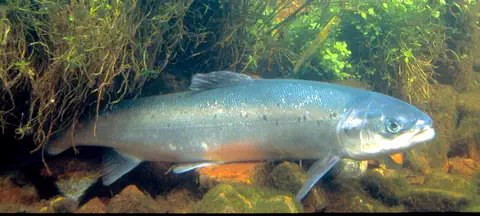
Animal
Atlantic salmon
The Atlantic salmon hatches in a river, swims out to the North Atlantic Ocean to feed and grow, then returns to the very river where it was born to lay its eggs. Along the way it changes color and shape several times.
- Watch What If? Lab What if a machine could run forever? For more than a thousand years, inventors have drawn wheels and gadgets that were meant to keep turning forever with nothing to power them. None has ever worked. Follow the energy in this thought experiment to see why: energy is never made from nothing, and every moving machine leaks a little of it away as heat.
- Watch What If? Lab What if the world ran on sunshine? Solar panels turn sunlight into electricity, and a 2020 World Bank study found that most countries get far more sunshine than they would need for all the electricity they use now. But the Sun sets every night, and winter days are short. Imagine a world running on sunshine and follow the big engineering puzzles: day and night, storing energy, and finding room for panels.
-
 Watch
Natural wonder
River Congo
The Congo is Africa's second-longest river, about 4,700 kilometers long. It curves in a giant arc through the rainforests of central Africa and empties into the Atlantic Ocean. Rain falls in its basin all year, so it carries a huge amount of water, and its wild lower rapids are home to about 320 kinds of fish, about 90 of them found nowhere else.
-
 Watch
Natural wonder
Yangtze River
The Yangtze, called Chang Jiang (Long River) in China, is the longest river in Asia, about 6,300 kilometers. It starts in glacier meltwater on the Plateau of Tibet, cuts through deep gorges, passes huge cities like Chongqing, Wuhan and Nanjing, and reaches the East China Sea at Shanghai. Nearly a third of China's people live in its basin.
-
 Watch
Landmark
Three Gorges Dam
The Three Gorges Dam crosses the Yangtze River in central China. It is 2,335 meters long and 185 meters high, and it can make more electricity than any other hydroelectric dam in the world. It also lets big ships travel far up the river, but building it meant that more than a million people had to move.
-
 Watch
Natural wonder
Volga
The Volga is Europe's longest river. It rises in the Valdai Hills northwest of Moscow and flows about 3,530 kilometers to the Caspian Sea, all within Russia. Almost half of Russia's people live in its basin. Big dams now turn much of it into a chain of long lakes, and its huge delta shelters up to 750,000 waterbirds in mild winters.
- Watch Try it What If? Lab What if a battery had more voltage? A battery's voltage is how hard it pushes electric current around a circuit. Swap a 3-volt battery for a 9-volt one in our model and the same two bulbs carry three times the current, and each one uses nine times the power. Find out why, and why a real bulb can burn out on too much voltage.
For parents & teachers
What children will learn
- Hydropower turns the energy of moving water into electricity using turbines and generators.
- The amount of electricity depends on how much water flows and how far it falls.
- Dams can block fish and change rivers; fish ladders and elevators help fish get past.
- Hydropower ranges from huge dams to micro systems for a single farm or home.
Recommended ages: 7 to 17 · About 15 minutes
Talk about it
- Why might a mountain stream be better for hydropower than a wide, slow river?
- What would you want to know before adding a hydropower plant to a river?
- How are a water wheel and a wind turbine alike?
Try at home or in class
- Make a water wheel from a paper plate and plastic spoons on a pencil axle. Pour water from a jug over it in a sink, first from low down, then from higher up (with a grown-up). Which spins faster?
- Draw a river with a dam, a reservoir and a fish ladder, and label where the water flows.
Key vocabulary: hydropower, dam, reservoir, turbine, penstock, fish ladder, head
Where these facts come from
- Hydropower explained , U.S. Energy Information Administration
- Where hydropower is generated , U.S. Energy Information Administration
- Hydropower and the environment , U.S. Energy Information Administration
- Types of Hydropower Plants , U.S. Department of Energy
- Hydropower Basics , U.S. Department of Energy
Checked, not yet human-reviewed. Last updated October 26, 2026. Spotted a mistake? Tell us.