
Animal
Tiger shark
The tiger shark is a big shark with dark stripes on its back. It swims in warm seas all around the world.
The tiger shark is one of the biggest sharks in the sea. Young tiger sharks have dark spots and stripes like a tiger, which fade as they grow. It eats an amazing range of food, and it travels long distances between warm and cooler seas.
Galeocerdo cuvier is a large requiem shark of tropical and warm temperate seas worldwide. It is famous for its broad diet, its serrated, notched teeth and an unusual way of nourishing its embryos without a placenta. The IUCN lists it as Near Threatened, with a decreasing population, mainly because of fishing.
Photo: Albert kok, CC BY-SA 3.0, via Wikimedia Commons
Meet the tiger shark
The tiger shark is a big fish.
It has a wide, blunt nose and dark stripes on its back. Baby tiger sharks have the boldest stripes. The stripes fade as the shark grows up.
The tiger shark is one of the largest sharks in the ocean. Most grown-ups are about 3 to 4 meters long and weigh 385 to 635 kilograms.
It is named for the dark spots and stripes on its gray back. These markings are boldest on young sharks and fade as they get older. Like all sharks, it is a fish, and its skeleton is made of bendy cartilage instead of bone.
Galeocerdo cuvier belongs to the requiem sharks (family Carcharhinidae), and the Florida Museum calls it probably the easiest member of that family to recognize. Adults commonly reach 3.25 to 4.25 meters and 385 to 635 kilograms; the largest exceed 5.5 meters and are estimated at more than 900 kilograms.
The common name comes from the dark vertical bars and spots on the flanks. In juveniles the blotches join into tiger-like stripes, which become less distinct as the shark matures. Georgia Aquarium notes that females are generally slightly larger than males.
Quick facts
- Group
- Fish
- Length
- 3.25 to 4.25 m
- Weight
- 385 to 635 kg
Where it lives
Tiger sharks live in warm seas all over the world.
Some swim near coasts and coral reefs. Others swim far out in the open ocean.
Tiger sharks live in tropical and warm temperate seas around the world, in the Atlantic, Pacific and Indian Oceans. One sea they are missing from is the Mediterranean.
They are at home both in the open ocean and in shallow water near coasts. They often visit river mouths, harbors, lagoons and coral reefs around islands, especially where the water is murky and full of food.
The Florida Museum describes the tiger shark as wide-ranging in temperate and tropical waters everywhere except the Mediterranean Sea, from the open ocean to shallow coasts. It favors murky coastal water such as estuaries, harbors and inlets, where runoff from land supports plenty of prey, and also the lagoons and atolls of oceanic islands.
It is often seen near the surface. The museum reports depths of 350 meters, and the IUCN assessment gives a lower depth limit of 1,136 meters. Sightings as far north as Iceland and the United Kingdom are thought to be roaming sharks that followed the warm Gulf Stream north.
Its habitat

Where can you find this animal?
- Lives here naturally · Countries and seas named by a scientific source
- Sightings recorded · Records of wild sightings (GBIF)
Lives here naturally · Countries and seas named by a scientific source
Tropical and warm temperate seas worldwide, from coasts, lagoons and reefs to the open ocean, but not the Mediterranean Sea. Shading is by whole ocean, so it is much wider than where tiger sharks actually live; rare visitors reach as far north as Iceland and the United Kingdom.
Places: Atlantic Ocean, Indian Ocean and Pacific Ocean.
Source: iucn-red-list · checked October 2026
Sightings recorded · Records of wild sightings (GBIF)
Counts of GBIF records of wild observations (human and machine) and preserved specimens. Records include introduced populations, vagrants, escaped or released animals and misidentifications, so a country with records is not necessarily part of the native range.
Wild sightings have been recorded in Australia, South Africa, Mozambique, United States, Brazil, Mexico, Germany, Bahamas and 67 more places.
Source: gbif · checked October 2026
Range maps show where scientists say an animal lives, often country by country. An animal may live in only part of a country shown, and sightings records can include animals that wandered far from home.
What it eats
Tiger sharks eat lots of different foods.
They catch fish, sea turtles, squid and sea birds. They also eat dead animals they find in the sea.
Tiger sharks have one of the widest diets of any shark. They eat bony fish, rays, other sharks, sea turtles, squid, crustaceans, sea birds and even dolphins. They also eat dead animals they find.
They are not picky at all. Scientists sometimes find trash in their stomachs, such as cans and plastic, swallowed by mistake in harbors where garbage ends up in the water.
The Florida Museum calls the tiger shark perhaps the least discriminating feeder of all sharks. Prey varies by region but commonly includes sea turtles, rays, other sharks, bony fishes, seabirds, dolphins, squid, crustaceans and carrion. Its heavily serrated teeth, combined with a sawing, side-to-side shake of the head, let it cut pieces from animals much larger than itself.
Objects of human origin are often recovered from tiger sharks caught in harbors and river mouths. One female from the Gulf of Aqaba had swallowed two cans, a plastic bottle and two sacks along with a squid and a fish, a reminder of how marine debris reaches large predators.
Did you know?
Shark skin feels rough, like sandpaper.
Shark skin is covered in tiny tooth-like scales called dermal denticles, so it feels like sandpaper. Tiger shark skin was once made into leather for traditional Hawaiian drums.
Sharks are covered in placoid scales (dermal denticles), structures similar to teeth; the Florida Museum notes that tough tiger shark skin was used for leather, including traditional Hawaiian drums.
Built for the hunt
A tiger shark has a wide, square nose and big eyes.
It has a tall fin on its back and a long, thin tail. Its teeth are sharp and bumpy, like a saw.
A tiger shark's body is thick and strong at the front and gets slimmer toward the tail. Its head is wide, with a blunt, almost square snout and large eyes.
The broad fin on its back keeps it from rolling over, and the long top part of its tail pushes it through the water. Its teeth are special: each one is curved, has a deep notch on one side and is lined with tiny saw-like edges. Like other sharks, it keeps growing new teeth to replace old ones.
The body is stout in front and tapers behind the abdomen. The head is robust, with large eyes, a conspicuously blunt snout and a large mouth with long furrows at the corners. A ridge runs along the back between the broad first dorsal fin and the much smaller second, and a low keel runs along the base of the tail, whose upper lobe is long and slender.
The teeth are distinctive: large, with curved cusps, finely serrated edges and a deep notch on the outer margin lined with small cusplets, similar in both jaws. As in all sharks, the skeleton is cartilage, and teeth sit on a membrane that moves forward like a conveyor belt, replacing worn or lost teeth (Fisheries and Oceans Canada).
Shark senses
Tiger sharks often hunt at night.
Their eyes work well when it is dark. They can also feel tiny movements in the water around them.
Tiger sharks hunt mostly at night, so their senses matter. Like other sharks, they have a shiny layer at the back of each eye that bounces light back through it, which helps them see in dim water.
A line of tiny holes along each side of the body, called the lateral line, feels movements in the water. Tiny pores on the head, called ampullae of Lorenzini, can sense the weak electric signals that other fish give off.
Fisheries and Oceans Canada describes the sensory kit sharks share. Behind the retina lies the tapetum lucidum, a layer of plate-like cells packed with reflective guanine crystals that sends light back through the retina, boosting vision in low light. That matters for a hunter that, according to the Florida Museum, feeds mostly at night.
The lateral line, canals of sensory neuromasts opening through pores along the body, detects water movement and sound. The ampullae of Lorenzini, gel-filled pores around the head, detect the tiny electric fields made by the muscles of nearby animals, though only at close range, which helps a shark find prey hidden in sand (University of Texas Marine Science Institute). Fisheries and Oceans Canada adds that they may also sense changes in water temperature.
Did you know?
Tiger sharks can swim very deep in the sea.
Tiger sharks are often seen near the surface, but the IUCN records them as deep as 1,136 meters.
The IUCN assessment gives a depth range from the surface to 1,136 meters, although the species is most often seen near the surface.
Growing up
Tiger shark babies are called pups.
They grow inside their mother for more than a year. Then many pups are born at once.
Tiger shark pups grow inside their mother for 13 to 16 months. At first each pup feeds on the yolk of a large egg. When the yolk runs out, it drinks fluid inside its mother's body.
A mother can give birth to anywhere from 10 to 82 pups at once. Newborn pups are about 51 to 76 centimeters long, and their tiger stripes are at their boldest.
Georgia Aquarium describes the tiger shark as the only member of its family that does not nourish its embryos through a placenta. Embryos first develop on the yolk of relatively large eggs; once that is used up they take in uterine fluid, a process called embryotrophy (Castro and colleagues, 2016, cited by the Florida Museum). Young are born alive, which is broadly called ovoviviparity.
Gestation lasts 13 to 16 months and litters range from 10 to 82 pups, 51 to 76 centimeters long at birth. In the Northern Hemisphere mating happens from March to May and pups are born from April to June the next year. Males mature at 2.26 to 2.9 meters and females at 2.5 to 3.25 meters.
A traveling night hunter
Tiger sharks swim slowly most of the time.
When they spot food, they can zoom forward fast. They travel to cooler seas in summer and back to warm seas in winter.
A tiger shark usually cruises slowly, but it can burst forward with a quick rush of speed to catch its food by surprise. It mostly hunts alone and at night, when it moves closer to the shore and the surface.
Tiger sharks are great travelers. In warm months many swim from the tropics into cooler seas, and in winter they head back. Some make long journeys across the open ocean between islands.
Although large and usually slow-moving, the tiger shark is an effective ambush predator that uses short bursts of speed. It hunts alone, mainly at night, moving inshore and nearer the surface. Groups do form, but the Florida Museum suggests they gather around food rather than for social reasons. It migrates seasonally, into temperate waters in summer and back to the tropics in winter, and makes long oceanic crossings between islands.
The Florida Museum reports that tiger sharks are often curious and unaggressive when met, but it also lists the species second only to the white shark in reported bites on people, and advises treating it with caution and respect.
Did you know?
Baby tiger sharks have the boldest stripes.
A tiger shark's stripes are boldest when it is young and slowly fade as it grows up.
Juvenile blotches fuse into tiger-like bars that become less distinct as the shark matures, so the boldest stripes belong to the young.
Protecting tiger sharks
There are fewer tiger sharks than before.
People catch too many of them in fishing nets and on hooks. Fishing is the biggest danger for them.
The tiger shark is listed as Near Threatened, which means it could become endangered in the future. Its numbers are going down.
The main problem is fishing. People catch tiger sharks for their fins, meat and oil, and many are caught by accident on lines and nets set for other fish. Young sharks have been hit especially hard in some places.
The IUCN assessed the tiger shark in August 2018 (published 2019) as Near Threatened under criteria A2bd+3d, with a decreasing population; fishing and harvesting are the listed threat. It is taken directly for fins, flesh and liver oil and as bycatch in commercial and recreational fisheries. In the United States it is the third most commonly caught of the large coastal sharks.
The Florida Museum reports that catch rates in the mid-Atlantic have fallen since the mid-1980s, and observer data suggest that heavy fishing, especially of juveniles, has reduced the population there. With a generation length of about 17.5 to 22.5 years (IUCN), losses are slow to replace.
IUCN Red List
How is the tiger shark doing in the wild?
- Least Concern
- Near Threatened (this animal)
- Vulnerable
- Endangered
- Critically Endangered
- Extinct in the Wild
- Extinct
Near Threatened
Not at risk yet, but it could be soon.
See the IUCN Red List assessment · The IUCN Red List of Threatened Species 2022.2
Amazing facts
-
Baby tiger sharks have the boldest stripes.
A tiger shark's stripes are boldest when it is young and slowly fade as it grows up.
Juvenile blotches fuse into tiger-like bars that become less distinct as the shark matures, so the boldest stripes belong to the young.
-
A tiger shark mom can have more than 80 babies at once.
A single tiger shark litter can have anywhere from 10 to 82 pups.
Litters range from 10 to 82 pups after a gestation of 13 to 16 months.
-
Shark skin feels rough, like sandpaper.
Shark skin is covered in tiny tooth-like scales called dermal denticles, so it feels like sandpaper. Tiger shark skin was once made into leather for traditional Hawaiian drums.
Sharks are covered in placoid scales (dermal denticles), structures similar to teeth; the Florida Museum notes that tough tiger shark skin was used for leather, including traditional Hawaiian drums.
-
Tiger sharks can swim very deep in the sea.
Tiger sharks are often seen near the surface, but the IUCN records them as deep as 1,136 meters.
The IUCN assessment gives a depth range from the surface to 1,136 meters, although the species is most often seen near the surface.
Words to know
- cartilage
- a strong, bendy material; a shark's skeleton is made of it instead of bone
- gill slits
- openings on a shark's side where water flows out after passing over the gills
- dorsal fin
- the fin on a fish's back that keeps it steady
- pup
- a baby shark
- migration
- a regular journey animals make from one place to another, often with the seasons
- bycatch
- animals caught by accident in fishing gear meant for other fish
Discovery challenge
-
How did the tiger shark get its name?
How did the tiger shark get its name?
What is the origin of the tiger shark's common name?
- It roars like a tiger
- It has dark stripes and spots
- It lives in the jungle
Show the answer
It has dark stripes and spots
Tiger sharks have dark stripes, like a tiger.
The dark spots and stripes on its back look like a tiger's. They are boldest on young sharks.
The name refers to the dark vertical bars and spots on the flanks, which are most distinct in juveniles and fade with age.
-
What do tiger sharks eat?
Which best describes what tiger sharks eat?
Which best describes the tiger shark's diet?
- Only seaweed
- Only tiny plankton
- Many kinds of animals, alive or dead
Show the answer
Many kinds of animals, alive or dead
Tiger sharks eat lots of things: fish, turtles, squid and more.
Tiger sharks eat fish, rays, sharks, sea turtles, squid, sea birds and dead animals: one of the widest diets of any shark.
It is a generalist predator and scavenger; prey commonly includes turtles, rays, sharks, bony fishes, seabirds, dolphins, squid, crustaceans and carrion.
-
When do tiger sharks do most of their hunting?
When do tiger sharks do most of their hunting?
When do tiger sharks mainly feed?
- At night
- At noon
- Never
Show the answer
At night
Tiger sharks hunt mostly at night.
Tiger sharks hunt mostly at night, moving closer to shore and to the surface.
They are solitary hunters that feed mainly at night, moving inshore and closer to the surface.
-
Where do tiger sharks live?
Where do tiger sharks live?
Which describes the tiger shark's range?
- In warm seas around the world
- Only in rivers
- Only in icy polar seas
Show the answer
In warm seas around the world
Tiger sharks live in warm seas all over the world.
They live in tropical and warm temperate seas of the Atlantic, Pacific and Indian Oceans.
Tropical and warm temperate waters worldwide except the Mediterranean, from coasts and lagoons to the open ocean.
Places where you might see it
Experiments to try
Explore next
-
 Watch
3D
Animal
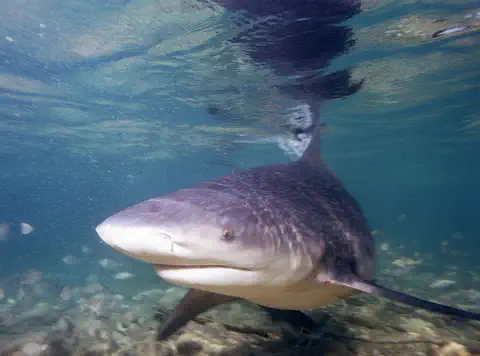
Bull shark
The bull shark is a large, stout shark of warm coasts around the world. It is one of very few sharks that can swim from the salty sea into fresh water, and it has been found thousands of kilometers up big rivers like the Amazon and the Mississippi.
-
 Watch
3D
Animal
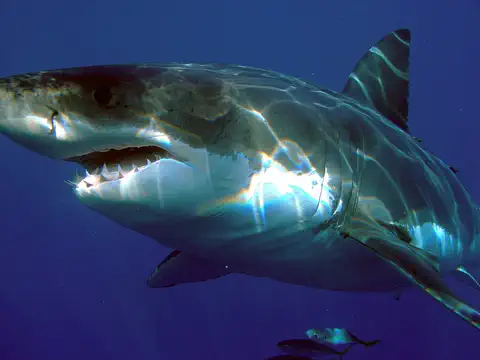
Great white shark
The great white shark is the largest of the mackerel sharks: a strong, torpedo-shaped fish with a gray back and a white belly. It hunts fish, seals and sea lions, and it is partly warm-blooded, which helps it stay active in cool water.
-
 Watch
Animal
Great hammerhead
The great hammerhead is the biggest of the hammerhead sharks. Its wide, flat head, called a cephalofoil, holds its eyes far apart and is packed with senses that help it find stingrays hiding in the sand of warm, shallow seas.
-
 Watch
Animal
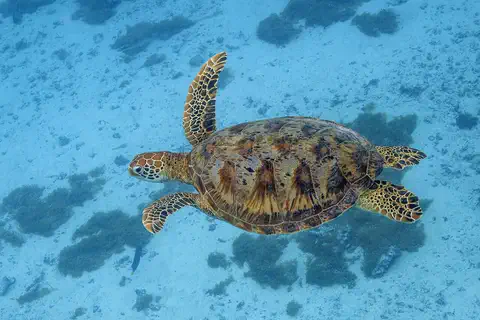
Green sea turtle
The green sea turtle is the largest sea turtle with a hard shell. It lives in warm seas around the world and, unlike other sea turtles, grown-ups eat mostly seagrass and algae. Females swim hundreds or even thousands of kilometers to lay their eggs on the beaches where they hatched long ago.
-
 Watch
 Country
Australia
Australia is a country and the smallest continent, surrounded by ocean in the Southern Hemisphere. Much of its middle is dry and flat, most people live near the coast, and its animals include kangaroos, koalas and the platypus, a mammal that lays eggs.
-
 Watch
3D
Animal
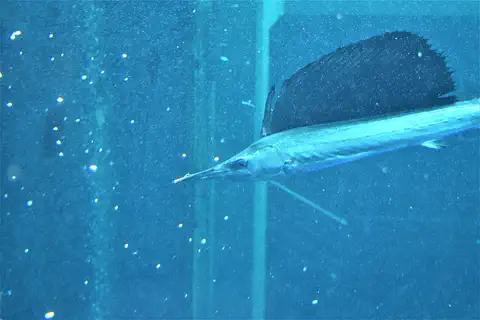
Indo-Pacific sailfish
The sailfish is a long, sleek ocean fish with a tall, sail-like fin on its back and a long, spear-shaped upper jaw called a bill. It hunts schools of small fish in warm seas, folding its sail away to speed up and raising it to make sharp turns.
- Watch What If? Lab What if sharks disappeared? Sharks catch and eat other sea animals, and just having them around changes where those animals go. Follow what scientists have found in Australia's Shark Bay seagrass meadows and on coral reefs, where the evidence is still debated, and how some shark populations are recovering.
-
 Watch
3D
Animal
Giant isopod
The giant isopod is a deep-sea relative of the pill bugs and sowbugs you find under garden stones, but it can grow to about 50 centimeters long. It crawls over the dark sea floor of the western Atlantic, cleaning up dead fish, squid and other food that sinks from above.
For parents & teachers
What children will learn
- Describe the tiger shark's main body features and what each does (snout, eyes, gills, fins, tail, teeth).
- Explain that the tiger shark is a generalist that eats many kinds of prey and carrion.
- Describe how tiger shark pups develop and are born.
- Explain why the species is Near Threatened and how fishing affects slow-breeding sharks.
Recommended ages: 3 to 17 · About 15 minutes
Talk about it
- Why might stripes be more useful to a young shark than to a big adult?
- Trash has been found inside tiger sharks. How does garbage get into the sea, and what could we do about it?
- Why do you think tiger sharks travel to cooler seas in summer?
Try at home or in class
- Measure 4 meters along a hallway or sidewalk with a tape measure to see how long a big tiger shark is.
- Hold a flat piece of cardboard in a bathtub or sink and push it through the water edge-first, then flat-side-first, to feel how a fin's shape changes the push of the water.
Key vocabulary: cartilage, gill slits, dorsal fin, pup, migration, bycatch
Where these facts come from
- The IUCN Red List of Threatened Species , International Union for Conservation of Nature (IUCN terms of use (no redistribution of Red List data or range maps))
- GBIF Backbone Taxonomy and GBIF Occurrence Search , Global Biodiversity Information Facility (CC0 1.0 (backbone); occurrence counts are facts derived from records under CC0, CC BY and CC BY-NC)
- Galeocerdo cuvier (Tiger Shark), 2018 global assessment , IUCN Red List of Threatened Species
- Tiger Shark (Galeocerdo cuvier) species profile , Florida Museum of Natural History
- Tiger Shark , Georgia Aquarium
- Shark anatomy , Fisheries and Oceans Canada
- Ampullae of Lorenzini (Science and the Sea) , Marine Science Institute, The University of Texas at Austin
- Wikidata , Wikimedia Foundation (CC0 1.0)
- Wikimedia Commons , Wikimedia Foundation (Per file: Public domain, CC0, CC BY or CC BY-SA only (credited on each page))
Checked, not yet human-reviewed. Last updated October 28, 2026. Spotted a mistake? Tell us.