
City Asia
Abu Dhabi
Abu Dhabi is the capital of the United Arab Emirates. The city is on an island by the sea.
Abu Dhabi is the capital of the United Arab Emirates. It began in the 1700s as a small settlement around fresh water on an island, guarded by a coral-stone watchtower. Before oil, it relied on fishing and pearl diving; since the 1960s, money from oil has turned it into a city of towers. An official estimate gave the city about 1.75 million people in 2023.
Abu Dhabi grew from a settlement founded after water was found on the island around 1761. Its ruler moved his seat of power to the island in 1795, with the fort of Qasr Al Hosn as his seat of government, and the city became the federal capital of the United Arab Emirates, formed in 1971. An official estimate gave the city about 1,750,000 people in mid-2023, and the Statistics Centre Abu Dhabi estimated 2,823,340 people in the wider Abu Dhabi region in 2024.
Photo: Валерий Дед, CC BY 3.0, via Wikimedia Commons
Discover Abu Dhabi
Abu Dhabi is the capital city of the United Arab Emirates. The city sits on an island in the sea.
It has many tall towers that shine at night.
Abu Dhabi is the capital of the United Arab Emirates, a country of seven emirates on the Arabian Peninsula. The city has the same name as the largest emirate, Abu Dhabi, and it stands on an island off the coast.
The Statistics Centre Abu Dhabi estimated 2,823,340 people in the Abu Dhabi region, one of the emirate's three regions, in 2024. For the city itself, an official estimate gave about 1.75 million people in 2023.
City Population's tables from the Statistics Centre Abu Dhabi give the Abu Dhabi region 1,310,485 people in 2011 (an estimate), 2,595,390 in the census of 20 September 2023 and 2,823,340 in the estimate for 20 September 2024. The whole emirate counted 3,847,585 in the revised 2023 census.
For the city alone, the cities table lists 243,257 people in the 1980 census, 398,695 in 1995 and an official estimate of about 1,750,000 for mid-2023.
- Country
- United Arab Emirates (its capital)
- People in the Abu Dhabi region (2024 estimate)
- 2,823,340
- People in the Abu Dhabi region (2023 census)
- 2,595,390
- People in Abu Dhabi city (2023 estimate)
- about 1,750,000
A coral fort and shining towers
Abu Dhabi has an old fort. It is made of coral and stone from the sea.
The city also has tall towers and a hotel with domes.
Qasr Al Hosn began as a watchtower built of coral and sea stone, which guarded the way onto the island and the small community growing around it. More towers were added later and joined into a fort, which became the ruler's home and seat of government.
The modern city has many tall towers. In the photo, the Emirates Palace, a hotel with many domes that opened in 2005, glows gold in front of the Etihad Towers, a group of five towers whose tallest is 305 meters high.
Qasr Al Hosn's own history says a sheikh of the Bani Yas tribe from the Liwa Oasis ordered the first watchtower, of coral and sea stone, to watch over coastal access to the island. Between 1793 and 1816 more towers were built and linked into a defensive enclosure, the seat of government and the ruler's family home. After the first oil concessions in 1939, a palace was built around the old fort walls, tripling the site. A later conservation project dealt with a white render that had trapped moisture on the original coral stone bricks, revealing the original foundation again.
Wikidata dates the Emirates Palace hotel's opening to February 2005, lists 305 m for the tallest of the five Etihad Towers (inception 2011), and 342 m for the ADNOC Headquarters tower (inception 2015), seen still under construction at the left of the photo.
- Qasr Al Hosn
- began as a watchtower of coral and sea stone
- Emirates Palace hotel
- opened in February 2005
- Etihad Towers
- five towers; the tallest 305 m
Water, pearls and oil
Long ago, people found fresh water on the island and built a little town there.
People dived into the sea for pearls. Later, oil was found, and the town grew into a big city.
People of the Bani Yas tribe found fresh water on the island around 1761, and a small settlement grew there. In 1795 their ruler moved his seat of power to the island from the Liwa Oasis inland. By the late 1800s Abu Dhabi had more than 400 pearling boats. Before oil, people dived for pearls in summer and herded animals or farmed at oases the rest of the year.
Money from oil exports began to transform Abu Dhabi in the 1960s. In 1971 the emirates joined to form the United Arab Emirates. Abu Dhabi is its federal capital.
The Encyclopedia of the Modern Middle East and North Africa (Malcolm C. Peck, updated by Anthony B. Toth) says a settlement named Abu Dhabi, 'Land of the Gazelle', was founded after water was discovered around 1761, and a small fort was built over its well. Qasr Al Hosn's history adds that the water lay not in one well but in shallow pools called 'scrapes', and that the seat of power moved from Liwa to the island in 1795.
In the 19th century the rulers signed treaties placing them under British protection, and nearby oyster banks drew many pearling ships to the town. Oil revenues brought rapid change from the 1960s; after Britain announced in 1968 that its protection would end, the emirates formed the UAE, and Qasr Al Hosn's history notes that meetings to negotiate the union were held in its National Consultative Chamber in 1971.
- Settlement
- after water was found, around 1761
- Seat of power moved to the island
- 1795
- United Arab Emirates formed
- 1971
A city on an island
Abu Dhabi is on an island, so there is water all around it.
Long ago, a watchtower kept watch over the way onto the island. Now Abu Dhabi also has an airport with planes to other countries.
The coast of the emirate of Abu Dhabi has many islands, and the capital city stands on one of them. The first watchtower was placed so that it overlooked the way onto the island from the coast.
The emirate's oil wealth has paid for modern airports, transportation and communications, and Oxford's World Encyclopedia notes that Abu Dhabi has an international airport and a container port for cargo ships.
The Encyclopedia of the Modern Middle East describes the emirate's land as mostly flat and rocky, with dunes inland and salt flats and many islands along the coast; Abu Dhabi City occupies one of these islands. Qasr Al Hosn's first watchtower 'overlooked and controlled coastal access to the island'.
The same encyclopedia says oil and gas revenues funded modern international airports and a modern communications and transportation network, and Oxford's World Encyclopedia notes Abu Dhabi's international airport and modern container port.
- Site
- one of the many islands along the emirate's coast
- First watchtower
- overlooked and controlled coastal access to the island
- Transport
- an international airport and a container port
Hot summers, mild winters
Summers in Abu Dhabi are very hot. Winters are mild.
It hardly ever rains, and almost never in summer.
The averages the World Meteorological Organization lists for Abu Dhabi (1982–1991) show daytime highs of about 42 °C in July, the hottest month, and about 24 °C in January, the coolest. January nights average about 12 °C.
Very little rain falls: about 89 millimeters in an average year, most of it from December to March. February is the wettest month, with about 42 millimeters, and from May to October almost no rain falls at all.
The WMO table, supplied by the UAE's National Center of Meteorology for 1982–1991, gives average highs of 42.0 °C in July and 41.5 °C in August, and 23.8 °C in January; average lows run from 11.8 °C in January to 28.7 °C in August.
The monthly rainfall averages add up to about 88.9 mm a year, on about 12 rain days (0.2 mm or more). February brings the most (42.0 mm), and the six months from May to October together average only 0.1 mm.
- July, average high (WMO, 1982–1991)
- 42.0 °C
- January, average low (same period)
- 11.8 °C
- Rain in a year (sum of the monthly averages)
- about 89 mm
From pearls to oil and museums
Long ago, people in Abu Dhabi dived for pearls and fished.
Then oil was found. Now the city has tall buildings, universities, hospitals and museums.
Abu Dhabi began as a settlement that relied on fishing and pearling. The first oil concessions, agreements letting companies look for oil, were negotiated in 1939, and from the 1960s oil exports transformed the emirate. The Encyclopedia of the Modern Middle East credited the emirate with about 90 percent of the UAE's oil reserves.
Oil money paid for universities, hospitals, museums, hotels and office towers. The Louvre Abu Dhabi, an art museum, opened in November 2017.
The Encyclopedia of the Modern Middle East credited the emirate with 90 percent of the UAE's roughly 100 billion barrels of oil reserves and 60 percent of its gas reserves, and said these revenues funded international airports, universities, hospitals, museums, towering hotels and office buildings 'where only fifty years earlier there were simple palm-frond huts and dusty paths'.
Qasr Al Hosn's history places the first oil concessions in 1939, negotiated with Great Britain. Wikidata dates the opening of the Louvre Abu Dhabi to 8 November 2017.
- First oil concessions
- 1939
- Share of the UAE's oil reserves in the emirate
- 90 percent (Encyclopedia of the Modern Middle East)
- Louvre Abu Dhabi
- opened 8 November 2017
Abu Dhabi on the map
Find the Arabian Peninsula on the globe. Look at its east side. Abu Dhabi is on an island by the coast!
The country around it is the United Arab Emirates.
Abu Dhabi is on the coast of the Arabian Peninsula at about 24° north. It stands on one of many islands along the coast.
Measured from Qasr Al Hosn, the old fort, the Emirates Palace is about 4.5 kilometers to the west-southwest, the Etihad Towers about 4 kilometers to the southwest, and the Louvre Abu Dhabi about 7 kilometers to the northeast.
Abu Dhabi lies at about 24.5° N and 54.4° E. Measured from Qasr Al Hosn (Wikidata points), the Emirates Palace is about 4.5 km west-southwest, the Etihad Towers about 4.3 km southwest and the Louvre Abu Dhabi about 7.3 km northeast.
The hero photo was taken at night across a marina about 0.55 km west-northwest of the Emirates Palace (camera point from Commons), looking toward the hotel and the towers behind it.
- Latitude
- about 24.5° north
- Longitude
- about 54.4° east
- Qasr Al Hosn to the Emirates Palace
- about 4.5 km west-southwest
Amazing facts
-
Abu Dhabi's old fort was built with coral from the sea!
Qasr Al Hosn began as a watchtower built of coral and sea stone.
Qasr Al Hosn's first watchtower was built of coral and sea stone; a later conservation project found that a white render was trapping moisture on the original coral stone bricks.
-
The water people found on the island long ago was in little pools, not one well.
The fresh water found on Abu Dhabi island was not a single well but shallow pools called 'scrapes'.
Qasr Al Hosn's history notes that the island's water was found not in a single well but in shallow pools known as 'scrapes'.
-
Long ago, more than 400 boats from Abu Dhabi went out to find pearls!
By the late 1800s, Abu Dhabi had more than 400 pearling boats.
Qasr Al Hosn's history says the town commanded more than 400 pearling boats by the late 1800s.
-
In Abu Dhabi, it almost never rains in summer.
From May to October, Abu Dhabi averages almost no rain at all.
In the WMO's 1982–1991 averages, May to October together bring only 0.1 mm of rain, all of it in August.
Words to know
- capital
- the city where a country's government is based
- emirate
- a land ruled by an emir or sheikh; the United Arab Emirates has seven
- watchtower
- a tall tower from which guards can see who is coming
- coral
- a hard material built up in the sea by tiny animals, once used as building stone
- pearling
- diving to the sea floor to collect oysters that may hold pearls
- concession
- an agreement that lets a company use land or look for resources such as oil
Discovery challenge
-
Abu Dhabi is the capital of which country?
Abu Dhabi is the capital of which country?
Abu Dhabi is the federal capital of which country, formed in 1971?
- Qatar
- The United Arab Emirates
- Oman
Show the answer
The United Arab Emirates
The United Arab Emirates!
The United Arab Emirates, a country of seven emirates.
The United Arab Emirates, formed in 1971.
-
What is Abu Dhabi city built on?
What kind of land does the city of Abu Dhabi stand on?
According to the Encyclopedia of the Modern Middle East, what does Abu Dhabi City occupy?
- A mountain
- An island
- A riverbank
Show the answer
An island
An island!
An island, one of many along the coast.
One of the many islands along the emirate's coast.
-
What was the old fort, Qasr Al Hosn, made of?
What was Qasr Al Hosn's first watchtower built of?
Which materials did the builders of Qasr Al Hosn's first watchtower use?
- Coral and sea stone
- Wood and straw
- Glass and steel
Show the answer
Coral and sea stone
Coral and stone from the sea!
Coral and sea stone.
Coral and sea stone, as Qasr Al Hosn's history records.
-
Long ago, what did people dive into the sea to find?
Before oil, what did people of Abu Dhabi dive for in summer?
Before oil, what did the emirate's people dive for in summer, with herding and oasis farming the rest of the year?
- Gold coins
- Pearls
- Sponges
Show the answer
Pearls
Pearls!
Pearls: the town had more than 400 pearling boats by the late 1800s.
Diving for pearls, near the rich oyster banks.
-
Which month is the hottest in Abu Dhabi?
Which month has Abu Dhabi's highest average daytime temperature?
In the WMO's 1982–1991 averages, which month has Abu Dhabi's highest average high (42.0 °C)?
- January
- April
- July
Show the answer
July
July!
July, at about 42 °C.
July (42.0 °C), just ahead of August (41.5 °C).
Nearby places
-
 Watch
Landmark
Burj Khalifa
Burj Khalifa in Dubai, United Arab Emirates, is 828 meters tall, the tallest building in the world (2026). It took about six years to build, from 2004 to 2010. Its Y-shaped plan, inspired by a desert flower, helps it stand up to strong winds.
-
 Watch
City
Dubai
Dubai is a city of the United Arab Emirates, on the coast of the Arabian Gulf with desert behind it. It began in 1833 as a small settlement beside a sheltered creek and grew from fishing, pearling and trade into a city of tall towers, including Burj Khalifa, the world's tallest building.
-
 Watch
City
Doha
Doha is the capital of Qatar, on the east coast of the Qatar peninsula. Its name means 'bay'. Doha was once a village of pearl divers and fishers; after oil was found, it grew into a city of towers, museums and metro lines. The 2020 census counted 1,186,023 people in Doha.
-
 Watch
Landmark
Al Zubarah
Al Zubarah is the ruin of a walled town on the coast of Qatar. For about 50 years, in the late 1700s and early 1800s, it was a busy center for pearls and trade. After it was abandoned, desert sand covered and protected its houses, palaces and streets. It became a UNESCO World Heritage Site in 2013.
-
 Watch
City
Muscat
Muscat is the capital of Oman, on a notch of coast on the Gulf of Oman ringed by mountains. Muscat itself had 24,099 people at the 2020 census, but it is the heart of a much bigger city that stretches along the coast, with 1,302,440 people in Muscat Governorate.
-
 Watch
Landmark
Persepolis
Persepolis was a royal city of the Persian kings. King Darius I began it around 518 BCE on a huge terrace at the foot of a mountain in southwestern Iran. Its palaces had very tall, slender columns and walls carved with long parades of people bringing gifts. It is a UNESCO World Heritage Site.
-
 Watch
City
Riyadh
Riyadh is the capital and biggest city of Saudi Arabia, in the middle of the Arabian Peninsula. It grew from small villages with gardens into a city of tall towers. An old fort built of mud and hay stands in its center, and a new driverless metro opened in 2024. The 2022 census counted 6,924,566 people in the city.
-
 Watch
City
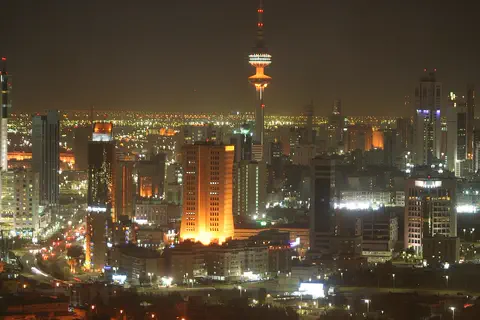
Kuwait City
Kuwait City is the capital of Kuwait. It began as a town on the coast early in the 1700s and grew rich from caravans and pearl fishing. Today tall towers rise over the city, and summer days average highs near 47 °C.
Explore next
-
Watch
 Country
United Arab Emirates
The United Arab Emirates, or UAE, is a country of seven emirates on the Arabian Peninsula, on the Persian Gulf and the Gulf of Oman. Most of it is desert, and its cities, Abu Dhabi, Dubai and Sharjah, line the coast. Dubai has the Burj Khalifa, the world's tallest building.
-
Watch
City
Dubai
Dubai is a city of the United Arab Emirates, on the coast of the Arabian Gulf with desert behind it. It began in 1833 as a small settlement beside a sheltered creek and grew from fishing, pearling and trade into a city of tall towers, including Burj Khalifa, the world's tallest building.
-
Watch
City
Doha
Doha is the capital of Qatar, on the east coast of the Qatar peninsula. Its name means 'bay'. Doha was once a village of pearl divers and fishers; after oil was found, it grew into a city of towers, museums and metro lines. The 2020 census counted 1,186,023 people in Doha.
- Watch Geography Capital cities A capital is the city where a country's government is based. Many capitals grew up over hundreds of years beside rivers and trade routes. A few, like Brasília and Canberra, were built from scratch, and some countries share out their capital's jobs among two or three cities.
-
Watch
City
Muscat
Muscat is the capital of Oman, on a notch of coast on the Gulf of Oman ringed by mountains. Muscat itself had 24,099 people at the 2020 census, but it is the heart of a much bigger city that stretches along the coast, with 1,302,440 people in Muscat Governorate.
-
 Watch
City
Almaty
Almaty is the main city of Kazakhstan, in the southeast of the country at the foot of the Ala-Tau mountains. It was founded in 1854 where a Kazakh village called Almaty, 'village of apple trees', stood. It was the capital until 1998, and about 2,387,900 people lived there on 1 September 2026.
-
 Watch
City
Amman
Amman is the capital of Jordan, built on steep hills around a valley high on a plateau. Long ago it was a Roman city called Philadelphia, and its Roman theater, carved into a hillside, still holds about 6,000 people. Today the city spreads across the hills, with houses faced in pale stone. About 4.6 million people lived in Amman Governorate at the end of 2021.
-
 Watch
City
Ankara
Ankara is the capital of Türkiye, in the interior of Anatolia, about 200 kilometers from the Black Sea. People have lived here since the Stone Age, and Romans, Byzantines, Seljuks and Ottomans all left buildings behind. It became the capital in 1923, and today it is a city of government, universities and museums.
For parents & teachers
What children will learn
- Locate Abu Dhabi and the United Arab Emirates on the Arabian Peninsula.
- Describe how fresh water, pearling and then oil shaped a city's growth.
- Explain the difference between a city, a region and an emirate when reading population figures.
- Read average monthly temperatures and rainfall for a desert coast.
Recommended ages: 3 to 17 · About 15 minutes
Talk about it
- Abu Dhabi began where people found fresh water. Why is water so important when choosing where to build a town?
- Before oil, people dived for pearls in summer and herded animals the rest of the year. How did the seasons shape their work?
- The city has about 1.75 million people, but the region around it has about 2.8 million. Why might it matter which area you count?
Try at home or in class
- Rain chart: plot Abu Dhabi's monthly rainfall and color the months with almost none.
- Island map: draw an island town with a watchtower guarding the way across from the mainland.
- Building materials: compare coral and sea stone with glass and steel, and talk about why builders used what was close by.
Key vocabulary: capital, emirate, watchtower, coral, pearling, concession
Where these facts come from
- Wikidata , Wikimedia Foundation (CC0 1.0)
- Natural Earth vector data , Natural Earth (NACIS) (Public domain)
- UAE: Abu Dhabi (regions; estimates 2011 and 2024, census 2023) , City Population (Thomas Brinkhoff), from the Statistics Centre Abu Dhabi
- United Arab Emirates: emirates and major cities (censuses and official estimates) , City Population (Thomas Brinkhoff), from the UAE Ministry of Economy and the emirates' statistical offices
- History , Qasr Al Hosn, Abu Dhabi
- Abu Dhabi (Encyclopedia of the Modern Middle East and North Africa; World Encyclopedia) , Encyclopedia.com (Malcolm C. Peck, updated by Anthony B. Toth; Oxford University Press)
- World Weather Information Service: Abu Dhabi climatological information , World Meteorological Organization (National Center of Meteorology, UAE)
- File:Абу-Даби (Abu Dhabi) - panoramio (1).jpg (Valery Ded, uploaded 25 February 2013) , Wikimedia Commons
- Wikimedia Commons , Wikimedia Foundation (Per file (public domain, CC0, CC BY or CC BY-SA); see each media record)
Checked, not yet human-reviewed. Last updated November 1, 2026. Spotted a mistake? Tell us.