
Landmark Asia
Al Zubarah
Al Zubarah is an old town in Qatar. Long ago it traded pearls. Then sand from the desert covered its ruins!
Al Zubarah is the ruin of a walled town on the coast of Qatar. For about 50 years, in the late 1700s and early 1800s, it was a busy center for pearls and trade. After it was abandoned, desert sand covered and protected its houses, palaces and streets. It became a UNESCO World Heritage Site in 2013.
Al Zubarah, a walled coastal town in northern Qatar, flourished as a pearling and trading center for some fifty years in the late 18th and early 19th centuries. Mostly destroyed in 1811 and abandoned in the early 20th century, it lay under wind-blown desert sand; UNESCO calls it the only remaining complete urban plan of an Arabian pearl-merchant town.
Photo: Alex Sergeev, CC BY-SA 3.0, via Wikimedia Commons
Discover Al Zubarah
Al Zubarah is in Qatar, a country in western Asia.
It was a town by the sea, with the desert all around it.
Al Zubarah was a walled town on the coast of Qatar, between the sea and the desert. Today it is an archaeological site.
UNESCO says the whole town still lies in its desert setting, and that only a small part of it has been dug up so far. The World Heritage Site covers more than 415 hectares.
UNESCO describes the property as the remains of the walled coastal town with its palaces, mosques, streets, courtyard houses and fishermen's huts, its harbor and double defensive walls, and, on its land side, a canal, two screening walls and cemeteries.
A short distance away lie the remains of the fort of Qal'at Murair, which shows how the desert's water supplies were managed and protected, and a further fort built in 1938. The property covers 415.66 ha.
- Where
- Madinat Ash Shamal Municipality, Qatar
- Flourished
- about 1760–1811
- Area
- 415.66 ha
- World Heritage Site
- 2013
A town of pearls and trade
Traders came to Al Zubarah to find pearls.
The town grew rich by selling pearls and other goods.
ICOMOS says the town is believed to have been founded by Utub merchants from Kuwait who were looking for a source of pearls. It was most successful between about 1760 and 1811.
At its height, Al Zubarah traded across the Indian Ocean, Arabia and Western Asia. It was mostly destroyed in 1811 and was finally abandoned in the early 1900s.
Al Zubarah is believed to have been founded by Utub merchants from Kuwait looking for a source of pearls. ICOMOS describes it as one of the most prosperous towns of the region in a short period between around 1760 and 1811, with trading links to the Indian Ocean, Arabia and Western Asia.
The town was mostly destroyed in 1811, partly resettled in the late 19th century and finally abandoned in the early 20th century. UNESCO links it to the small independent states of the 18th and early 19th centuries from which the region's modern states grew.
Walls of coral stone
The town had a wall all the way around it, with round towers.
The walls were made of a stone called coral limestone.
Al Zubarah had two town walls. The outer wall, from the town's busiest years, was built of rough coral limestone held together with lime mortar, and had 22 round towers. A later inner wall was lower, with 11 towers.
Inside the walls, the town seems to have been planned, with neighborhoods, palaces and squares.
ICOMOS records two town walls: the outer one, of the main phase (c. 1760-1811), built of undressed coral limestone bonded with lime mortar, with twenty-two circular towers built into the pattern of houses; and a later, lower inner wall with eleven towers that overlies earlier streets. The walls survive in layout over several kilometers, and a few towers have been reconstructed.
The town appears to follow an overall plan of neighborhoods, palaces and squares, with two palace compounds.
Kept under the sand
After people left, wind blew desert sand over the town.
The sand kept the old walls safe for a long time!
After the town was abandoned, its buildings of rubble stone and mortar fell down and were slowly covered by sand blown from the desert. The sand protected them.
Archaeologists have found weights used by pearl divers, pottery from other lands, pictures of boats called dhows, fish traps and wells. They show how the town lived from the sea and the desert.
UNESCO explains that after abandonment the remaining rubble-stone and mortar buildings collapsed and were gradually covered by a protective layer of wind-blown sand, so the 18th-century layout is almost entirely preserved in place.
Pearl divers' weights, imported ceramics, depictions of dhows, fish traps, wells and evidence of farming show, in UNESCO's words, how closely the inhabitants were connected with the sea and their desert hinterland.
- Outer wall towers
- 22
- Inner wall towers
- 11
- Later fort
- 1938
- UNESCO criteria
- (iii)(iv)(v)
Ruins under a stormy sky
In this photo, low pale walls of old rooms sit on the sandy ground.
Dark storm clouds fill the sky.
This photo was taken on 28 November 2014. Low, pale walls of dug-up rooms and houses stand on flat sandy ground, with a small information sign and a rope fence. The sea is a thin dark line on the far left.
Overhead, the photographer caught storm clouds moving in along a cold front.
The photograph (28 November 2014, by Alex Sergeev) shows excavated walls of rooms and courtyards in pale, rounded masonry, a rope barrier and a visitor information panel, with flat desert and a thin line of sea beyond; the photographer describes thunderstorm clouds along an approaching cold front.
UNESCO warns that the physical remains are highly vulnerable to erosion, both those still buried and those already uncovered.
Amazing facts
-
Desert sand kept the old town safe for many years!
Sand blown from the desert slowly covered the abandoned town and protected its remains.
After abandonment, the collapsed rubble-stone buildings were gradually covered by a protective layer of wind-blown sand.
-
The town's walls had 22 round towers!
The outer town wall had 22 round towers built in among the houses.
The outer wall, of undressed coral limestone bonded with lime mortar, had twenty-two circular towers integrated into the pattern of houses.
-
Pearl divers used weights to sink down in the sea!
Weights used by pearl divers have been found at Al Zubarah.
Pearl divers' weights are among the finds UNESCO cites as evidence of the town's ties to the sea.
Words to know
- pearl
- a smooth, shiny gem that forms inside some oysters and other shellfish
- archaeological site
- a place where people dig up and study things left from the past
- coral limestone
- a rock made from the remains of ancient coral
- dhow
- a traditional wooden sailing boat
- hinterland
- the land behind a coast or a town
- World Heritage Site
- a place UNESCO lists as important for all people
Discovery challenge
-
In which country is Al Zubarah?
Al Zubarah is an archaeological site in which country?
In which country's Madinat Ash Shamal Municipality does Al Zubarah lie?
- Qatar
- Kenya
- Chile
Show the answer
Qatar
Qatar!
Qatar.
Qatar.
-
What did the people of Al Zubarah trade?
Which treasure from the sea made Al Zubarah rich?
For which high-value export was Al Zubarah's trade best known?
- Pearls
- Gold
- Silk
Show the answer
Pearls
Pearls!
Pearls.
Pearls.
-
What covered the old town after people left?
What covered and protected Al Zubarah after it was abandoned?
What formed the protective layer over the collapsed buildings?
- Sand from the desert
- Snow
- Lava
Show the answer
Sand from the desert
Sand!
Sand blown from the desert.
Wind-blown desert sand.
-
How many round towers did the outer wall have?
How many towers did Al Zubarah's outer wall have?
How many circular towers did ICOMOS count in the outer town wall?
- 22
- 2
- 220
Show the answer
22
22 towers!
22.
Twenty-two.
-
When did Al Zubarah become a World Heritage Site?
In which year did UNESCO list Al Zubarah?
In which year was the Al Zubarah Archaeological Site inscribed?
- 2013
- 1913
- 1813
Show the answer
2013
2013!
2013.
2013.
Nearby places
-
 Watch
City
Doha
Doha is the capital of Qatar, on the east coast of the Qatar peninsula. Its name means 'bay'. Doha was once a village of pearl divers and fishers; after oil was found, it grew into a city of towers, museums and metro lines. The 2020 census counted 1,186,023 people in Doha.
-
 Watch
City
Abu Dhabi
Abu Dhabi is the capital of the United Arab Emirates. It began in the 1700s as a small settlement around fresh water on an island, guarded by a coral-stone watchtower. Before oil, it relied on fishing and pearl diving; since the 1960s, money from oil has turned it into a city of towers. An official estimate gave the city about 1.75 million people in 2023.
-
 Watch
City
Dubai
Dubai is a city of the United Arab Emirates, on the coast of the Arabian Gulf with desert behind it. It began in 1833 as a small settlement beside a sheltered creek and grew from fishing, pearling and trade into a city of tall towers, including Burj Khalifa, the world's tallest building.
-
 Watch
Landmark
Burj Khalifa
Burj Khalifa in Dubai, United Arab Emirates, is 828 meters tall, the tallest building in the world (2026). It took about six years to build, from 2004 to 2010. Its Y-shaped plan, inspired by a desert flower, helps it stand up to strong winds.
-
 Watch
City
Riyadh
Riyadh is the capital and biggest city of Saudi Arabia, in the middle of the Arabian Peninsula. It grew from small villages with gardens into a city of tall towers. An old fort built of mud and hay stands in its center, and a new driverless metro opened in 2024. The 2022 census counted 6,924,566 people in the city.
-
 Watch
Landmark
Persepolis
Persepolis was a royal city of the Persian kings. King Darius I began it around 518 BCE on a huge terrace at the foot of a mountain in southwestern Iran. Its palaces had very tall, slender columns and walls carved with long parades of people bringing gifts. It is a UNESCO World Heritage Site.
-
 Watch
City
Kuwait City
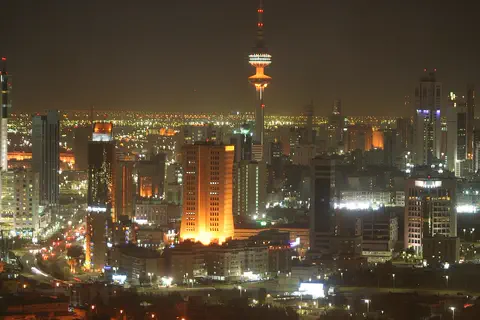
Kuwait City is the capital of Kuwait. It began as a town on the coast early in the 1700s and grew rich from caravans and pearl fishing. Today tall towers rise over the city, and summer days average highs near 47 °C.
-
 Watch
Landmark
Ur
Ur was a great city of Sumer, in the south of what is now Iraq, founded more than 5,000 years ago. Twice it was the capital of an empire. Archaeologists found royal tombs full of gold treasures, streets of brick houses and a huge stepped temple tower called a ziggurat. When the Euphrates River moved away, the fields dried up and the city was abandoned.
Explore next
-
Watch
 Country
Qatar
Qatar is a small desert country on a peninsula that pokes north into the Persian Gulf. Its people once lived by pearl diving and fishing; today it is one of the world's biggest exporters of natural gas. Its capital, Doha, has a skyline of towers, and about 3.2 million people lived in Qatar at the end of 2025.
-
Watch
City
Doha
Doha is the capital of Qatar, on the east coast of the Qatar peninsula. Its name means 'bay'. Doha was once a village of pearl divers and fishers; after oil was found, it grew into a city of towers, museums and metro lines. The 2020 census counted 1,186,023 people in Doha.
-
Watch
City
Kuwait City
Kuwait City is the capital of Kuwait. It began as a town on the coast early in the 1700s and grew rich from caravans and pearl fishing. Today tall towers rise over the city, and summer days average highs near 47 °C.
-
 Watch
Landmark
Abraj Al Bait
Abraj Al Bait is a group of seven hotel towers in Mecca, Saudi Arabia, beside the city's Great Mosque. In the middle rises the Makkah Royal Clock Tower, 601 meters tall to the tip of its spire, with a huge clock near the top. It was finished in 2012.
-
 Watch
Landmark
Agra Fort
Agra Fort is a huge red sandstone fortress beside the Yamuna River in Agra, India. The Mughal emperor Akbar began it in 1565. Its walls, about 2.5 kilometers around, protect palaces, halls and mosques added by later emperors. It was both an army base and a royal home.
-
 Watch
Landmark
Akashi Kaikyō Bridge
The Akashi Kaikyō Bridge is a suspension bridge almost 4 kilometers long that crosses the Akashi Strait between Kobe and Awaji Island in Japan. Its middle span is 1,991 meters. When it opened in 1998, it was the longest suspension bridge in the world.
-
 Watch
Landmark
Al-Aqsa Mosque
Al-Aqsa Mosque stands at the southern end of a huge raised plaza in the Old City of Jerusalem. Built in the early 700s, it has a silver-gray dome, and the golden Dome of the Rock stands nearby. The plaza is important to Muslims and to Jews.
-
 Watch
Landmark
Al-Masjid al-Haram
Al-Masjid al-Haram, the Great Mosque of Mecca in Saudi Arabia, was built around the Kaaba, a cube-shaped building that Muslims face when they pray. It is the most important place of pilgrimage in Islam. In 2026, 1,707,301 pilgrims came to Mecca for the hajj, and the mosque can hold up to about one million worshippers.
For parents & teachers
What children will learn
- Explain how sand can bury and protect an abandoned town.
- Describe how a town can live from both the sea and the desert.
- Explain how archaeologists learn from small objects such as weights and pottery.
Recommended ages: 4 to 17 · About 15 minutes
Talk about it
- Why might a town grow quickly around one valuable thing, like pearls?
- Why is it useful that only a small part of the town has been dug up?
- How could wind and rain damage walls once they are uncovered?
Try at home or in class
- Build small walls from sugar cubes in a tray, cover them with sand, then gently uncover them with a soft brush like an archaeologist.
- Find Qatar, Doha and Kuwait on a map.
Key vocabulary: pearl, archaeological site, coral limestone, dhow, hinterland, World Heritage Site
Where these facts come from
- Wikidata , Wikimedia Foundation (CC0 1.0)
- Al Zubarah Archaeological Site , UNESCO World Heritage Centre
- Advisory Body Evaluation: Al Zubarah Archaeological Site, No 1402rev , ICOMOS / UNESCO World Heritage Centre
- File:Ruins in Zubarah on a cloudy day.jpg , Wikimedia Commons
- UNESCO World Heritage List , UNESCO World Heritage Centre (Linked as a reference; site facts come from Wikidata)
- Wikimedia Commons , Wikimedia Foundation (Per file (public domain, CC0, CC BY or CC BY-SA); see each media record)
Checked, not yet human-reviewed. Last updated November 1, 2026. Spotted a mistake? Tell us.