
City Asia
Dubai
Dubai is a big city by the sea in the United Arab Emirates. It has the tallest building in the world. Little boats cross a creek in the old part of town.
Dubai is a city of the United Arab Emirates, on the coast of the Arabian Gulf with desert behind it. It began in 1833 as a small settlement beside a sheltered creek and grew from fishing, pearling and trade into a city of tall towers, including Burj Khalifa, the world's tallest building.
Dubai, capital of the emirate of Dubai, grew around a natural harbor, Dubai Creek, settled in 1833 by about 800 members of the Bani Yas led by the Maktoum family. Pearling and sea trade made it a port city by 1900; oil exports from 1969 were followed by rapid growth. Official figures put the emirate's population at 4,807,185 in September 2026.
Photo: Tim Reckmann from Hamm, Deutschland, CC BY-SA 3.0, via Wikimedia Commons
Discover Dubai
Dubai is a big city in the United Arab Emirates.
It is beside the sea, with sandy desert behind it. Very, very tall buildings rise up from the city.
Dubai is a city on the coast of the Arabian Gulf, in the United Arab Emirates. It is the capital of the emirate of Dubai, the second largest of the country's seven emirates. The emirate has sandy beaches on the coast, desert inland, and rocky valleys called wadis around Hatta.
Dubai is growing fast. Its official population count passed 4 million people in September 2025, and by September 2026 it had reached about 4.8 million. Its skyline is famous for Burj Khalifa, which at 828 meters is the tallest building in the world.
Dubai city, capital of the emirate of Dubai, lies on the Arabian Gulf coast of the Arabian Peninsula. The emirate covers 4,114 km², about 5 percent of the UAE excluding islands, and borders Abu Dhabi to the south, Sharjah to the northeast and Oman to the southeast. Its landscapes range from beaches in the west and a mangrove at the eastern end of the Creek to inland desert and the wadis of Hatta.
Dubai's official statisticians, now the Dubai Data and Statistics Establishment (part of Digital Dubai), count people who usually live in the emirate for at least six months, using administrative records and real-time data. Their count first passed 4 million in September 2025, reached 4,580,300 at the end of 2025 and stood at 4,807,185 on September 28, 2026; men made up 68.5 percent of residents in 2025.
- Country
- United Arab Emirates (capital of the emirate of Dubai)
- People in the emirate (September 2026 estimate)
- 4,807,185
- Area of the emirate
- 4,114 km²
- Founded
- 1833, beside Dubai Creek
Towers, sails and an old creek
Burj Khalifa is the tallest building in the whole world.
Another famous building looks like a giant sail. By the old creek, there are old markets.
Burj Khalifa rises 828 meters above Downtown Dubai. The Council on Vertical Urbanism, which ranks the world's tallest buildings, puts it first. It opened on January 4, 2010.
Another landmark is Burj Al Arab, a hotel shaped like a sail. The oldest part of the city lies along Dubai Creek, with Deira on one side and Bur Dubai on the other. Traditional markets, called souqs, stand near the abra stations, and small boats called abras cross between the two sides.
Burj Khalifa, inaugurated on January 4, 2010, is 828 m tall to its architectural top and ranks first in the world in the Council on Vertical Urbanism's height list. Its builders note that it passed Taipei 101 in roof height during construction.
The UAE government portal lists the sail-shaped Burj Al Arab hotel and the wadis of Hatta among the emirate's main attractions, and says the older districts are known as the 'Pearl of the Gulf' for their heritage and history. They lie along Dubai Creek, which divides Deira from Bur Dubai; popular traditional markets stand near the abra route.
- Burj Khalifa
- 828 m, opened January 4, 2010
- Burj Al Arab
- a sail-shaped hotel
- Dubai Creek
- the old harbor between Deira and Bur Dubai

From pearls to towers
Long ago, Dubai was a small village by a creek.
People went fishing and dove for pearls. Later, oil was found, and the village grew into a giant city.
Dubai was founded in 1833, when about 800 people of the Bani Yas tribe, led by the Maktoum family, settled beside Dubai Creek. The Maktoum family has ruled Dubai ever since. The Creek was a natural harbor, a sheltered place for boats, so Dubai became a center for fishing, pearling and sea trade. By the early 1900s it was a successful port city.
Oil was discovered in the 1960s, and Dubai first sold oil abroad in 1969. A time of very fast growth followed. In the 1980s and early 1990s Dubai decided to become a big destination for tourists.
The UAE government portal dates Dubai's establishment to 1833, when some 800 members of the Bani Yas tribe, led by the Maktoum family, settled by the Creek; the Al Maktoum have ruled since. The Creek's natural harbor supported fishing, pearling and maritime trade, and by the beginning of the 20th century Dubai was a successful port city.
The discovery of oil in the 1960s transformed the emirate: first exports in 1969 began a period of rapid development. Sheikh Rashid bin Saeed Al Maktoum ruled from 1958 to 1990. In the 1980s and early 1990s Dubai took a strategic decision to become an international tourism destination. Today the economy relies heavily on trade, services and finance.
Abras and the metro
In Dubai you can cross the creek in a little boat called an abra.
The trip takes about five minutes. You can also ride the metro, a train that runs across the city.
An abra is a traditional boat, and its name means "to cross" in Arabic. About 150 abras, each holding about 20 passengers, cross Dubai Creek between Deira and Bur Dubai, and each crossing takes about five minutes. Some abras now have air-conditioning.
The Dubai Metro has a Red Line and a Green Line. A new Blue Line, 30 kilometers long with 14 stations, is scheduled for 2029. It will cross Dubai Creek on a 1.3-kilometer bridge, the first metro bridge over the Creek.
Gulf News reported in 2024 that about 150 motorized abras, each carrying about 20 passengers, work the two routes between Deira and Bur Dubai from around 6 a.m., with crossings of about five minutes; a one-way trip cost Dh1, or Dh2 on an air-conditioned abra, and more than 17 million passengers a year used some form of water transport in Dubai.
The metro currently runs the Red and Green Lines. The Blue Line, which the Roads and Transport Authority scheduled for 2029, adds 30 km (15.5 km underground, 14.5 km above ground) and 14 stations, with interchanges to both lines and a 1.3 km bridge over Dubai Creek; Gulf News reported that it will take the network to 131 km and 78 stations.
- Abra
- a traditional boat; the word means 'to cross' in Arabic
- Crossing the Creek by abra
- about 5 minutes, about 20 passengers per boat
- Metro Blue Line (planned)
- 30 km and 14 stations, scheduled for 2029
Very hot summers, mild winters
Dubai is very hot in summer.
It hardly ever rains. Winter days are warm.
Dubai has a desert climate. At the World Meteorological Organization's Dubai station, July days averaged about 41 °C between 1974 and 1991, and even nights stayed near 29 °C. January is much milder, with days around 24 °C and nights around 14 °C.
Rain is rare: the whole year averages only about 94 millimeters, and from June to October the station recorded almost none at all. Most of the little rain falls between December and March.
WMO normals for Dubai (National Center of Meteorology, 1974–1991) give average highs and lows of about 24.0 °C and 13.7 °C in January and 40.6 °C and 28.9 °C in July; August nights average 29.3 °C, the warmest of the year.
The monthly averages sum to only about 94 mm. February is the wettest month at 35.7 mm, with 3.7 rain days, while June to October each average 0.0 mm. December to March together bring about 84 mm, nearly 90 percent of the year's rain.
- January, average daily high and low (WMO Dubai station, 1974–1991)
- about 24 °C and 14 °C
- July, average daily high and low (same station and period)
- about 41 °C and 29 °C
- Rain in a year (sum of the monthly averages)
- about 94 mm
Living in Dubai
Lots of people move to Dubai to live and work.
The city has shopping centers, old markets and sandy beaches.
Dubai's population counts both Emirati citizens and people from other countries who live and work there, and between January and late September 2026 alone the emirate gained more than 226,000 residents.
Today Dubai earns its living mainly from trade, services and finance. It is known for hotels, modern buildings, traditional markets, shopping centers and sports events, and visitors also go to the beaches and to the wadis, or rocky valleys, of Hatta.
Dubai's official estimates cover the emirate's residents, citizens and expatriates alike. The population grew by about 332,000 in 2025 and by 226,885 more between January 1 and September 28, 2026; men made up 68.5 percent of residents in 2025, more than two for every woman, and about 1.81 million people traveled into Dubai each day in 2025.
Once built on pearling and sea trade, then on oil, the economy now relies heavily on trade, services and finance. The government portal highlights hotels, modern architecture, traditional markets, shopping centers and sporting events, alongside heritage areas on the Creek and the wadis of Hatta.
- Economy
- trade, services and finance
- Growth, January to late September 2026
- 226,885 new residents
- Population count
- continuously updated by the Dubai Data and Statistics Establishment
Dubai on the map
Find Dubai on the globe.
It is on the edge of the Arabian Peninsula, beside a sea called the Arabian Gulf. Desert stretches out behind it.
Dubai is on the eastern coast of the Arabian Peninsula, on the Arabian Gulf. The emirate of Abu Dhabi lies to the south, Sharjah to the northeast and the country of Oman to the southeast.
Dubai Creek, an inlet of the sea, cuts into the old city. Deira lies on one side and Bur Dubai on the other, and newer districts such as Downtown Dubai spread out along the coast.
Dubai lies at about 25.2° N and 55.3° E, on the eastern coast of the Arabian Peninsula, on the Arabian Gulf. The emirate is bounded by Abu Dhabi to the south and Sharjah to the northeast, with an international border with Oman to the southeast; the government portal puts its elevation at roughly 16 m.
The Creek divides the historic city into Deira and Bur Dubai, with a mangrove at its eastern end; the emirate also takes in desert in the interior and west, and the wadis of the Hatta region.
- Latitude
- about 25.2° north
- Longitude
- about 55.3° east
- Neighbors
- Abu Dhabi, Sharjah and Oman
Amazing facts
-
The word abra means 'to cross', and abra boats cross Dubai's creek.
Dubai's creek boats are called abras, from an Arabic word meaning "to cross." A trip across the Creek takes about five minutes.
Abra means 'to cross' in Arabic; about 150 motorized abras, each holding about 20 passengers, link Deira and Bur Dubai in crossings of about five minutes (Gulf News, 2024).
-
Dubai's tallest tower is 828 meters high.
Burj Khalifa in Dubai is 828 meters tall and is ranked the tallest building in the world.
At 828 m to its architectural top, Burj Khalifa holds first place in the Council on Vertical Urbanism's world height ranking.
-
Dubai has a clock that counts how many people live there.
In September 2025, the Dubai Statistics Center's population clock passed 4 million people for the first time.
The Dubai Statistics Center's population clock gained 5,161 residents in a single week in September 2025, passing 4 million for the first time.
-
Long ago, people in Dubai dove into the sea to find pearls.
Before oil, Dubai's harbor on the Creek made it a center for fishing, pearling and sea trade.
Dubai Creek's natural harbor made the town a center of fishing, pearling and maritime trade, and a successful port city by the early 20th century.
Words to know
- emirate
- a land ruled by an emir; the United Arab Emirates is made of seven of them
- creek
- a narrow inlet where the sea reaches into the land
- harbor
- a sheltered stretch of water where boats can stay safely
- pearling
- diving into the sea to collect oysters that may hold pearls
- skyscraper
- a very tall building with many floors
- wadi
- a rocky valley in dry country that only has water after rain
Discovery challenge
-
Dubai is in which country?
Dubai is a city in which country?
Dubai is the capital of one of the seven emirates of which country?
- The United Arab Emirates
- Egypt
- India
Show the answer
The United Arab Emirates
The United Arab Emirates!
The United Arab Emirates, on the Arabian Gulf.
The United Arab Emirates; the country's capital is Abu Dhabi, and Dubai is the capital of the emirate of Dubai.
-
What is Burj Khalifa?
What is Burj Khalifa famous for?
Burj Khalifa, opened in 2010 at 828 m, holds which ranking?
- The tallest building in the world
- The longest bridge in the world
- The biggest park in the world
Show the answer
The tallest building in the world
It is the tallest building in the world!
At 828 meters, it is the tallest building in the world.
First in the Council on Vertical Urbanism's world height ranking.
-
What is an abra?
What is an abra in Dubai?
What is an abra, whose name means 'to cross' in Arabic?
- A small boat
- A desert animal
- A kind of bread
Show the answer
A small boat
A small boat! It crosses the creek.
A small boat that carries people across Dubai Creek in about five minutes.
A traditional boat; about 150 of them cross Dubai Creek between Deira and Bur Dubai.
-
What did people find in the sea near Dubai long ago?
Before oil, what did Dubai's people collect from the sea?
Along with fishing and sea trade, which activity made Dubai Creek's harbor important before oil?
- Pearls
- Gold bars
- Diamonds
Show the answer
Pearls
Pearls! They grow inside oysters.
Pearls; Dubai was a center for fishing, pearling and sea trade.
Pearling; oil exports only began in 1969.
-
Is Dubai wet or dry?
About how much rain falls in Dubai in an average year?
About how much rain does the Dubai station average in a year (WMO, 1974–1991)?
- About 94 mm
- About 940 mm
- About 2,000 mm
Show the answer
About 94 mm
Dry! It hardly ever rains.
About 94 millimeters, mostly between December and March.
About 94 mm, with February the wettest month at 35.7 mm.
Nearby places
-
Watch
Landmark
Burj Khalifa
Burj Khalifa in Dubai, United Arab Emirates, is 828 meters tall, the tallest building in the world (2026). It took about six years to build, from 2004 to 2010. Its Y-shaped plan, inspired by a desert flower, helps it stand up to strong winds.
-
 Watch
City
Abu Dhabi
Abu Dhabi is the capital of the United Arab Emirates. It began in the 1700s as a small settlement around fresh water on an island, guarded by a coral-stone watchtower. Before oil, it relied on fishing and pearl diving; since the 1960s, money from oil has turned it into a city of towers. An official estimate gave the city about 1.75 million people in 2023.
-
 Watch
City
Doha
Doha is the capital of Qatar, on the east coast of the Qatar peninsula. Its name means 'bay'. Doha was once a village of pearl divers and fishers; after oil was found, it grew into a city of towers, museums and metro lines. The 2020 census counted 1,186,023 people in Doha.
-
 Watch
City
Muscat
Muscat is the capital of Oman, on a notch of coast on the Gulf of Oman ringed by mountains. Muscat itself had 24,099 people at the 2020 census, but it is the heart of a much bigger city that stretches along the coast, with 1,302,440 people in Muscat Governorate.
-
 Watch
Landmark
Al Zubarah
Al Zubarah is the ruin of a walled town on the coast of Qatar. For about 50 years, in the late 1700s and early 1800s, it was a busy center for pearls and trade. After it was abandoned, desert sand covered and protected its houses, palaces and streets. It became a UNESCO World Heritage Site in 2013.
-
 Watch
Landmark
Persepolis
Persepolis was a royal city of the Persian kings. King Darius I began it around 518 BCE on a huge terrace at the foot of a mountain in southwestern Iran. Its palaces had very tall, slender columns and walls carved with long parades of people bringing gifts. It is a UNESCO World Heritage Site.
-
 Watch
City
Kuwait City
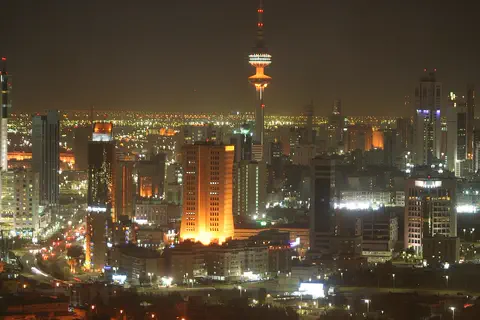
Kuwait City is the capital of Kuwait. It began as a town on the coast early in the 1700s and grew rich from caravans and pearl fishing. Today tall towers rise over the city, and summer days average highs near 47 °C.
-
 Watch
City
Riyadh
Riyadh is the capital and biggest city of Saudi Arabia, in the middle of the Arabian Peninsula. It grew from small villages with gardens into a city of tall towers. An old fort built of mud and hay stands in its center, and a new driverless metro opened in 2024. The 2022 census counted 6,924,566 people in the city.
Explore next
-
Watch
 Country
United Arab Emirates
The United Arab Emirates, or UAE, is a country of seven emirates on the Arabian Peninsula, on the Persian Gulf and the Gulf of Oman. Most of it is desert, and its cities, Abu Dhabi, Dubai and Sharjah, line the coast. Dubai has the Burj Khalifa, the world's tallest building.
-
Watch
Landmark
Burj Khalifa
Burj Khalifa in Dubai, United Arab Emirates, is 828 meters tall, the tallest building in the world (2026). It took about six years to build, from 2004 to 2010. Its Y-shaped plan, inspired by a desert flower, helps it stand up to strong winds.
-
Watch
City
Abu Dhabi
Abu Dhabi is the capital of the United Arab Emirates. It began in the 1700s as a small settlement around fresh water on an island, guarded by a coral-stone watchtower. Before oil, it relied on fishing and pearl diving; since the 1960s, money from oil has turned it into a city of towers. An official estimate gave the city about 1.75 million people in 2023.
-
Watch
City
Doha
Doha is the capital of Qatar, on the east coast of the Qatar peninsula. Its name means 'bay'. Doha was once a village of pearl divers and fishers; after oil was found, it grew into a city of towers, museums and metro lines. The 2020 census counted 1,186,023 people in Doha.
-
 Watch
City
Hong Kong
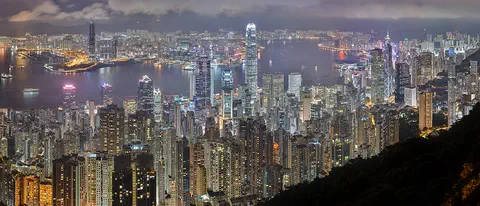
Hong Kong, on the south coast of China, grew around one of the world's great natural harbors. It was a British colony for 156 years and has been a special administrative region of China since 1997. About 7.5 million people lived there in mid-2026.
-
Watch
City
Kuwait City
Kuwait City is the capital of Kuwait. It began as a town on the coast early in the 1700s and grew rich from caravans and pearl fishing. Today tall towers rise over the city, and summer days average highs near 47 °C.
-
Watch
City
Muscat
Muscat is the capital of Oman, on a notch of coast on the Gulf of Oman ringed by mountains. Muscat itself had 24,099 people at the 2020 census, but it is the heart of a much bigger city that stretches along the coast, with 1,302,440 people in Muscat Governorate.
-
Watch
City
Riyadh
Riyadh is the capital and biggest city of Saudi Arabia, in the middle of the Arabian Peninsula. It grew from small villages with gardens into a city of tall towers. An old fort built of mud and hay stands in its center, and a new driverless metro opened in 2024. The 2022 census counted 6,924,566 people in the city.
For parents & teachers
What children will learn
- Locate Dubai on the Arabian Gulf coast of the United Arab Emirates.
- Describe how a natural harbor helped a small settlement grow into a port city.
- Explain how Dubai's economy changed from pearling and trade to oil and then to trade, services and finance.
- Read temperature and rainfall averages to describe a hot desert climate.
Recommended ages: 3 to 17 · About 15 minutes
Talk about it
- Dubai began beside a sheltered creek. Why do you think so many towns started next to water?
- Dubai gained about 332,000 residents in 2025. What does a city need to build when that many people arrive?
- Dubai gets only about 94 millimeters of rain a year. How do you think people stay cool and find water in a place like that?
Try at home or in class
- Measure out 94 millimeters on a ruler and compare it with your own town's yearly rainfall, if you can find it.
- Build a mini skyline from cardboard tubes and boxes, making one tower much taller than the rest, and label it with real heights in meters.
Key vocabulary: emirate, creek, harbor, pearling, skyscraper, wadi
Where these facts come from
- Wikidata , Wikimedia Foundation (CC0 1.0)
- Natural Earth vector data , Natural Earth (NACIS) (Public domain)
- Dubai , The Official Portal of the UAE Government (u.ae)
- Dubai records fastest population growth in its history, surpassing 4 million residents , Gulf News
- Burj Khalifa , Council on Vertical Urbanism, formerly CTBUH (The Skyscraper Center)
- The making of Burj Khalifa , Burj Khalifa (official site, Emaar)
- Explore Dubai's creek by abra: Deira Old Souq Station reopens , Gulf News
- Dubai Metro Blue Line guide: routes, stations, key features and opening date , Gulf News
- Dubai: climatological information , World Meteorological Organization, World Weather Information Service
- Dubai population rises by 226,885 since start of 2026 , Gulf News
- Abu Dhabi , The Official Portal of the UAE Government (u.ae)
- Wikimedia Commons , Wikimedia Foundation (Per file (public domain, CC0, CC BY or CC BY-SA); see each media record)
Checked, not yet human-reviewed. Last updated November 1, 2026. Spotted a mistake? Tell us.