City Asia
Kuwait City
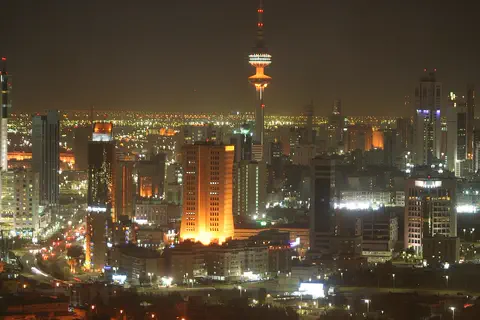
Kuwait City is the capital of Kuwait, a hot desert country by the sea. At night its tall towers glow with lights.
Kuwait City is the capital of Kuwait. It began as a town on the coast early in the 1700s and grew rich from caravans and pearl fishing. Today tall towers rise over the city, and summer days average highs near 47 °C.
Kuwait City, capital of Kuwait, was founded early in the 18th century and walled about 1750. It grew as a caravan stop and a pearl-fishing port. In the register-based 2021 census, the central place Al-Kuwayt had 55,159 people and the Capital Governorate around it 574,839.
Photo: Snap® from Kuwait, Kuwait, CC BY 2.0, via Wikimedia Commons
Discover Kuwait City
Kuwait City is the capital of Kuwait, a small desert country in Asia.
It sits by the sea. Lots of tall buildings stand in the city.
Kuwait City is the capital of Kuwait. Using the 2021 census of Kuwait's Central Statistical Office, City Population counts 55,159 people in the place called Al-Kuwayt (Kuwait City), and 574,839 in the Capital Governorate, whose capital it is.
The place listed as the southern suburbs of Kuwait City had 388,294 more, and the whole country had an estimated 4,913,271 people at the start of 2024.
City Population's tables, from Kuwait's Central Statistical Office, give the place Al-Kuwayt (Kuwait City) 28,747 people in 1995, 31,574 in 2005, 26,594 in 2011 and 55,159 in the 2021 census, which was register-based. The Capital Governorate (Al-'Āṣimah), whose capital is Al-Kuwayt, had 574,839, and the place listed as the southern suburbs of Kuwait City had 388,294.
Kuwait as a whole grew from 1,575,570 in the 1995 census to an estimated 4,913,271 on 1 January 2024.
- Country
- Kuwait (capital of the Capital Governorate, Al-'Āṣimah)
- People in Kuwait City, Al-Kuwayt (census, 30 June 2021)
- 55,159
- People in the Capital Governorate (census, 30 June 2021)
- 574,839
- People in all of Kuwait (estimate, 1 January 2024)
- 4,913,271
City lights
Look at all the lights! A very tall, thin tower stands in the middle, with round rings near the top.
Orange and white lights shine on the buildings below.
This night view of Kuwait City was taken on 8 June 2007. The camera stood about 12 kilometers east of the tall tower in the middle, looking west across the city.
The tower is a telecommunications tower, 372 meters tall, Wikidata says. Below it, a tall building glows orange, other towers shine white and blue, and the lights of the city spread far into the distance.
Commons file data: 'Kuwait cosmopolis - the night view', taken 8 June 2007 by the Flickr photographer Snap® from Kuwait; camera location 29.3488° N, 48.0988° E. Wikidata places the telecommunications tower (372 m) 12.2 km west of that point, at a bearing of 280°, which matches the tower at the center of the picture.
In the photo, the tower rises above a tall building lit orange, with white- and blue-lit towers to the right and a road streaked with car lights at the lower left.
- Photo
- a night view, taken on 8 June 2007
- The tall tower in the photo
- a telecommunications tower, 372 m tall
- Where the camera stood
- about 12 km east of the tall tower, looking west
From pearls and caravans
Long ago, Kuwait City was a town with a wall around it.
Its people sailed boats to fish for pearls, and caravans stopped there on long trips.
Universalis says the town of Kuwait was founded early in the 18th century. Around then, groups of the 'Utub tribe, among them the Sabah family, moved from central Arabia to the coast and settled at Kuwait. About 1750 Kuwait began to govern itself, and a wall was built around the town.
The town grew rich as a stop for caravans traveling between Arabia and the Fertile Crescent, and from its fleet of pearl-fishing boats.
Universalis (Droz-Vincent and Salamé) dates the town's founding to the early 18th century and its self-rule and town wall to about 1750. Under the long rule of Abdallah ibn Sabah (1764-1815), the imperial mail and part of the trade from India passed through Kuwait by the land route.
When he died, Universalis says, he left a town with nearly 800 pearl-fishing boats and a thriving caravan trade. From 1899 a series of agreements made Kuwait's ruler a protégé of Britain.
- Founded
- early in the 18th century
- Town wall
- built about 1750
- Pearl-fishing boats (1815)
- nearly 800
Very hot summers, short rains
Kuwait City is very, very hot in summer. In summer it almost never rains.
Winter is much cooler, and a little rain falls then.
The World Meteorological Organization's averages for Kuwait City (1994–2008) give July and August days an average high of almost 47 °C. January nights average 8.5 °C.
Only about 116 millimeters of rain fall in a year, mostly from November to April. From June to September the average rainfall is zero. Universalis says Kuwait's desert climate brings stifling heat from April to November and often violent sandstorms.
WMO World Weather Information Service, Kuwait City (station data 1994–2008): average highs from 19.5 °C in January to 46.7 °C in July and 46.9 °C in August; average lows from 8.5 °C in January to 30.7 °C in July. Rainfall totals 116.2 mm on about 22 days with at least 0.1 mm; January is the wettest month (30.2 mm), and June to September average 0.0 mm.
Universalis describes a desert climate with stifling heat between April and November and frequent violent sandstorms.
- August, average high (WMO, 1994–2008)
- 46.9 °C
- January, average low (same table)
- 8.5 °C
- Rain in a year
- 116.2 mm, on about 22 days
Towers and museums
Kuwait City has three towers by the sea, called the Kuwait Towers. It also has museums.
Many people from other countries live in Kuwait.
Wikidata describes the Kuwait Towers as a group of three towers standing on a point of land jutting into the sea, with a height of 187 meters, designed by Sune Lindström and Malene Bjørn. The Al Hamra Tower, a skyscraper 412 meters tall with 80 floors, opened in 2015.
Kuwait National Museum opened in 1983, and Sadu House is a museum and cultural center. Kuwait's statistics show that in 2024 more than two out of three people in the country held another country's citizenship.
Wikidata: Kuwait Towers, three towers on a promontory, height 187 m, architects Sune Lindström and Malene Bjørn; Al Hamra Tower, 412 m, 80 floors, opened 2015; Kuwait National Museum, opened 1983; Sadu House, a museum and cultural center.
City Population's 2024 estimate for the whole country (Central Statistical Office): 1,545,781 Kuwaiti citizens and 3,367,490 people of other citizenship; 3,021,216 males and 1,892,055 females.
- Kuwait Towers
- 187 m tall, designed by Sune Lindström and Malene Bjørn
- Al Hamra Tower
- a skyscraper 412 m tall, 80 floors, opened 2015
- Kuwait National Museum
- opened 1983
- People in Kuwait who are citizens of other countries (estimate, 2024)
- 3,367,490 of 4,913,271
Planes and a causeway
Big planes land at Kuwait International Airport, south of the city.
A causeway bridge opened in 2019.
Kuwait International Airport lies about 17 kilometers south of the Seif Palace. Wikidata counts 15,448,909 passengers there in 2019, up from 6,910,309 in 2007, and lists two runways. Its three-letter airport code is KWI.
The Sheikh Jaber al-Ahmad al-Sabah Causeway, a bridge, opened on 1 May 2019, Wikidata says. Its Wikidata point lies about 6 kilometers west of the Seif Palace.
Wikidata: Kuwait International Airport (KWI), 17.15 km S of the Seif Palace, elevation 63 m, runways 15R/33L and 15L/33R; passengers 6,910,309 (2007), 10,198,933 (2012), 15,448,909 (2019).
Sheikh Jaber al-Ahmad al-Sabah Causeway: a bridge, opened 1 May 2019; its Wikidata point lies about 6 km west of the Seif Palace.
- Kuwait International Airport
- about 17 km south of the Seif Palace, two runways
- Airport passengers (2019)
- 15,448,909
- Sheikh Jaber al-Ahmad al-Sabah Causeway
- a bridge, opened 1 May 2019
Kuwait City on the map
Find Kuwait on the globe, in the Middle East, by the sea. Kuwait City is on its coast.
Kuwait City lies at about 29.4° north, on Kuwait's coast. Measured from the Seif Palace, a historic palace, the Kuwait Towers stand about 3.3 kilometers to the east-northeast and the Al Hamra Tower about 2.1 kilometers to the east.
Kuwait International Airport is about 17 kilometers south of the palace.
Kuwait City lies at about 29.37° N and 47.98° E. From the Seif Palace (Wikidata points): Sadu House 0.8 km SSW, Kuwait National Museum 0.97 km SSW, Al Hamra Tower 2.11 km E, Kuwait Towers 3.26 km ENE, Kuwait International Airport 17.15 km S.
City Population lists Kuwait as 17,294 km², with six governorates.
- Latitude
- about 29.4° north
- Longitude
- about 48.0° east
- Kuwait International Airport
- about 17 km south of the Seif Palace
Amazing facts
-
Long ago, Kuwait had almost 800 boats for fishing pearls!
Universalis says that by 1815 the town of Kuwait had nearly 800 pearl-fishing boats.
Universalis: at Abdallah ibn Sabah's death in 1815 the town had nearly 800 pearl-fishing boats and a thriving caravan trade.
-
In summer it almost never rains in Kuwait City.
In the WMO's averages for Kuwait City, June, July, August and September each get 0.0 millimeters of rain.
WMO, Kuwait City (1994–2008): 0.0 mm average rainfall from June to September; May 0.4 mm, October 1.4 mm.
-
The Kuwait Towers stand on a point of land that sticks out into the sea.
Wikidata says the three Kuwait Towers stand on a point of land jutting into the sea, and gives them a height of 187 meters.
Wikidata: Kuwait Towers, a group of three towers on a promontory, 187 m, architects Sune Lindström and Malene Bjørn.
-
The Al Hamra Tower has 80 floors!
Wikidata gives the Al Hamra Tower a height of 412 meters and 80 floors; it opened in 2015.
Wikidata: Al Hamra Tower, skyscraper, 412 m, 80 floors, opened 2015, about 2.1 km east of the Seif Palace.
Words to know
- capital
- the city where a country's government is based
- governorate
- one of the big areas a country like Kuwait is divided into
- caravan
- a group of travelers and their animals crossing a desert together
- pearl
- a smooth, shiny gem that grows inside some oysters
- census
- an official count of the people living in a place
- telecommunications tower
- a tall tower that carries antennas for sending signals such as phone and TV
Discovery challenge
-
Kuwait City is the capital of which country?
Kuwait City is the capital of which country?
Kuwait City is the capital of which country, and of its Capital Governorate?
- Kuwait
- Egypt
- Morocco
Show the answer
Kuwait
Kuwait!
Kuwait.
Kuwait; the city is also the capital of the Capital Governorate, Al-'Āṣimah.
-
What did people in old Kuwait sail out to fish for?
Besides caravans, what helped the old town of Kuwait grow rich?
According to Universalis, Kuwait had nearly 800 boats for what kind of fishing by 1815?
- Pearls
- Whales
- Gold
Show the answer
Pearls
Pearls!
Its fleet of pearl-fishing boats.
Pearl fishing: nearly 800 boats.
-
What is summer like in Kuwait City?
About how hot are August days in Kuwait City on average?
What is the August average high in the WMO's Kuwait City table (1994–2008)?
- Very hot, almost 47 °C
- Snowy, below 0 °C
- Cool, about 15 °C
Show the answer
Very hot, almost 47 °C
Very, very hot!
Almost 47 °C.
46.9 °C.
-
How tall is the Al Hamra Tower?
How tall is Kuwait City's Al Hamra Tower?
Wikidata gives the Al Hamra Tower (80 floors, opened 2015) what height?
- 40 meters
- 412 meters
- 4,120 meters
Show the answer
412 meters
412 meters!
412 meters, with 80 floors.
412 m.
-
Long ago, what did people build around the town of Kuwait?
What was built around the town of Kuwait about 1750?
About 1750, when Kuwait began to govern itself, what was built around the town?
- A canal
- A wall
- A railway
Show the answer
A wall
A wall!
A town wall.
A town wall (Universalis).
Nearby places
-
 Watch
Landmark
Ur
Ur was a great city of Sumer, in the south of what is now Iraq, founded more than 5,000 years ago. Twice it was the capital of an empire. Archaeologists found royal tombs full of gold treasures, streets of brick houses and a huge stepped temple tower called a ziggurat. When the Euphrates River moved away, the fields dried up and the city was abandoned.
-
 Watch
Landmark
Susa
Susa, in southwest Iran, is one of the most ancient places where towns first grew. People built there from more than 6,000 years ago until about 800 years ago, one town on top of another. It was the capital of the Elamites and later of the Persian king Darius I, whose great palace still lies in ruins there.
-
 Watch
Landmark
Persepolis
Persepolis was a royal city of the Persian kings. King Darius I began it around 518 BCE on a huge terrace at the foot of a mountain in southwestern Iran. Its palaces had very tall, slender columns and walls carved with long parades of people bringing gifts. It is a UNESCO World Heritage Site.
-
 Watch
Landmark
Al Zubarah
Al Zubarah is the ruin of a walled town on the coast of Qatar. For about 50 years, in the late 1700s and early 1800s, it was a busy center for pearls and trade. After it was abandoned, desert sand covered and protected its houses, palaces and streets. It became a UNESCO World Heritage Site in 2013.
-
 Watch
Landmark
Babylon
Babylon was one of the most famous cities of the ancient world, beside the Euphrates River in what is now Iraq. Kings like Hammurabi and Nebuchadnezzar II ruled from here. Today its ruins are a UNESCO World Heritage Site, and about 85 percent of it has never been dug up.
-
 Watch
City
Isfahan
Isfahan is one of Iran's main cities, in the center of the country. Its great public square, built in the early 1600s, is a UNESCO World Heritage site, with rows of shops in arcades on every side. Iran's 2016 census counted 1,961,260 people in the city.
-
 Watch
Landmark
Naqsh-e Jahan Square
Naqsh-e Jahan Square in Isfahan, Iran, was built by Shah Abbas I of the Safavid dynasty in the early 1600s. It is 560 meters long and 160 meters wide, with shops in two-story arcades and a grand building on each side. UNESCO listed it as a World Heritage Site in 1979.
-
 Watch
City
Riyadh
Riyadh is the capital and biggest city of Saudi Arabia, in the middle of the Arabian Peninsula. It grew from small villages with gardens into a city of tall towers. An old fort built of mud and hay stands in its center, and a new driverless metro opened in 2024. The 2022 census counted 6,924,566 people in the city.
Explore next
-
Watch
 Country
Kuwait
Kuwait is a small desert country at the top of the Persian Gulf, between Iraq and Saudi Arabia. It grew from a trading town on Kuwait Bay into a modern country after oil was found. About 4.9 million people live there, most of them in and around Kuwait City.
-
Watch
City
Riyadh
Riyadh is the capital and biggest city of Saudi Arabia, in the middle of the Arabian Peninsula. It grew from small villages with gardens into a city of tall towers. An old fort built of mud and hay stands in its center, and a new driverless metro opened in 2024. The 2022 census counted 6,924,566 people in the city.
-
 Watch
City
Doha
Doha is the capital of Qatar, on the east coast of the Qatar peninsula. Its name means 'bay'. Doha was once a village of pearl divers and fishers; after oil was found, it grew into a city of towers, museums and metro lines. The 2020 census counted 1,186,023 people in Doha.
-
 Watch
City
Dubai
Dubai is a city of the United Arab Emirates, on the coast of the Arabian Gulf with desert behind it. It began in 1833 as a small settlement beside a sheltered creek and grew from fishing, pearling and trade into a city of tall towers, including Burj Khalifa, the world's tallest building.
-
Watch
Landmark
Al Zubarah
Al Zubarah is the ruin of a walled town on the coast of Qatar. For about 50 years, in the late 1700s and early 1800s, it was a busy center for pearls and trade. After it was abandoned, desert sand covered and protected its houses, palaces and streets. It became a UNESCO World Heritage Site in 2013.
-
 Watch
City
Abu Dhabi
Abu Dhabi is the capital of the United Arab Emirates. It began in the 1700s as a small settlement around fresh water on an island, guarded by a coral-stone watchtower. Before oil, it relied on fishing and pearl diving; since the 1960s, money from oil has turned it into a city of towers. An official estimate gave the city about 1.75 million people in 2023.
-
 Watch
City
Almaty
Almaty is the main city of Kazakhstan, in the southeast of the country at the foot of the Ala-Tau mountains. It was founded in 1854 where a Kazakh village called Almaty, 'village of apple trees', stood. It was the capital until 1998, and about 2,387,900 people lived there on 1 September 2026.
-
 Watch
City
Amman
Amman is the capital of Jordan, built on steep hills around a valley high on a plateau. Long ago it was a Roman city called Philadelphia, and its Roman theater, carved into a hillside, still holds about 6,000 people. Today the city spreads across the hills, with houses faced in pale stone. About 4.6 million people lived in Amman Governorate at the end of 2021.
For parents & teachers
What children will learn
- Locate Kuwait City on the coast of Kuwait, between Iraq and Saudi Arabia.
- Explain how caravan trade and pearl fishing helped an early town grow.
- Read a climate table and find the hottest and wettest months.
- Compare a city's population with its governorate's and its country's.
Recommended ages: 3 to 17 · About 15 minutes
Talk about it
- Kuwait City's central place had 55,159 people in 2021, but its governorate had 574,839. Why might a city be counted in different ways?
- From June to September it hardly ever rains in Kuwait City. How might people plan for water in such a dry place?
- Pearl fishing once helped Kuwait grow rich. What other jobs might people do in a town by the sea?
Try at home or in class
- Climate chart: plot Kuwait City's monthly average highs and rainfall, and mark the hottest and wettest months.
- Population bars: draw bars for Al-Kuwayt, the Capital Governorate and all of Kuwait, and compare their sizes.
- Skyline drawing: draw a city skyline at night with a tall tower in the middle and lit windows below.
Key vocabulary: capital, governorate, caravan, pearl, census, telecommunications tower
Where these facts come from
- Wikidata , Wikimedia Foundation (CC0 1.0)
- Natural Earth vector data , Natural Earth (NACIS) (Public domain)
- Kuwait: Governorates & Major Places , City Population (Thomas Brinkhoff), from the Central Statistical Office, State of Kuwait
- Koweït , Encyclopaedia Universalis (Philippe Droz-Vincent, Ghassan Salamé)
- Kuwait City: climatological information , World Meteorological Organization, World Weather Information Service (Meteorological Department, Kuwait)
- File:Kuwait cosmopolis - don't miss the details - zoom in (540280595).jpg (Snap® from Kuwait, 8 June 2007) , Wikimedia Commons
- Wikimedia Commons , Wikimedia Foundation (Per file (public domain, CC0, CC BY or CC BY-SA); see each media record)
Checked, not yet human-reviewed. Last updated November 1, 2026. Spotted a mistake? Tell us.