
City Asia
Ankara
Ankara is the capital city of Türkiye. It sits far from the sea, with an old castle on a hill.
Ankara is the capital of Türkiye, in the interior of Anatolia, about 200 kilometers from the Black Sea. People have lived here since the Stone Age, and Romans, Byzantines, Seljuks and Ottomans all left buildings behind. It became the capital in 1923, and today it is a city of government, universities and museums.
Ankara, capital of Türkiye since 1923, lies in the northwestern part of the country, about 200 km south of the Black Sea. Inhabited since the Stone Age, a Phrygian town by the end of the 2nd millennium BCE and part of the Roman Empire from 25 BCE, it grew into a seat of government, Türkiye's second industrial city and home to the Museum of Anatolian Civilizations.
Photo: Jorge Franganillo from Barcelona, Spain, CC BY 2.0, via Wikimedia Commons
Discover Ankara
Ankara is the capital city of Türkiye.
It is far from the sea. Red roofs cover the hills. At night, the city glows with lights.
Ankara is the capital of Türkiye. It lies in the northwestern part of the country, in the interior of the region called Anatolia, about 200 kilometers south of the Black Sea. Three streams meet near the city.
Ankara is where Türkiye's government works, and it is also the country's second most important city for industry, after Istanbul. About 5.8 million people lived in the whole of Ankara Province in 2023. From the hills, you can look out over red-tiled roofs, tall apartment blocks and mosques.
Ankara lies in the northwestern part of Türkiye, about 200 km south of the Black Sea, near the meeting of the Hatip, İnce Su and Çubuk streams. It is a major crossroads of trade, a junction of the national road network and a station on the main east-west railway across Anatolia.
Government is the city's main business, but Ankara is also Türkiye's second industrial city after Istanbul. Britannica's 2013 estimate put the city at 4,417,522 people, up from 3,203,362 at the 2000 census; the whole of Ankara Province, which reaches far beyond the city, had 5,803,482 people in 2023.
- Country
- Türkiye (capital)
- People in Ankara Province (2023)
- about 5.8 million
- Capital since
- 1923
- Distance from the Black Sea
- about 200 km
Famous places
On a hill in Ankara stands an old castle with thick walls.
You can climb it and see the whole city! Nearby is a museum full of treasures made by people thousands of years ago.
Ankara's old castle, or citadel, sits on a hill in the old part of the city, and visitors climb to the top for a view over the rooftops. Near it are the ruins of a Roman temple and a Roman bath, the Seljuk-era Alâeddin Mosque, and the Hacı Bayram Mosque, built in 1427–28.
The Museum of Anatolian Civilizations is in two Ottoman buildings, an old covered market and an inn. It shows objects from the Stone Age to Roman times, with a world-famous collection from the Hittites, and in 1997 it was named European Museum of the Year. The modern city has the huge Atatürk Mausoleum, Anıtkabir.
Ankara's architecture records its layered past: Roman remains include a bath, the Column of Julian and the Temple of Augustus; the citadel and a cemetery survive from the Byzantine city; the square, single-minaret Alâeddin Mosque near the walled citadel dates from the Seljuk era; and Ottoman buildings include the Hacı Bayram Mosque (1427–28).
Two 15th-century Ottoman buildings near the castle, the Mahmut Paşa covered bazaar and the Kurşunlu Han, were restored between 1938 and 1968 to house the Museum of Anatolian Civilizations, which grew from a museum for Hittite works set up in 1921. Its chronological galleries run from the Paleolithic through the Assyrian trade colonies, the Hittites, Phrygians and Urartians to the Classical periods; it was named European Museum of the Year in 1997. The modern city contains the huge Atatürk Mausoleum complex, whose Atatürk Museum displays many of his personal belongings.
- Hacı Bayram Mosque
- 1427–28
- Museum of Anatolian Civilizations
- European Museum of the Year, 1997
- Atatürk Mausoleum (Anıtkabir)
- a huge memorial complex with a museum
From ancient town to capital
People have lived in Ankara since the Stone Age.
Long ago, traders' caravans passed through on their way east. In 1923, Ankara became the capital of a new country, Türkiye.
Nobody knows exactly when Ankara was founded, but people have lived here since the Stone Age. About 3,000 years ago it was a busy town of a people called the Phrygians. Alexander the Great took it in 333 BCE, and in 25 BCE it became part of the Roman Empire.
Later, Byzantines, Seljuk Turks and Ottomans ruled Ankara. It grew important again because it stood on the caravan route to the East. After World War I, Mustafa Kemal Atatürk made Ankara his headquarters in 1919, and in 1923 it became the capital of the new Republic of Türkiye.
The date of Ankara's founding is uncertain; archaeology shows habitation since at least the Stone Age, and a thriving Phrygian town stood here at the end of the 2nd millennium BCE. Alexander the Great took it in 333 BCE; in the 3rd century BCE it was the capital of the Tectosages, a tribe of Galatia; and in 25 BCE Augustus incorporated it into the Roman Empire.
A Byzantine city attacked by Persians and Arabs, it fell to the Seljuk Turks about 1073, was retaken by the Crusader Raymond IV of Toulouse in 1101, and was then contested among Seljuk princes and Turkish frontier lords. The Ottoman sultan Orhan captured it in 1354; after Timur's campaign it returned to Ottoman rule in 1403 and regained importance on the caravan route east. After World War I, Mustafa Kemal Atatürk made Ankara the center of the nationalist movement, opposing both the Ottoman sultan's government and Greek forces, with his headquarters there from 1919. Ankara was declared the capital in 1923, and on October 29, 1923, the assembly declared Türkiye a republic with Mustafa Kemal as its first president.
Getting around Ankara
Many roads meet in Ankara.
Trains rush across the country through the city. Airplanes fly from an airport outside town.
Ankara sits at a crossroads. Many of Türkiye's main roads meet here, and the main railway that runs east and west across Anatolia passes through the city.
For hundreds of years, Ankara has been a stop on trade routes: in Ottoman times, caravans heading east passed through. Today, Esenboğa Airport, northeast of the city, has flights to other countries.
Ankara is an important crossroads for trade and a major junction of Türkiye's road network; it lies on the main east-west rail line across Anatolia, and Esenboğa Airport, to the northeast, provides international services.
That role is old. After it returned to Ottoman rule in 1403, Ankara regained its importance as a commercial and urban center because of its position on the caravan route to the East. Today Ankara is still described by Britannica as a major junction of the national road network.
- Airport
- Esenboğa, to the northeast
- Railway
- on the main east-west line across Anatolia
- Roads
- a major junction of Türkiye's road network
Weather and seasons
Ankara has cold winters with freezing nights.
Summers are hot and sunny, with very little rain. Spring is the rainiest time.
Ankara, far from the sea, has cold winters and hot, dry summers. In January, days average about 4 °C and nights about −4 °C. In July, days average about 30 °C and nights about 15 °C.
Only about 383 millimeters of rain and snow falls in a whole year. May is the wettest month, and July and August are the driest, with rain on only a few days.
World Meteorological Organization normals for 1926–2000 give mean daily maxima and minima of 4.1 °C and −3.5 °C in January and 29.9 °C and 15.4 °C in July, a seasonal swing of about 26 °C in daytime highs.
Monthly precipitation totals add up to about 383 mm a year, peaking in May (51 mm) and December (46 mm) and falling to 11 mm in August, when precipitation days average just over two.
- January, average daily high and low
- about 4 °C and −4 °C
- July, average daily high and low
- about 30 °C and 15 °C
- Rain and snow in a year
- about 383 mm
Living in Ankara
Ankara has big universities where young people study.
Families visit museums and the castle. They go to concerts by a big orchestra and to plays at the theater.
Many people in Ankara work for the government, but the city also has factories that make flour, sugar, pasta, biscuits, milk, cement and tractors. More and more people work in services and tourism.
Ankara is a city of students. Ankara University, Middle East Technical University and Hacettepe University were all founded between 1946 and 1967. The National Library is here, and families can enjoy the state theater, the Presidential Symphony Orchestra and museums such as the Ethnographic Museum, about Turkish history, folk traditions and art.
Ankara's factories produce wine and beer, flour, sugar, macaroni, biscuits, milk, cement, terrazzo, construction materials and tractors, and service and tourist industries are growing fast. Higher education is a major presence: the University of Ankara (1946), Middle East Technical University (1956) and Hacettepe University (1967).
The National Library, the state theater and the Presidential Symphony Orchestra are based here. Several museums are housed in renovated Ottoman buildings, presenting a panorama of Anatolian history: above all the Museum of Anatolian Civilizations, with its renowned Hittite collection, and the Ethnographic Museum, devoted to Turkish history, folklore and art.
- Ankara University
- established 1946
- Middle East Technical University
- established 1956
- Hacettepe University
- established 1967
Ankara on the map
Find Ankara on the globe.
Look for Türkiye, between the Black Sea and the Mediterranean Sea. Ankara is in the north part of the country, but not on the coast.
Ankara is in the northwestern part of Türkiye, in the Anatolian interior, far from any coast. The Black Sea is about 200 kilometers to the north, and three streams, the Hatip, the İnce Su and the Çubuk, meet near the city.
Istanbul is to the northwest, on the Bosporus. Ankara is in Asia, and many of Türkiye's main roads, and its main railway across Anatolia from east to west, pass through it.
Ankara lies at about 39.9° N and 32.9° E in the northwestern part of Türkiye, about 200 km south of the Black Sea, where the Hatip, İnce Su and Çubuk streams meet.
The old city lies around the walled citadel, with the Seljuk-era Alâeddin Mosque nearby, the Hacı Bayram Mosque and the Temple of Augustus just to the northwest, and the Museum of Anatolian Civilizations below the castle. The Atatürk Mausoleum stands farther southwest, in the modern city.
- Latitude
- about 39.9° north
- Longitude
- about 32.9° east
- Region
- Anatolia
Amazing facts
-
Ankara's great museum is inside an old market and an old inn.
The Museum of Anatolian Civilizations is housed in two Ottoman buildings: a covered market and an inn.
The Mahmut Paşa covered bazaar and the Kurşunlu Han, restored between 1938 and 1968, now house the Museum of Anatolian Civilizations.
-
Ankara's museum once won a prize as the best in Europe.
In 1997 the Museum of Anatolian Civilizations was named European Museum of the Year.
The Museum of Anatolian Civilizations, famous for its Hittite collection, received the European Museum of the Year title in 1997.
-
Ankara became the capital about 100 years ago.
Ankara was declared the capital of Türkiye in 1923, the same year Türkiye became a republic.
Mustafa Kemal set up his headquarters in Ankara in 1919; it was declared the capital in 1923, the year the assembly proclaimed the republic (October 29).
-
Ankara has ruins of a Roman bath.
More than 2,000 years ago, Ankara joined the Roman Empire. You can still see a Roman bath and temple there.
Incorporated into the Roman Empire by Augustus in 25 BCE, Ankara keeps a Roman bath, the Column of Julian and the Temple of Augustus.
Words to know
- capital
- the city where a country's government meets
- plateau
- a large area of high, fairly flat land
- citadel
- a fortress on high ground protecting a city
- caravan
- a group of traders traveling together, often with camels
- mausoleum
- a large building that holds the tomb of an important person
- museum
- a building where important objects are kept and shown to visitors
- republic
- a country whose leaders are chosen by the people instead of a king, queen or sultan
Discovery challenge
-
Which country is Ankara the capital of?
Ankara is the capital of which country?
Since 1923, Ankara has been the capital of which country?
- Türkiye
- Greece
- Egypt
Show the answer
Türkiye
Türkiye! Ankara is far from the sea.
Türkiye. Ankara is in the Anatolian interior.
Türkiye, declared a republic on October 29, 1923.
-
What old building sits on a hill in Ankara?
What stands on the hill in Ankara's old town, with views over the city?
Which Byzantine-era structure survives on the hill at the heart of old Ankara?
- A castle
- A lighthouse
- A windmill
Show the answer
A castle
A castle! You can climb it and look around.
The castle, or citadel, with a panoramic view from the top.
The citadel, with the Seljuk-era Alâeddin Mosque nearby.
-
What can you see in Ankara's big museum?
Which ancient people is the Museum of Anatolian Civilizations especially famous for?
The Museum of Anatolian Civilizations was begun in 1921 as a museum for the works of which civilization?
- The Hittites
- The Vikings
- The Aztecs
Show the answer
The Hittites
Treasures of the Hittites, who lived long, long ago!
The Hittites. Its Hittite collection is world-famous.
The Hittites; Hittite works were gathered from across the country.
-
Who lived in Ankara more than 2,000 years ago?
Ankara joined which empire in 25 BCE?
Which emperor incorporated Ankara into the Roman Empire in 25 BCE?
- Augustus (the Romans)
- Napoleon (the French)
- Charlemagne (the Franks)
Show the answer
Augustus (the Romans)
The Romans! They built a bath there.
The Roman Empire, under the emperor Augustus.
Augustus, in 25 BCE.
Nearby places
-
 Watch
Landmark
Topkapı Palace
Topkapı Palace sits on a point of land where the Bosphorus Strait meets the sea in Istanbul. Sultan Mehmed II built it between 1460 and 1478, and for nearly 400 years it was the home of the Ottoman sultans and the center of their government. In 1924 it became a museum.
-
 Watch
Landmark
Hagia Sophia
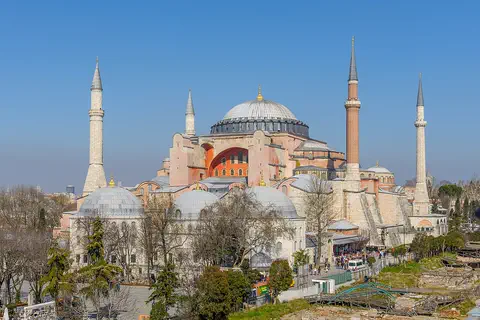
Hagia Sophia in Istanbul was built in under six years, from 532 to 537, for the emperor Justinian. Its enormous dome seems to float on a ring of 40 windows. Over almost 1,500 years it has been a church, a mosque and a museum, and since 2020 it has been a mosque.
-
 Watch
Landmark
Sultan Ahmed Mosque
The Sultan Ahmed Mosque in Istanbul was built between 1609 and about 1616 for the Ottoman ruler Sultan Ahmed I. Its central dome is ringed by half-domes and smaller domes, and six slender minarets rise around it. Many people call it the Blue Mosque because of the blue and green tiles and painted decoration inside. It is still a working mosque, where Muslims come to pray.
-
 Watch
City
Istanbul
Istanbul is the biggest city in Türkiye, built on both sides of the Bosporus, the narrow strait between Europe and Asia. Once called Byzantium and then Constantinople, it was the capital of two great empires. About 15.7 million people lived in Istanbul province in 2023.
-
 Watch
Natural wonder
Pamukkale
Pamukkale, in southwestern Türkiye, is a hillside of bright white terraces and pools built by warm spring water. The water is full of a dissolved mineral called calcium carbonate, and as it flows over the slope it leaves the mineral behind as a rock called travertine. Its name means "cotton castle". On top stand the ruins of Hierapolis, an ancient spa town.
-
 Watch
Landmark
Temple of Artemis at Ephesus
The Temple of Artemis at Ephesus was one of the Seven Wonders of the ancient world. It was rebuilt several times, and its 6th-century BCE version was more than 300 feet long. After a fire in 356 BCE it was built again just as big. Today only scattered stones and one column remain.
-
 Watch
Landmark
Ephesus
Ephesus was a great Greek and Roman city on the west coast of what is now Türkiye. Its ruins include ancient streets, a theater for nearly 25,000 people and the Library of Celsus, whose two-story front has been rebuilt. Archaeologists have been digging there since 1895.
-
 Watch
Landmark
Mausoleum at Halicarnassus
The Mausoleum at Halicarnassus was the tomb of Mausolus, ruler of Caria, in what is now southwestern Turkey. Built around 353 to 351 BCE, it was covered in sculptures by four famous Greek artists and became one of the Seven Wonders of the World. An earthquake probably brought it down, and its stones went into other buildings, but its name lives on in the word 'mausoleum'.
Explore next
-
 Watch
 Country
Türkiye (Turkey)
Türkiye, also called Turkey, lies partly in Asia and partly in Europe. A narrow waterway called the Bosporus runs through its biggest city, Istanbul, and its land is mostly mountains and high plains. About 86 million people live there.
-
Watch
City
Istanbul
Istanbul is the biggest city in Türkiye, built on both sides of the Bosporus, the narrow strait between Europe and Asia. Once called Byzantium and then Constantinople, it was the capital of two great empires. About 15.7 million people lived in Istanbul province in 2023.
-
 Watch
City
Damascus
Damascus, the capital of Syria, grew beside a river in a green oasis at the edge of the desert. People have lived there for thousands of years, and many scholars think it may be the oldest city in the world that has been lived in all the time. Its walled Old City, with its Great Mosque, markets and courtyard houses, is a UNESCO World Heritage Site.
-
 Watch
City
Athens
Athens is the capital of Greece and one of the oldest cities in the world. Above it rises the Acropolis, a rocky hill crowned by the marble Parthenon, built about 2,500 years ago. Ancient Athens was home to early democracy, great thinkers and theater.
-
Watch
Landmark
Hagia Sophia
Hagia Sophia in Istanbul was built in under six years, from 532 to 537, for the emperor Justinian. Its enormous dome seems to float on a ring of 40 windows. Over almost 1,500 years it has been a church, a mosque and a museum, and since 2020 it has been a mosque.
- Watch Geography Villages, towns and cities A place where people live together is called a settlement. A village is a small settlement, often in the countryside. A town is bigger than a village but smaller than a city. A city is a large place with many people, buildings, roads and jobs. In 2025, the United Nations reported that 45 percent of the world's people live in cities.
-
 Watch
City
Baghdad
Baghdad, the capital of Iraq, stands on the Tigris River in the land once called Mesopotamia. It was founded in 762 as a round city, and for about 500 years it was one of the greatest cities in the world and a great center of learning, where scholars studied math, medicine and the stars. Today it is Iraq's largest city.
-
 Watch
City
Baku
Baku, the capital of Azerbaijan, curves around a bay on the Caspian Sea, the world's largest inland body of water. Its old walled town, with the Maiden Tower and a palace of the Shirvan shahs, is a World Heritage Site, and oil has made the city important for more than 150 years.
For parents & teachers
What children will learn
- Locate Ankara in the Anatolian interior of Türkiye.
- Describe how many peoples, from Phrygians to Ottomans, left their mark on one city.
- Explain why a country might choose an inland city as its capital.
- Compare winter and summer temperatures in a city far from the sea.
Recommended ages: 3 to 17 · About 15 minutes
Talk about it
- Ankara's great museum is inside an old market and inn. What old building near you could become something new?
- Why might a city far from the coast make a good capital?
- Ankara has Roman, Byzantine, Seljuk and Ottoman buildings. Which would you visit first, and why?
Try at home or in class
- Make a 'museum timeline' on a long strip of paper, drawing one object for each age from the Stone Age to today.
- Fill two cups with water, put one in a sunny window and one in a cool spot, and compare the temperatures, like summer and winter.
Key vocabulary: capital, plateau, citadel, caravan, mausoleum, museum, republic
Where these facts come from
- Wikidata , Wikimedia Foundation (CC0 1.0)
- Natural Earth vector data , Natural Earth (NACIS) (Public domain)
- Ankara , Encyclopaedia Britannica
- Turkey: declaration of the Turkish republic , Encyclopaedia Britannica
- Anatolian Civilizations Museum , Republic of Türkiye Ministry of Culture and Tourism (muze.gov.tr)
- Ankara: climatological information , World Meteorological Organization, World Weather Information Service
- Wikimedia Commons , Wikimedia Foundation (Per file (public domain, CC0, CC BY or CC BY-SA); see each media record)
Checked, not yet human-reviewed. Last updated October 27, 2026. Spotted a mistake? Tell us.