
City Asia
Doha
Doha is the capital of Qatar. It is a city of tall towers beside a bay of blue-green water.
Doha is the capital of Qatar, on the east coast of the Qatar peninsula. Its name means 'bay'. Doha was once a village of pearl divers and fishers; after oil was found, it grew into a city of towers, museums and metro lines. The 2020 census counted 1,186,023 people in Doha.
Doha, whose Arabic name Ad-Dawhah means 'the bay', grew from a pearling and fishing village into the capital of Qatar, chosen at independence in September 1971. Oil wealth after the Second World War rebuilt the city. The census of 31 December 2020 counted 1,186,023 people in Doha municipality, about two-fifths of Qatar's 2,846,118.
Photo: Francisco Anzola, CC BY 2.0, via Wikimedia Commons
Discover Doha
Doha is a big city by the sea. It is the capital of Qatar.
Qatar is a country in the desert, with water on three sides.
Doha is the capital of Qatar, a country on a peninsula. The city curves around a shallow bay on Qatar's east coast, and its Arabic name, Ad-Dawhah, means 'the bay'.
Qatar's 2020 census counted 1,186,023 people in Doha municipality. That is about two out of every five people in the whole country.
Encyclopaedia Universalis places Doha on the east coast of the Qatar peninsula, around a shallow bay about 5 km across from east to west, and says it has long been a port of local importance.
City Population's table from the Planning and Statistics Authority gives 1,186,023 people in Doha municipality at the census of 31 December 2020, out of 2,846,118 in Qatar (about 42%). The next municipality, Al Rayyan, had 826,786. Doha had 234,753 people at the 1986 census, so it grew about fivefold in 34 years.
- Country
- Qatar (its capital)
- People in Doha municipality (census, 31 December 2020)
- 1,186,023
- People in Qatar (same census)
- 2,846,118
- Meaning of the name
- Ad-Dawhah, 'the bay'
Towers, a desert rose and an island
Doha has lots of very tall towers with fun shapes.
Its national museum is shaped like a desert rose, a crystal that grows in the sand.
In the hero photo, a long row of towers rises along the shore across the water, some round, some twisted and some covered in a diamond pattern.
The National Museum of Qatar was designed by the architect Jean Nouvel. Its shape copies the desert rose, a natural crystal formation found in Qatar's desert, and it wraps around a historic palace. Its galleries cover more than 430,000 square feet and tell Qatar's story.
Visit Qatar describes the National Museum's design as inspired by Qatar's natural desert rose formations, surrounding the historic Palace of Sheikh Abdullah bin Jassim Al-Thani, a former residence 'that once guided Qatar's future'. Its highlights include the Pearl Carpet of Baroda; the museum stands off the Doha Corniche, by the National Museum metro station on the Gold Line.
Universalis names West Bay Lagoon, Lusail City and the artificial island of The Pearl-Qatar as large housing projects near Doha that show how fast the capital has grown.
- National Museum of Qatar
- designed by Jean Nouvel, inspired by the desert rose
- Museum galleries
- more than 430,000 square feet (about 40,000 m²)
- The Pearl-Qatar
- an artificial island of homes near Doha
From pearls to oil
Long ago, people in Doha dove into the sea to find pearls. They also caught fish.
Later, oil was found, and Doha grew into a big city.
For a long time Doha was a small village that lived from pearling and fishing. In the early 1900s it still had nearly 350 pearling boats. Then cultured pearls from Japan and a world economic crisis in the 1930s hit the town hard.
After the Second World War, oil changed everything. Qatar became very wealthy and rebuilt its capital, with new neighborhoods, a deep-water port and water made from seawater. When Qatar became independent in September 1971, Doha was chosen as its capital.
Universalis mentions the historic quarter of Al-Bida', in the northwest of today's city, and says Qatar became a British protectorate in 1916, when a British political agent settled in Doha. Coral reefs offshore and the shallow bay let only small boats use the harbor until a deep-water port was completed in the 1970s.
Oil production after the Second World War made Qatar one of the countries with the highest income per person. Old neighborhoods were cleared for modern business and housing districts, the city got a water supply from distilled seawater, and a new government palace rose on the waterfront in 1969.
- Pearling boats
- nearly 350 in the early 20th century
- Deep-water port
- finished in the 1970s
- Capital of independent Qatar
- since September 1971
Metro, trams and a big airport
Doha has a metro, a fast train for getting around the city.
One little tram in Doha runs on hydrogen!
Doha's metro opened its first section on 8 May 2019 and now has three lines. The Red Line runs about 40 kilometers north to south, with a branch to Hamad International Airport; the Green and Gold lines cross the city.
Doha also has trams. A short tram in the downtown Msheireb district, opened in 2019, runs on hydrogen, and new trams serve Lusail, a new town just north of Doha, and Education City in the west.
UrbanRail lists the Red Line (40 km north–south, first section Al Qassar to Al Wakra on 8 May 2019, airport branch on 10 December 2019), the Green Line (22 km from the city center to the northwest, 10 December 2019) and the Gold Line (14 km east–west, 21 November 2019).
The Msheireb tram, a 2 km downtown loop with nine stops opened on 30 December 2019, uses three hydrogen vehicles. The 38.5 km Lusail tram began on 1 January 2022, and the Education City tram opened on 24 December 2019. Wikidata dates Hamad International Airport to 30 April 2014.
- Doha Metro
- 3 lines; first section opened 8 May 2019
- Red Line
- 40 km north–south, with a branch to the airport
- Hamad International Airport
- opened 30 April 2014
Very hot summers, mild winters
Summer in Doha is very, very hot. It almost never rains then.
Winter is mild, with a little rain.
The World Meteorological Organization's climate averages for Doha give July days of about 42 °C, with nights near 29 °C. January is the coolest month, with days of about 22 °C and nights of about 13 °C.
Doha is very dry: only about 75 millimeters of rain fall in an average year. February is the wettest month, and from June to September the averages show no rain at all.
WMO's averages for Doha (the service gives no averaging period for this station) show highs and lows of 41.5 °C and 29.1 °C in July, the hottest month, and 21.7 °C and 12.8 °C in January; highs pass 40 °C from June to August.
The monthly rainfall averages add up to about 75 mm. February is the wettest month (17.1 mm), and June to September each average 0.0 mm; December to March bring about 59 mm, nearly four-fifths of the year.
- July, average daily high and low (WMO)
- 41.5 °C and 29.1 °C
- January, average daily high and low (WMO)
- 21.7 °C and 12.8 °C
- Rain in a year (sum of the monthly averages)
- about 75 mm
Water from the sea
Doha gets very little rain. People there make fresh water from seawater!
At the national museum, visitors learn Qatar's story.
As it modernized, Doha was given a water supply made by distilling seawater: the salt is left behind and fresh water is collected. Universalis lists this water network among the big changes that oil wealth brought.
At the National Museum of Qatar, visitors follow Qatar's story from ancient times to today through traditions, discoveries and milestones, and can see treasures such as the Pearl Carpet of Baroda.
Universalis writes that the modernized city was given a water supply obtained by distilling seawater, alongside a deep-water port for ocean-going ships.
Visit Qatar describes the National Museum's galleries as tracing traditions, discoveries and milestones, with rare artifacts, manuscripts, jewelry and the Pearl Carpet of Baroda. Universalis recalls how cultured Japanese pearls and the economic crisis of the 1930s hit Doha's pearling, which once kept nearly 350 boats busy.
- Water supply
- seawater, distilled to make fresh water
- Pearl Carpet of Baroda
- a highlight of the National Museum
- Msheireb tram
- 2 km, 9 stops, hydrogen vehicles
Doha on the map
Find the Arabian Peninsula on the globe. On its east side, a small thumb of land sticks out: that is Qatar.
Doha is on Qatar's east coast.
Doha is on the east coast of Qatar, at about 25° north, a little north of the Tropic of Cancer.
Measured from the Souq Waqif market, the National Museum is about 1.6 kilometers to the east, the airport about 8 kilometers to the east-southeast, and The Pearl-Qatar island about 9 kilometers to the north-northeast.
Doha lies at about 25.3° N and 51.5° E, on the east coast of the Qatar peninsula (Universalis).
Measured from Souq Waqif (Wikidata points), the National Museum of Qatar is about 1.6 km east, Hamad International Airport about 7.7 km east-southeast and The Pearl-Qatar about 9.2 km north-northeast. The hero photo was taken about 1.9 km northwest of Souq Waqif, looking across the water at the towers.
- Latitude
- about 25.3° north
- Longitude
- about 51.5° east
- Hamad International Airport
- about 7.7 km east-southeast of Souq Waqif
Amazing facts
-
Doha's name means 'the bay'!
Doha's Arabic name, Ad-Dawhah, means 'the bay', and the city curves around one.
Universalis gives the Arabic name as Ad-Dawhah, 'bay'; the shallow bay is about 5 km across from east to west.
-
A tram in Doha runs on hydrogen!
Doha's Msheireb tram, a short loop downtown, runs with three hydrogen vehicles.
UrbanRail describes the Msheireb tram as a 2 km single-track downtown loop with nine stops, opened on 30 December 2019 and run with three hydrogen vehicles.
-
Doha's big museum is shaped like a crystal from the desert.
The National Museum of Qatar's shape was inspired by the desert rose, a crystal formation found in Qatar's desert.
Jean Nouvel's design for the National Museum of Qatar takes its shape from Qatar's natural desert rose formations and surrounds a historic palace.
-
Big ships could not reach old Doha because the water was too shallow.
Coral reefs and the shallow bay meant only small boats could use Doha's harbor until a deep-water port was finished in the 1970s.
Universalis: offshore coral reefs and the bay's shallowness limited the harbor to small craft until the deep-water port was completed in the 1970s.
Words to know
- peninsula
- land with water on three sides
- bay
- a part of the sea that curves into the land
- pearl
- a smooth, shiny gem that grows inside some oysters
- cultured pearl
- a pearl grown with people's help, by placing a tiny bead inside an oyster
- distill
- to boil a liquid and collect the steam, leaving salt and other things behind
- desert rose
- a rose-shaped cluster of crystals with grains of sand inside, found in deserts
Discovery challenge
-
Doha is the capital of which country?
Doha is the capital of which country?
Doha was chosen as the capital of which country at its independence in September 1971?
- Qatar
- Oman
- Egypt
Show the answer
Qatar
Qatar!
Qatar.
Qatar.
-
What does the name Doha mean?
What does Doha's Arabic name, Ad-Dawhah, mean?
Ad-Dawhah, Doha's Arabic name, means what?
- The mountain
- The bay
- The river
Show the answer
The bay
The bay!
The bay.
The bay; the city curves around a shallow one.
-
What did people in old Doha dive into the sea to find?
Doha had nearly 350 boats in the early 1900s. What were they used to find?
Doha's early-20th-century fleet of nearly 350 boats was hit by cultured pearls from Japan. What did the boats collect?
- Gold coins
- Pearls
- Seashells for buttons
Show the answer
Pearls
Pearls!
Pearls: they were pearling boats.
Pearls.
-
What is the National Museum of Qatar shaped like?
The National Museum of Qatar's design was inspired by what?
Jean Nouvel's design for the National Museum of Qatar takes its shape from what natural formation?
- A seashell
- A palm tree
- A desert rose
Show the answer
A desert rose
A desert rose!
A desert rose, a crystal formation.
Qatar's desert rose formations.
-
How does Doha get fresh water?
Doha gets very little rain. Where does its water supply come from?
Universalis says the modernized city's water supply comes from what?
- From seawater, with the salt taken out
- From a big river
- From melting snow
Show the answer
From seawater, with the salt taken out
From the sea!
By distilling seawater.
Distilled seawater.
Nearby places
-
 Watch
Landmark
Al Zubarah
Al Zubarah is the ruin of a walled town on the coast of Qatar. For about 50 years, in the late 1700s and early 1800s, it was a busy center for pearls and trade. After it was abandoned, desert sand covered and protected its houses, palaces and streets. It became a UNESCO World Heritage Site in 2013.
-
 Watch
City
Abu Dhabi
Abu Dhabi is the capital of the United Arab Emirates. It began in the 1700s as a small settlement around fresh water on an island, guarded by a coral-stone watchtower. Before oil, it relied on fishing and pearl diving; since the 1960s, money from oil has turned it into a city of towers. An official estimate gave the city about 1.75 million people in 2023.
-
 Watch
Landmark
Burj Khalifa
Burj Khalifa in Dubai, United Arab Emirates, is 828 meters tall, the tallest building in the world (2026). It took about six years to build, from 2004 to 2010. Its Y-shaped plan, inspired by a desert flower, helps it stand up to strong winds.
-
 Watch
City
Dubai
Dubai is a city of the United Arab Emirates, on the coast of the Arabian Gulf with desert behind it. It began in 1833 as a small settlement beside a sheltered creek and grew from fishing, pearling and trade into a city of tall towers, including Burj Khalifa, the world's tallest building.
-
 Watch
City
Riyadh
Riyadh is the capital and biggest city of Saudi Arabia, in the middle of the Arabian Peninsula. It grew from small villages with gardens into a city of tall towers. An old fort built of mud and hay stands in its center, and a new driverless metro opened in 2024. The 2022 census counted 6,924,566 people in the city.
-
 Watch
Landmark
Persepolis
Persepolis was a royal city of the Persian kings. King Darius I began it around 518 BCE on a huge terrace at the foot of a mountain in southwestern Iran. Its palaces had very tall, slender columns and walls carved with long parades of people bringing gifts. It is a UNESCO World Heritage Site.
-
 Watch
City
Kuwait City
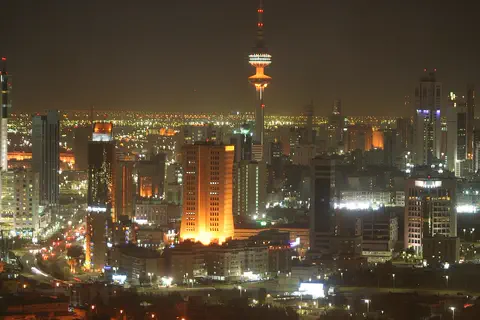
Kuwait City is the capital of Kuwait. It began as a town on the coast early in the 1700s and grew rich from caravans and pearl fishing. Today tall towers rise over the city, and summer days average highs near 47 °C.
-
 Watch
City
Muscat
Muscat is the capital of Oman, on a notch of coast on the Gulf of Oman ringed by mountains. Muscat itself had 24,099 people at the 2020 census, but it is the heart of a much bigger city that stretches along the coast, with 1,302,440 people in Muscat Governorate.
Explore next
-
Watch
 Country
Qatar
Qatar is a small desert country on a peninsula that pokes north into the Persian Gulf. Its people once lived by pearl diving and fishing; today it is one of the world's biggest exporters of natural gas. Its capital, Doha, has a skyline of towers, and about 3.2 million people lived in Qatar at the end of 2025.
-
Watch
City
Dubai
Dubai is a city of the United Arab Emirates, on the coast of the Arabian Gulf with desert behind it. It began in 1833 as a small settlement beside a sheltered creek and grew from fishing, pearling and trade into a city of tall towers, including Burj Khalifa, the world's tallest building.
-
Watch
City
Riyadh
Riyadh is the capital and biggest city of Saudi Arabia, in the middle of the Arabian Peninsula. It grew from small villages with gardens into a city of tall towers. An old fort built of mud and hay stands in its center, and a new driverless metro opened in 2024. The 2022 census counted 6,924,566 people in the city.
-
Watch
City
Abu Dhabi
Abu Dhabi is the capital of the United Arab Emirates. It began in the 1700s as a small settlement around fresh water on an island, guarded by a coral-stone watchtower. Before oil, it relied on fishing and pearl diving; since the 1960s, money from oil has turned it into a city of towers. An official estimate gave the city about 1.75 million people in 2023.
- Watch Geography Capital cities A capital is the city where a country's government is based. Many capitals grew up over hundreds of years beside rivers and trade routes. A few, like Brasília and Canberra, were built from scratch, and some countries share out their capital's jobs among two or three cities.
-
Watch
City
Kuwait City
Kuwait City is the capital of Kuwait. It began as a town on the coast early in the 1700s and grew rich from caravans and pearl fishing. Today tall towers rise over the city, and summer days average highs near 47 °C.
-
Watch
Landmark
Al Zubarah
Al Zubarah is the ruin of a walled town on the coast of Qatar. For about 50 years, in the late 1700s and early 1800s, it was a busy center for pearls and trade. After it was abandoned, desert sand covered and protected its houses, palaces and streets. It became a UNESCO World Heritage Site in 2013.
-
 Watch
City
Almaty
Almaty is the main city of Kazakhstan, in the southeast of the country at the foot of the Ala-Tau mountains. It was founded in 1854 where a Kazakh village called Almaty, 'village of apple trees', stood. It was the capital until 1998, and about 2,387,900 people lived there on 1 September 2026.
For parents & teachers
What children will learn
- Locate Doha on the east coast of the Qatar peninsula.
- Describe how pearling and then oil shaped a city.
- Explain how distilling turns seawater into fresh water.
- Compare monthly temperatures and rainfall in a hot desert climate.
Recommended ages: 3 to 17 · About 15 minutes
Talk about it
- Doha once lived from pearls. Why might cultured pearls from far away hurt a pearling town?
- Doha makes fresh water from seawater. What would your town do if it had almost no rain?
- The National Museum's shape copies a desert crystal. What natural shape would you use for a building?
Try at home or in class
- Salt water test: with a grown-up, warm salty water in a pan with a cold lid and taste the drops that form on the lid.
- Rainfall chart: compare Doha's monthly rain with your town's and count Doha's months with no rain.
- Peninsula map: draw the Arabian Peninsula and the Qatar peninsula and mark Doha on its bay.
Key vocabulary: peninsula, bay, pearl, cultured pearl, distill, desert rose
Where these facts come from
- Wikidata , Wikimedia Foundation (CC0 1.0)
- Natural Earth vector data , Natural Earth (NACIS) (Public domain)
- Qatar: municipalities and zones (censuses 1986–2020) , City Population (Thomas Brinkhoff), from the Qatar Planning and Statistics Authority
- Doha , Encyclopaedia Universalis
- National Museum of Qatar , Visit Qatar
- Doha Metro & Tram , UrbanRail.Net (Robert Schwandl)
- File:Doha skyline in the morning (12544910974).jpg (Francisco Anzola, 15 February 2014) , Wikimedia Commons
- Doha, Qatar: climatological information , World Meteorological Organization, World Weather Information Service
- Wikimedia Commons , Wikimedia Foundation (Per file (public domain, CC0, CC BY or CC BY-SA); see each media record)
Checked, not yet human-reviewed. Last updated November 1, 2026. Spotted a mistake? Tell us.