
City Europe
Lisbon
Lisbon is the capital city of Portugal. It is built on hills beside a wide river near the ocean. Long ago, explorers sailed from here to faraway lands.
Lisbon, the capital of Portugal, is the westernmost capital in mainland Europe, on the hills above the Tagus River near the Atlantic. By the 1400s it was the base for Portugal's voyages of exploration. Destroyed by an earthquake in 1755 and rebuilt, it is a city of steep streets, viewpoints and a famous tower at Belém. About 546,000 people lived there in 2021.
Lisbon, Portugal's capital and chief port, rises in terraces from the north bank of the Tagus estuary, 13 km from the Atlantic; it is the westernmost capital in continental Europe. Roman, then Moorish until 1147 and capital since 1256, it became the hub of 15th- and 16th-century Portuguese exploration. The 1755 earthquake destroyed its center, which Pombal rebuilt on a grid; Expo '98 brought the biggest renewal since. The city had about 545,796 people in 2021, in a metropolitan area of about 2.87 million.
Photo: Rehman Abubakr, CC BY-SA 4.0, via Wikimedia Commons
Discover Lisbon
Lisbon is the capital city of Portugal.
It is built on hills beside a wide river. The river flows into the big Atlantic Ocean nearby. Houses with orange roofs climb up the hills.
Lisbon is the capital and biggest city of Portugal, in the far southwest of Europe. It is the westernmost capital city in mainland Europe. It sits on the north bank of the Tagus River, about 13 kilometers from where the river reaches the Atlantic Ocean, and its natural harbor is one of the most beautiful in the world.
About 546,000 people lived in the city in 2021, and about 2.87 million in the wider Lisbon area. Lisbon is built in terraces up a range of low hills, so it is a city of steep streets, stairs, balconies and wonderful views.
Lisbon lies on the north bank of the Tagus (Tejo) estuary, about 13 km from the river's mouth on the Atlantic, and is the westernmost capital in continental Europe, as well as Portugal's chief port, largest city and commercial, political and tourist center. Britannica credits its historical prominence to its natural harbor, one of the most beautiful in the world. The city proper covers 85 km²; it had about 545,796 people in 2021 (INE census via Wikidata; Britannica gives 544,851) and its metropolitan area 2,871,133.
Once a remote outpost at what was thought to be the edge of the known world, Lisbon was the center of Portuguese exploration by the 15th century. Its terraces climb from the Tagus and the Mar de Palha toward the Sintra Mountains. Despite modernization, Britannica says, it keeps the air of a 19th-century city: fish vendors carrying baskets on their heads, trolley cars clanging by the quays and a port that still feels close to its city.
- Country
- Portugal (capital)
- People in the city (2021)
- 545,796
- People in the metro area (2021)
- 2,871,133
- Area of the city
- 85 km²

Famous places
On the riverbank stands the Tower of Belém.
It looks like a small stone castle in the water. Nearby is a huge, lacy stone monastery. High on a hill, an old castle looks over the city.
At Belém, west of the center, the Tower of Belém was built from 1515 to 1521 to defend the city. Nearby, the Jerónimos Monastery was begun in 1502. Both are carved in the Manueline style, Portugal's own decorated style that celebrated the voyages of discovery, and together they are a UNESCO World Heritage Site. The Monument to the Discoveries honors Portugal's explorers.
In the center, a marble staircase rises from the river to the huge Commerce Square. On the hill above Alfama, one of the oldest quarters, stands the Castle of St. George, which began as a Moorish fortress.
Manueline architecture, an extreme late Gothic decoration that celebrated the voyages of discovery and Portugal's sole contribution to European architecture according to Britannica, is best seen at Belém. The five-story Tower of Belém (1515–21) was built as a fort in the middle of the Tagus, which later changed course; it combines a Gothic interior with North African touches and Renaissance arches. The Jerónimos Monastery, begun in 1502 by Diogo de Boytac, took the rest of the century and four more architects. UNESCO inscribed both in 1983.
The official entrance to the city is a marble staircase from the water to the arcaded Commerce Square (Praça do Comércio), lined with 18th-century buildings and centered on Machado de Castro's equestrian statue of Joseph I. Above Alfama, on the hill where Lisbon was first settled, the Castle of St. George is Moorish in origin; it was named for England's patron saint in honor of an alliance of 1386. The Carmo Church, left roofless after 1755, is now an archaeological museum.
- Tower of Belém
- built 1515–21
- Jerónimos Monastery
- begun 1502
- UNESCO World Heritage Site
- Monastery and Tower of Belém, 1983
- Monument to the Discoveries
- 1960

Explorers and an earthquake
Lisbon is a very old city.
Romans lived here, and later the Moors. Long ago, explorers set sail from Lisbon to reach faraway lands. One day a huge earthquake shook the city, and people built it again with straight, wide streets.
Lisbon may have begun as a Phoenician trading post about 3,200 years ago, though nobody can prove it. Romans ruled here from 205 BCE, and Moors from North Africa from the 700s until 1147, when Portuguese and Crusader forces captured it. It became Portugal's capital in 1256.
In 1498 Vasco da Gama led a Portuguese fleet to India, and Lisbon grew rich from trade. On November 1, 1755, one of the greatest earthquakes ever recorded struck the city, followed by a tsunami and fires. The prime minister, later the marquês de Pombal, rebuilt the center, the Baixa, with straight streets in a grid.
Britannica thinks it likely, but unproven, that Phoenicians founded a trading station here about 1200 BCE. Rome ruled from 205 BCE to about 409 CE, and Julius Caesar named it Felicitas Julia; Alani, Suebi and Visigoths followed. Moors held it for 433 years until Afonso I, with Crusader forces, took it in 1147; it became the national capital in 1256. Ferdinand I's 14th-century wall had 77 towers and 38 gates, and the first census (1527) counted 65,000 people. After Vasco da Gama reached India in 1498, merchants from across Europe settled; African slaves were also a familiar sight, as Portugal played a major role in that trade.
On the morning of November 1, 1755, All Saints' Day, an earthquake of three shocks lasting 10 minutes struck; the quay sank, a tsunami drowned those on the river and fires burned for days. About 60,000 people died and more than 12,000 buildings were destroyed. Pombal rebuilt the Baixa on a grid with uniform buildings. On April 25, 1974, a military coup overthrew the government of Marcello Caetano, Salazar's successor; the Tagus bridge completed in 1966 as the Salazar Bridge now carries the date in its name, the 25th of April Bridge. In 1994 Lisbon was a European City of Culture, and Expo '98 brought the largest renewal since 1755, including the Vasco da Gama Bridge and new riverside districts.
Getting around Lisbon
Lisbon has lots of steep hills.
People ride trams that clang up and down the streets. Some streets are so steep they turn into stairs! An iron elevator lifts people from one part of town to another.
Lisbon's hills make getting around an adventure. Some streets in the Bairro Alto are so steep that they end in stairs, cable cars or, in one case, an iron elevator, the Santa Justa Lift. Trolley cars clang along by the quays, and ferryboats cross the river.
The metro opened on December 29, 1959, and by 2016 had 4 lines and 56 stations. Two long bridges cross the Tagus: the 25th of April Bridge on the west side of the city and the Vasco da Gama Bridge, built for Expo '98, which was then the longest bridge in Europe.
Some Bairro Alto streets leading down to the Baixa are so steep that they end in stairs, cable cars or, in one case, an elevator: the iron Santa Justa Lift designed by Raoul Mesnier du Ponsard. Trolley cars run by the quays, and the port mixes freighters, cruise liners and ferryboats with fragatas, crescent-shaped lighters with black hulls and pink sails.
The metro was begun in 1955 and opened on December 29, 1959, as a Y-shaped line; the Red (Oriente) Line opened in May 1998 for Expo '98, and by 2016 the network had 4 independent lines, 56 stations and 44.2 km, linked to suburban rail and to the river connections with the south bank. The 25th of April Bridge spans the straight, 3 km wide lower Tagus; the six-lane Vasco da Gama Bridge, then Europe's longest, crosses the widest part of the estuary to relieve it.
- Metro opened
- December 29, 1959
- Metro network (2016)
- 4 lines, 56 stations, 44.2 km
- Bridges over the Tagus
- 25th of April Bridge and Vasco da Gama Bridge

Weather and seasons
Lisbon is mild almost all year.
Winters are cool and rainy, but not very cold. Summers are warm, sunny and dry. Ocean breezes help keep the weather gentle.
Lisbon has a mild climate, with an average temperature for the year of about 17 °C. The nearby Atlantic Ocean and the Gulf Stream keep winters gentle: in January, highs average about 15 °C and lows about 8 °C. In August, the warmest month, highs average about 28 °C.
Most of the rain falls from October to April. Summers are very dry: in July and August, only about 5 millimeters of rain fall in a month.
Britannica describes a mild, equable climate, with a mean annual temperature of about 17 °C, moderated by the Atlantic and the Gulf Stream; January averages 10 °C, August seldom exceeds 28 °C, and monthly rainfall ranges from about 3 mm in summer to about 100 mm in winter. World Meteorological Organization normals for 1961–1990 give mean daily maxima and minima of 14.5 °C and 8.2 °C in January and 27.9 °C and 17.7 °C in August.
The WMO monthly totals add up to about 750 mm, with more than 100 mm in each of November, December, January and February and under 6 mm in July and August. Several geologic faults cross the region, but since the 20th century seismic activity has been limited to slight tremors.
- January, average daily high and low
- about 15 °C and 8 °C
- August, average daily high and low
- about 28 °C and 18 °C
- Average for the year
- about 17 °C
Living in Lisbon
People in Lisbon love music called fado.
Fado songs are full of feeling. Fishing boats bring fish to busy markets. Families visit an aquarium by the river.
Lisbon is a city of balconies and views. On seven of its hillsides, the city keeps terraces called miradouros, where people stop to look out over the river. Many Lisboetas, as the people of Lisbon are called, say their city has seven hills, like Rome.
In restaurants in old quarters such as Alfama and Bairro Alto, singers perform fado, melodic and deeply emotional folk songs. At dawn, fishing boats bring in their catch for auction. Expo '98 left an oceanarium by the river, and museums show the painted tiles called azulejos and carved, gilded coaches.
Britannica notes that Lisboetas have long discussed saudade, a melancholy tempered by fatalism said to be reflected in fado, the emotional folk songs still heard in restaurants of Alfama and Bairro Alto. The municipality maintains miradouros, viewpoint terraces, on seven hillsides. Cultural life includes the Belém Cultural Centre (1992), the Calouste Gulbenkian Foundation and Museum, the Azulejo Museum of painted tiles, the National Museum of Coaches and the St. Charles (São Carlos) and Dona Maria II theaters.
The medieval university, founded in 1288, moved permanently to Coimbra in 1537, leaving the capital without one until the University of Lisbon was restored in 1911. In the late 20th century Lisbon lost about half its population to the suburbs; immigrants, mainly from Africa, eastern Europe and Brazil, have added to housing pressures. Expo '98 brought an oceanarium, marinas and new venues along the Tagus.
- Viewpoint terraces (miradouros)
- on seven hillsides
- European City of Culture
- 1994
- University of Lisbon
- restored 1911
Lisbon on the map
Find Lisbon on the globe.
It is in Portugal, at the western edge of Europe. Look for a wide river flowing into the Atlantic Ocean. Lisbon sits on its bank.
Lisbon is on the west coast of Portugal, at the western edge of Europe. It sits on the north bank of the Tagus River, about 13 kilometers before the river meets the Atlantic Ocean.
Next to the city, the Tagus suddenly widens into a bay about 11 kilometers across, called the Mar de Palha, or "Sea of Straw," because of the way it shimmers in the sun. To the northwest rise the green Sintra Mountains.
Lisbon lies at about 38.7° N and 9.1° W on the north bank of the Tagus estuary. From the ocean to the city the river is almost straight and about 3 km wide; just east of the 25th of April Bridge it broadens into the Mar de Palha, an 11 km bay named for its shimmer, crossed at its widest by the Vasco da Gama Bridge. The bay lies on a strategic sea route and handles much of the trade between Portugal and Spain.
The heart of the city lies in a valley that was once the bed of a forked branch of the Tagus, and the metro forks at the same spot. Terraces of low hills rise northwest toward the Sintra Mountains, and many affluent families have moved out to Oeiras, Cascais and Sintra.
- Latitude
- about 38.7° north
- Longitude
- about 9.1° west
- Distance to the Atlantic
- about 13 km
- Mar de Palha (Sea of Straw)
- about 11 km wide
Amazing facts
-
Lisbon's river shimmers so much it is called the Sea of Straw.
A wide part of the Tagus next to Lisbon is called the Mar de Palha, "Sea of Straw," because of the way it shimmers in the sun.
East of the 25th of April Bridge the Tagus broadens into an 11 km bay, the Mar de Palha ('Sea of Straw'), named for its shimmer.
-
Some streets in the old center are named after jobs.
After 1755, the new streets of the Baixa were named for the workers meant to use them, such as Golden Street for goldsmiths.
Pombal's parallel streets in the Baixa were each named for their intended occupants, for example Rua Áurea ('Golden Street') for the goldsmiths.
-
The Tower of Belém was first built in the middle of the river.
The Tower of Belém was built as a fort in the middle of the Tagus. The river later changed its course.
The Tower of Belém was built in 1515 as a fort in the middle of the Tagus, which subsequently altered course, leaving it at the riverbank.
-
Lisbon's metro follows an old riverbed.
The valley at the heart of Lisbon was once a forked branch of the Tagus River, and the metro forks at the same spot today.
In prehistoric times the valley at the heart of Lisbon held a forked branch of the Tagus; the subway now forks at the same spot.
-
Old boats with pink sails still work in Lisbon's harbor.
Crescent-shaped boats called fragatas, with black hulls and pink sails, still carry cargo in Lisbon's harbor.
The fragatas, crescent-shaped lighters of Phoenician origin with black hulls and pink sails, still perform most of the harbor's lighterage.
Words to know
- capital
- the city where a country's government meets
- estuary
- the wide mouth of a river, where fresh water mixes with the sea
- explorer
- a person who travels to places that are new to them to find out about them
- earthquake
- a sudden shaking of the ground caused by movement deep in the Earth
- tsunami
- a huge, fast sea wave, often caused by an earthquake under the sea
- fado
- an emotional kind of Portuguese folk song
- azulejo
- a painted, glazed tile, often blue and white
Discovery challenge
-
Which river is Lisbon beside?
Lisbon sits on the north bank of which river?
Lisbon lies on the estuary of which river, 13 km from the Atlantic?
- The Tagus
- The Danube
- The Volga
Show the answer
The Tagus
The Tagus! It flows into the ocean.
The Tagus (Tejo), which flows into the Atlantic Ocean.
The Tagus (Tejo); its bay beside the city is the Mar de Palha.
-
What happened in Lisbon in 1755?
What destroyed the center of Lisbon on November 1, 1755?
Which disaster of 1755, followed by a tsunami and fires, led to Pombal's rebuilding of the Baixa?
- An earthquake
- A volcano
- A snowstorm
Show the answer
An earthquake
An earthquake. Then the city was built again.
A huge earthquake, followed by a tsunami and fires.
The earthquake of November 1, 1755, one of the greatest ever recorded.
-
Which tower stands by the water in Lisbon?
Which 16th-century tower was built to defend Lisbon from the river?
Which Manueline fort of 1515–21, inscribed by UNESCO in 1983, stands at Belém?
- The Tower of Belém
- The Leaning Tower of Pisa
- The Eiffel Tower
Show the answer
The Tower of Belém
The Tower of Belém! It looks like a little castle.
The Tower of Belém, built from 1515 to 1521.
The Tower of Belém, built as a fort in the middle of the Tagus.
-
Which explorer sailed from Portugal all the way to India?
Which Portuguese explorer led a fleet to India in 1498?
Whose 1498 voyage to India broke the Venetian monopoly on Asian trade and drew foreign merchants to Lisbon?
- Vasco da Gama
- Christopher Columbus
- Neil Armstrong
Show the answer
Vasco da Gama
Vasco da Gama! A big bridge is named after him.
Vasco da Gama. Lisbon's longest bridge is named after him.
Vasco da Gama; after 1498, German, Flemish, Dutch, English and French traders settled in Lisbon.
-
What is fado?
What is fado, which you can hear in Alfama and Bairro Alto?
Fado, said to reflect saudade, is what kind of art?
- A kind of song
- A kind of boat
- A kind of cake
Show the answer
A kind of song
A kind of song! Fado songs are full of feeling.
A kind of song: melodic and deeply emotional folk music.
Melodic but deeply emotional folk song, heard in restaurants of the historic quarters.
Nearby places
-
 Watch
Landmark
Way of Saint James
The Way of Saint James, or Camino de Santiago, is a network of old pilgrim routes across Europe that all end at the cathedral of Santiago de Compostela in northwest Spain. People have walked it for more than 1,000 years, and each year hundreds of thousands still set out on foot, by bicycle or on horseback.
-
 Watch
Landmark
Royal Monastery of San Lorenzo de El Escorial
The Royal Monastery of San Lorenzo de El Escorial stands at the foot of the Guadarrama mountains, northwest of Madrid, Spain. King Philip II began it in 1563, and it was finished in 1584. Inside its granite walls are a monastery, a church, a royal palace, a school and a famous library.
-
 Watch
Landmark
Museo del Prado
The Museo del Prado in Madrid opened in 1819 to show the paintings collected by Spain's kings and queens. Its stone building was first planned as a science museum. Today it holds about 8,600 paintings, including the world's most complete collections of the Spanish painters El Greco, Velázquez and Goya.
-
 Watch
City
Madrid
Madrid, the capital of Spain, sits almost exactly in the middle of the Iberian Peninsula, high on a flat plateau. Once a small fortress, it became the royal capital in the 1500s. About 3.5 million people lived there in 2025.
-
 Watch
Landmark
Alhambra
The Alhambra is a palace and fortress above the city of Granada, in Spain. The Nasrid rulers built most of it between 1238 and 1358. It is famous for its courtyards, fountains, carved plaster and tiles, and the gardens of the Generalife next door.
- Watch Natural wonder Cave of Altamira The Cave of Altamira, in northern Spain, holds some of the most famous prehistoric paintings in the world. People who hunted and gathered their food used the cave between about 36,000 and 13,000 years ago, and painted and engraved bison, horses, deer, hands and signs on its walls and ceiling. It was the first cave where prehistoric cave art was ever recognized.
-
 Watch
Landmark
Sagrada Família
The Sagrada Família is a huge church in Barcelona, Spain, designed by the architect Antoni Gaudí. Building began in 1882 and is still going on. In February 2026 its tallest tower was finished at 172.5 meters, making it the tallest church in the world.
-
 Watch
City
Barcelona
Barcelona, the capital of Catalonia in northeastern Spain, lies on the Mediterranean between mountains and the sea. It is famous for the buildings of the architect Antoni Gaudí, including the Sagrada Família, a giant church begun in 1882. About 1.7 million people live in the city (2025).
Explore next
-
Watch
 Country
Portugal
Portugal is a country on the Atlantic coast of the Iberian Peninsula in southwestern Europe, with Spain as its only land neighbor. It also includes the Azores and Madeira islands far out in the ocean. About 11.4 million people lived there at the start of 2026, and its capital is Lisbon, on the Tagus River.
-
Watch
City
Madrid
Madrid, the capital of Spain, sits almost exactly in the middle of the Iberian Peninsula, high on a flat plateau. Once a small fortress, it became the royal capital in the 1500s. About 3.5 million people lived there in 2025.
-
 Watch
City
Rio de Janeiro
Rio de Janeiro is a city of about 6.7 million people (2025) on Brazil's Atlantic coast. Forested mountains, a giant statue on Corcovado, the Sugarloaf peak and famous beaches make it one of the most recognizable cities on Earth. It was Brazil's capital until 1960.
-
 Watch
City
Valparaíso
Valparaíso is a busy port on Chile's Pacific coast, built around a bay on steep hills. Founded in 1536, it became the leading port on South America's Pacific coast in the late 1800s. Its historic quarter, with hillside neighborhoods and funicular "elevators," is a UNESCO World Heritage Site, and Chile's National Congress meets here.
-
Watch
City
Barcelona
Barcelona, the capital of Catalonia in northeastern Spain, lies on the Mediterranean between mountains and the sea. It is famous for the buildings of the architect Antoni Gaudí, including the Sagrada Família, a giant church begun in 1882. About 1.7 million people live in the city (2025).
-
 Watch
City
Amsterdam
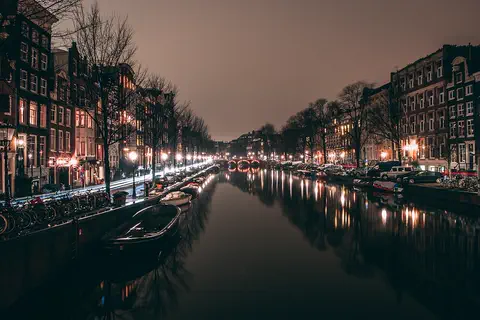
Amsterdam is the capital of the Netherlands. It began as a fishing village beside a dam on the Amstel River, which gave the city its name. Today about 942,000 people live among its rings of canals, hundreds of bridges, houseboats and bicycles.
-
 Watch
City
Athens
Athens is the capital of Greece and one of the oldest cities in the world. Above it rises the Acropolis, a rocky hill crowned by the marble Parthenon, built about 2,500 years ago. Ancient Athens was home to early democracy, great thinkers and theater.
-
 Watch
City
Belgrade
Belgrade, the capital of Serbia, stands where the Sava River flows into the Danube. Its name, Beograd, means "white city", probably because of the white limestone walls of its old fortress above the rivers. At the 2022 census, about 1.2 million people lived in the city itself and about 1.7 million in the wider City of Belgrade.
For parents & teachers
What children will learn
- Locate Lisbon on the Tagus estuary at the western edge of Europe.
- Explain why Lisbon's harbor made it a base for exploration.
- Describe the 1755 earthquake and how the city was rebuilt.
- Describe how hills shape the way people travel in a city.
Recommended ages: 3 to 17 · About 15 minutes
Talk about it
- Lisbon is built on steep hills. What clever ways have people found to get up and down them?
- After the earthquake, Lisbon was rebuilt with straight streets. Why might planners choose a grid?
- Explorers left Lisbon for faraway lands. What would you pack for a voyage of many months?
Try at home or in class
- Design a tile: draw a pattern on a square of paper in blue and white, like an azulejo, then put several together.
- Make a hill from a stack of books and a ramp, and test how a toy car climbs it with and without a string pulling it, like a cable car.
Key vocabulary: capital, estuary, explorer, earthquake, tsunami, fado, azulejo
Where these facts come from
- Wikidata , Wikimedia Foundation (CC0 1.0)
- Natural Earth vector data , Natural Earth (NACIS) (Public domain)
- Lisbon , Encyclopaedia Britannica
- Lisbon: City layout , Encyclopaedia Britannica
- Lisbon: History , Encyclopaedia Britannica
- Lisbon: Health, education and cultural life , Encyclopaedia Britannica
- Lisbon: Evolution of the modern city , Encyclopaedia Britannica
- Lisbon: The 20th century , Encyclopaedia Britannica
- Brief history , Metropolitano de Lisboa
- Monastery of the Hieronymites and Tower of Belém in Lisbon , UNESCO World Heritage Centre
- Lisboa: climatological information , World Meteorological Organization, World Weather Information Service
- Wikimedia Commons , Wikimedia Foundation (Per file (public domain, CC0, CC BY or CC BY-SA); see each media record)
Checked, not yet human-reviewed. Last updated October 27, 2026. Spotted a mistake? Tell us.
Picture credits
- Photo: Rehman Abubakr, CC BY-SA 4.0, via Wikimedia Commons · source · license
- Photo: Matti Blume, CC BY-SA 4.0, via Wikimedia Commons · source · license
- Photo: Holger Uwe Schmitt, CC BY-SA 4.0, via Wikimedia Commons · source · license
- Photo: Paulo Valdivieso from Lisboa, Portugal, CC BY-SA 2.0, via Wikimedia Commons · source · license