
City Asia
Guangzhou
Guangzhou is a huge city in the south of China. It has a very tall, twisty tower and many skyscrapers.
Guangzhou, also known as Canton, is the capital of Guangdong Province in southern China. About 19.08 million people lived there in November 2025. For centuries it was a great port, and today its Canton Tower rises 600 meters.
Guangzhou (Canton), capital of Guangdong, lies 60 km from the sea at the far end of the Pearl River estuary. A port site since at least 1055 and for centuries the gateway to central China, it had 19,081,000 residents on 1 November 2025, 14.85% of the province, according to the city statistics bureau's 1% sample survey.
Photo: Tim Wu, CC BY-SA 4.0, via Wikimedia Commons
Discover Guangzhou
Guangzhou is a giant city in the south of China. More than 19 million people live there!
It sits by a wide river that flows to the sea.
Guangzhou is the capital of Guangdong Province, in the south of China. It is also known as Canton. Universalis says it lies 60 kilometers from the sea, at the far end of a river estuary.
The Guangzhou Statistics Bureau says about 19.08 million people lived in the city on 1 November 2025, more than in any other city of Guangdong. That is 2.2% more than at the 2020 census.
The Guangzhou Statistics Bureau's 1% population sample survey (published 28 August 2026) gives 19,081,000 permanent residents on 1 November 2025, 14.85% of Guangdong's people and the most of any city in the province. The 2020 census counted 18,676,605 (City Population), so the city grew by about 404,400 in five years.
The same survey puts 87.51% of residents in towns and 12.49% in the countryside within the city's borders, and finds 35,302 people with a college education in every 100,000.
- Country
- China (capital of Guangdong Province)
- People in Guangzhou (1% sample survey, 1 November 2025)
- about 19,081,000
- People in Guangzhou (census, 1 November 2020)
- 18,676,605
- Distance from the sea
- 60 km
The Canton Tower
Look at the tall tower in the middle of the photo! It is the Canton Tower. Its sides are a white net that gets narrow in the middle.
Behind it, across a river, are lots of skyscrapers.
This photo was taken from the air on 26 June 2022, about 1.2 kilometers south of the Canton Tower. Wikidata lists the tower as a television and tourism tower, 600 meters tall, opened on 30 September 2010. Its outside is a white lattice that narrows at the waist, with a thin mast on top.
Across the river stand many skyscrapers. Wikidata places two very tall ones about 1.2 kilometers north of the tower: the Guangzhou International Finance Center, 440 meters, and the CTF Finance Centre, 530 meters.
Wikidata: Canton Tower, a television and tourism tower in Chigang Subdistrict, Haizhu District, 600 m, opened 30 September 2010; Guangzhou Opera House, designed by Zaha Hadid, opened 9 May 2010, 0.94 km north-northwest of the tower; Guangzhou International Finance Center (440 m, 2010) 1.24 km north; CTF Finance Centre (530 m, 2016) 1.24 km north.
The photo's camera point on Commons lies 1.22 km due south of the tower, so the view looks north across the river to the skyline, with green hills on the horizon.
- Canton Tower
- 600 m tall, opened 30 September 2010
- Guangzhou Opera House
- opened 9 May 2010, designed by Zaha Hadid
- Guangzhou International Finance Center
- 440 m tall
- CTF Finance Centre
- 530 m tall
China's door to the world
Long ago, ships from far away came to Guangzhou to trade.
For a long time it was the door where China met the rest of the world.
Universalis says Guangzhou owes its success to its place where trade routes meet. It is a classic port site, at the farthest point the tide reaches, chosen for good in 1055, though its links with Arabs and Persians began much earlier.
For centuries Guangzhou was the door to central China. The Portuguese came to the port from 1514, and in the 18th century it was the only Chinese port that stayed open to foreign merchants, under strict rules.
Universalis (Jean Delvert; Jean Chesneaux) calls Canton in the Middle Ages the main base of the Arabs in China. In the 18th century, as China closed almost completely to foreign merchants, Canton was the one port left open to them, on condition that they deal through a Chinese guild holding a monopoly, the Cohong (Gonghang).
In the 19th century it remained the main point of contact between China and other countries. Many Chinese emigrants, merchants and workers, left from Canton for Southeast Asia and the lands around the Pacific, and stayed in touch with the city, giving it a wider outlook than other Chinese cities.
- Port site chosen for good
- 1055
- The Portuguese
- visited the port from 1514
- 18th century
- the only Chinese port still open to foreign traders
Metro, trains and planes
Guangzhou has a metro, a railway for getting around the city. The first line opened more than 25 years ago.
Big planes land at an airport about 32 kilometers north of the Canton Tower.
UrbanRail.Net says Guangzhou approved a subway in 1989 and began building it in 1993. Line 1, 18.5 kilometers long, started trial service on 28 June 1997 and opened officially two years later. A small automated people mover in Zhujiang New Town, 3.9 kilometers long with 9 stations, opened on 8 November 2010.
Wikidata dates Guangzhou Baiyun International Airport to 5 August 2004 and places it about 32 kilometers north of the Canton Tower.
UrbanRail.Net: subway approved 1989, construction from 1993; Line 1 (18.5 km) trial service 28 June 1997, official inauguration 28 June 1999; the Guangfo Line (39.5 km, 25 stations) links Guangzhou with Foshan; the Zhujiang New Town automated people mover (3.9 km, 9 stations) opened 8 November 2010.
From the Canton Tower (Wikidata points): Guangzhou Baiyun International Airport (opened 5 August 2004) 31.56 km north; Guangzhou South railway station (opened 30 January 2010) 14.27 km south-southwest.
- First metro line
- trial service 28 June 1997, opened officially 28 June 1999 (18.5 km)
- Guangzhou Baiyun International Airport
- opened 5 August 2004, about 32 km north of the Canton Tower
- Zhujiang New Town people mover
- 3.9 km, 9 stations, opened 8 November 2010
Hot, wet summers
Summers in Guangzhou are hot and very rainy.
Winters are mild, and only a little rain falls then.
The World Meteorological Organization's table for Guangzhou (1961–1990) gives July days an average high of about 33 °C. In January, nights average about 10 °C and days about 18 °C.
About 1,683 millimeters of rain and other precipitation fall in an average year, about four-fifths of it from April to September. May is the wettest month, with 284 millimeters, and December the driest, with 24.
The WMO table for Guangzhou (1961–1990) gives average highs from 18.3 °C in January to 32.7 °C in July and average lows from 9.8 °C in January to 25.3 °C in July.
The monthly precipitation averages add up to 1,683 mm; April to September bring 1,345 mm (80%). May (284 mm) and June (258 mm) are the wettest months; October to February together bring 253 mm.
- July, average high (WMO, 1961–1990)
- 32.7 °C
- January, average low (same table)
- 9.8 °C
- Precipitation in a year (sum of the monthly averages)
- about 1,683 mm
A city of millions
Millions of children live in Guangzhou. Most people live in the town areas.
Some live in the countryside inside the city's borders.
The 2025 survey counted about 2.67 million children aged 14 or younger in Guangzhou, about one person in seven. Most residents, 87.51%, lived in towns; about 2.38 million lived in the countryside inside the city's borders.
Universalis calls the Pearl River estuary, where Guangzhou stands, one of the three major zones of China's development.
Guangzhou Statistics Bureau, 1 November 2025: 0-14 years 2.673 million (14.01%), 15-59 years 13.809 million (72.37%), 60 and over 2.599 million (13.62%); men 9.851 million, women 9.230 million; 16.697 million in towns, 2.384 million rural (87.51% urban, up 1.32 points since 2020).
Universalis credits the city's fortune to its remarkable position where trade routes meet, and names the Zhujiang (Pearl River) estuary one of the three major zones of Chinese development.
- Living in towns (2025 survey)
- 87.51% of residents
- Children up to 14 (2025 survey)
- 2.673 million (14.01%)
- Pearl River estuary
- one of China's three major development zones
Guangzhou on the map
Find China on the globe. Guangzhou is in the south, near the sea.
Guangzhou lies at about 23.1° north, in southern China. Universalis places it at the foot of a lone rocky hill on a plain of river mud, at the far end of an estuary formed by the Xijiang, its tributary the Beijiang, and the Dongjiang.
Measured from the Canton Tower, the Opera House is about 0.9 kilometers to the north-northwest and the airport about 32 kilometers to the north.
Guangzhou lies at about 23.15° N and 113.32° E. Universalis: 60 km from the sea, at the foot of an isolated rocky hill in the Xijiang's alluvial plain, at the end of the estuary formed by the Xijiang, the Beijiang and the Dongjiang, the Zhujiang or Pearl River.
From the Canton Tower (Wikidata points): Opera House 0.94 km NNW, Guangzhou International Finance Center and CTF Finance Centre 1.24 km N, South railway station 14.27 km SSW, Baiyun airport 31.56 km N.
- Latitude
- about 23.1° north
- Longitude
- about 113.3° east
- Setting
- on the alluvial plain at the far end of the Pearl River estuary
Amazing facts
-
The Canton Tower is 600 meters tall!
Wikidata gives the Canton Tower a height of 600 meters; it opened on 30 September 2010.
Wikidata: Canton Tower, a television and tourism tower, 600 m, opened 30 September 2010, in Haizhu District.
-
Long ago, Guangzhou was the only port in China where traders from far away were allowed to come.
Universalis says that in the 18th century, Guangzhou was the only Chinese port still open to foreign merchants.
Universalis: in the 18th century Canton was the only port left open to foreign merchants, who had to deal through the Cohong, a Chinese guild with a monopoly.
-
Guangzhou's first metro trains started running in 1997.
UrbanRail.Net says Line 1 began trial service on 28 June 1997 and opened officially on 28 June 1999.
UrbanRail.Net: subway approved 1989, building from 1993, Line 1 (18.5 km) trial service 28 June 1997, official inauguration 28 June 1999.
-
May is the rainiest month in Guangzhou.
In the WMO's Guangzhou table, May averages 284 millimeters of rain, while December averages just 24.
WMO Guangzhou (1961–1990): April to September bring 1,345 of the year's 1,683 mm (80%).
Words to know
- estuary
- the wide part of a river where it meets the sea
- port
- a town or city where ships load and unload goods
- province
- a large area of a country with its own local government
- lattice
- a pattern of crossing strips with gaps between them
- metro
- a city railway, often running under the streets
- sample survey
- a count that asks some of the people and works out figures for everyone
Discovery challenge
-
Guangzhou is a city in which country?
Guangzhou is the capital of a province in which country?
Guangzhou is the capital of Guangdong Province in which country?
- Japan
- China
- Thailand
Show the answer
China
China!
China.
China.
-
How tall is the Canton Tower?
How tall is the Canton Tower, according to Wikidata?
Wikidata gives the Canton Tower which height?
- 60 meters
- 600 meters
- 6,000 meters
Show the answer
600 meters
600 meters!
600 meters.
600 m; it opened in 2010.
-
What is Guangzhou's other name?
By which other name is Guangzhou also known?
Under which older name does Universalis file Guangzhou?
- Canton
- Peking
- Bombay
Show the answer
Canton
Canton!
Canton.
Canton (Guangzhou).
-
When does most rain fall in Guangzhou?
In which months does Guangzhou get most of its rain?
In the WMO's Guangzhou table, which six months bring about 80% of the year's precipitation?
- October to March
- April to September
- It rains the same every month
Show the answer
April to September
In spring and summer!
April to September.
April to September: 1,345 of 1,683 mm.
-
What kind of trains started running in Guangzhou in 1997?
Which kind of transport started trial service in Guangzhou in 1997?
UrbanRail.Net dates the trial service of which Guangzhou line to 28 June 1997?
- Metro trains
- Boats
- Cable cars
Show the answer
Metro trains
On metro trains!
The metro: Line 1.
Metro Line 1 (18.5 km).
Nearby places
-
 Watch
City
Macau
Macau is a small city on the south coast of China. It was a busy trading port under Portuguese administration from the mid-1500s until 1999, when it came under Chinese sovereignty. Its historic center, where Chinese and Portuguese buildings mix, is a UNESCO World Heritage Site.
-
 Watch
City
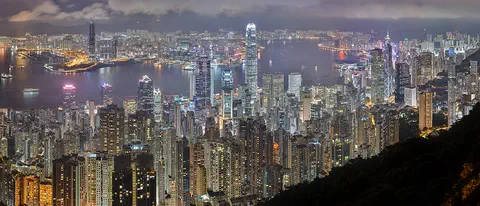
Hong Kong
Hong Kong, on the south coast of China, grew around one of the world's great natural harbors. It was a British colony for 156 years and has been a special administrative region of China since 1997. About 7.5 million people lived there in mid-2026.
-
 Watch
City
Hechi
Hechi is a city in Guangxi, in southern China. China's 2020 census counted 268,122 people living in the city itself, and 3,417,945 in the much larger area it leads, a prefecture-level city of 33,488 square kilometers.
-
 Watch
Natural wonder
Ha Long Bay
Ha Long Bay is a bay in northeast Vietnam where more than a thousand limestone islands rise straight out of the sea. Over millions of years, water dissolved the limestone into towers and caves, and then the sea flooded in around them. Together with the nearby Cat Ba Archipelago it is a World Heritage site.
-
 Watch
City
Kaohsiung
Kaohsiung is a city on the southwest coast of Taiwan, with the largest international port on the island. The port's history says it began as a small fishing village, and it was opened to trade with other countries in 1863. The census of 1 November 2020 counted 2,734,275 people in Kaohsiung City.
-
 Watch
Natural wonder
Wulingyuan
Wulingyuan, in China's Hunan Province, is a World Heritage Site with more than 3,000 narrow pillars of quartz sandstone, many over 200 meters high, rising from forests, ravines and streams.
-
 Watch
City
Guiyang
Guiyang is a big city in southern China and the capital of Guizhou Province, 320 kilometers south of Chongqing. It is a meeting point of roads and railways and a city of industry. China's 2020 census counted 4,021,275 people in its urban districts.
-
 Watch
City
Hanoi
Hanoi is the capital of Vietnam, in Southeast Asia. It grew beside the Red River, where a city called Thang Long was founded in 1010. Its old citadel is a UNESCO World Heritage Site, and its old quarter is known for its 36 streets. The 2019 census counted about 8 million people in the city and its surrounding districts.
Explore next
-
 Watch
 Country
China
China is the largest country in Asia, almost as big as all of Europe. The land steps down from the high, cold Plateau of Tibet in the west to plains and coasts in the east, and about 1.4 billion people live there, along with giant pandas in the mountains of south-central China.
-
Watch
City
Hong Kong
Hong Kong, on the south coast of China, grew around one of the world's great natural harbors. It was a British colony for 156 years and has been a special administrative region of China since 1997. About 7.5 million people lived there in mid-2026.
-
Watch
City
Macau
Macau is a small city on the south coast of China. It was a busy trading port under Portuguese administration from the mid-1500s until 1999, when it came under Chinese sovereignty. Its historic center, where Chinese and Portuguese buildings mix, is a UNESCO World Heritage Site.
-
 Watch
City
Shanghai
Shanghai is China's most populous city, on the coast where the great Yangtze River meets the East China Sea. Once a small fishing village, it grew into one of the world's busiest seaports. About 24.9 million people lived in Shanghai in 2020, and the towers of Pudong rise across the Huangpu River.
-
Watch
City
Guiyang
Guiyang is a big city in southern China and the capital of Guizhou Province, 320 kilometers south of Chongqing. It is a meeting point of roads and railways and a city of industry. China's 2020 census counted 4,021,275 people in its urban districts.
-
Watch
City
Hechi
Hechi is a city in Guangxi, in southern China. China's 2020 census counted 268,122 people living in the city itself, and 3,417,945 in the much larger area it leads, a prefecture-level city of 33,488 square kilometers.
-
 Watch
City
Tianjin
Tianjin is one of China's most important cities and one of its main ports. It lies on the Haihe River, about 45 kilometers from the sea, and is one of four cities in China run directly by the national government, like a province. At the end of 2025, about 13.63 million people lived in all of Tianjin.
-
 Watch
City
Abu Dhabi
Abu Dhabi is the capital of the United Arab Emirates. It began in the 1700s as a small settlement around fresh water on an island, guarded by a coral-stone watchtower. Before oil, it relied on fishing and pearl diving; since the 1960s, money from oil has turned it into a city of towers. An official estimate gave the city about 1.75 million people in 2023.
For parents & teachers
What children will learn
- Locate Guangzhou at the end of the Pearl River estuary in southern China.
- Explain why a river port where trade routes meet can grow into a great city.
- Read a climate table with a wet season from April to September.
- Compare a 2020 census with a 2025 sample survey and work out the change.
Recommended ages: 3 to 17 · About 15 minutes
Talk about it
- In the 18th century Guangzhou was the only Chinese port open to foreign merchants. How might that have changed life in the city?
- Guangzhou grew by about 404,000 people in five years. What would a city need to build for that many new residents?
- Most of Guangzhou's rain falls from April to September. How might people plan for a long wet season?
Try at home or in class
- Rain chart: plot Guangzhou's monthly precipitation and compare it with your town's.
- Tower model: build a twisting tower from paper strips or straws and see how the lattice narrows at the middle.
- Map trace: find Guangzhou, Hong Kong and Macau on a map of the Pearl River estuary.
Key vocabulary: estuary, port, province, lattice, metro, sample survey
Where these facts come from
- Wikidata , Wikimedia Foundation (CC0 1.0)
- Natural Earth vector data , Natural Earth (NACIS) (Public domain)
- Guangzhou 2025 1% population sample survey: data interpretation , Guangzhou Statistics Bureau
- China: Guangdong (prefectures, cities, districts and counties; census results) , City Population (Thomas Brinkhoff)
- Canton ou Guangzhou , Encyclopaedia Universalis (Jean Chesneaux, Jean Delvert)
- Guangzhou Metro , UrbanRail.Net
- World Weather Information Service: Guangzhou climatological information , World Meteorological Organization
- File:Canton Tower 20220626 (cropped).jpg (Tim Wu, 26 June 2022) , Wikimedia Commons
- Wikimedia Commons , Wikimedia Foundation (Per file (public domain, CC0, CC BY or CC BY-SA); see each media record)
Checked, not yet human-reviewed. Last updated November 1, 2026. Spotted a mistake? Tell us.