
City Asia
Shanghai
Shanghai is a giant city in China, beside the sea. It has some of the tallest buildings in the world. A super-fast floating train zooms to the airport.
Shanghai is China's most populous city, on the coast where the great Yangtze River meets the East China Sea. Once a small fishing village, it grew into one of the world's busiest seaports. About 24.9 million people lived in Shanghai in 2020, and the towers of Pudong rise across the Huangpu River.
Shanghai, a province-level municipality on the East China Sea between the Yangtze mouth and Hangzhou Bay, grew from a Song-dynasty fishing village into China's leading port and industrial and financial center. Opened to Western trade in 1842, it was rebuilt from the 1990s with Pudong's skyscrapers; the 2020 census counted 24,870,895 residents in its 6,200 km².
Photo: MasaneMiyaPA, CC BY-SA 4.0, via Wikimedia Commons
Discover Shanghai
Shanghai is a giant city in China.
It is beside the sea, near the mouth of a very long river. Big ships come and go from its port. Very tall buildings reach up to the clouds.
Shanghai is on the east coast of China, between the mouth of the Yangtze River to the north and the bay of Hangzhou to the south. It is China's most populous city, and one of the world's largest seaports.
About 24.9 million people lived in Shanghai in 2020. The Huangpu River flows through the city: on its west bank is Puxi, the older center, and on its east bank is Pudong, where some of the tallest buildings in the world now stand. The land is very flat and low, only 3 to 5 meters above the sea.
Shanghai is a city and province-level municipality (shi) in east-central China, on the East China Sea between the Yangtze estuary and Hangzhou Bay. Bordered by Jiangsu and Zhejiang provinces, the municipality includes the districts of the city, suburbs, an agricultural hinterland and islands such as Chongming (1,267 km²) in the Yangtze mouth.
The mainland part lies on an almost level deltaic plain, averaging 3 to 5 m above sea level and crisscrossed by canals linking it with the Lake Tai region. Britannica calls Shanghai China's most populous city and a major industrial, commercial and financial center. The 2020 census counted 24,870,895 permanent residents; most people are of Han Chinese origin, and a significant share are migrants from other provinces who came to work in factories.
- Country
- China (a province-level municipality)
- People in the municipality (2020 census)
- about 24.9 million
- Area of the municipality
- about 6,200 km²
- Height of the land
- about 3 to 5 m above sea level
Towers, gardens and museums
Shanghai has some of the tallest towers in the world.
One tower has 128 floors! In the old part of the city there is a beautiful old garden. A big museum shows very old bronze and pottery.
Across the Huangpu River in Pudong rise three giant towers: the 88-story Jin Mao Tower (1999), the 101-story Shanghai World Financial Center (2008) and the 128-story Shanghai Tower (2015).
In the old Chinese city stands Yuyuan Garden, created in the 1500s, a famous example of garden design from the Ming dynasty. The Shanghai Museum holds bronzes, ceramics and other treasures from thousands of years of history. Nanjing Road, the main commercial street, has big department stores and restaurants.
Pudong, founded in 1870 as one of the earliest industrial areas and once a notorious slum, now holds the Lujiazui finance and trade zone with the 88-story Jin Mao Tower (1999), the 101-story Shanghai World Financial Center (2008) and the 128-story Shanghai Tower (2015); the Pudong New District was established in 1993, and Pudong held most of Expo 2010.
In Puxi, the old Chinese city, once enclosed by a 5 km wall now traced by Renmin Lu and Zhonghua Lu, has a labyrinth of streets and the 16th-century Yuyuan Garden, an outstanding example of late Ming garden architecture. Central Shanghai's grid follows the former British concession; Nanjing Dong Lu is the main commercial artery. The Shanghai Museum holds bronzes and ceramics spanning several thousand years, and the Longhua Pagoda dates from the Northern Song dynasty.
- Shanghai Tower
- 128 stories, completed 2015
- Shanghai World Financial Center
- 101 stories, completed 2008
- Yuyuan Garden
- 16th century

From fishing village to world port
Long ago, Shanghai was a little fishing village.
Then ships started to stop here. Farmers grew cotton, and people spun it into thread. The village grew into a huge city full of factories and tall buildings.
Shanghai began as a small fishing village. During the Song dynasty, about 1,000 years ago, people saw that its deep water made it a good port. By the end of the 1200s it was a county seat, and later, in the Ming dynasty, most of the farmland around it grew cotton for spinning and weaving.
In 1842, a treaty with Britain opened Shanghai to foreign trade. Britain, France and the United States controlled areas of the city, and banks and trading companies poured in. By 1860 Shanghai was China's leading port. Since the 1990s, huge building projects, especially in Pudong, have given it a skyline of towering skyscrapers.
Under the Song dynasty, Shanghai emerged from a small fishing village as coastal and inland shipping grew; a customs office existed by the early 11th century, and by the end of the 13th century it was a county seat. Under the Ming (1368–1644) about 70 percent of the surrounding farmland grew cotton, and by the mid-18th century more than 20,000 people worked as cotton spinners.
After the First Opium War (1839–42), the Treaty of Nanjing opened Shanghai to unrestricted foreign trade; British, French and American concessions followed, and Japan gained one in 1895. By 1860 the city handled about a quarter of China's shipping tonnage, and industry grew from the 1890s. The Chinese Communist Party was founded in Shanghai in 1921. Japan occupied the city during the Second Sino-Japanese War, and in 1949 the People's Liberation Army took control. From the late 20th century Shanghai became China's most advanced city: Pudong was rebuilt with skyscrapers, a rail transit system opened in the early 1990s, and the city hosted the 2010 world exposition.
Getting around Shanghai
Shanghai has a train that floats!
Magnets lift it above the track, and it zooms to the airport super fast. Big ships sail right up the river into the city.
Shanghai has an amazing train: a maglev, short for magnetic levitation. Magnets lift it above its track. Since 2003 it has carried passengers between Pudong International Airport and the city, and it has reached 501 kilometers per hour.
A rail transit system opened in the early 1990s and has grown a lot since. High-speed trains have run to Beijing since 2011. Shanghai is both a seaport and a river port: at high tide, ocean ships can sail up the Huangpu River right into the city.
The central city is both a seaport and a river port; at high tide oceangoing vessels can sail up the Huangpu, and terminals on the Yangtze's south bank and a deepwater port off Hangzhou Bay (from 2005) expanded capacity. Canals and the Suzhou and Wusong rivers link Shanghai with Suzhou, Wuxi, Yangzhou and Hangzhou.
Shanghai is the terminus of the Shanghai–Nanjing and Shanghai–Hangzhou–Ningbo rail lines, and a high-speed line to Beijing opened in 2011. A light-rail transit system was inaugurated in the early 1990s and greatly expanded, and a high-speed maglev line between Pudong International Airport and central Shanghai began operating in 2003; Britannica's caption notes it has hit 501 km/h. Hongqiao Airport now serves mainly domestic flights, while Pudong International (since 1999), about 30 km southeast, is one of China's busiest. Car use rose sharply after 2000, bringing frequent traffic jams.
- Maglev train to Pudong Airport
- opened 2003; has reached 501 km/h
- High-speed rail to Beijing
- 2011
- Pudong International Airport
- in service since 1999, about 30 km from the center
Weather and seasons
Shanghai has hot summers and chilly winters.
In summer the air is hot and it rains a lot. In winter it is chilly, and nights can be close to freezing.
Because Shanghai is beside the sea, its climate is fairly mild. On a typical January day, the high is about 8 °C and the low about 1 °C. In July, highs average about 32 °C and lows about 25 °C.
About 1,110 millimeters of rain and snow fall in a year. Most of it falls from spring to early autumn, and the wettest months are June and September. December is the driest month.
Britannica describes a mild maritime climate with an annual mean of about 16 °C and about 1,140 mm of precipitation, heaviest in June and lightest in December. WMO normals for 1961–1990 at Shanghai Hongqiao give mean daily maxima and minima of 7.7 °C and 0.5 °C in January and 31.6 °C and 24.8 °C in July.
The WMO monthly totals add up to about 1,112 mm, with peaks of about 152 mm in June and 156 mm in September and a low of about 35 mm in December. Because the city is so low-lying, flood walls protect areas at risk of tidal flooding, and two long sea walls east of the Huangpu run more than 21 km.
- January, average daily high and low
- about 8 °C and 1 °C
- July, average daily high and low
- about 32 °C and 25 °C
- Precipitation in a year
- about 1,110 mm
Living in Shanghai
People in Shanghai enjoy parks, museums and shows.
There are puppet shows, ballet and opera. Many families live in big apartment buildings. Lots of people work in factories, banks and offices.
Shanghai is China's leading center of universities and science, with schools such as Fudan and Tongji universities. For fun, people visit parks such as People's Park, watch ballet, opera, symphonies and puppet shows, or go to the Great World entertainment center, founded in the 1920s.
Shanghai is also a giant workplace. Its factories make machines, chemicals, cloth and steel, and many banks have offices there. Since the 1980s, large housing complexes have been built to replace shanties.
Shanghai is China's leading center of higher education and scientific research, with Fudan, Jiaotong and Tongji universities among many institutions, and New York University opened a campus there in 2013. Cultural life includes the Shanghai Museum, the Great World (Dashijie) theater center founded in the 1920s, conservatories, ballet, opera, symphony and puppet troupes.
The city has long been China's leading industrial center, from iron and steel (Baosteel, in Baoshan) to machine tools, chemicals and textiles, with light industry favored since the late 1970s. Domestic and foreign banks have multiplied since the 1980s. Housing complexes have replaced shanties since the 1980s, and parks expanded after 1949; structures from Expo 2010, including China's pavilion, remain in parkland on the expo site. Britannica notes serious air, water and noise pollution, yet the Huangpu remains the main water source, and a municipal corporation recycles more than 1,000 materials.
- People's Park and Huangpu Park
- among the first parks opened for public use
- Expo 2010
- world exposition held in Shanghai
Shanghai on the map
Find Shanghai on the globe.
It is in China, on the east coast. Look for where the long Yangtze River reaches the sea. Shanghai is right there.
Shanghai is on the east coast of China, in Asia, facing the East China Sea. Just to the north, the Yangtze River pours into the sea. Big islands sit in the river's mouth, and the largest, Chongming, is part of Shanghai.
Two rivers meet in the city: the Suzhou River and the Huangpu. From where they join, the city spreads out to the north, west and south.
Shanghai lies at about 31.2° N and 121.4° E on the Yangtze delta, between the river's mouth and Hangzhou Bay. The municipality radiates north, west and south from the confluence of the Suzhou and Huangpu rivers; the Huangpu, a tributary of the Yangtze, serves as the harbor.
Its islands include Chongming, which extends more than 80 km upstream from the Yangtze's mouth, Changxing and Hengsha. Canals connect the city with the Lake Tai region to the west, and with Jiangsu to the north and west and Zhejiang to the southwest.
- Latitude
- about 31.2° north
- Longitude
- about 121.4° east
- Chongming Island
- 1,267 km²
Amazing facts
-
Shanghai's airport train floats on magnets.
Shanghai's maglev train, running since 2003, uses magnets to float and has reached 501 kilometers per hour.
The Pudong Airport maglev line began operating in 2003; Britannica records a top speed of 501 km/h.
-
Long ago, thousands of people in Shanghai spun cotton.
In the Ming dynasty, about 70 percent of the farmland around Shanghai grew cotton, and by the mid-1700s more than 20,000 people worked as cotton spinners.
Under the Ming, roughly 70 percent of the cultivated land around Shanghai produced cotton for its spinning industry; more than 20,000 people were cotton spinners by the mid-18th century.
-
Shanghai recycles more than 1,000 kinds of things.
A city company in Shanghai recycles more than 1,000 different materials, from plastic and oil to old machine parts.
A municipal corporation recovers more than 1,000 different materials, including plastics, chemical fibers, machine components, oil and grease, rags, human hair and animal bones.
-
Big ocean ships can sail right into the middle of Shanghai.
At high tide, ocean-going ships can sail up the Huangpu River all the way to the city.
Shanghai is both a seaport and a river port: the Huangpu serves as its harbor, and at high tide oceangoing vessels can reach the city.
Words to know
- port
- a town or city with a harbor where ships load and unload
- delta
- flat land at the mouth of a river, built from mud the river carries
- maglev
- a train that floats above its track using magnets (magnetic levitation)
- skyscraper
- a very tall building with many floors
- municipality
- a city with its own government; Shanghai's has the same rank as a province
- concession
- an area of a city given to a foreign country to run, as in old Shanghai
- census
- an official count of all the people in a place
Discovery challenge
-
Which long river reaches the sea near Shanghai?
Which great river flows into the sea just north of Shanghai?
Shanghai lies between Hangzhou Bay and the mouth of which river?
- The Yangtze
- The Nile
- The Mississippi
Show the answer
The Yangtze
The Yangtze! It meets the sea near Shanghai.
The Yangtze, which flows into the East China Sea just north of the city.
The Yangtze; the Huangpu, which flows through the city, is one of its tributaries.
-
What helps Shanghai's airport train float?
What makes Shanghai's maglev train float above its track?
What does the "mag" in maglev, the line opened in 2003, stand for?
- Magnets
- Balloons
- Wings
Show the answer
Magnets
Magnets! They lift the train up.
Magnets. Maglev is short for magnetic levitation.
Magnetic: maglev means magnetic levitation; Shanghai's line has reached 501 km/h.
-
How many floors does the Shanghai Tower have?
How many stories does the Shanghai Tower, completed in 2015, have?
How many stories does the Shanghai Tower in Lujiazui have?
- 28
- 128
- 1,028
Show the answer
128
128! That is a very tall tower.
128 stories. It was completed in 2015.
128 stories, beside the 101-story World Financial Center and the 88-story Jin Mao Tower.
-
What was Shanghai long, long ago?
What was Shanghai before it grew into a great port?
According to Britannica, what was Shanghai before the Song dynasty's shipping boom?
- A small fishing village
- A desert oasis
- A mountain fort
Show the answer
A small fishing village
A little fishing village by the water!
A small fishing village. Its deep water later made it a great port.
A small, isolated fishing village; it became a county seat by the end of the 13th century.
-
Which month is hotter in Shanghai?
In which month is Shanghai hotter, on average?
In which month do Shanghai's daily highs average about 32 °C?
- January
- July
Show the answer
July
July! Summer is hot in Shanghai.
July highs average about 32 °C; January highs only about 8 °C.
July: WMO normals for 1961–1990 give 31.6 °C highs and 24.8 °C lows.
Nearby places
-
 Watch
Landmark
Taipei 101
Taipei 101 is a skyscraper in Taipei, Taiwan, 508 meters tall with its spire and 101 stories high. When it opened, it was the tallest building in the world. Inside hangs a 660-ton steel ball, a tuned mass damper, that helps steady the tower in typhoon winds and earthquakes.
-
 Watch
City
Seoul
Seoul is the capital of South Korea, on the Han River. It became a capital in 1394, and its old palaces and city gates still stand among skyscrapers. About 9.7 million people lived there in 2020, and its subway is one of the main ways to get around.
-
 Watch
Landmark
Three Gorges Dam
The Three Gorges Dam crosses the Yangtze River in central China. It is 2,335 meters long and 185 meters high, and it can make more electricity than any other hydroelectric dam in the world. It also lets big ships travel far up the river, but building it meant that more than a million people had to move.
-
 Watch
Landmark
Forbidden City
The Forbidden City in Beijing was built between 1406 and 1420 as the palace of China's emperors. Over about 500 years, 24 emperors came to the throne there. High walls and a wide moat surround it. Since 1925 it has been the Palace Museum, and it became a World Heritage Site in 1987.
-
Watch
City
Beijing
Beijing, the capital of China, has been the country's capital for most of the last 600 years. At its heart is the Forbidden City, the emperors' palace. About 21.8 million people lived in the Beijing municipality at the end of 2024.
-
 Watch
Landmark
Great Wall of China
The Great Wall is not one wall but many walls, built over about 2,000 years across northern China. The best-kept part, built under the Ming emperors, runs about 8,850 kilometers, with watchtowers, gates and signal towers along the way.
-
 Watch
Landmark
Terracotta Army
In 1974, farmers digging a well near Xi'an, China, found pieces of clay soldiers. Archaeologists uncovered an army of about 8,000 life-size soldiers and horses, made for the tomb of Qin Shi Huang, the first emperor of a united China, who died in 210 BCE. The figures were once brightly painted, and each has its own face.
-
 Watch
City
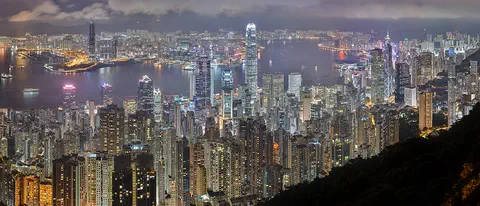
Hong Kong
Hong Kong, on the south coast of China, grew around one of the world's great natural harbors. It was a British colony for 156 years and has been a special administrative region of China since 1997. About 7.5 million people lived there in mid-2026.
Explore next
-
 Watch
 Country
China
China is the largest country in Asia, almost as big as all of Europe. The land steps down from the high, cold Plateau of Tibet in the west to plains and coasts in the east, and about 1.4 billion people live there, along with giant pandas in the mountains of south-central China.
-
 Watch
Natural wonder
Yangtze River
The Yangtze, called Chang Jiang (Long River) in China, is the longest river in Asia, about 6,300 kilometers. It starts in glacier meltwater on the Plateau of Tibet, cuts through deep gorges, passes huge cities like Chongqing, Wuhan and Nanjing, and reaches the East China Sea at Shanghai. Nearly a third of China's people live in its basin.
-
Watch
City
Hong Kong
Hong Kong, on the south coast of China, grew around one of the world's great natural harbors. It was a British colony for 156 years and has been a special administrative region of China since 1997. About 7.5 million people lived there in mid-2026.
-
Watch
City
Beijing
Beijing, the capital of China, has been the country's capital for most of the last 600 years. At its heart is the Forbidden City, the emperors' palace. About 21.8 million people lived in the Beijing municipality at the end of 2024.
-
 Watch
City
Ankara
Ankara is the capital of Türkiye, in the interior of Anatolia, about 200 kilometers from the Black Sea. People have lived here since the Stone Age, and Romans, Byzantines, Seljuks and Ottomans all left buildings behind. It became the capital in 1923, and today it is a city of government, universities and museums.
-
 Watch
City
Baghdad
Baghdad, the capital of Iraq, stands on the Tigris River in the land once called Mesopotamia. It was founded in 762 as a round city, and for about 500 years it was one of the greatest cities in the world and a great center of learning, where scholars studied math, medicine and the stars. Today it is Iraq's largest city.
-
 Watch
City
Baku
Baku, the capital of Azerbaijan, curves around a bay on the Caspian Sea, the world's largest inland body of water. Its old walled town, with the Maiden Tower and a palace of the Shirvan shahs, is a World Heritage Site, and oil has made the city important for more than 150 years.
-
 Watch
City
Bangkok
Bangkok, the capital of Thailand, lies on the delta of the Chao Phraya River, about 40 kilometers from the sea. It became the capital in 1782, when the new royal palace and temples were built. Once called the 'Venice of the East' for its canals, it is now a huge, busy city with skyscrapers and an elevated railway.
For parents & teachers
What children will learn
- Locate Shanghai on the coast of China near the mouth of the Yangtze.
- Explain how a fishing village grew into one of the world's largest ports.
- Describe how a maglev train uses magnets to float.
- Compare the old city and the new skyscraper district of Pudong.
Recommended ages: 3 to 17 · About 15 minutes
Talk about it
- Shanghai grew because ships could reach it easily. Why are ports often important cities?
- Pudong changed from farms and factories to skyscrapers in a few decades. What might be good and hard about changing that fast?
- Shanghai is only a few meters above the sea. What could a low city do to stay safe from high tides?
Try at home or in class
- Try a mini maglev: put two magnets with the same poles facing each other and feel them push apart. Can you make a light object float above another magnet?
- Stack paper cups to build the three Pudong towers to scale: 88, 101 and 128 cups' worth of stories, or 9, 10 and 13 cups.
Key vocabulary: port, delta, maglev, skyscraper, municipality, concession, census
Where these facts come from
- Wikidata , Wikimedia Foundation (CC0 1.0)
- Natural Earth vector data , Natural Earth (NACIS) (Public domain)
- Shanghai , Encyclopaedia Britannica
- Shanghai: Downtown Shanghai and the people , Encyclopaedia Britannica
- Shanghai: Economy and transportation , Encyclopaedia Britannica
- Shanghai: Administration, society and cultural life , Encyclopaedia Britannica
- Shanghai: History , Encyclopaedia Britannica
- Communiqué of the Seventh National Population Census (No. 3) , National Bureau of Statistics of China
- Shanghai: climatological information , World Meteorological Organization, World Weather Information Service
- Wikimedia Commons , Wikimedia Foundation (Per file (public domain, CC0, CC BY or CC BY-SA); see each media record)
Checked, not yet human-reviewed. Last updated October 27, 2026. Spotted a mistake? Tell us.