
City Europe
Ostrava
Ostrava is a big city in Czechia. It grew up around coal mines and ironworks.
Ostrava is the third-largest city in Czechia and the capital of the Moravian-Silesian Region. Universalis says it was born of the industrial revolution, as a place for mining coal, and grew with a big iron and steel industry. Czechia's 2021 census counted 282,450 people.
Ostrava, capital of the Moravian-Silesian Region, grew from coal mining and metallurgy (Universalis); its Vítkovice ironworks, begun in 1828 and closed in 1998, are now a national cultural monument (VisitCzechia). Census 26 March 2021: 282,450, Czechia's third city.
Photo: Marek Slusarczyk, CC BY 3.0, via Wikimedia Commons
Discover Ostrava
Ostrava is a big city in Czechia. Only two cities in Czechia have more people.
Until not long ago, many people there worked in coal mines and ironworks.
Ostrava is the capital of the Moravian-Silesian Region of Czechia. Universalis says the city was born of the industrial revolution, as a place for mining coal, and grew thanks to a powerful iron and steel industry.
Czechia's census of 26 March 2021 counted 282,450 people in Ostrava, the country's third-largest city. The Czech Statistical Office's estimate for 31 December 2024 is 283,187.
Universalis: capital of Moravia-Silesia; born of the industrial revolution as a seat of coal extraction, it developed through a powerful metallurgical industry; until recently most of the workforce was employed in mining, energy production and steelmaking.
Czech Statistical Office via City Population (city of Ostrava): census 2001 316,744; census 2011 296,224; census 26 March 2021 282,450; estimate 31 December 2024 283,187 (rank 3, after Prague and Brno).
- Country
- Czechia (capital of the Moravian-Silesian Region)
- People in Ostrava (census, 26 March 2021)
- 282,450
- Newer estimate (31 December 2024)
- 283,187
- Rank
- Czechia's third-largest city
A city seen from the sky
This photo was taken from high in the sky. You can see big blocks of buildings, roads, fields and woods. Far away, tall chimneys rise in the haze.
This photo shows Ostrava from the air on 18 September 2009. The photographer names the districts in it: Poruba, Svinov, Ostrava-Jih, Nová Ves and Vítkovice. Rows of large building blocks, roads and railway lines spread between green woods and brown and green fields, and tall chimneys stand in the haze far away.
VisitCzechia says the Vítkovice area, in the heart of Ostrava, shows a skyline of blast furnaces, steel structures, pipelines and bridges.
Commons: '003 Ostrava city, Czech Republic - aerial view', own work by Marek Ślusarczyk (Tupungato), CC BY 3.0, 18 September 2009; description: aerial view with the districts of Poruba, Svinov, Ostrava-Jih, Nová Ves and Vítkovice.
VisitCzechia: the Vítkovice area, in the heart of Ostrava, shows a unique panorama of blast furnaces, steel structures, pipelines and technological bridges; its silhouette has become one of the city's defining symbols. Wikidata: Poruba (Q3500288), a district of Ostrava, 8.79 km W of the city point.
- Photo
- aerial view of Ostrava, 18 September 2009, by Marek Ślusarczyk
- Districts in the photo
- Poruba, Svinov, Ostrava-Jih, Nová Ves and Vítkovice (the photographer's description)
- The Vítkovice area
- blast furnaces, steel structures, pipelines and bridges in the heart of Ostrava (VisitCzechia)
Coal and iron
Long ago, people dug coal out of the ground at Ostrava. They used it to make iron in huge furnaces, and the city grew bigger and bigger.
VisitCzechia says the Vítkovice ironworks began in 1828. In 1836 the first coke-fired blast furnace in the Habsburg Monarchy started work there, and over time the works grew to six blast furnaces.
For almost 170 years the site was very important for the region's industry. Universalis says that since the 1990s coal mining has stopped in the Ostrava area itself, and much of the steel industry has shut down. Iron production at Vítkovice ended in 1998.
VisitCzechia: the Vítkovice Ironworks date back to 1828, when an archduke of Austria began the establishment of an ironworks in Vítkovice; the first coke-fired blast furnace in the Habsburg Monarchy was put into operation in 1836; over time six blast furnaces joined the complex; for almost 170 years the site was crucial to the region's industrial development; production ended in 1998.
Universalis: Ostrava became the hub of an industrial conurbation with older and newer centers and diversified industry (metallurgy, machinery, chemicals, textiles, electrical equipment, electronics); since the 1990s coal mining has ceased in the Ostrava area itself, and a large part of the steel plants have stopped.
- 1828
- an ironworks was started in Vítkovice (VisitCzechia)
- 1836
- the first coke-fired blast furnace in the Habsburg Monarchy started work here (VisitCzechia)
- 1998
- iron production at Vítkovice ended (VisitCzechia)
Mines, furnaces and bridges joined up
At the old ironworks, coal from the mine rode on long moving belts. Bridges carried it straight to the furnaces. Now visitors can ride up a furnace and look out over the city.
VisitCzechia says the Hlubina Mine, in the north of the Vítkovice area, supplied coal. It was joined to the coking plant and the blast furnaces by a network of conveyor belts and transport bridges, so the whole chain from coal to iron sat in one place.
Today a lift carries visitors up Blast Furnace No. 1, with wide views of Ostrava. Universalis calls Ostrava the center of a group of industrial towns around it, such as Karviná and Frýdek-Místek.
VisitCzechia: the Vítkovice area keeps the complete technological chain from coal mining and coke production to pig iron in a single location; the Hlubina Mine in the north was connected to the coking plant and blast furnaces by conveyor belts, transport bridges and other infrastructure; the visitor route begins at Blast Furnace No. 1 and follows the raw materials (iron ore, coke, limestone); a skip lift carries visitors to the upper parts of the furnace.
Universalis: Ostrava became the pole of an industrial conurbation with old centers (Karviná) and new ones (Poruba, Frýdek-Místek, Třinec, Havířov and others). Wikidata: Lower Vítkovice (Q12016587), industrial heritage site, 1.93 km SSW of the city point.
- Hlubina Mine
- supplied coal, linked to the coking plant and blast furnaces by conveyor belts and transport bridges (VisitCzechia)
- Lower Vítkovice
- an industrial heritage site about 1.9 km from the city's Wikidata point (Wikidata)
- A conurbation
- Ostrava is the center of a group of industrial towns, including Karviná and Frýdek-Místek (Universalis)
Cold winters and rainy summers
Ostrava has cold winters and warm summers. Most of its rain falls in summer.
The World Meteorological Organization's averages for Ostrava for 1981 to 2010 show cold winters: in January the average daily high is only 1.6 °C and the average low is −4.3 °C. July is the warmest month, with an average high of 25.4 °C.
The summer months are the wettest: July brings 93.5 millimeters of rain, more than three times January's 28.9 millimeters. The twelve months add up to about 693 millimeters.
WMO World Weather Information Service, Ostrava (Czech Hydrometeorological Institute; period 1981–2010 as given in the data): mean daily maximum 1.6 °C (Jan) to 25.4 °C (Jul); mean daily minimum −4.3 °C (Jan) to 13.1 °C (Jul). Precipitation 28.9 mm (Jan) to 93.5 mm (Jul); June 91.3 mm, August 85.5 mm; sum of the months 693.4 mm. Mean days with at least 1 mm: 7.3 (Jan) to 10.7 (Jun); the twelve monthly means add up to about 106.
- Average daily highs (WMO, Ostrava, 1981–2010)
- 1.6 °C (January) to 25.4 °C (July)
- Average daily lows (same table)
- −4.3 °C (January) to 13.1 °C (July)
- Rain and snow in a year (twelve months added up)
- about 693 mm
From ironworks to a place for culture
Ostrava's old ironworks are now a place to visit. People go there to learn about science and technology, and to see the giant old furnaces up close.
VisitCzechia says the Vítkovice area is a national cultural monument and one of Europe's best-kept industrial heritage sites. People often call the mine, coking plant and furnaces together 'Ostrava's Hradčany'.
After iron making ended in 1998, the area was changed into Dolní Vítkovice, a lively center of culture, education, science and social life. It has the Bolt Tower, the Gong hall and the World of Technology.
VisitCzechia: the Vítkovice area is a national cultural monument, one of Europe's most significant and best-preserved industrial heritage sites; the interconnected operations are often called 'Ostrava's Hradčany'; after production ended in 1998 the area was transformed and revitalised; Dolní Vítkovice is a center of culture, education, science and social life, with the Bolt Tower, the Gong multifunctional hall and the World of Technology. Wikidata: Bolt Tower (Q30249466), height 77.7 m, 2.09 km SSW of the city point.
- National cultural monument
- the Vítkovice area: the Hlubina mine, the coking plant and the blast furnaces (VisitCzechia)
- Dolní Vítkovice today
- a center of culture, education, science and social life (VisitCzechia)
- Bolt Tower
- 77.7 m tall (Wikidata)
Ostrava on the map
Find Czechia on the globe. Ostrava is in the far east of the country.
Ostrava lies at about 49.8° north and 18.3° east, in the Moravian-Silesian Region in the east of Czechia.
Measured from the city's center point on Wikidata, Lower Vítkovice is about 1.9 kilometers south-southwest, the Bolt Tower about 2.1 kilometers south-southwest and the district of Poruba about 8.8 kilometers west.
Ostrava lies at about 49.84° N and 18.29° E (Wikidata point Q8385; the Natural Earth/sheet point is 3.10 km from it). From the Wikidata point: Lower Vítkovice (Q12016587) 1.93 km SSW; Bolt Tower (Q30249466) 2.09 km SSW; Poruba (Q3500288) 8.79 km W.
- Latitude
- about 49.8° north
- Longitude
- about 18.3° east
- Region
- Moravian-Silesian Region, Czechia
Amazing facts
-
At Ostrava's old ironworks, visitors can ride a lift up the side of a huge furnace!
VisitCzechia says a skip lift carries visitors to the upper parts of Blast Furnace No. 1, with wide views of Ostrava.
VisitCzechia: the visitor route begins at Blast Furnace No. 1; a skip lift carries visitors to its upper sections.
-
At Ostrava's old ironworks, everything needed to make iron was in one place: a coal mine, a coke plant and the furnaces!
VisitCzechia says the Vítkovice area keeps the whole chain of iron making in one place, from the coal mine to the coke plant to the blast furnaces.
VisitCzechia: the Vítkovice area uniquely preserves the complete technological chain from coal mining and coke production to the manufacture of pig iron in a single location.
-
In Ostrava, July gets more than three times as much rain as January.
In the World Meteorological Organization's averages, July brings Ostrava 93.5 millimeters of rain and January 28.9 millimeters.
WMO normals for Ostrava (1981–2010): July 93.5 mm, January 28.9 mm, a ratio of about 3.2.
Words to know
- coal
- a black rock dug from the ground that burns and gives heat
- ironworks
- a factory where iron is made from rock called iron ore
- blast furnace
- a very tall, very hot oven where iron ore is melted to make iron
- coke
- a fuel made by heating coal, used in blast furnaces
- industrial revolution
- the time when machines and factories changed how people worked and lived
- census
- an official count of all the people in a country
Discovery challenge
-
Ostrava is a city in which country?
Ostrava is the capital of the Moravian-Silesian Region of which country?
Ostrava is the third-largest city of which country?
- Czechia
- Portugal
- Greece
Show the answer
Czechia
Czechia!
Czechia.
Czechia.
-
What did people dig out of the ground at Ostrava?
Universalis says Ostrava was born as a place for mining what?
According to Universalis, Ostrava was born of the industrial revolution as a seat of extracting what?
- Coal
- Gold
- Salt
Show the answer
Coal
Coal!
Coal.
Coal.
-
In which year did the old ironworks at Vítkovice begin?
In which year did the Vítkovice ironworks begin?
VisitCzechia dates the origins of the Vítkovice Ironworks to which year?
- 1828
- 1998
- 1728
Show the answer
1828
1828!
1828.
1828.
-
How many big furnaces did the Vítkovice ironworks have?
Over time, how many blast furnaces became part of the Vítkovice complex?
VisitCzechia: how many blast furnaces became part of the Vítkovice complex over time?
- Six
- Two
- Twenty
Show the answer
Six
Six!
Six.
Six.
-
Which month is the rainiest in Ostrava?
In the World Meteorological Organization's averages, which month gets the most rain in Ostrava?
WMO normals for Ostrava (1981–2010): which month has the most precipitation, 93.5 mm?
- July
- January
- October
Show the answer
July
July!
July.
July (93.5 mm).
Nearby places
-
 Watch
City
Kraków
Kraków is a city in southern Poland on the Vistula River. For almost three centuries it was the capital of Poland, where kings were crowned and buried at Wawel Hill. Its historic center is a UNESCO World Heritage Site, and about 816,600 people lived in the city at the end of 2025.
-
 Watch
City
Bratislava
Bratislava is the capital of Slovakia, on the Danube River close to the borders with Austria and Hungary. For more than 200 years it was the capital of the Kingdom of Hungary. The 2021 census counted 475,503 people in the city.
-
 Watch
City
Vienna
Vienna is the capital of Austria, on the Danube River. For centuries it was the home of emperors, and composers such as Haydn, Mozart and Beethoven lived and worked there. About 2 million people lived in the city at the start of 2026.
-
Watch
Landmark
Belvedere
The Belvedere in Vienna is made of two Baroque palaces, the Lower and the Upper Belvedere, joined by a large garden. Prince Eugene of Savoy had them built as a summer home from 1712 to 1723, to designs by Johann Lukas von Hildebrandt. In 1777 the Upper Belvedere became, the museum says, one of the world's first public museums, and today the Belvedere is an art museum.
-
 Watch
City
Košice
Košice is the second-largest city in Slovakia and the center of the country's east. It lies in the valley of the Hornád River, with hills and mountains around it. Slovakia's 2021 census counted 229,040 people in the city.
-
 Watch
City
Budapest
Budapest, the capital of Hungary, was made in 1873 by joining three towns on the Danube River: hilly Buda and old Óbuda on one bank and flat Pest on the other. About 1.7 million people live there (2026), with hot springs under the ground and the first underground railway built on the European mainland.
-
 Watch
City
Prague
Prague, the capital of the Czech Republic, lies on the Vltava River in the heart of Europe. With Prague Castle on its hill, the 14th-century Charles Bridge and so many church towers that it is called the 'City of a Hundred Spires', its historic center is a UNESCO World Heritage Site. About 1.4 million people lived there in 2025.
-
 Watch
Landmark
Old New Synagogue
The Old New Synagogue in Prague was built in the 1270s. Prague's official tourist site calls it the oldest synagogue in Central Europe and one of the oldest Gothic buildings in the country. It has a high saddle roof with tall brick gables.
Explore next
-
 Watch
 Country
Czechia
Czechia, also called the Czech Republic, is a landlocked country in central Europe. Mountains ring the old land of Bohemia, the Vltava River flows through the capital, Prague, and about 10.9 million people lived there in 2026.
-
Watch
City
Prague
Prague, the capital of the Czech Republic, lies on the Vltava River in the heart of Europe. With Prague Castle on its hill, the 14th-century Charles Bridge and so many church towers that it is called the 'City of a Hundred Spires', its historic center is a UNESCO World Heritage Site. About 1.4 million people lived there in 2025.
-
Watch
City
Kraków
Kraków is a city in southern Poland on the Vistula River. For almost three centuries it was the capital of Poland, where kings were crowned and buried at Wawel Hill. Its historic center is a UNESCO World Heritage Site, and about 816,600 people lived in the city at the end of 2025.
-
Watch
City
Košice
Košice is the second-largest city in Slovakia and the center of the country's east. It lies in the valley of the Hornád River, with hills and mountains around it. Slovakia's 2021 census counted 229,040 people in the city.
-
 Watch
City
Amsterdam
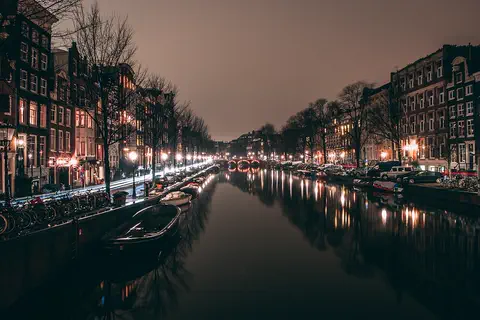
Amsterdam is the capital of the Netherlands. It began as a fishing village beside a dam on the Amstel River, which gave the city its name. Today about 942,000 people live among its rings of canals, hundreds of bridges, houseboats and bicycles.
-
 Watch
City
Antwerp
Antwerp is a city in Belgium on the Scheldt river, and Universalis calls it the second port of continental Europe, after Rotterdam. Belgium's statistics office estimated 565,615 people in the city on 1 January 2026. In the 1500s it was one of Europe's great trading cities.
-
 Watch
City
Athens
Athens is the capital of Greece and one of the oldest cities in the world. Above it rises the Acropolis, a rocky hill crowned by the marble Parthenon, built about 2,500 years ago. Ancient Athens was home to early democracy, great thinkers and theater.
-
 Watch
City
Barcelona
Barcelona, the capital of Catalonia in northeastern Spain, lies on the Mediterranean between mountains and the sea. It is famous for the buildings of the architect Antoni Gaudí, including the Sagrada Família, a giant church begun in 1882. About 1.7 million people live in the city (2025).
For parents & teachers
What children will learn
- Locate Ostrava in the east of Czechia.
- Explain how coal and iron helped a city grow during the industrial revolution.
- Describe how an old industrial site can be reused for culture and learning.
- Read a climate table with cold winters and wetter summers.
Recommended ages: 3 to 17 · About 15 minutes
Talk about it
- Why might a city grow up near a coal mine?
- What happens to a city when its mines and factories close?
- Why might people want to keep old furnaces instead of knocking them down?
Try at home or in class
- Coal to iron chain: draw the chain from mine to coking plant to blast furnace and label what moves along each link.
- Rain bars: make a bar chart of Ostrava's monthly rain and find the wettest season.
- Time math: the ironworks began in 1828 and stopped making iron in 1998. How many years is that?
Key vocabulary: coal, ironworks, blast furnace, coke, industrial revolution, census
Where these facts come from
- Wikidata , Wikimedia Foundation (CC0 1.0)
- Natural Earth vector data , Natural Earth (NACIS) (Public domain)
- Ostrava , Encyclopædia Universalis
- Vítkovice: Into the Heart of Europe's Industrial Heritage , VisitCzechia (CzechTourism)
- Czech Republic: Cities , City Population (Thomas Brinkhoff), from the Czech Statistical Office
- Ostrava: climatological information (1981–2010) , World Meteorological Organization, World Weather Information Service
- File:003 Ostrava city, Czech Republic - aerial view.jpg (Marek Ślusarczyk, September 2009) , Wikimedia Commons
- Wikimedia Commons , Wikimedia Foundation (Per file (public domain, CC0, CC BY or CC BY-SA); see each media record)
Checked, not yet human-reviewed. Last updated November 1, 2026. Spotted a mistake? Tell us.