
City Europe
Budapest
Budapest is the capital city of Hungary. The Danube River runs through the middle. Bridges join the hilly side to the flat side.
Budapest, the capital of Hungary, was made in 1873 by joining three towns on the Danube River: hilly Buda and old Óbuda on one bank and flat Pest on the other. About 1.7 million people live there (2026), with hot springs under the ground and the first underground railway built on the European mainland.
Budapest, capital of Hungary, unites Buda, Óbuda and Pest, which faced each other across the Danube until their union took effect in 1873. Its 525 km² hold about 1.7 million people (2026), one in five Hungarians, and UNESCO protects its Danube banks, Buda Castle Quarter and Andrássy Avenue, with continental Europe's first underground railway beneath it.
Photo: Thomas Depenbusch (Depi) from Cologne, Germany, CC BY 2.0, via Wikimedia Commons
Discover Budapest
Budapest is the capital city of Hungary.
A wide river called the Danube flows through the middle. On one side there are hills and a castle. On the other side the land is flat. Long bridges join the two sides.
Budapest is the capital of Hungary, in central Europe. The wide Danube River splits it in two. On the west bank is Buda, built on hills and high river terraces. On the east bank is Pest, which is much bigger and spreads across a flat, sandy plain. Bridges link the two halves.
About 1.7 million people lived in the city in 2026, about one in every five people in Hungary. Budapest was once called the "Queen of the Danube." Today it is divided into 23 districts, and each one has its own mayor.
Budapest is Hungary's political, administrative, industrial and commercial center and the seat of Pest county. It stands where the hills of western Hungary meet the plains stretching east and south, at the center of the Carpathian Basin, on an ancient route that crossed the Danube here because a few islands made the wide river fordable. Buda occupies the higher terraces and hills of the west bank; the considerably larger Pest spreads across a flat, featureless sand plain on the east bank.
The site has been settled continuously since prehistoric times. The city covers 525 km², about half of it built up, and held 1,675,777 people at the start of 2026, roughly a fifth of the country's population. It is divided into 23 districts (6 in Buda, 16 in Pest, and Csepel Island), each with its own mayor, under a chief mayor and a 34-member General Assembly. Britannica notes that more than half of Hungary's university students study there.
- Country
- Hungary (capital)
- People in the city (2026)
- about 1.7 million
- Area of the city
- 525 km²
- Districts
- 23, each with its own mayor
Famous places
Budapest has a castle on a hill.
Across the river stands a huge, fancy building called the Parliament. The oldest bridge is held up by giant iron chains.
On the Buda side, Castle Hill rises 168 meters above sea level. On top stands Buda Castle, a royal palace rebuilt many times. Today it holds a library and museums. Nearby, the spire of the old Matthias Church pokes into the sky, and in front of it stands the Fishermen's Bastion, built in the late 1800s.
Facing the castle across the river is the Parliament Building, built between 1884 and 1904 in an ornate Gothic Revival style. The Széchenyi Chain Bridge, finished in 1849, is the oldest of the city's bridges. In the Danube lies Margaret Island, a park about a mile long with swimming pools.
UNESCO inscribed "Budapest, including the Banks of the Danube, the Buda Castle Quarter and Andrássy Avenue" in 1987 and extended it in 2002. Castle Hill (168 m) carries Buda Castle: a 13th-century fortress replaced by a large Baroque palace under Maria Theresa (queen 1740–80), razed in World War II and restored by the mid-1970s. It now houses the National Széchényi Library, the Budapest History Museum and the Hungarian National Gallery. Beside it rise the Gothic Matthias Church and the Neo-Romanesque Fishermen's Bastion.
The Neo-Gothic Parliament (1884–1904), influenced by London's Houses of Parliament, faces the castle across the river; UNESCO ranks it with the great parliament buildings of London, Munich, Vienna and Athens. W.T. Clark's suspension bridge, the Széchenyi Chain Bridge, finished in 1849 and named for the reformer István Széchenyi, became a symbol of the union of Buda and Pest. South of Castle Hill, Gellért Hill, a steep limestone cliff, carries the Citadel, built by the Austrian army in the mid-19th century to watch over the town.
- Széchenyi Chain Bridge
- finished 1849
- Parliament Building
- built 1884–1904
- Castle Hill
- 168 m above sea level
- UNESCO World Heritage Site
- 1987, extended 2002
Three towns become one city
Long ago, the Romans built a town here by the river.
Later there were three towns: Buda, Óbuda and Pest. In 1873 they joined together. The new city was called Budapest!
People have lived beside the Danube here since the Stone Age. At the end of the first century, the Romans built a camp and a town called Aquincum, with two amphitheaters, about 3 kilometers north of today's Castle Hill.
In the Middle Ages, a fortress and town grew on Castle Hill. This was Buda, and the old Roman site to the north became Óbuda, "Old Buda." Across the river stood Pest. In 1838 a great flood destroyed more than half the houses in Pest. In 1872 a law joined Buda, Óbuda and Pest into one city, which began in 1873. Budapest then grew fast: about 100,000 people lived there in the 1840s, and 1,000,000 by 1918.
Neolithic people settled the west bank; the Celtic Eravisci founded Ak-Ink ("Ample Water"), which became Aquincum when the Romans built a military camp and civilian town at the end of the 1st century CE. It was the seat of the province of Pannonia Inferior from about 106 and grew into a thriving town with two amphitheaters. The settlement later moved to Castle Hill, while Pest grew on the east bank. Mongol invaders devastated Pest in 1241; King Béla IV built the castle of Buda soon after and granted a royal charter in 1244. Turkish forces held Buda from 1541 to 1686.
Pest boomed from the late 18th century. In 1848 revolution broke out in Pest; under the Dual Monarchy of 1867, Pest became one of the empire's two seats of government. Buda, Pest and Óbuda were united by an 1872 law that took effect in 1873. In the fighting of winter 1944–45, Castle Hill was left in ruins and every bridge was blown up. In October 1956 a student demonstration grew into an uprising that briefly overthrew the communist government before the Soviet army retook the city in early November. From the late 1980s Hungary moved to multiparty politics, and in the 1990s the city opened up to private business, foreign investment and tourism.
Getting around Budapest
Budapest has trains under the ground.
One of them is very old. It was the first underground train in mainland Europe! Trams rattle along the streets too. In the hills, children help run a little railway.
Under Andrássy Avenue runs the Millennium Underground Railway, built between 1893 and 1896. It was the first underground railway on the European continent, and it still carries passengers today. Today the metro has four lines, and one of them runs under the Danube.
Horse-drawn trams first appeared in 1866, and electric trams in 1887. Today trams and buses fill the streets. To reach the wooded Buda Hills, you can ride an old cog railway or a chairlift up János Hill. There, the Children's Railway winds through the trees, and it is run mostly by children!
Transportation built Budapest's growth: the country's main roads and railway lines all radiate from the capital, which also has Hungary's largest bus terminal and its largest commercial airport, Budapest Ferenc Liszt International. Csepel Free Port on Csepel Island handles container freight on the Danube, and the international Danube Commission has its head office in the city.
Horse trams began in 1866 and electric ones in 1887; buses followed in 1915. UNESCO lists the Millennium Underground Railway (1893–1896), dug beneath Andrássy Avenue, as continental Europe's first underground railway; it remains in service, though its City Park stations were moved underground. The metro, built mainly in the 1970s, runs four lines, one under the river linking Buda and Pest. A cog railway, buses and a chairlift serve the Buda Hills, where János Hill reaches 527 m, the city's highest point, and the Children's Railway (Gyermekvasút) is managed largely by children.
- Millennium Underground Railway
- built 1893–1896, the first in continental Europe
- Metro lines
- 4
- Main airport
- Budapest Ferenc Liszt International
Weather and seasons
Budapest has four seasons.
Winters are cold, and sometimes lots of snow falls. Summers can be hot. Spring and autumn are in between.
Budapest has cold winters and warm to hot summers. In January, the average high is about 3 °C and the average low about −3 °C, a little below freezing. In July, highs average about 28 °C and lows about 16 °C.
Snow can fall heavily in winter, and in summer heat waves with damp air can feel stuffy. About 535 millimeters of rain and snow fall in a year, and the wettest months are May to August. Long ago, the Danube often flooded Pest, until people tamed the river in the 1800s.
Britannica describes a climate transitional between the extremes of the Great Hungarian Plain and the milder, wetter hills of Transdanubia, with a mean annual temperature of about 11 °C. World Meteorological Organization normals for 1981–2010 give mean daily maxima and minima of 2.6 °C and −3.0 °C in January and 27.9 °C and 16.4 °C in July.
The WMO's monthly precipitation totals add up to about 535 mm, wettest in May and June at about 62–64 mm and driest in February at about 26 mm. Winter snowfalls can be heavy and temperatures can drop below −15 °C, while humid summer heat waves can make the air oppressive. Flooding was a constant threat to Pest until the river was regulated in the 19th century.
- January, average daily high and low
- about 3 °C and −3 °C
- July, average daily high and low
- about 28 °C and 16 °C
- Precipitation in a year
- about 535 mm
Living in Budapest
Hot water bubbles up from under Budapest.
People swim and relax in warm baths. The city has big museums, concert halls and an opera house. There is a big park on an island in the river.
Hot springs bubble up from deep under the city, and people have bathed in them since Roman times. Today Budapest has many thermal baths, where visitors soak in warm mineral water, and lots of swimming pools too.
Budapest is also Hungary's center for music, books, theater and science. The Hungarian National Museum was founded in 1802, and the pianist and composer Franz Liszt founded the city's famous music academy in 1875. The composers Béla Bartók and Zoltán Kodály both lived here. Green places include the wooded Buda Hills, with their footpaths, and Margaret Island, a park in the middle of the river.
Numerous underground hot springs, carrying radium and other minerals, feed a large variety of thermal baths; bathers have sought them out since Roman times. Britannica also notes an unusual number of bookshops and swimming pools.
The capital dominates Hungary's cultural life: broadcasting and film are based here, most leading schools and universities are here, and so are the Hungarian Academy of Sciences and most of its research institutes. Composers Ferenc Erkel, Ernst von Dohnányi, Béla Bartók and Zoltán Kodály lived in the city. The Hungarian National Museum dates from 1802; the music academy founded by Franz Liszt in 1875 is internationally known; the Opera House was restored in 1984; and the National Theatre (2002) and Müpa Budapest (2005) stand by the Danube. Between the 1840s and 1918 the population grew from about 100,000 to 1,000,000, mainly through people moving in from villages and towns; Britannica describes today's city as almost entirely Hungarian-speaking, apart from its many visitors.
- Hungarian National Museum
- founded 1802
- Franz Liszt Academy of Music
- founded 1875
Budapest on the map
Find Budapest on the globe.
It is in Hungary, in the middle of Europe. Look for the long Danube River. Budapest sits right on it.
Budapest is in Hungary, in central Europe. The Danube flows through the middle of the city, past Margaret Island and, farther downstream, Csepel Island.
On the west bank, the Buda side, three hills line the river: Rose Hill, Castle Hill and Gellért Hill. Behind them rise the wooded Buda Hills. On the east bank, Pest stretches out flat, with wide boulevards curving around its old center.
Budapest lies at about 47.5° N and 19.1° E, at the center of the Carpathian Basin, where the hills of Transdanubia meet the Great Hungarian Plain. The Danube flows south through the city past Margaret Island and, downstream, Csepel Island.
On the right (west) bank, Rózsa (Rose) Hill, Castle Hill (168 m) and the higher Gellért Hill (235 m) rise above the river, backed by the wooded Buda Hills, which reach 527 m at János Hill. On the left bank, Pest's boulevards form semicircles around the Belváros (Inner Town); the Nagykörút (Great Boulevard) follows the bed of a dried-up tributary of the Danube, and Andrássy Avenue runs straight out to City Park.
- Latitude
- about 47.5° north
- Longitude
- about 19.1° east
- Highest point
- János Hill, 527 m
Amazing facts
-
In Budapest, children help run a real railway.
The Children's Railway in the Buda Hills is run mostly by children.
The Gyermekvasút (Children's Railway), which winds through the Buda Hills, is managed largely by children.
-
Budapest's old underground train was the first one in mainland Europe.
The Millennium Underground Railway, built from 1893 to 1896 under Andrássy Avenue, was the first underground railway on the European mainland.
UNESCO calls the Millennium Underground Railway (1893–1896), beneath Andrássy Avenue, the first in continental Europe; its stations under the Avenue keep their original features.
-
Warm water comes up from under the ground in Budapest.
Hot springs full of minerals lie under Budapest, and people have bathed in them since Roman times.
Numerous underground hot springs, containing radium and other minerals, feed Budapest's thermal baths; bathers have used them since Roman times.
-
At first, the city's name had a dash in it: Buda-Pest.
When the towns were united in 1872, the new city was called "Buda-Pest." Within a year the hyphen had disappeared.
"Buda-Pest" was created in 1872 when Pest, Buda and Óbuda were united into one borough of 10 districts; within a year the hyphen had vanished, even from official documents.
-
Budapest grew very fast, from a town into a giant city.
About 100,000 people lived in Budapest in the 1840s. By 1918 there were 1,000,000.
Budapest grew from about 100,000 people in the 1840s to 1,000,000 in 1918, faster than London over the same years, almost entirely through people moving in.
Words to know
- capital
- the city where a country's government meets
- district
- one of the parts a city is divided into; Budapest has 23
- suspension bridge
- a bridge whose road hangs from cables or chains held up by towers
- thermal bath
- a pool or bathhouse filled with warm water from a hot spring
- hot spring
- a place where warm water flows up out of the ground
- underground railway
- a railway that runs in tunnels beneath a city; also called a subway or metro
- World Heritage Site
- a place UNESCO lists as important to all people, to be protected
Discovery challenge
-
Which river flows through Budapest?
Which river flows through the middle of Budapest?
Which river separates Buda from Pest?
- The Thames
- The Danube
- The Volga
Show the answer
The Danube
The Danube! It flows right through Budapest.
The Danube splits Budapest in two, with hilly Buda on the west bank and flat Pest on the east bank.
The Danube: Buda occupies the hills and terraces of the west bank, and the larger Pest the sand plain to the east.
-
Budapest's name comes from two towns. Which two?
Budapest's name joins the names of two towns on opposite banks. Which two?
Which two towns, on opposite banks of the river, give Budapest its name?
- Buda and Pest
- Bern and Paris
- Bonn and Prague
Show the answer
Buda and Pest
Buda and Pest! Put them together and you get Budapest.
Buda and Pest. A third town, Óbuda, joined them too, and the new city began in 1873.
Buda and Pest, together with Óbuda, were united by an 1872 law that took effect in 1873; the name was first written "Buda-Pest."
-
When was Budapest's first underground railway finished?
In which year was the Millennium Underground Railway, the first on the European mainland, finished?
In which year was the Millennium Underground Railway beneath Andrássy Avenue completed?
- 1796
- 1896
- 1996
Show the answer
1896
1896! That is more than 100 years ago.
It was built between 1893 and 1896, and it still carries passengers today.
Built 1893–1896, it was the first underground railway in continental Europe, according to UNESCO.
-
Who helps run the Children's Railway in the hills?
Who runs most of the Children's Railway in the Buda Hills?
Who largely manages the Gyermekvasút, the railway that winds through the Buda Hills?
- Children
- Robots
- Astronauts
Show the answer
Children
Children! That is why it is called the Children's Railway.
Children do most of the work on this railway through the wooded Buda Hills.
Britannica describes the Children's Railway as managed largely by children.
-
What fills the warm baths in Budapest?
What fills Budapest's famous thermal baths?
What supplies Budapest's thermal baths?
- Hot spring water
- Sea water
- Melted snow
Show the answer
Hot spring water
Hot spring water! It comes up warm from under the ground.
Warm water full of minerals rises from hot springs under the city. People have bathed in it since Roman times.
Numerous underground hot springs, carrying radium and other minerals, feed the baths; they have drawn bathers since Roman times.
Nearby places
-
 Watch
City
Vienna
Vienna is the capital of Austria, on the Danube River. For centuries it was the home of emperors, and composers such as Haydn, Mozart and Beethoven lived and worked there. About 2 million people lived in the city at the start of 2026.
-
 Watch
City
Belgrade
Belgrade, the capital of Serbia, stands where the Sava River flows into the Danube. Its name, Beograd, means "white city", probably because of the white limestone walls of its old fortress above the rivers. At the 2022 census, about 1.2 million people lived in the city itself and about 1.7 million in the wider City of Belgrade.
-
 Watch
City
Prague
Prague, the capital of the Czech Republic, lies on the Vltava River in the heart of Europe. With Prague Castle on its hill, the 14th-century Charles Bridge and so many church towers that it is called the 'City of a Hundred Spires', its historic center is a UNESCO World Heritage Site. About 1.4 million people lived there in 2025.
-
 Watch
City
Warsaw
Warsaw is the capital of Poland, on the Vistula River. Much of the city was destroyed in World War II, and afterward its people rebuilt the Old Town so carefully that UNESCO made it a World Heritage Site. About 1.86 million people lived there in 2024.
-
 Watch
City
Munich
Munich is the capital of Bavaria, a state in southern Germany, and the country's third-biggest city. It began in 1158 as a market by a bridge over the Isar River, and its name means "Home of the Monks." Today it is famous for its palaces, art museums, the huge Deutsches Museum and its autumn Oktoberfest.
-
 Watch
City
Venice
Venice, in northern Italy, is spread over 118 small islands in a shallow lagoon off the Adriatic Sea. There are no cars in the old city: people walk or travel by boat along its canals, past palaces and over about 400 bridges. High tides sometimes flood its squares, so giant gates now protect the lagoon.
-
 Watch
Landmark
Neuschwanstein Castle
Neuschwanstein Castle stands on a rocky ridge in Bavaria, Germany. King Ludwig II had it built from 1869 as a private retreat in the style of a medieval knights' castle, but with the newest technology inside. It opened to visitors in 1886, and in 2025 about 1.1 million people came.
-
 Watch
City
Sofia
Sofia, the capital of Bulgaria, lies in a valley near the middle of the Balkans, at the foot of Vitosha Mountain. The Romans called it Serdica, and an old church of St. Sofia later gave the city its name. About 1.2 million people lived there in 2025.
Explore next
-
Watch
 Country
Hungary
Hungary is a landlocked country in central Europe, in a wide lowland called the Carpathian Basin. Wide plains cover much of it, the Danube River flows through its capital, Budapest, and about 9.5 million people lived there in 2026.
-
 Watch
Natural wonder
Danube
The Danube is Europe's second-longest river, after the Volga. It begins as two small streams in Germany's Black Forest and flows about 2,850 kilometers east to the Black Sea, passing through 10 countries and four capital cities. For more than 2,000 years it has been a border, a highway for boats and a home for wildlife, and it ends in a giant delta of reeds, lakes and birds.
-
Watch
City
Vienna
Vienna is the capital of Austria, on the Danube River. For centuries it was the home of emperors, and composers such as Haydn, Mozart and Beethoven lived and worked there. About 2 million people lived in the city at the start of 2026.
-
Watch
City
Prague
Prague, the capital of the Czech Republic, lies on the Vltava River in the heart of Europe. With Prague Castle on its hill, the 14th-century Charles Bridge and so many church towers that it is called the 'City of a Hundred Spires', its historic center is a UNESCO World Heritage Site. About 1.4 million people lived there in 2025.
-
 Watch
City
Bucharest
Bucharest, the capital of Romania, lies on a wide plain beside the Dâmbovița River. First written about in 1459, it became the capital of Walachia in 1659 and of Romania in 1862. Today it is a city of broad boulevards, a huge parliament palace, the Romanian Athenaeum concert hall and an open-air Village Museum.
-
Watch
City
Belgrade
Belgrade, the capital of Serbia, stands where the Sava River flows into the Danube. Its name, Beograd, means "white city", probably because of the white limestone walls of its old fortress above the rivers. At the 2022 census, about 1.2 million people lived in the city itself and about 1.7 million in the wider City of Belgrade.
-
 Watch
City
Amsterdam
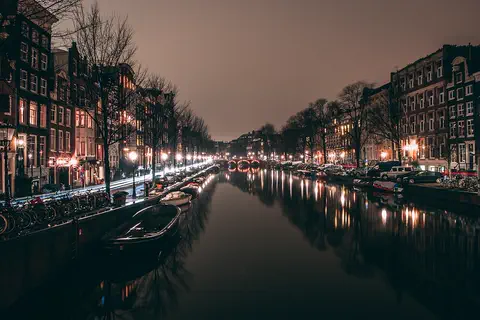
Amsterdam is the capital of the Netherlands. It began as a fishing village beside a dam on the Amstel River, which gave the city its name. Today about 942,000 people live among its rings of canals, hundreds of bridges, houseboats and bicycles.
-
 Watch
City
Athens
Athens is the capital of Greece and one of the oldest cities in the world. Above it rises the Acropolis, a rocky hill crowned by the marble Parthenon, built about 2,500 years ago. Ancient Athens was home to early democracy, great thinkers and theater.
For parents & teachers
What children will learn
- Locate Budapest on the Danube in central Europe and explain how three towns became one city.
- Compare the two sides of the city: hilly Buda and flat Pest.
- Describe how bridges, trams and an early underground railway connected a growing city.
- Read average daily highs and lows to describe a climate with cold winters and warm summers.
Recommended ages: 3 to 17 · About 15 minutes
Talk about it
- Budapest began as separate towns on opposite banks of a river. What might change when two towns become one city?
- Why do you think a bridge across the Danube became a symbol of Buda and Pest joining together?
- The Children's Railway is run mostly by children. What job in your town would you like to try, and what would you need to learn?
Try at home or in class
- Draw the Danube as a line down the middle of a page. Add hills and a castle on the left (Buda) and flat streets on the right (Pest), then draw bridges to join them.
- Make a model suspension bridge: tie string between two stacks of books and hang a strip of card from it with paper clips. How much weight can the road hold?
Key vocabulary: capital, district, suspension bridge, thermal bath, hot spring, underground railway, World Heritage Site
Where these facts come from
- Wikidata , Wikimedia Foundation (CC0 1.0)
- Natural Earth vector data , Natural Earth (NACIS) (Public domain)
- UNESCO World Heritage List , UNESCO World Heritage Centre (Linked as a reference; site facts come from Wikidata)
- Budapest , Encyclopaedia Britannica
- Budapest: People, economy and transportation , Encyclopaedia Britannica
- Budapest: Administration, cultural life and early history , Encyclopaedia Britannica
- Budapest: The modern city , Encyclopaedia Britannica
- Budapest, including the Banks of the Danube, the Buda Castle Quarter and Andrássy Avenue , UNESCO World Heritage Centre
- Budapest: climatological information , World Meteorological Organization, World Weather Information Service
- Wikimedia Commons , Wikimedia Foundation (Per file (public domain, CC0, CC BY or CC BY-SA); see each media record)
Checked, not yet human-reviewed. Last updated October 27, 2026. Spotted a mistake? Tell us.