
City Europe
Vaduz
Vaduz is the capital of Liechtenstein, a tiny country in the Alps. A castle sits on the hill above the town.
Vaduz is the capital of Liechtenstein. It lies on the edge of the Rhine valley, below a steep mountainside, with Vaduz Castle, the home of the country's prince, on a ledge above the town. About 6,100 people lived in Vaduz at the end of 2025, and the town has never had a railway.
Vaduz, first named in writing as 'Faduzes' between 1175 and 1200, grew below a castle first mentioned in 1322 and became the main town of the Principality of Liechtenstein, formed in 1719. Its castle has been the prince's home since 1938. The preliminary count for the commune was 6,109 people on 31 December 2025, a little fewer than neighboring Schaan.
Photo: Lucas Kendall, CC BY-SA 4.0, via Wikimedia Commons
Discover Vaduz
Vaduz is a capital city where about 6,000 people live. It is the capital of Liechtenstein, a tiny country between Switzerland and Austria.
A steep mountainside rises behind the town.
Vaduz is the capital of Liechtenstein, a country in the Alps between Switzerland and Austria. The town lies where the flat valley of the Rhine River meets a steep mountainside.
Liechtenstein's statistics office counted 6,109 people in the commune of Vaduz at the end of 2025 (a preliminary figure). That is a little fewer than Schaan, the next commune to the north, so the capital is not the country's most populous commune.
The Historical Lexicon of the Principality of Liechtenstein describes Vaduz as the political commune and main town of the principality, 455 m above sea level at its parish church, with an area of 17.284 km². Besides the town itself, the commune owns six exclaves: four on the Rhine valley side (the farmland of the Vaduzer Riet and three forest plots) and two Alpine pastures in the mountains.
City Population's table from the Office of Statistics gives 6,109 people for Vaduz on 31 December 2025 (preliminary), up from 5,741 in the 2020 register-based census. Schaan had 6,297, so Vaduz ranks second of the 11 communes.
- Country
- Liechtenstein (its capital)
- People in Vaduz commune (preliminary, 31 December 2025)
- 6,109
- Area of the commune
- 17.284 km² (with six exclaves)
- Height above sea level
- 455 m (at the parish church)
A castle and a black box
A castle stands on a ledge high above Vaduz. The prince of Liechtenstein lives there.
Down in the town is an art museum shaped like a big dark box.
Vaduz Castle stands on a narrow ledge about 100 meters above the town. It was first mentioned in about 1322, and since 1938 it has been the home of Liechtenstein's ruling prince.
Down in the town's pedestrian zone stands the Kunstmuseum Liechtenstein, the country's museum of modern and contemporary art. It opened in November 2000. The museum calls its building the 'Black Box': its dark walls are made of tinted cement, black basalt and river pebbles, ground until they gleam softly.
Encyclopaedia Universalis says the castle, mentioned in a document from about 1322, was destroyed in the Swabian War of 1499, rebuilt over the following centuries and restored in 1905–1916 in the style of the 16th century. The princes owned it from 1712, but Franz Joseph II, who came to the throne in 1938, was the first to make it his permanent home.
The Kunstmuseum, designed by Meinrad Morger and Heinrich Degelo with Christian Kerez, is a dark block 60 m long, almost 25 m wide and 12 m high, with 1,750 m² for exhibitions. Its facade mixes cement colored with soot and iron oxide, black basalt and river pebbles that echo the Rhine valley, ground to a gently gleaming surface.
- Vaduz Castle
- first mentioned about 1322; restored 1905–1916
- Kunstmuseum Liechtenstein
- opened 11 November 2000
- Museum building
- 60 m long, almost 25 m wide, 12 m high
From village to capital
Long ago, Vaduz was a farming village below a castle.
Later it became the capital of the new country of Liechtenstein.
Vaduz first appears in writing between 1175 and 1200, spelled 'Faduzes'. Its castle is first mentioned in 1322, and lords who lived there ruled the land that later became Liechtenstein.
In 1712 the princes of Liechtenstein became the castle's owners, and in 1719 the lordships of Vaduz and Schellenberg were joined to form the Principality of Liechtenstein, whose main town today is Vaduz. Liechtenstein's first factory, a cotton weaving mill, and its first bank both started in Vaduz in 1861.
The Historical Lexicon says the origin of the settlement is unknown; its earliest record, 'Faduzes' (1175/1200), places it in the High Middle Ages at the latest. A division treaty between the brothers Hartmann and Rudolf of Werdenberg-Sargans on 3 May 1342 created the County of Vaduz, and the castle passed to the barons of Brandis (1416), the counts of Sulz (1510) and Hohenems (1613), and the princes of Liechtenstein (1712).
In the 19th century Vaduz gained Liechtenstein's first factory (a cotton weaving mill at Möliholz, 1861) and first bank (1861). The lexicon (2011) notes that the government sits in the Government House, built in 1903–1905; the parliament, which met there from 1905 to 2007, moved into its own building, opened in 2008.
- Earliest written name
- Faduzes, between 1175 and 1200
- Principality of Liechtenstein
- formed in 1719 from the lordships of Vaduz and Schellenberg
- Government House
- built 1903–1905
A bridge, but never a train
Long ago, people crossed the Rhine River near Vaduz on a ferry boat. Now there is a bridge.
Vaduz has never had a train station!
Vaduz lies on a travel route from Lake Constance over the Alps to Italy that people have used since Roman times. From the Middle Ages, the main road ran through the part of town now called the Städtli.
Until the second half of the 1800s, the only way across the Rhine River to the west was by ferry; a bridge has linked Vaduz to the far bank since 1871. People tried again and again to bring the railway to Vaduz, but it never came.
The Historical Lexicon notes that the land left little room for the route: it could only pass over the castle plateau or along the foot of its slope. The Roman road's exact line is unknown, but the imperial road can be traced through today's Städtli from the High Middle Ages.
The Rhine was crossed only by ferry until a bridge opened in 1871, and despite repeated attempts Vaduz was never connected to the railway. The lexicon (2011) adds that most tourists come for the day; since 1998 tour buses have had their own terminal by the town hall.
- Old route
- a road from Lake Constance over the Alps to Italy, used since Roman times
- Bridge over the Rhine
- since 1871 (before that, only a ferry)
- Railway
- none: repeated attempts to connect Vaduz failed
Mild valley weather
Winters in Vaduz are cold, and summers are warm.
Rain or snow falls in every month, but summer is the wettest time.
MeteoSwiss, the Swiss weather service, runs a weather station in Vaduz. Its monthly measurements from 1991 to 2020 average about 1 °C in January, the coldest month, and about 19 °C in July, the warmest.
Rain and snow add up to about 964 millimeters in an average year. Summer is the wettest season: August brings the most, about 148 millimeters, and February the least, about 35.
Averaging MeteoSwiss's monthly values for its Vaduz station (457 m) over 1991–2020 gives mean temperatures of 1.4 °C in January and 19.4 °C in July, with a yearly mean of about 10.6 °C. These are averages of whole days and nights, not daily highs.
The monthly precipitation totals average about 964 mm a year. August is the wettest month (148.2 mm) and February the driest (34.8 mm); June to August bring about 401 mm, roughly two-fifths of the year. The Historical Lexicon says the soil of the slopes and an especially warm and dry local climate make Vaduz a good place for wine growing.
- January, average temperature (MeteoSwiss, 1991–2020)
- about 1.4 °C
- July, average temperature (same period)
- about 19.4 °C
- Precipitation in a year (sum of the monthly averages)
- about 964 mm
Vines, museums and commuters
Grapes have grown on the slopes of Vaduz for a very long time.
Vaduz also has museums, with art and with stamps.
The first record of grapevines in Vaduz is from 1249. Wine growing was an important trade there until the late 1800s, and a town plan drawn up in the 1970s turned most of the vineyards from building land into protected vine zones; it took effect in 1982.
Vaduz has several museums. The Postal Museum, founded in 1930, shows stamps Liechtenstein has issued since 1912. Many people come to Vaduz to work: in 2005 the town had 8,114 jobs, but fewer than one worker in five lived in Vaduz itself.
The Historical Lexicon traces wine growing to 1249, when a papal document named a vineyard in Vaduz among the property of Bregenz Abbey; a zoning revision of 1973–1976 turned most vineyard areas from building land into protected vine zones, in force from 1982.
In 2005 Vaduz had 8,114 jobs: 1,394 (17.2%) held by Vaduz residents, 3,506 (43.2%) by people from other Liechtenstein communes and 3,214 (39.6%) by people living abroad. Universalis adds that the Postal Museum displays every stamp the country has issued since 1912, and the lexicon that the National Museum reopened in 2003 after more than ten years.
- Wine growing
- first recorded in 1249
- Postal Museum
- founded 1930
- Jobs in Vaduz (2005)
- 8,114, held mostly by people living elsewhere
Vaduz on the map
Find Switzerland and Austria on the globe. Tiny Liechtenstein is squeezed in between them.
Vaduz is beside the Rhine River.
Vaduz is in the Alps of central Europe, at about 47° north. To the west, across the Rhine, lie the Swiss towns of Buchs and Sevelen.
Measured from Vaduz Castle, the Kunstmuseum is about 150 meters to the west, the Government House about 300 meters to the south-southwest, and the wooden bridge over the Rhine to Sevelen about 1.2 kilometers to the southwest.
Vaduz lies at about 47.1° N and 9.5° E. The Historical Lexicon lists its neighbors: Triesen to the south, Triesenberg to the east, Schaan to the north and the Swiss communes of Buchs and Sevelen to the west.
Measured from Vaduz Castle (Wikidata points), the Kunstmuseum is about 0.15 km west, the National Museum about 0.19 km southwest, the Government House about 0.28 km south-southwest and the Sevelen–Vaduz Rhine Bridge about 1.2 km southwest. The hero photo was taken on the hillside about 150 m north of the castle, looking over the town.
- Latitude
- about 47.1° north
- Longitude
- about 9.5° east
- Rhine bridge to Sevelen
- about 1.2 km southwest of Vaduz Castle
Amazing facts
-
Vaduz is a capital city with no train station!
People tried many times to bring the railway to Vaduz, but it never arrived.
The Historical Lexicon of Liechtenstein records that, despite repeated attempts, Vaduz was never connected to the railway network.
-
The capital of Liechtenstein is not its biggest town!
At the end of 2025 Schaan had 6,297 people and Vaduz 6,109, so the capital is the second-biggest commune.
Preliminary figures for 31 December 2025 give Schaan 6,297 people and Vaduz 6,109, making the capital the second most populous of Liechtenstein's 11 communes.
-
The art museum's dark walls have river pebbles in them.
The Kunstmuseum's walls are made of dark cement, black basalt and river pebbles, ground smooth until they gleam.
The museum's facade combines cement tinted with soot and iron oxide, black basalt and river pebbles that refer to the Rhine valley, ground in a long process to a softly reflective surface.
-
Long ago, people could only cross the river by boat.
Until 1871, the only way across the Rhine at Vaduz was a ferry.
The Rhine at Vaduz could be crossed only by ferry until the second half of the 19th century; a bridge has linked the banks since 1871.
Words to know
- capital
- the city or town where a country's government is based
- principality
- a country ruled by a prince
- commune
- a town or village with its own local government; Liechtenstein has 11
- exclave
- a piece of land that belongs to a place but is cut off from it by other land
- vineyard
- a field where grapevines are grown
- ferry
- a boat that carries people and goods across water
Discovery challenge
-
Vaduz is the capital of which country?
Vaduz is the capital of which country?
Vaduz is the main town of which principality, formed in 1719?
- Switzerland
- Liechtenstein
- Austria
Show the answer
Liechtenstein
Liechtenstein!
Liechtenstein, between Switzerland and Austria.
Liechtenstein, formed from the lordships of Vaduz and Schellenberg.
-
What has Vaduz never had?
What has Vaduz never had, even though people tried many times?
Despite repeated attempts, what was Vaduz never connected to?
- A railway
- A castle
- A museum
Show the answer
A railway
A railway!
A railway: trains never came to Vaduz.
The railway network.
-
Who lives in the castle above Vaduz?
Who has lived in Vaduz Castle since 1938?
Since 1938, Vaduz Castle has been the permanent home of whom?
- Nobody
- A family of farmers
- The prince of Liechtenstein
Show the answer
The prince of Liechtenstein
The prince!
Liechtenstein's ruling prince.
The reigning prince; Franz Joseph II was the first to live there permanently.
-
Which town had a few more people than Vaduz at the end of 2025?
Which commune had more people than Vaduz at the end of 2025?
Which commune outnumbered Vaduz (6,109) in the preliminary count of 31 December 2025?
- Planken
- Gamprin
- Schaan
Show the answer
Schaan
Schaan!
Schaan, with 6,297 people.
Schaan (6,297); Gamprin had 1,772 and Planken 499.
-
Which month brings the most rain and snow to Vaduz?
In which month does Vaduz get the most precipitation, on average?
Which month averages 148.2 mm of Vaduz's roughly 964 mm a year (MeteoSwiss, 1991–2020)?
- February
- August
- December
Show the answer
August
August!
August. February is the driest.
August (148.2 mm); February is the driest (34.8 mm).
Nearby places
-
 Watch
City
Zurich
Zurich is the biggest city in Switzerland, where the Limmat River leaves Lake Zurich. Romans built a fort on a hill here, and old churches with tall towers line the river. More than 450,000 people lived in the city at the end of 2025, more than ever before.
-
 Watch
Natural wonder
Rhine
The Rhine begins as two small streams high in the Swiss Alps and flows about 1,230 kilometers north and west to the North Sea, through Switzerland, Germany, France and the Netherlands. It tumbles over the Rhine Falls and winds through a gorge lined with castles. After a chemical spill in 1986, the countries along it worked together to clean it, and salmon came back.
-
 Watch
Natural wonder
Rhine Falls
The Rhine Falls is a waterfall on the River Rhine in northern Switzerland, beside the town of Neuhausen am Rheinfall near Schaffhausen. The river pours over a rock step about 150 meters wide. In June, the month with the most water, an average of about 560 cubic meters of water rush over it every second, and a rock island stands in the middle of the falls.
-
 Watch
Natural wonder
Alps
The Alps are Europe's great mountain range, an arc about 1,200 kilometers long that runs from the Mediterranean coast near Nice, in France, to Vienna, in Austria. Their highest peak is Mont Blanc, which Britannica gives as 4,807 meters. The Alps rose when the plate carrying Africa pushed north into Europe, and Ice Age glaciers carved their sharp peaks and deep valleys.
-
 Watch
Landmark
Neuschwanstein Castle
Neuschwanstein Castle stands on a rocky ridge in Bavaria, Germany. King Ludwig II had it built from 1869 as a private retreat in the style of a medieval knights' castle, but with the newest technology inside. It opened to visitors in 1886, and in 2025 about 1.1 million people came.
-
 Watch
Natural wonder
Aletsch Glacier
The Great Aletsch Glacier, in the Swiss Alps, is Europe's largest glacier, UNESCO says. It is part of the Swiss Alps Jungfrau-Aletsch World Heritage Site, and like many glaciers in the Alps, it is shrinking.
-
 Watch
Natural wonder
Danube
The Danube is Europe's second-longest river, after the Volga. It begins as two small streams in Germany's Black Forest and flows about 2,850 kilometers east to the Black Sea, passing through 10 countries and four capital cities. For more than 2,000 years it has been a border, a highway for boats and a home for wildlife, and it ends in a giant delta of reeds, lakes and birds.
-
 Watch
City
Bern
Bern is the federal city of Switzerland, where the country's government is based. It was founded in the 12th century on a hill surrounded by a loop of the Aare River, and its old town, with covered arcades and old fountains, is a UNESCO World Heritage Site. About 147,000 people lived in the city at the end of 2025.
Explore next
-
Watch
 Country
Liechtenstein
Liechtenstein is one of the smallest countries in Europe, tucked between Switzerland and Austria. Its west is the flat valley of the Rhine River, and its east is steep Alpine mountains. About 41,000 people live there, and its head of state is a prince.
-
 Watch
 Country
Switzerland
Switzerland is a small, landlocked country in central Europe. The Alps cover its south and east, great rivers such as the Rhine and Rhône begin there, and its 9.1 million people share four national languages: German, French, Italian and Romansh.
-
 Watch
 Country
Austria
Austria is a landlocked country in central Europe. The Alps cover much of it, the Danube River flows across the north, and about 9.2 million people live there. Its capital, Vienna, is famous for its music and palaces.
-
Watch
City
Bern
Bern is the federal city of Switzerland, where the country's government is based. It was founded in the 12th century on a hill surrounded by a loop of the Aare River, and its old town, with covered arcades and old fountains, is a UNESCO World Heritage Site. About 147,000 people lived in the city at the end of 2025.
-
Watch
City
Zurich
Zurich is the biggest city in Switzerland, where the Limmat River leaves Lake Zurich. Romans built a fort on a hill here, and old churches with tall towers line the river. More than 450,000 people lived in the city at the end of 2025, more than ever before.
- Watch Geography Capital cities A capital is the city where a country's government is based. Many capitals grew up over hundreds of years beside rivers and trade routes. A few, like Brasília and Canberra, were built from scratch, and some countries share out their capital's jobs among two or three cities.
-
 Watch
City
Amsterdam
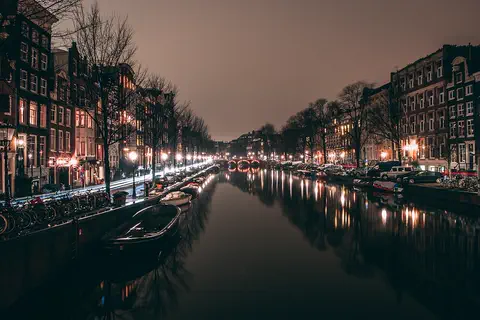
Amsterdam is the capital of the Netherlands. It began as a fishing village beside a dam on the Amstel River, which gave the city its name. Today about 942,000 people live among its rings of canals, hundreds of bridges, houseboats and bicycles.
-
 Watch
City
Antwerp
Antwerp is a city in Belgium on the Scheldt river, and Universalis calls it the second port of continental Europe, after Rotterdam. Belgium's statistics office estimated 565,615 people in the city on 1 January 2026. In the 1500s it was one of Europe's great trading cities.
For parents & teachers
What children will learn
- Locate Vaduz and Liechtenstein between Switzerland and Austria.
- Describe how a village below a castle became a national capital.
- Explain why a river crossing and a missing railway shape how people travel.
- Read monthly temperature and precipitation averages for a mountain valley.
Recommended ages: 3 to 17 · About 15 minutes
Talk about it
- Vaduz is the capital, but Schaan has a few more people. What makes a place a capital, if not its size?
- Most people who worked in Vaduz in 2005 lived somewhere else. Why might people travel to another town for work?
- Vaduz never got a railway. How do you think people get around a town without trains?
Try at home or in class
- Castle model: build a hillside from a box and place a castle on a ledge above a flat valley, like Vaduz.
- Precipitation chart: plot Vaduz's monthly precipitation and find the wettest and driest months.
- Tiny country map: trace Liechtenstein and its 11 communes and mark Vaduz and Schaan.
Key vocabulary: capital, principality, commune, exclave, vineyard, ferry
Where these facts come from
- Wikidata , Wikimedia Foundation (CC0 1.0)
- Natural Earth vector data , Natural Earth (NACIS) (Public domain)
- Liechtenstein: communes (population estimate 31 December 2025, preliminary; censuses 1980–2020) , City Population (Thomas Brinkhoff), from the Office of Statistics, Liechtenstein
- Vaduz (Gemeinde) , Historisches Lexikon des Fürstentums Liechtenstein (Ulrike Mayr, Patrick Sele)
- Vaduz , Encyclopaedia Universalis
- Das Museum (history and architecture) , Kunstmuseum Liechtenstein
- SwissMetNet monthly values, Vaduz (VAD) , MeteoSwiss (Federal Office of Meteorology and Climatology), open data
- SwissMetNet stations (metadata: Vaduz, 457 m) , MeteoSwiss, open data
- File:View of Vaduz.jpg (Lucas Kendall, 18 August 2025) , Wikimedia Commons
- Wikimedia Commons , Wikimedia Foundation (Per file (public domain, CC0, CC BY or CC BY-SA); see each media record)
Checked, not yet human-reviewed. Last updated November 1, 2026. Spotted a mistake? Tell us.