
City Europe
Zurich
Zurich is a big city in Switzerland. It sits where a river flows out of a lake. Trams and boats carry people around.
Zurich is the biggest city in Switzerland, where the Limmat River leaves Lake Zurich. Romans built a fort on a hill here, and old churches with tall towers line the river. More than 450,000 people lived in the city at the end of 2025, more than ever before.
Zurich's history reaches back to the Lindenhof hill above the Limmat, where a Roman fort stood in the 4th century and a royal palace in the 9th; the Fraumünster convent, founded in 853, enjoyed royal favor and strong influence. Today it is Switzerland's largest city, served by about 86 km of tram routes and an S-Bahn network introduced in 1990. Statistik Stadt Zürich counted 452,421 residents at the end of 2025, a record.
Photo: Ikiwaner, CC BY-SA 3.0, via Wikimedia Commons
Discover Zurich
Zurich is a big city in Switzerland. Switzerland is a country in Europe with high mountains.
A river flows through Zurich. At one end of the city there is a long lake.
Zurich is the biggest city in Switzerland. The city's statistics office counted 452,421 people living there at the end of 2025, more than at any time before.
The Limmat River flows out of Lake Zurich and right through the old town. Old churches, guild houses and bridges line its banks, and trams glide through the streets.
Zurich is Switzerland's largest city. Statistik Stadt Zürich counted 452,421 residents at the end of 2025, the highest number ever, after growth of 3,757 during the year; 33.9 percent of residents were foreign nationals. The city had about 150,000 people at the start of the 20th century, jumped from 264,000 to 316,000 when neighboring municipalities were merged into it in 1934, and reached 440,180 in 1962. It shrank in the 1970s and 1980s, grew again from the 2000s, and passed its 1962 record at the end of 2022.
The office also reports that births fell sharply between 2021 (5,261) and 2022 (4,538), the steepest drop in the 130 years since the city first absorbed its neighbors, and have since stabilized at the lower level.
- Country
- Switzerland
- People in the city (end of 2025)
- 452,421
- Growth in 2025
- 3,757 people
- Tram network
- about 86 km, 15 lines
A clock, colored windows and a hill with a view
One church tower has a giant clock. Its face is almost 9 meters wide!
Another old church has windows of bright colored glass.
The photo shows two old churches beside the Limmat. On the left is the Fraumünster, with its tall green spire, founded in 853. Its windows of colored glass were made by the artists Marc Chagall and Augusto Giacometti. On the right rises the tower of St. Peter, the oldest parish church in Zurich. Its clock face is 8.7 meters across, which Zurich Tourism calls the largest church clock face in Europe.
Up on the Lindenhof, a hill in the old town, people look out over the rooftops, the river and the university.
The photo frames, from left, the Fraumünster, the Zunfthaus zur Meisen (a guild house), the Münsterbrücke across the Limmat and the tower of St. Peter. The Fraumünster's north window is by Augusto Giacometti, and the five windows in the chancel and the rose window in the south transept by Marc Chagall; its cloister has frescoes by Paul Bodmer.
St. Peter, which Zurich Tourism calls the city's oldest parish church, has a tower clock face 8.7 m in diameter, presented as the largest church clock face in Europe; until 1911 its tower served as a fire watch post. Nearby, the Lindenhof square looks across to the Old Town, the Grossmünster, the City Hall, the Limmat, the university and the Swiss Federal Institute of Technology (ETH).
- St. Peter's clock face
- 8.7 m across; the largest church clock face in Europe, says Zurich Tourism
- Fraumünster
- founded 853; stained glass windows by Marc Chagall and Augusto Giacometti
- Lindenhof
- a hilltop square with a view over the old town
A Roman fort, a royal palace and a convent
Long ago, Roman soldiers built a fort on a hill here.
Later, a palace was built on the same hill. Today you can see the whole old town from there.
In the 4th century, the Romans had a fort on the Lindenhof hill above the river. In the 800s, a grandson of the emperor Charlemagne built a royal palace on the same spot.
In 853 King Louis the German founded the Fraumünster, a convent for women from noble families. Until the 1200s, its abbess even had the right to make Zurich's coins. Much later, in 1934, the city grew in one jump when nearby towns joined it.
Zurich Tourism traces the Lindenhof's history from a Roman fort in the 4th century to a royal palace built in the 9th century by a grandson of Charlemagne; the square remained a gathering place for the townspeople up to the start of the modern era, and in 1798 the oath to the Helvetic Constitution was sworn there.
The Fraumünster, founded in 853 by King Louis the German, housed a convent of noblewomen; it enjoyed royal patronage, and its abbess held the right to mint Zurich's coins until the 13th century. After the Reformation the convent passed to the city. In modern times the city expanded by absorbing its neighbors; the second merger, in 1934, raised its population from 264,000 to 316,000 at a stroke.
- Roman fort on the Lindenhof
- 4th century
- Fraumünster convent founded
- 853, by King Louis the German
- Neighboring municipalities merged into the city
- 1934 (second merger)
Trams, S-Bahn trains and lake boats
Zurich has lots of trams. Trains go to towns all around the city.
Boats sail on the lake. A train climbs up a hill!
Zurich has a large tram network, about 86 kilometers long with 15 lines. In 1973 the city's voters decided not to build an underground metro. Part of a tunnel already built for it has carried trams since 1986.
S-Bahn trains, started in 1990, connect Zurich with towns all around. Boats sail on Lake Zurich, and a train called the S10 climbs the Uetliberg hill, where you can look out over the city and the lake.
UrbanRail.Net describes a fully integrated network: about 86 km of tram routes on 15 lines (2 km underground), an S-Bahn introduced in 1990 that now labels all of the canton's rail lines, about 380 km, plus two funiculars, a rack railway, six trolleybus lines and boat services on Lake Zurich.
In the early 1970s Zurich planned a full U-Bahn, but voters rejected it in a 1973 referendum; a tunnel already built with a motorway was linked to the tram network in 1986. Recent extensions include the Glattalbahn to the airport (2008) and the Limmattalbahn to the west, opened in full on 11 December 2022. The private SZU's S10 line climbs the Uetliberg, which offers a view over the city and the lake.
- Trams
- about 86 km of routes, 15 lines
- S-Bahn
- introduced 1990; about 380 km
- Also
- two funiculars, a rack railway, trolleybuses and boats on Lake Zurich
Cold winters and mild, rainy summers
Winter in Zurich is cold. Nights are often below freezing.
Summer is mild. Rain falls in every month.
Zurich has cold winters and mild summers. The World Meteorological Organization's averages for 1961 to 1990 give January days of about 2 °C and nights of about −3 °C, below freezing. July is the warmest month, with days of about 23 °C and nights of about 13 °C.
Rain or snow falls in every month, on 8 to 12 days. August is the wettest month, with about 133 millimeters, and a whole year brings about 1,086 millimeters.
WMO normals for Zurich (1961–1990) give average highs and lows of 2.0 °C and −2.8 °C in January, with lows below freezing in February (−1.9 °C) and December (−1.7 °C) too. July is the warmest month at 23.0 °C and 12.8 °C, just ahead of August (22.0 °C and 12.4 °C).
The monthly precipitation averages add up to about 1,086 mm a year, with a clear summer maximum: from 67 to 73 mm a month from December to March to 124 mm in June, 117 mm in July and 133 mm in August. Most months have 10 to 12 days with precipitation; September and October have 8.
- January, average daily high and low (WMO, 1961–1990)
- 2.0 °C and −2.8 °C
- July, average daily high and low (same period)
- 23.0 °C and 12.8 °C
- Rain and snow in a year (sum of the monthly averages)
- about 1,086 mm
Chess on the Lindenhof and summer on the lake
On a hill in the old town, people meet to play chess.
In summer, people swim in the lake and ride on boats.
In the middle of the old town, the Lindenhof is a quiet square on a hill, where chess players meet and visitors look out over the river.
Zurich is home to people from many countries: at the end of 2025, about one in three residents had a foreign nationality. In summer, Lake Zurich is busy with swimmers at lakeside baths, sailboats and steamboats, and in a summer event up to 10,000 people swim across the lake.
Zurich Tourism describes the Lindenhof as a haven of calm in the heart of the city and a meeting point for chess players, with a view across the Limmat to the Old Town, the Grossmünster, the City Hall, the university and ETH.
The city's population has long been international. Statistik Stadt Zürich reports that the share of foreign residents was 34.2 percent in 1912, fell to 6.8 percent by 1945, and has risen again since, reaching 33.9 percent at the end of 2025. Zurich Tourism notes that Lake Zurich, once mainly a transport route, is now a place for swimming, sailing and picnics: lakeside baths at Wollishofen, Mythenquai, Enge, Utoquai and Tiefenbrunnen fill in summer, the Lake Zurich Navigation Company runs steamboats and motor vessels, and in the summer 'Seeüberquerung' up to 10,000 people swim from Wollishofen to Tiefenbrunnen.
- Lindenhof today
- a quiet square and a meeting point for chess players
- Residents with a foreign nationality (end of 2025)
- 33.9%
- Lake Zurich in summer
- lakeside baths, boats, and a lake-crossing swim for up to 10,000 people
Zurich on the map
Find Zurich on the globe.
It is in Europe, in the north of Switzerland. Look for the long lake next to the city.
Zurich is in northern Switzerland, in the middle of Europe. The city lies where the Limmat River flows out of Lake Zurich.
The main railway station is on the river's west bank. A short walk south are the Lindenhof and the Fraumünster, with the Grossmünster across the river. The Uetliberg hill rises to the southwest.
Zurich lies at about 47.4° N and 8.5° E in northern Switzerland, where the Limmat flows out of Lake Zurich and through the city.
On the map, the Hauptbahnhof stands about 0.6 km north of the Lindenhof; the Fraumünster is about 0.4 km south of the Lindenhof on the west bank, and the Grossmünster faces it across the Limmat, about 0.2 km away. The Uetliberg summit lies about 4.6 km southwest of the Lindenhof.
- Latitude
- about 47.4° north
- Longitude
- about 8.5° east
- Setting
- where the Limmat flows out of Lake Zurich
Amazing facts
-
A church clock in Zurich is almost 9 meters wide.
St. Peter's clock face is 8.7 meters across, which Zurich Tourism calls the largest church clock face in Europe.
St. Peter's tower clock face measures 8.7 m in diameter, and until 1911 the tower was used as a fire watch post.
-
Long ago, a church leader in Zurich was allowed to make coins.
The abbess of the Fraumünster had the right to make Zurich's coins until the 1200s.
The Fraumünster's abbess held the right to mint coins in Zurich until the 13th century.
-
People play chess on a hill in the middle of Zurich.
The Lindenhof, where a Roman fort once stood, is now a meeting point for chess players.
The Lindenhof has held a Roman fort (4th century), a royal palace (9th century) and, in 1798, the oath to the Helvetic Constitution.
-
Zurich's people voted not to build an underground metro.
In 1973 voters decided against building an underground metro, and part of the tunnel built for it now carries trams.
A metro tunnel, built with a new motorway for a planned U-Bahn, was linked to the tram network in 1986, after voters rejected the U-Bahn in 1973.
Words to know
- tram
- an electric train that runs on rails along city streets
- convent
- a community where nuns live and work together
- abbess
- the woman who leads a convent
- stained glass
- colored glass set together to make pictures in a window
- referendum
- a vote in which people decide a question directly
- merger
- when two or more places or groups join into one
Discovery challenge
-
Zurich is a city in which country?
Zurich is the biggest city in which country?
Zurich, with 452,421 residents at the end of 2025, is the largest city of which country?
- Austria
- Switzerland
- Germany
Show the answer
Switzerland
Switzerland!
Switzerland, in the middle of Europe.
Switzerland.
-
Which river flows through Zurich?
Which river flows out of Lake Zurich and through the city?
Which river, overlooked by the Lindenhof, leaves Lake Zurich in the city?
- The Rhône
- The Limmat
- The Danube
Show the answer
The Limmat
The Limmat!
The Limmat.
The Limmat.
-
Who built a fort on the Lindenhof hill long ago?
Who had a fort on the Lindenhof in the 4th century?
Whose 4th-century fort stood on the Lindenhof before a 9th-century royal palace?
- The Romans
- The Vikings
- The Aztecs
Show the answer
The Romans
The Romans!
The Romans.
The Romans; later a grandson of Charlemagne built a palace there.
-
What is very big on St. Peter's church tower?
What on St. Peter's tower is 8.7 meters across?
What does Zurich Tourism call the largest of its kind in Europe, on St. Peter's tower?
- A bell
- A clock face
- A window
Show the answer
A clock face
A clock face!
The clock face, 8.7 meters across.
Its church clock face, 8.7 m in diameter.
-
What do people ride along Zurich's streets?
Zurich's voters said no to a metro in 1973. What kind of network carries people along its streets instead?
Which network runs about 86 km on 15 lines in Zurich?
- Trams
- Cable cars
- Canal boats
Show the answer
Trams
Trams!
Trams, on about 86 kilometers of routes.
The tram network, with 15 lines.
Nearby places
-
 Watch
Natural wonder
Rhine Falls
The Rhine Falls is a waterfall on the River Rhine in northern Switzerland, beside the town of Neuhausen am Rheinfall near Schaffhausen. The river pours over a rock step about 150 meters wide. In June, the month with the most water, an average of about 560 cubic meters of water rush over it every second, and a rock island stands in the middle of the falls.
-
 Watch
City
Vaduz
Vaduz is the capital of Liechtenstein. It lies on the edge of the Rhine valley, below a steep mountainside, with Vaduz Castle, the home of the country's prince, on a ledge above the town. About 6,100 people lived in Vaduz at the end of 2025, and the town has never had a railway.
-
 Watch
Natural wonder
Rhine
The Rhine begins as two small streams high in the Swiss Alps and flows about 1,230 kilometers north and west to the North Sea, through Switzerland, Germany, France and the Netherlands. It tumbles over the Rhine Falls and winds through a gorge lined with castles. After a chemical spill in 1986, the countries along it worked together to clean it, and salmon came back.
-
 Watch
Natural wonder
Danube
The Danube is Europe's second-longest river, after the Volga. It begins as two small streams in Germany's Black Forest and flows about 2,850 kilometers east to the Black Sea, passing through 10 countries and four capital cities. For more than 2,000 years it has been a border, a highway for boats and a home for wildlife, and it ends in a giant delta of reeds, lakes and birds.
-
 Watch
Natural wonder
Alps
The Alps are Europe's great mountain range, an arc about 1,200 kilometers long that runs from the Mediterranean coast near Nice, in France, to Vienna, in Austria. Their highest peak is Mont Blanc, which Britannica gives as 4,807 meters. The Alps rose when the plate carrying Africa pushed north into Europe, and Ice Age glaciers carved their sharp peaks and deep valleys.
-
 Watch
Landmark
Zytglogge
The Zytglogge is a medieval clock tower in the old town of Bern, Switzerland. Built from 1218 to 1220 as a defensive tower, it became a clock tower after a great fire in 1405. Bern Welcome dates its astronomical clock and moving figures to 1530.
-
 Watch
City
Bern
Bern is the federal city of Switzerland, where the country's government is based. It was founded in the 12th century on a hill surrounded by a loop of the Aare River, and its old town, with covered arcades and old fountains, is a UNESCO World Heritage Site. About 147,000 people lived in the city at the end of 2025.
-
 Watch
Natural wonder
Black Forest
The Black Forest is a range of forested mountains in the German state of Baden-Württemberg. Its core is gneiss and granite, covered in places by a sandstone called Buntsandstein, and it rises steeply from the Rhine valley on its west side. Its highest peak, the Feldberg, reaches 1,493 meters, and a national park lets part of its forest grow wild.
Explore next
-
 Watch
 Country
Switzerland
Switzerland is a small, landlocked country in central Europe. The Alps cover its south and east, great rivers such as the Rhine and Rhône begin there, and its 9.1 million people share four national languages: German, French, Italian and Romansh.
-
Watch
City
Bern
Bern is the federal city of Switzerland, where the country's government is based. It was founded in the 12th century on a hill surrounded by a loop of the Aare River, and its old town, with covered arcades and old fountains, is a UNESCO World Heritage Site. About 147,000 people lived in the city at the end of 2025.
-
 Watch
City
Munich
Munich is the capital of Bavaria, a state in southern Germany, and the country's third-biggest city. It began in 1158 as a market by a bridge over the Isar River, and its name means "Home of the Monks." Today it is famous for its palaces, art museums, the huge Deutsches Museum and its autumn Oktoberfest.
-
 Watch
City
Milan
Milan is the second city of Italy, a center of business, fashion and design on the flat Po plain in the north. It began about 600 BCE and was a Roman city called Mediolanum. Italy's statistics office counted 1,365,698 residents on January 1, 2025.
-
 Watch
City
Vienna
Vienna is the capital of Austria, on the Danube River. For centuries it was the home of emperors, and composers such as Haydn, Mozart and Beethoven lived and worked there. About 2 million people lived in the city at the start of 2026.
-
Watch
City
Vaduz
Vaduz is the capital of Liechtenstein. It lies on the edge of the Rhine valley, below a steep mountainside, with Vaduz Castle, the home of the country's prince, on a ledge above the town. About 6,100 people lived in Vaduz at the end of 2025, and the town has never had a railway.
-
 Watch
City
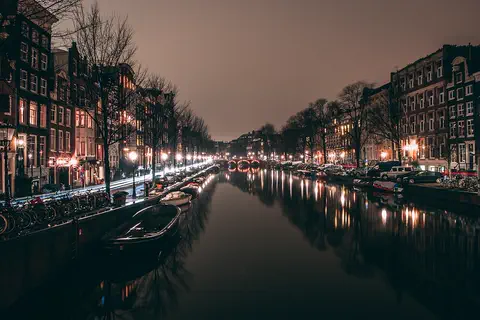
Amsterdam
Amsterdam is the capital of the Netherlands. It began as a fishing village beside a dam on the Amstel River, which gave the city its name. Today about 942,000 people live among its rings of canals, hundreds of bridges, houseboats and bicycles.
-
 Watch
City
Antwerp
Antwerp is a city in Belgium on the Scheldt river, and Universalis calls it the second port of continental Europe, after Rotterdam. Belgium's statistics office estimated 565,615 people in the city on 1 January 2026. In the 1500s it was one of Europe's great trading cities.
For parents & teachers
What children will learn
- Locate Zurich at the north end of Lake Zurich, in northern Switzerland.
- Explain how a hill like the Lindenhof can hold layers of a city's history.
- Describe how a city chooses and builds its public transportation.
- Read monthly temperature and precipitation averages to describe a city's climate.
Recommended ages: 3 to 17 · About 15 minutes
Talk about it
- Zurich's voters decided not to build a metro. How do people in your town decide what to build?
- A Roman fort, a palace and a square all stood on the same hill. Why do people keep using the same good spots?
- About one in three people in Zurich has a foreign nationality. What can a city gain from people coming from many places?
Try at home or in class
- Giant clock: mark 8.7 meters on the floor or playground with chalk or string, and compare it with your height.
- Colored windows: make a 'stained glass' window with colored tissue paper on a sheet of clear plastic or wax paper.
- Tram map: draw a city map with tram lines in different colors that all meet at the main station.
Key vocabulary: tram, convent, abbess, stained glass, referendum, merger
Where these facts come from
- Wikidata , Wikimedia Foundation (CC0 1.0)
- Natural Earth vector data , Natural Earth (NACIS) (Public domain)
- Bevölkerung 2025: Die Geburtenzahlen haben sich stabilisiert , Stadt Zürich, Statistik Stadt Zürich
- Lindenhof , Zürich Tourism (zuerich.com)
- Fraumünster: art, histoire et vitraux (French page) , Zürich Tourism (zuerich.com)
- St. Peter – the oldest parish church in Zurich , Zürich Tourism (zuerich.com)
- Lake Zurich , Zürich Tourism (zuerich.com)
- Zürich tram, S-Bahn and other rail , UrbanRail.Net
- Zurich: climatological information , World Meteorological Organization, World Weather Information Service
- Wikimedia Commons , Wikimedia Foundation (Per file (public domain, CC0, CC BY or CC BY-SA); see each media record)
Checked, not yet human-reviewed. Last updated November 1, 2026. Spotted a mistake? Tell us.