Animal
Ethiopian wolf
The Ethiopian wolf is a red wolf with a long nose. It lives only high up on the mountains of Ethiopia, in Africa.
The Ethiopian wolf is a slender red wolf that lives only in the high mountains of Ethiopia. Wolf families share a territory, but each wolf hunts alone for rats and mole-rats. It is one of the rarest wild dogs on Earth.
Canis simensis is a specialist of Ethiopia's Afroalpine grasslands above about 3,000 meters, where it hunts rodents alone yet lives in cohesive family packs. With fewer than 500 adults in six isolated populations, it is listed as Endangered; habitat loss and diseases caught from domestic dogs are the main threats.
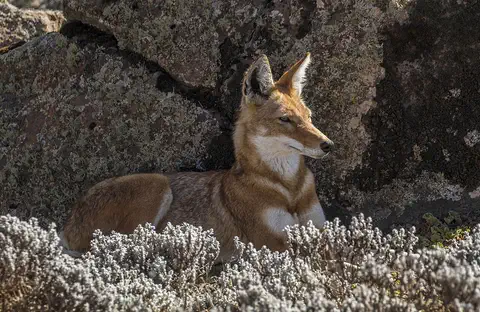
Photo: Charles J. Sharp, CC BY-SA 4.0, via Wikimedia Commons
Meet the Ethiopian wolf
The Ethiopian wolf lives high on the mountains of Ethiopia, in Africa.
It has red fur, a white chest and a long, thin nose. Its tail is bushy and black. It is a little smaller than a big pet dog.
The Ethiopian wolf is a wild member of the dog family. It has long, thin legs, a long muzzle, pointed ears and a bright red-orange coat with white on its throat and chest. Its bushy tail is black.
It looks a bit like a fox, but scientists say it comes from the same family line as gray wolves: its ancestors arrived in Africa from Europe and Asia. Today it lives only in Ethiopia, and fewer than 500 adults are left in the wild.
Canis simensis has been called the Simien fox and red jackal, but the Ethiopian Wolf Conservation Programme (EWCP) describes it as a recent descendant of a gray-wolf-like ancestor that reached Africa from Eurasia: "a wolf in fox clothing".
Adults weigh about 11 to 20 kilograms (African Wildlife Foundation); males are clearly larger, averaging about 16 kilograms against 13 for females. With fewer than 500 adults surviving, EWCP calls it the rarest canid in the world and the most endangered carnivore in Africa.
Quick facts
- Group
- Mammal
- Length
- up to 1 m
- Weight
- 11 to 20 kg
- Lifespan in the wild
- up to 10 years
Where it lives
Ethiopian wolves live only in Ethiopia.
They live very high up on mountains, above the trees. Their home is cold and windy, with short grass, rocks and small bushes.
Ethiopian wolves live nowhere else in the world but the mountains of Ethiopia. They stay high up, between about 3,000 and 4,500 meters above sea level, in a cool, open land of short grass, heather and rocks called the Afroalpine zone.
Farms cover much of the lower land, so the wolves live in small mountain areas like islands. Today there are six separate populations, in places such as the Bale Mountains and the Simien Mountains.
The species is confined to Afroalpine grasslands and heathlands on either side of Ethiopia's Great Rift Valley, between about 3,000 and 4,500 meters, and only above the agricultural frontier, which reaches about 4,000 meters in places (EWCP).
EWCP lists six surviving populations: the Simien Mountains, the North and South Wollo highlands, Guassa-Menz, the Arsi Mountains and the Bale Mountains. Populations at Gosh Meda and Mount Guna died out recently, and Mount Choke lost its wolves decades ago. The IUCN reports that more than half of all Ethiopian wolves live in the Bale Mountains, where the densest groups live on short, rodent-rich grassland.
Continent
Its habitats


Where can you find this animal?
- Lives here naturally · Countries and seas named by a scientific source
- Sightings recorded · Records of wild sightings (GBIF)
Lives here naturally · Countries and seas named by a scientific source
Only in Ethiopia: six small, isolated mountain populations in the Afroalpine highlands, between about 3,000 and 4,500 meters. Wolves live in only a tiny part of the country.
Places: Ethiopia.
Source: iucn-red-list · checked October 2026
Sightings recorded · Records of wild sightings (GBIF)
Counts of GBIF records of wild observations (human and machine) and preserved specimens. Records include introduced populations, vagrants, escaped or released animals and misidentifications, so a country with records is not necessarily part of the native range.
Wild sightings have been recorded in Ethiopia and Sudan.
Source: gbif · checked October 2026
Range maps show where scientists say an animal lives, often country by country. An animal may live in only part of a country shown, and sightings records can include animals that wandered far from home.
What it eats
Ethiopian wolves eat small animals like rats.
A wolf walks slowly through the grass. When a rat pokes out of its hole, the wolf jumps on it. Each wolf hunts by itself.
Ethiopian wolves eat almost nothing but rodents. Their main meal in the Bale Mountains is the giant mole-rat, a big burrowing rodent found only there. They also catch grass rats.
Unlike other wolves, Ethiopian wolves usually hunt alone. They hunt in the daytime, when the rodents come out of their burrows. Once in a while a small group chases a young antelope, a lamb or a hare.
This is a rodent specialist. In the Bale Mountains wolves feed almost entirely on day-active small mammals, mainly the giant mole-rat (Tachyoryctes macrocephalus), which lives only in Bale, plus grass rats. Elsewhere the smaller common mole-rat takes its place, and some populations depend entirely on small rats (EWCP).
Wolves forage alone and are active by day, with feeding peaks that match the times rodents are above ground. Small packs occasionally chase young antelopes, lambs and hares, and wolves will eat carrion, though domestic dogs and jackals tend to take over carcasses. The wolf's long muzzle and small, well-spaced teeth appear suited to catching rodents.
Did you know?
Ethiopian wolves live in families, but each wolf hunts alone.
Unlike gray wolves, Ethiopian wolves hunt alone, even though they live in packs.
Ethiopian wolves forage alone, yet the African Wildlife Foundation explains that living in packs lets them defend a territory with enough rodents to feed the whole group.
An amazing body
An Ethiopian wolf has long, thin legs.
It has a long nose and pointy ears. Its red fur has white on the chest and throat.
The Ethiopian wolf is built for open mountain grassland. Its long, slender legs carry it across wide spaces. Its long muzzle and small, well-spaced teeth help it grab rodents.
Its coat is soft and short, bright reddish-tan, with thick, pale underfur beneath. Its throat, chest and belly are white, and the line between red and white is sharp and clear. The bushy tail is black, with some white underneath near the body. Females are usually paler than males.
EWCP describes strikingly long, slender legs suited to running in open country, a long muzzle with small, well-spaced teeth that suggest adaptation to a rodent diet, and broad, pointed ears whose backs are fringed with long white hairs.
The short adult coat is a distinctive bright tawny-rufous over dense whitish to pale ginger underfur. The throat, chest, a band around the lower neck, the underparts and the insides of the legs are white, with sharp boundaries. The tail is a thick black brush, white underneath for its first third, and can reach about 40 centimeters (AWF). Females tend to be paler and smaller than males.
Growing up
Baby wolves are called pups.
They are born in a den under a big rock. The whole wolf family helps. They guard the den and bring food to the pups.
In each wolf family, usually only the top female has pups, once a year. She is pregnant for about two months. The pups are born in a den under a boulder or in a rocky crack, and up to seven pups come out of the den when they are about three weeks old.
The whole pack helps. Family members guard the den and carry food back for the pups, and other females may help feed them milk. By ten weeks old the pups eat mostly solid food.
Breeding is tightly synchronized: in the Bale Mountains females are receptive for less than two weeks, sometime between August and November. Usually only the dominant female breeds. Gestation lasts 60 to 62 days, and pups are born between October and December in a den, often under a boulder or in a rock crevice with several entrances (AWF).
Up to seven pups emerge after about three weeks. All pack members guard the den, chase off predators and bring rodent prey; subordinate females may help suckle. Pups live almost entirely on solid food by week 10, stop being fed by adults at about a year, look fully adult at two years and mature during their second year (EWCP).
Pack life
Ethiopian wolves live in families called packs.
They say hello to each other every day. They sleep together at night. Then each wolf goes off to hunt on its own.
Ethiopian wolves live in family groups called packs, often about six wolves, though some packs are much bigger. The pack shares a territory and guards it together.
The wolves meet for greetings at dawn, noon and evening, walk the edges of their territory leaving scent marks, and sleep together out in the open at night. If two packs meet at a border there is lots of noise, and the smaller pack runs away.
Packs are cohesive, hierarchical family groups that share and defend an exclusive territory, averaging about 6 square kilometers. In good habitat a pack can hold up to 20 wolves older than one year, though about six is most common (EWCP). Young males usually stay in the pack where they were born, so packs are mostly related males with one or two females.
Members gather for greetings and border patrols at dawn, noon and evening, scent-mark along territory edges and rest together in the open at night. Encounters between packs are highly vocal and end with the smaller group fleeing. Because a dead breeding female is usually replaced by her daughter, inbreeding is a risk, partly offset by matings with males from neighboring packs.
Did you know?
This wolf looks like a fox, but it is really a wolf.
It was once called the Simien fox, but its ancestors were wolves that came to Africa from Europe and Asia.
EWCP describes the species as a recent descendant of a gray-wolf-like ancestor that immigrated to Africa from Eurasia: "a wolf in fox clothing".
Helping Ethiopian wolves
There are very few Ethiopian wolves left.
They need their mountain homes, and they can catch sicknesses from dogs. Rangers and helpers watch over the wolves and give vaccines to keep them healthy.
The Ethiopian wolf is endangered. Farms are spreading higher up the mountains, taking away the grassland where wolves hunt, and overgrazing by livestock damages it further.
Another danger comes from pet and village dogs. They can pass on diseases such as rabies and canine distemper, which have killed many wolves. To help, people vaccinate dogs and some wolves, teams watch every wolf population, and by 2011 most of the land where wolves live had been made a protected area. Killing a wolf in Ethiopia can bring up to two years in prison.
The IUCN's 2011 assessment, still the current one but marked as needing an update, lists the species as Endangered with a decreasing trend. It estimated 360 to 440 adults, fewer than 250 of them mature breeders, in an extent of occurrence of only about 4,200 square kilometers. Rabies and canine distemper caught from domestic dogs cut the Bale population by about 30 percent after 2008.
The main long-term threat is high-altitude farming: about 60 percent of land above 3,200 meters has been converted to farmland. Overgrazing, roads and some hybridization with dogs in western Bale add pressure. Conservation includes vaccinating dogs and wolves, full legal protection, and protected areas, which grew from about 40 percent of the wolf range in 2000 to about 87 percent in 2011 (EWCP); from April 2024 to March 2025 EWCP monitored 41 packs across all six populations.
IUCN Red List
How is the ethiopian wolf doing in the wild?
- Least Concern
- Near Threatened
- Vulnerable
- Endangered (this animal)
- Critically Endangered
- Extinct in the Wild
- Extinct
Endangered
At very high risk of disappearing from the wild.
See the IUCN Red List assessment · The IUCN Red List of Threatened Species 2022.2
Amazing facts
-
Ethiopian wolves live in families, but each wolf hunts alone.
Unlike gray wolves, Ethiopian wolves hunt alone, even though they live in packs.
Ethiopian wolves forage alone, yet the African Wildlife Foundation explains that living in packs lets them defend a territory with enough rodents to feed the whole group.
-
This wolf looks like a fox, but it is really a wolf.
It was once called the Simien fox, but its ancestors were wolves that came to Africa from Europe and Asia.
EWCP describes the species as a recent descendant of a gray-wolf-like ancestor that immigrated to Africa from Eurasia: "a wolf in fox clothing".
-
Wolf families say hello to each other three times a day.
Pack members meet for greetings and to patrol their borders at dawn, at noon and in the evening.
Packs congregate for greetings and border patrols at dawn, noon and evening, and rest together in the open at night (EWCP).
-
The whole wolf family helps look after the pups.
All the wolves in a pack help guard the den and bring food to the pups, and other females may help feed them milk.
Pack members guard the den, chase predators and provision pups with rodents, and subordinate females may help suckle the dominant female's litter.
Words to know
- endemic
- found naturally in only one place in the world
- pack
- a family group of wolves that live together
- territory
- an area an animal or group lives in and defends
- rodent
- a small gnawing mammal, such as a rat or mole-rat
- Afroalpine
- the high, cold mountain zone above the trees in Africa
- vaccinate
- to give a medicine that protects against a disease
Discovery challenge
-
Where do Ethiopian wolves live?
In which country do Ethiopian wolves live in the wild?
Which country holds the Ethiopian wolf's entire wild population?
- Ethiopia
- Brazil
- Canada
Show the answer
Ethiopia
They live only in Ethiopia, high on the mountains.
They live only in Ethiopia, in the high mountains of eastern Africa.
All six surviving populations are in the Ethiopian highlands, between about 3,000 and 4,500 meters.
-
What does an Ethiopian wolf eat most?
What makes up most of an Ethiopian wolf's food?
Which kind of prey dominates the Ethiopian wolf's diet?
- Fish
- Rodents such as mole-rats
- Grass and leaves
Show the answer
Rodents such as mole-rats
They eat rats and mole-rats.
They eat almost only rodents, especially mole-rats and grass rats.
Day-active rodents, above all the giant mole-rat in Bale; elsewhere common mole-rats and other rats.
-
How does an Ethiopian wolf hunt?
How do Ethiopian wolves usually hunt?
How do Ethiopian wolves usually forage?
- In a big group
- Alone
- Only at night under water
Show the answer
Alone
Each wolf hunts by itself.
They live in packs, but each wolf usually hunts rodents alone in the daytime.
Foraging is solitary and daytime; only occasionally do small packs chase young antelopes, lambs or hares.
-
What can make Ethiopian wolves sick?
Which animals can pass dangerous diseases to Ethiopian wolves?
Rabies and canine distemper reach Ethiopian wolves mainly from which animals?
- Domestic dogs
- Fish
- Birds
Show the answer
Domestic dogs
Dogs can pass on sicknesses. Giving dogs vaccines helps keep the wolves safe.
Village and pet dogs can carry rabies and canine distemper, so people vaccinate dogs near wolf areas.
Domestic dogs are reservoirs of rabies and canine distemper; outbreaks cut the Bale population by about 30 percent after 2008.
Places where you might see it
Explore next
-
 Watch
3D
Animal
Gray wolf
The gray wolf is the largest member of the dog family and the wild ancestor of pet dogs. Wolves live in family packs that hunt big animals like elk and moose together, and their howls can carry about 10 kilometers. After being wiped out in many places, wolves are coming back in parts of North America and Europe.
-
 Watch
3D
Animal
African wild dog
The African wild dog, or painted dog, has a patchy coat unlike any other dog's, big round ears and only four toes on its front feet. It lives in close packs that hunt together, share food and care for the pups. It is endangered: the IUCN estimated in 2025 that only about 1,676 adults are left in the wild.
-
 Watch
Animal
Red fox
The red fox is a small, clever member of the dog family with an orange coat, black legs and a bushy, white-tipped tail. It lives across North America, Europe, Asia and North Africa, more of the world than any other wild land carnivore, and has even moved into big cities.
-
 Watch
 Country
Ethiopia
Ethiopia is a country on the Horn of Africa with no coast. Much of it is high, rugged land cut by the Great Rift Valley, it is one of the world's oldest countries, and more than 110 million people live there.
-
 Watch
Animal
Aardvark
The aardvark is a shy night digger of African savannas. It sniffs out ant and termite nests, rips them open with its spade-like claws and laps up the insects with a sticky tongue about 30 centimeters long. Its name means 'earth pig' in Afrikaans.
-
 Watch
Animal
African buffalo
The African buffalo is a huge, cow-like grazer with heavy, curving horns. It lives in herds that can number in the thousands, and a herd will rush to protect a calf in danger. It lives across much of Africa south of the Sahara, from open savannas to rainforests.
-
 Watch
Animal
African forest elephant
The African forest elephant is a separate species from the bigger bush elephant. It lives in the rainforests of central and western Africa, eats lots of fruit and spreads the seeds of forest trees in its dung. It is Critically Endangered.
-
 Watch
Animal
Alpaca
Alpacas are small, woolly members of the camel family from the high Andes Mountains of South America. People bred them from wild vicuñas thousands of years ago, mainly for their soft, warm fleece. Every alpaca lives with people.
For parents & teachers
What children will learn
- Describe how the Ethiopian wolf's body and habits suit hunting rodents in high mountain grassland.
- Explain the difference between living in a pack and hunting alone.
- Locate Ethiopia and understand what 'endemic' means.
- Describe the threats to the species and how vaccination and protected areas help.
Recommended ages: 3 to 17 · About 15 minutes
Talk about it
- Why might a wolf that eats rats hunt alone, while gray wolves that hunt deer work as a team?
- How can vaccinating village dogs help a wild animal?
- What problems might an animal face if it lives in only a few small places?
Try at home or in class
- Draw a mountain and shade the zone above 3,000 meters: talk about why animals that live only up there have so little room.
- Look at a map of Africa together and find Ethiopia and the Great Rift Valley.
Key vocabulary: endemic, pack, territory, rodent, Afroalpine, vaccinate
Where these facts come from
- The IUCN Red List of Threatened Species , International Union for Conservation of Nature (IUCN terms of use (no redistribution of Red List data or range maps))
- GBIF Backbone Taxonomy and GBIF Occurrence Search , Global Biodiversity Information Facility (CC0 1.0 (backbone); occurrence counts are facts derived from records under CC0, CC BY and CC BY-NC)
- Canis simensis, global Red List assessment 2011 , IUCN Red List of Threatened Species
- Ecology and behaviour , Ethiopian Wolf Conservation Programme (EWCP)
- Taxonomy, distribution and status , Ethiopian Wolf Conservation Programme (EWCP)
- Ethiopian Wolf Conservation Programme home page (monitoring 2024-2025) , Ethiopian Wolf Conservation Programme (EWCP)
- Ethiopian wolf , African Wildlife Foundation
- Wikidata , Wikimedia Foundation (CC0 1.0)
- Wikimedia Commons , Wikimedia Foundation (Per file: Public domain, CC0, CC BY or CC BY-SA only (credited on each page))
Checked, not yet human-reviewed. Last updated October 27, 2026. Spotted a mistake? Tell us.