
 Country
Europe
Ireland
Ireland is a green country on an island in the Atlantic Ocean. It has rocky coasts, soft rain and lots of grassy fields.
Ireland is a country on an island in the Atlantic Ocean, west of Great Britain. It covers most of the island, while Northern Ireland, in the northeast, is part of the United Kingdom. Rain keeps its fields green, its capital is Dublin, and more than 5.5 million people live there.
Ireland occupies about five-sixths of the westernmost major island of the British Isles; the other sixth, Northern Ireland, is part of the United Kingdom. A limestone central plain ringed by coastal mountains, a mild Atlantic climate and a population of 5,525,600 (April 2026) shape the country.
Photo: 瑞丽江的河水, CC BY-SA 4.0, via Wikimedia Commons
Discover Ireland
Ireland is a country on an island.
The big Atlantic Ocean is to the west. It rains a lot, so the grass is very green. Ireland shares its island with Northern Ireland. The capital city is Dublin.
Ireland is a country in western Europe. It is on an island west of Great Britain, and it covers most of that island. The northeast part of the island, Northern Ireland, belongs to the United Kingdom.
Plenty of rain falls on Ireland, and its wide grasslands are so green that people call it the Emerald Isle. In the middle of the country is a low, flat plain with lakes and bogs, and mountains rise near the coasts. The capital is Dublin, and more than 5.5 million people lived in Ireland in 2026.
The state of Ireland covers about five-sixths of the island of Ireland, the westernmost major island of the British Isles; Northern Ireland, six of the island's 32 counties in the province of Ulster, remains part of the United Kingdom. The state's area is 69,797 square kilometers, of an island of 84,421.
Britannica explains the nickname Emerald Isle by the green grasslands that abundant rain keeps growing. A broad central plain of limestone, mostly 60 to 120 meters above sea level, is almost ringed by coastal highlands. Ireland's Central Statistics Office estimated the population at 5,525,600 in April 2026, up 66,900 in a year.

Cities and famous places
Dublin is the biggest city in Ireland.
It is on the east coast. Cork and Galway are cities too. Very old stone tombs stand near a river called the Boyne. On a rocky island out at sea, monks once built little stone buildings.
Dublin, the capital, is on the east coast. More than a quarter of everyone in Ireland lives in and around it: about 1.6 million people lived in Dublin in 2026. Cork, the second largest city, is a port in the southwest, and Galway lies on the west coast.
North of Dublin, beside the River Boyne, stand Newgrange, Knowth and Dowth, three huge, very old mounds with stone tombs inside, built by early farmers. Off the southwest coast, monks once lived on a steep rocky island called Skellig Michael, in small stone buildings that still stand.
Dublin is the chief port and a center of finance, commerce and culture; its metropolitan area holds more than a quarter of the population, and the CSO estimated that 1,597,700 people (28.9 percent) lived in Dublin in April 2026. Cork, the second largest city, is a cathedral city and port in the southwest; Galway and Limerick are principal centers in the west.
Brú na Bóinne, on the north bank of the Boyne, is dominated by the great mounds of Knowth, Newgrange and Dowth with about 40 smaller passage graves; UNESCO calls it Europe's largest and most important concentration of prehistoric megalithic art (inscribed 1993). Sceilg Mhichíl (Skellig Michael), almost 12 km off the Iveragh Peninsula in County Kerry, holds an early medieval monastery and a hermitage on terraces below its 218-meter South Peak; it was inscribed in 1996 and is one of Ireland's most important seabird breeding sites.

Plains, bogs, mountains and rain
The middle of Ireland is low and flat.
It has lakes and soft, wet ground called bogs. Mountains stand near the sea. The tallest one is Carrauntoohil. Ireland gets lots of rain, but not much snow.
The middle of Ireland is a low plain with lakes, bogs and low hills, ringed almost all the way round by mountains near the coast. The highest peak, Carrauntoohil, is 1,039 meters tall, in the Macgillycuddy's Reeks in the southwest. The River Shannon flows slowly south through the middle of the country for about 260 kilometers.
The Atlantic Ocean, never more than 113 kilometers from anywhere inland, shapes the weather, which is mild. Winters are cool but snow is unusual except in the mountains, and the west gets far more rain than the east.
The central lowland, underlain by limestone and lying mostly between 60 and 120 m, is scattered with lakes, large bogs and low ridges; at least two glaciations shaped it, and peat bogs are a notable feature across the country. Coastal mountains ring it: granite in the west, northwest and east, Old Red Sandstone ridges trending east-west in the south. Carrauntoohil in the Macgillycuddy's Reeks is the highest point at 1,039 m (Britannica gives 1,041 m); Lugnaquillia tops the Wicklow Mountains at 926 m. The Shannon flows sluggishly for some 260 km to tidewater at Limerick.
The climate is western maritime. Mild southwesterly winds and the warm North Atlantic Current keep temperatures almost uniform: January and February average mainly 4 to 7 °C, July and August 14 to 16 °C. Yearly precipitation rises from about 760 mm in the east to more than 2,533 mm in exposed western areas, and severe snowstorms are rare.
Animals of Ireland
Ireland has no wild snakes.
It has a hare that lives only in Ireland. Red deer live in a big park called Killarney. Many seabirds nest on a rocky island called Skellig Michael.
Ice covered almost all of Ireland during the Ice Age, and most of its plants and animals arrived from other places afterward. Ireland has no wild snakes, moles or weasels, and its only reptile is one kind of lizard. Mammals found only in Ireland include the Irish hare and the Irish stoat.
In Killarney National Park lives the last native herd of red deer in Ireland, there since the Stone Age. White-tailed sea eagles, gone since the early 1900s, have been brought back there. Ireland is full of birds, and many water birds that nest in Iceland and Greenland spend the winter in Ireland.
Because Ireland was almost completely glaciated during the Ice Age, its plants and animals mainly arrived later from other areas, while a land connection lasted; Ireland separated from Britain before Britain separated from the continent. Snakes have not lived wild on the island since the Ice Age, the weasel and mole are absent, there are only two kinds of mice and the only reptile is one lizard species. Endemic mammals include the Irish stoat and the Irish hare, while the giant Irish elk has long been extinct.
The National Parks and Wildlife Service describes the red deer of Killarney National Park as the last surviving indigenous herd in Ireland, present since Neolithic times; other herds descend from reintroduced stock, mainly from Scotland. White-tailed sea eagles, absent since the early 20th century, were reintroduced in the park. Forests that once covered the midlands had shrunk to about 1 percent of the land by the late 19th century, and reforestation has mostly favored fast-growing Sitka spruce.
People, languages and music
More than 5.5 million people live in Ireland.
People speak English, and many learn Irish too. Music is played on fiddles and tin whistles. Gaelic football and hurling are old Irish games.
Ireland has two official languages, Irish and English. English is spoken everywhere, and Irish is taught in schools. In a few areas, mostly in the west, called the Gaeltacht, Irish is still the everyday language.
Traditional music is played on the fiddle, the tin whistle and the uilleann pipes, a kind of Irish bagpipes, and the harp is a symbol of Ireland. Gaelic football and hurling are Irish games, and big matches are played at Croke Park in Dublin. Traditional foods include soda bread and colcannon, made from potatoes and cabbage.
The CSO estimated 5,525,600 people in April 2026, with 992,400 aged 0 to 14 (the first time under a million since 2014) and 891,100 aged 65 and over; 110,600 people immigrated in the year to April 2026. Immigration from the rest of Europe, Africa and Asia has been significant since the late 20th century, and the Travellers, a traditionally nomadic Indigenous ethnic minority with their own customs and language, have lived in Ireland for centuries.
The constitution makes Irish the first official language and English the second; English is universally spoken, and Irish as an everyday language is concentrated in small Gaeltacht areas. Roman Catholicism is the largest religion, and there is no established church. The Gaelic Athletic Association, founded in 1884 to revive native sports, runs Gaelic football and hurling. Four Irish writers have won the Nobel Prize for Literature: Yeats (1923), Shaw (1925), Beckett (1969) and Heaney (1995).

A long history
People have lived in Ireland for a very long time.
Long ago, farmers built huge stone tombs. Later, people in monasteries made beautiful books by hand. Today Ireland is its own country, with Dublin as the capital.
Farming began in Ireland about 5,000 years ago, and early farmers built great stone tombs such as Newgrange. By the 400s there were Christians in Ireland, and monasteries became famous places of learning. Scribes there made beautiful handwritten books, such as the Book of Kells.
In 1801 Ireland became part of the United Kingdom, and in the 1800s many people left to live in other countries. In 1922 most of the island became the self-governing Irish Free State, while Northern Ireland stayed in the United Kingdom. In 1949 the state became the Republic of Ireland, and in 1973 it joined the group of countries that became the European Union.
Radiocarbon dates suggest the Neolithic began in Ireland about 3000 BCE; farming communities built court tombs, portal tombs and passage tombs, including Newgrange and Knowth, among Europe's most magnificent megalithic tombs. The main Celtic arrivals probably came in the Iron Age. The earliest firm date for Christianity is 431 CE, when Palladius was sent to Ireland; monasteries such as Clonmacnoise and Clonard became centers of learning, and the Book of Kells probably dates from the late 8th or early 9th century.
After a failed uprising in the early 17th century, Ireland effectively became an English colony, and it was formally incorporated into the United Kingdom in 1801. The Irish Potato Famine of the 1840s was followed by mass emigration. A Home Rule Act of 1914 was never implemented, owing to pro-union militancy in the north, World War I and the Irish War of Independence that followed; in 1920 the island was effectively partitioned, and under the Anglo-Irish Treaty of 1921 the other 26 counties became the Irish Free State in 1922, followed by a civil war over the treaty that ended in 1923. A 1937 constitution created an elected president and a taoiseach as head of government; Ireland left the Commonwealth as a republic in 1949 and joined the European Economic Community in 1973.
Ireland on the map
Find Ireland on the globe.
It is in Europe, at the edge of the big Atlantic Ocean. Great Britain is across the sea to the east. Ireland's only land neighbor is Northern Ireland, part of the United Kingdom.
Ireland is at the far western edge of Europe. The island it sits on is about 486 kilometers from north to south and 275 kilometers from east to west. The Atlantic Ocean lies to the west, and to the east the North Channel, the Irish Sea and St. George's Channel separate it from Great Britain.
Ireland's only land border is with Northern Ireland, which is part of the United Kingdom. Off the Dingle Peninsula in the southwest lie the Blasket Islands, at the very edge of Europe.
Ireland lies between about 51°30′ and 55°30′ N and 6°00′ and 10°30′ W, as far north as Labrador and as far west as Liberia, according to Britannica. The island stands on the European continental shelf, in seas generally less than 200 m deep, and is separated from Great Britain by 18 to 193 km of water: the North Channel, the Irish Sea and St. George's Channel. Its Atlantic coast faces about 3,200 km of open ocean.
The west and southwest coasts are deeply indented, with wide bays such as Bantry and Dingle that are drowned river valleys, while the east coast is little indented. Tearaght Island in the Blaskets, off the Dingle Peninsula, is the western extreme of the Atlantic fringe of Eurasia. The state's one land boundary is with Northern Ireland, in the United Kingdom.
- Latitude
- about 51°30′ to 55°30′ north
- Longitude
- about 6°00′ to 10°30′ west
- Size of the island
- about 486 km north to south, 275 km east to west
- Share of the island
- about five-sixths (the rest is Northern Ireland, UK)
Amazing facts
-
Ireland has no wild snakes.
Snakes have not lived wild in Ireland since the Ice Age, thousands of years ago.
Before snakes were brought in as pets and zoo animals in the 20th century, none had lived on the island for the thousands of years since the Ice Age.
-
Nowhere in Ireland is very far from the sea.
No place inside Ireland is more than 113 kilometers from the Atlantic Ocean.
Britannica classes the climate as western maritime: the Atlantic, its main influence, is no more than 113 km from any inland location.
-
Red deer have lived in Killarney since the Stone Age.
The red deer of Killarney National Park are Ireland's last native herd. They have been there since the Stone Age.
The NPWS describes Killarney's red deer as the last surviving indigenous herd in Ireland, present since Neolithic times; all other herds descend from reintroduced stock.
-
Monks once lived on a steep island far out at sea.
On Skellig Michael, a rocky island almost 12 kilometers off the coast, monks built a monastery of small stone buildings.
Sceilg Mhichíl's early medieval monastery and hermitage stand on terraces on a rock almost 12 km off the Iveragh Peninsula; its peaks reach 185 m and 218 m.
-
Four writers from Ireland have won a big prize for books.
Four Irish writers have won the Nobel Prize for Literature: W. B. Yeats, George Bernard Shaw, Samuel Beckett and Seamus Heaney.
Ireland's Nobel laureates in literature are Yeats (1923), Shaw (1925), Beckett (1969) and Heaney (1995).
Words to know
- bog
- an area of soft, wet ground where peat forms from old plant material
- maritime climate
- weather shaped by a nearby ocean, usually mild and often wet
- endemic
- found naturally in only one place in the world
- Gaeltacht
- the areas of Ireland where Irish is the everyday language
- passage tomb
- an ancient stone tomb inside a round mound, reached by a stone passage
- partition
- the division of a place into separate parts
- World Heritage Site
- a place UNESCO lists as important to all people, to be protected
Discovery challenge
-
What is the capital city of Ireland?
Which city is the capital of Ireland?
Which east-coast city, whose metropolitan area holds more than a quarter of the population, is Ireland's capital?
- Dublin
- Cork
- Galway
Show the answer
Dublin
Dublin is the capital of Ireland.
Dublin, on the east coast, is the capital. Cork is the second largest city.
Dublin is the capital and chief port; about 1.6 million people lived in Dublin in April 2026.
-
Ireland shares its island. What is the other part called?
Which part of the island of Ireland belongs to the United Kingdom?
Which six-county area of the island remained part of the United Kingdom after partition in 1920?
- Northern Ireland
- Galway
- The Blasket Islands
Show the answer
Northern Ireland
The other part is Northern Ireland.
Northern Ireland, in the northeast of the island, is part of the United Kingdom.
Northern Ireland, six of the 32 counties, in Ulster, stayed in the United Kingdom; the other 26 became the Irish Free State in 1922.
-
What is the tallest mountain in Ireland?
Which mountain is the highest in Ireland?
Which peak in the Macgillycuddy's Reeks is Ireland's highest point?
- Mount Everest
- Mount Fuji
- Carrauntoohil
Show the answer
Carrauntoohil
Carrauntoohil is the tallest mountain in Ireland.
Carrauntoohil, 1,039 meters tall, is in the southwest of Ireland.
Carrauntoohil (Carrantuohill) in the Macgillycuddy's Reeks of County Kerry is the highest point, at 1,039 m.
-
Which animal does not live wild in Ireland?
Which animals have not lived wild in Ireland since the Ice Age?
Which animals have been absent from the wild in Ireland since the Ice Age?
- Snakes
- Hares
- Red deer
Show the answer
Snakes
There are no wild snakes in Ireland. Hares and red deer live there.
Snakes have not lived wild in Ireland since the Ice Age. The Irish hare lives only in Ireland.
Snakes have not lived on the island since the Ice Age; the Irish hare is endemic, and Killarney holds the last indigenous red deer herd.
-
Which two languages are official in Ireland?
What are Ireland's two official languages?
Which two languages does Ireland's constitution make official, naming Irish first and English second?
- Irish and English
- French and German
- Spanish and Portuguese
Show the answer
Irish and English
Irish and English are both official.
Irish and English are official. English is spoken everywhere, and Irish is taught in schools.
The constitution makes Irish the first official language and English the second; Irish is the everyday language mainly in the Gaeltacht.
Places to discover in Ireland
Animals of Ireland
-
 Watch
Animal
Red deer
The red deer is one of the largest deer in the world. It lives in forests, hills and moors across Europe and into western Asia and North Africa. Males, called stags, grow huge branching antlers every year and roar to win mates in autumn.
-
 Watch
3D
Animal
Atlantic puffin
The Atlantic puffin is a small seabird of the North Atlantic, often called the clown of the sea because of its huge, colorful bill. It spends most of its life far out on the ocean and comes ashore only in summer to nest in burrows on islands and cliff tops. Underwater, its small wings work like flippers.
-
 Watch
Animal
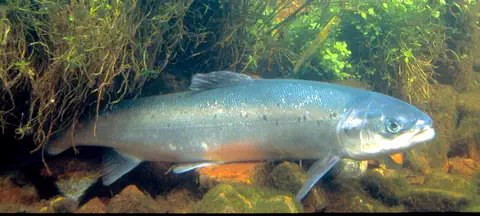
Atlantic salmon
The Atlantic salmon hatches in a river, swims out to the North Atlantic Ocean to feed and grow, then returns to the very river where it was born to lay its eggs. Along the way it changes color and shape several times.
Explore next
-
Watch
City
Dublin
Dublin, the capital of Ireland, sits where the River Liffey flows into Dublin Bay. Vikings built a town here in the 800s, and its name comes from a "black pool" in the river. Today it is famous for its writers, music, Georgian squares and Trinity College, home of the Book of Kells.
-
Watch
Animal
Red deer
The red deer is one of the largest deer in the world. It lives in forests, hills and moors across Europe and into western Asia and North Africa. Males, called stags, grow huge branching antlers every year and roar to win mates in autumn.
-
Watch
3D
Animal
Atlantic puffin
The Atlantic puffin is a small seabird of the North Atlantic, often called the clown of the sea because of its huge, colorful bill. It spends most of its life far out on the ocean and comes ashore only in summer to nest in burrows on islands and cliff tops. Underwater, its small wings work like flippers.
- Watch Geography Ocean currents Ocean currents are flows of seawater from one place to another. Winds push the surface water, and because Earth spins, the currents curve into giant loops called gyres. Deep down, cold, salty water sinks and creeps slowly around the planet. Together, currents carry heat from the warm tropics toward the cold poles.
-
Watch
Animal
Atlantic salmon
The Atlantic salmon hatches in a river, swims out to the North Atlantic Ocean to feed and grow, then returns to the very river where it was born to lay its eggs. Along the way it changes color and shape several times.
-
 Watch
Journey
The first flights across the Atlantic
In 1919, airplanes crossed the Atlantic Ocean for the first time. A US Navy flying boat, NC-4, crossed in stages, and then John Alcock and Arthur Brown flew nonstop from Newfoundland to Ireland in about 16 hours. In 1927, Charles Lindbergh flew alone and nonstop from New York to Paris in 33 and a half hours.
-
 Watch
 Country
Belarus
Belarus is a landlocked country in eastern Europe. Ice sheets of the last ice age shaped its low hills and wide plains, it has more than 10,000 lakes and one of Europe's largest wetlands, and about 9.1 million people lived there in 2025.
-
 Watch
 Country
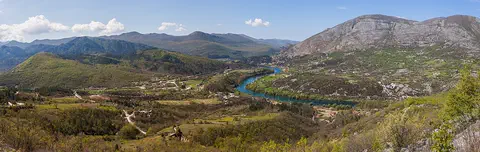
Bosnia and Herzegovina
Bosnia and Herzegovina is a mountainous country in southeastern Europe. It has forests, limestone hills and many rivers, and famous old stone bridges cross some of them. Its capital is Sarajevo. It touches the Adriatic Sea along only about 20 kilometers of coast.
For parents & teachers
What children will learn
- Locate Ireland, explain that it shares its island with Northern Ireland (UK), and name the seas between it and Great Britain.
- Describe Ireland's central plain ringed by mountains and its mild, wet Atlantic climate.
- Describe which animals live in Ireland, and which, such as snakes, do not.
- Outline Ireland's history from Neolithic tombs to the republic of 1949, and describe its languages, music and sports without treating its people as one single culture.
Recommended ages: 3 to 17 · About 15 minutes
Talk about it
- Why might an island have fewer kinds of animals than the land next to it?
- Ireland has two official languages. Why might a country want to keep an old language alive?
- What does living close to the ocean change about the weather where you live, or where a relative lives?
Try at home or in class
- Make a model of Ireland's landscape: press clay or dough into a shallow plate, raise mountains around the edge, and pour a little water into the middle to make lakes.
- Keep a rain log for a week with a jar and a ruler, then compare it with Ireland's wet west, where more than 2,500 mm of rain can fall in a year.
Key vocabulary: bog, maritime climate, endemic, Gaeltacht, passage tomb, partition, World Heritage Site
Where these facts come from
- Wikidata , Wikimedia Foundation (CC0 1.0)
- Natural Earth vector data , Natural Earth (NACIS) (Public domain)
- UNESCO World Heritage List , UNESCO World Heritage Centre (Linked as a reference; site facts come from Wikidata)
- Population and Migration Estimates, April 2026: Key Findings , Central Statistics Office (Ireland)
- Ireland (introduction, Land, Relief) , Encyclopaedia Britannica
- Ireland: Drainage (soils, climate) , Encyclopaedia Britannica
- Ireland: Plant and animal life , Encyclopaedia Britannica
- Ireland: Ethnic groups, language, and religion , Encyclopaedia Britannica
- Ireland: Daily life and social customs (the arts) , Encyclopaedia Britannica
- Ireland: Sports and recreation , Encyclopaedia Britannica
- Ireland: Neolithic Period (Bronze and Iron Ages) , Encyclopaedia Britannica
- Ireland: Early Christianity , Encyclopaedia Britannica
- Ireland: Independent Ireland to 1959 , Encyclopaedia Britannica
- Killarney National Park: Nature and Conservation , National Parks and Wildlife Service (Ireland)
- Brú na Bóinne - Archaeological Ensemble of the Bend of the Boyne , UNESCO World Heritage Centre
- Sceilg Mhichíl , UNESCO World Heritage Centre
- PlayOwl region table, version 1 , PlayOwl (PlayOwl original data)
- flag-icons 7.5.0 , Panayiotis Lipiridis and contributors (MIT)
- Wikimedia Commons , Wikimedia Foundation (Per file (public domain, CC0, CC BY or CC BY-SA); see each media record)
Checked, not yet human-reviewed. Last updated October 24, 2026. Spotted a mistake? Tell us.
Picture credits
- Photo: 瑞丽江的河水, CC BY-SA 4.0, via Wikimedia Commons · source · license
- Photo: © Superbass / CC BY-SA 4.0 (via Wikimedia Commons), CC BY-SA 4.0, via Wikimedia Commons · source · license
- Photo: K.ristof, CC BY-SA 3.0, via Wikimedia Commons · source · license
- Photo: Jerzy Strzelecki, CC BY-SA 3.0, via Wikimedia Commons · source · license