
Animal
Atlantic puffin
The Atlantic puffin is a small black and white seabird with a big, bright orange beak. It lives at sea and nests in holes on islands.
The Atlantic puffin is a small seabird of the North Atlantic, often called the clown of the sea because of its huge, colorful bill. It spends most of its life far out on the ocean and comes ashore only in summer to nest in burrows on islands and cliff tops. Underwater, its small wings work like flippers.
Fratercula arctica is a member of the auk family that breeds in dense colonies on North Atlantic islands from Maine and Newfoundland to Norway and Russia, and winters far out at sea. Although millions remain, the IUCN lists it as Vulnerable because populations are declining, mainly because warming waters and overfishing are changing the supply of the small fish they eat.
Photo: Charles J. Sharp, CC BY-SA 4.0, via Wikimedia Commons
Meet the Atlantic puffin
The Atlantic puffin is a small, round seabird.
It is black on top and white underneath. In summer it has a big orange, yellow and gray beak and bright orange feet. People call it the clown of the sea.
The Atlantic puffin is a stout little seabird, about 26 to 29 centimeters long, with a big head, a short neck and a huge triangle-shaped bill. All year it is black above and white below.
In the breeding season its bill is striped black, orange and yellow, its face is grayish white and its feet are bright orange. In winter, out at sea, its face turns darker gray and the bill sheds its bright outer parts and shrinks slightly. Young puffins have all-dark bills.
Fratercula arctica belongs to the auk family (Alcidae). Cornell describes it as a medium-sized, stout seabird, 26 to 29 centimeters long and 310 to 550 grams, that stands upright on land and floats high in the water.
The bill is a seasonal ornament. Breeding adults have a large black, orange and yellow bill and a grayish-white face; in winter the face darkens and the bill loses its yellow highlights and shrinks. The bill also grows larger and gains more grooves as the bird ages, while juveniles have all-dark bills.
Quick facts
- Group
- Bird
- Length
- 0.26 to 0.29 m
- Wingspan
- 0.53 m
- Weight
- 0.31 to 0.55 kg
Where it lives
Puffins live on the cold North Atlantic Ocean.
In summer they nest on rocky islands and cliffs. The rest of the year they float far out at sea.
Atlantic puffins live across the North Atlantic, from Canada and the United States to Norway, and south to Spain. They nest on rocky islands with short grass and on the tops of sea cliffs.
About half of all Atlantic puffins nest in Iceland. Others nest in Canada, Greenland, Norway, the United Kingdom, Ireland and the Faroe Islands, and a few in Maine. From late August until spring, puffins live far out at sea, often a long way from any coast.
The IUCN's 2018 global assessment lists breeding or resident populations from Canada, the United States (Maine) and Greenland through Iceland, the Faroe Islands, Ireland, the United Kingdom, Norway, Svalbard and European Russia, with further populations listed for France and North African coasts, and non-breeding birds south to Spain, Portugal and Italy.
About half the global population breeds in Iceland; the Westman Islands hold the world's largest colony, and half of North America's puffins breed at Witless Bay, Newfoundland. Colonies sit in turf on small islands and cliff tops, or in crevices and under boulders in the far north. Outside the breeding season puffins are pelagic, and RSPB tracking shows UK birds wintering far out in the Atlantic or in the North Sea.
Continents
Its habitat

Where can you find this animal?
- Lives here naturally · Countries and seas named by a scientific source
- Sightings recorded · Records of wild sightings (GBIF)
- Visits for part of the year · Countries and seas named by a scientific source
Lives here naturally · Countries and seas named by a scientific source
Rocky islands and sea cliffs of the North Atlantic, where puffins nest from late April to August, and the open ocean where they spend the rest of the year. The Faroe Islands and Svalbard are also in the range but have no separate map shape.
Places: Canada, Greenland, Iceland, Ireland, Norway, Russia, UK, United States and 7 more places.
Source: iucn-red-list · checked October 2026
Sightings recorded · Records of wild sightings (GBIF)
Counts of GBIF records of wild observations (human and machine) and preserved specimens. Records include introduced populations, vagrants, escaped or released animals and misidentifications, so a country with records is not necessarily part of the native range.
Wild sightings have been recorded in UK, United States, Canada, Norway, Iceland, Sweden, Ireland, Spain and 23 more places.
Source: gbif · checked October 2026
Visits for part of the year · Countries and seas named by a scientific source
Coasts of countries where the IUCN lists puffins only outside the breeding season.
Places: Belgium, Germany, Italy, Netherlands, Portugal, Spain and Sweden.
Source: iucn-red-list · checked October 2026
Range maps show where scientists say an animal lives, often country by country. An animal may live in only part of a country shown, and sightings records can include animals that wandered far from home.
What it eats
Puffins eat small fish.
They dive underwater to catch them. A puffin can carry lots of little fish in its beak at once!
Puffins eat small fish about 5 to 15 centimeters long, such as sand eels, sprats, capelin, herring, hake and young cod. In the breeding season they fish close to their colony, usually within about 16 kilometers of shore.
A puffin can catch several fish on one dive and hold them all crosswise in its bill. Tiny backward-pointing spines on the roof of its mouth and its tongue help keep the fish from slipping out.
The diet is small fish around 5 to 15 centimeters long, mainly sand lance (sandeels), sprat, capelin, herring, hake and cod. During breeding, adults forage in shallow water near the colony, generally within about 16 kilometers (10 miles) of shore.
Puffins often catch several fish in a single dive and carry them crosswise in the bill, gripped by backward-pointing spines on the palate and tongue. In the southern part of the range, including the United Kingdom, sandeels are a staple food (RSPB), and Cornell links warming waters off southern Iceland to changes in sandeel availability.

Flying in air and water
Puffins flap their little wings very fast to fly.
Underwater, their wings work like flippers. Their orange feet help them steer.
In the air, puffins flap their short, straight wings very fast to stay up. Underwater, the same wings become powerful flippers, so puffins 'fly' through the sea, using their feet as a rudder to steer. They can dive about 60 meters deep, but usually fish in shallower water.
On land puffins stand upright and waddle like a penguin, teetering from side to side. They dig their nesting burrows with their bills and feet.
Puffins fly with constant, fast wingbeats of short, straight wings, and underwater the wings provide propulsion while the feet act as a rudder. Cornell gives a diving depth of around 200 feet (about 60 meters), though most feeding is shallower.
On land they stand upright and waddle. The bill and feet serve as digging tools for burrows, and the bill's grip on fish depends on backward-pointing spines in the mouth. Plumage is black above and white below year-round; the colorful bill plates and grayish-white face are breeding-season features that change in winter.
Burrows and pufflings
Puffins nest in holes in the ground.
The mother lays just one egg. The baby puffin is called a puffling. Mom and Dad bring it beakfuls of fish.
Puffin pairs dig a burrow into the soil with their bills and feet, or nest in a crack between rocks, and line it with grass and twigs. Many pairs use the same burrow with the same mate year after year.
The female lays a single white egg, which takes 36 to 45 days to hatch. The chick, called a puffling, is covered in dark gray down. It stays in the burrow for 38 to 44 days before heading out to sea. Puffins do not start breeding until they are 3 to 6 years old.
Pairs are monogamous and often return to the same burrow with the same mate. Both sexes dig, the male typically more, and burrows are lined with grass and twigs; northern colonies use crevices and boulder cavities.
Cornell gives a clutch of one dull white egg, an incubation period of 36 to 45 days and a nestling period of 38 to 44 days; the chick hatches covered in dark gray down. Puffins are long-lived and do not breed until 3 to 6 years old. The oldest recorded Atlantic puffin, banded as a chick in Norway, lived to 41, and Cornell suggests some live longer.
Life in a puffin colony
Puffins live together in big, busy groups.
Puffin pairs rub their beaks together. They stomp their feet and shake their heads to say, 'This is my home!'
Puffins nest in colonies, with burrows often just a couple of body lengths apart. To say 'I'm friendly', a puffin walks through the colony crouched low, and birds arriving at the colony may stand as if bowing.
Puffin pairs keep their bond by rubbing their bills together. To show that a burrow is theirs, they shake their heads from side to side or stomp their feet. Puffins that are not breeding often fly in big circles or figure-eights over the cliffs, which is called wheeling.
Puffins spend most of their lives on the open ocean, coming ashore only to breed. In summer they forage in small groups of up to about seven; in winter they are less social, often foraging alone or in pairs.
Colonies are dense, with burrows a couple of body lengths apart. Arriving birds crouch horizontally with one foot forward, and a horizontal walk signals nonaggression. Males court by flicking their heads and grunting near a burrow; pairs maintain their bond by rubbing bills, and owners proclaim burrows by head-shaking and foot-stomping. Nonbreeders perform 'wheeling flight' in circuits over the colony.
Did you know?
A baby puffin is called a puffling.
Puffin chicks are called pufflings.
Chicks, known as pufflings, hatch covered in dark gray down.
Helping puffins
There are fewer puffins than there used to be.
The sea is getting warmer, and that changes the fish they eat. People are helping by protecting islands and the little fish puffins need.
The Atlantic puffin is listed as Vulnerable. There are still millions, but their numbers are falling, mainly because warmer seas are changing the supply of the small fish they eat. In southern Iceland, puffins have had almost no chicks survive in most years for more than ten years.
People are helping. In Maine, puffins had disappeared, but scientists moved young puffins to old nesting islands, and more than 2,000 puffins now nest there again. In 2024 the United Kingdom banned large-scale fishing for sandeels in the English North Sea and Scottish waters.
The IUCN's 2018 global assessment lists the species as Vulnerable, with a decreasing population of about 12 to 14 million mature individuals. Cornell attributes the decline mainly to warming waters changing food supplies; in southern Iceland, where about half the world's puffins breed, changes in sandeel availability have caused almost complete breeding failure each year for more than a decade. The RSPB reports that the UK lost 23 percent of its puffins in about 20 years (Seabirds Count, 2023) and also blames industrial-scale overfishing.
Invasive American mink eliminated almost all of Iceland's mainland colonies after the 1930s. Heavy hunting in the 1800s and early 1900s wiped puffins out of the United States, but protected areas and Audubon's Project Puffin, which moved chicks to former islands, restored more than 2,000 breeding birds in Maine.
IUCN Red List
How is the atlantic puffin doing in the wild?
- Least Concern
- Near Threatened
- Vulnerable (this animal)
- Endangered
- Critically Endangered
- Extinct in the Wild
- Extinct
Vulnerable
At high risk of disappearing from the wild.
See the IUCN Red List assessment · The IUCN Red List of Threatened Species 2021.3
Amazing facts
-
A baby puffin is called a puffling.
Puffin chicks are called pufflings.
Chicks, known as pufflings, hatch covered in dark gray down.
-
Puffins can fly underwater!
Puffins use their wings to 'fly' underwater and their feet to steer, diving about 60 meters deep.
Wing-propelled diving with the feet as a rudder reaches depths of around 60 meters.
-
A puffin's beak changes color in winter.
After the breeding season a puffin sheds the bright outer parts of its bill, and its face turns darker gray.
The bill loses its yellow highlights and shrinks slightly in winter, and the face darkens.
-
One puffin lived to be 41 years old.
The oldest known Atlantic puffin was banded as a chick in Norway and lived to be 41 years old.
The longevity record is 41 years, for a bird banded as a chick in Norway; durable bands are recent, so older birds may exist.
Words to know
- seabird
- a bird that lives and finds its food on the sea
- burrow
- a hole or tunnel dug in the ground as a home
- colony
- a large group of animals that nest close together
- puffling
- a baby puffin
- sandeel
- a small, thin fish that many seabirds eat
- vulnerable
- at risk of becoming endangered
Discovery challenge
-
What is a baby puffin called?
What is a puffin chick called?
What name is given to a puffin chick?
- A puffling
- A kitten
- A tadpole
Show the answer
A puffling
A baby puffin is a puffling.
Puffin chicks are called pufflings.
Pufflings hatch in dark gray down and stay in the burrow for 38 to 44 days.
-
Where does a puffin make its nest?
Where do Atlantic puffins nest?
Which nest site do Atlantic puffins mostly use?
- In a burrow in the ground
- At the top of a tall tree
- On floating ice
Show the answer
In a burrow in the ground
Puffins nest in holes in the ground.
They dig burrows in the soil on islands and cliff tops.
Burrows dug into turf on islands and cliff tops, or crevices and boulder cavities in the north.
-
What do puffins eat?
What is a puffin's main food?
Which prey does the Atlantic puffin mainly take?
- Small fish
- Leaves
- Nuts
Show the answer
Small fish
Puffins eat little fish.
Small fish such as sandeels, sprats, capelin and herring.
Small fish of about 5 to 15 cm, mainly sand lance, sprat, capelin, herring, hake and cod.
-
How does a puffin swim underwater?
What do puffins use to swim underwater?
What propels a puffin underwater?
- Its wings
- Its tail only
- It cannot swim
Show the answer
Its wings
Puffins flap their wings to swim.
Their wings work like flippers, and their feet help steer.
Wing propulsion, with the feet acting as a rudder.
Places where you might see it
-
 Watch
 Country
Iceland
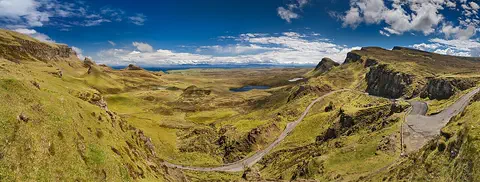
Iceland is an island country in the North Atlantic, close to the Arctic Circle. It sits on the border between two giant plates of Earth's crust and has about 200 volcanoes, many hot springs and huge glaciers, and about 396,500 people lived there in mid-2026.
-
 Watch
 Country
Norway
Norway stretches along the western side of the Scandinavian Peninsula, far into the Arctic. Deep, narrow inlets of the sea called fjords cut into its mountains, and about 5.6 million people live there, many of them near Oslo, the capital.
-
 Watch
 Country
United Kingdom
The United Kingdom, or UK, lies on islands off the northwest coast of Europe. It is made up of four parts, England, Scotland, Wales and Northern Ireland, and about 69.5 million people live there. Its capital is London.
-
 Watch
 Country
Ireland
Ireland is a country on an island in the Atlantic Ocean, west of Great Britain. It covers most of the island, while Northern Ireland, in the northeast, is part of the United Kingdom. Rain keeps its fields green, its capital is Dublin, and more than 5.5 million people live there.
Experiments to try
Explore next
-
 Watch
3D
Animal
Atlantic herring
The Atlantic herring is a small, silvery fish of the cold North Atlantic. Herring swim in enormous schools, eat tiny floating plankton, and lay their sticky eggs on the sea floor. Whales, seabirds and many fish depend on them for food, and people have fished for them for hundreds of years.
-
 Watch
3D
Animal
Atlantic cod
The Atlantic cod is a large, speckled fish of the cold North Atlantic. It has a whisker-like barbel on its chin and three fins along its back. For hundreds of years people have caught cod for food, so many that some cod populations crashed and are still being rebuilt today.
-
 Watch
Animal
Emperor penguin
The emperor penguin is the largest penguin in the world. It lives around Antarctica, and it is the only animal that breeds during the dark, freezing Antarctic winter. Fathers keep the egg warm on their feet for about two months, huddled together against the storms.
-
Watch
Country
Iceland
Iceland is an island country in the North Atlantic, close to the Arctic Circle. It sits on the border between two giant plates of Earth's crust and has about 200 volcanoes, many hot springs and huge glaciers, and about 396,500 people lived there in mid-2026.
-
Watch
Country
Norway
Norway stretches along the western side of the Scandinavian Peninsula, far into the Arctic. Deep, narrow inlets of the sea called fjords cut into its mountains, and about 5.6 million people live there, many of them near Oslo, the capital.
-
Watch
Country
United Kingdom
The United Kingdom, or UK, lies on islands off the northwest coast of Europe. It is made up of four parts, England, Scotland, Wales and Northern Ireland, and about 69.5 million people live there. Its capital is London.
-
 Watch
Animal
Common loon
The common loon is a big diving bird of northern lakes. In summer it wears a black head, a striped white necklace and a checkered back. It chases fish underwater, calls with eerie wails and yodels, and spends the winter on the coast.
-
 Watch
Animal
American flamingo
The American flamingo is a tall, bright pink wading bird of the Caribbean. It gets its color from pigments in the tiny water animals and algae it eats, and it feeds by filtering water through its bent bill with its head upside down. Flamingos live and nest in huge, noisy groups.
For parents & teachers
What children will learn
- Describe how the Atlantic puffin's bill, wings and feet help it live at sea and on land.
- Describe the puffin's breeding life in burrows and the growth of the puffling.
- Explain how changes in small fish affect puffins.
- Describe how people brought puffins back to Maine.
Recommended ages: 3 to 17 · About 15 minutes
Talk about it
- Why might a bird that feeds its chick fish need to nest close to good fishing waters?
- What could happen to puffins if the small fish they eat moved away or became scarce?
- Why do you think puffins nest on islands rather than the mainland?
Try at home or in class
- Use clothespins or tongs to see how many paper 'fish' you can hold crosswise at once, like a puffin's bill.
- Cut a 28-centimeter strip of paper and compare it with a ruler to see a puffin's length.
Key vocabulary: seabird, burrow, colony, puffling, sandeel, vulnerable
Where these facts come from
- The IUCN Red List of Threatened Species , International Union for Conservation of Nature (IUCN terms of use (no redistribution of Red List data or range maps))
- GBIF Backbone Taxonomy and GBIF Occurrence Search , Global Biodiversity Information Facility (CC0 1.0 (backbone); occurrence counts are facts derived from records under CC0, CC BY and CC BY-NC)
- Wikidata , Wikimedia Foundation (CC0 1.0)
- Fratercula arctica (Atlantic Puffin), Red List global assessment 2018 , IUCN Red List of Threatened Species
- Atlantic Puffin overview , Cornell Lab of Ornithology, All About Birds
- Atlantic Puffin life history , Cornell Lab of Ornithology, All About Birds
- Atlantic Puffin identification , Cornell Lab of Ornithology, All About Birds
- Puffin , RSPB
- Wikimedia Commons , Wikimedia Foundation (Per file: Public domain, CC0, CC BY or CC BY-SA only (credited on each page))
Checked, not yet human-reviewed. Last updated October 28, 2026. Spotted a mistake? Tell us.