
City Europe
Dublin
Dublin is the capital city of Ireland. A river runs through the middle, and a giant park has deer and a zoo.
Dublin, the capital of Ireland, sits where the River Liffey flows into Dublin Bay. Vikings built a town here in the 800s, and its name comes from a "black pool" in the river. Today it is famous for its writers, music, Georgian squares and Trinity College, home of the Book of Kells.
Dublin, capital of Ireland and its chief port, stands at the head of Dublin Bay where the Liffey crosses a hill-ringed plain. Founded by Norse settlers about 831, made a seat of English government after 1170 and the second city of the British Empire in the 18th century, it had 592,713 people in Dublin City at the 2022 census.
Photo: 瑞丽江的河水, CC BY-SA 4.0, via Wikimedia Commons
Discover Dublin
Dublin is the capital city of Ireland.
A river called the Liffey flows right through the middle. Bridges cross it. The river flows into the sea at a big bay.
Dublin is the capital and biggest city of Ireland. It is on the country's east coast, where the River Liffey flows east across a plain ringed by hills and into Dublin Bay, part of the Irish Sea.
The name Dublin comes from a "black pool" made by dark bog water draining into the river. About 593,000 people lived in Dublin City at the 2022 census, and about one in four people in the Republic of Ireland live in the wider Dublin area. The Liffey divides the city into a north side and a south side.
Dublin, in the province of Leinster, lies at the head of Dublin Bay, where the Liffey breaks eastward through a hill-ringed plain to the Irish Sea. Britannica suggests that this opening from the sea toward Ireland's fertile central plains first drew Viking raiders and Norse settlers; the dark bog water draining into the river made the "black pool" that gave the city its name. The Dublin and Wicklow mountains set a natural limit to the south.
The 2022 census counted 592,713 people in Dublin City; Britannica's 2011 figures were 527,612 for the city and 1,273,069 for Greater Dublin, where about a quarter of the Republic's people live. As the country's chief port and the center of its finance, commerce and culture, the city mixes reminders of older political and economic conditions with symbols of modern prosperity.
- Country
- Ireland (capital)
- People in Dublin City (2022 census)
- about 593,000
- Name means
- black pool
- Irish name
- Baile Átha Cliath
Famous places
Trinity College is a very old university in the middle of Dublin.
Its library has a famous old book with beautiful painted pages. Dublin also has an old castle and a tall, shiny, pointed spire. A huge park has a zoo!
Trinity College was founded in 1592. Its 18th-century Old Library holds the Book of Kells, a decorated manuscript made in the 800s, and its Long Room has shelves for about 200,000 of the library's oldest books. Nearby, Dublin Castle was the center of British rule in Ireland until 1922 and is now used for ceremonies.
On O'Connell Street rises the Spire, a 120-meter stainless-steel point. West of the center lies Phoenix Park, Europe's largest enclosed city park, opened to the public in 1747; its zoo opened in 1831.
Dublin Castle joins the city's three architectural layers, Norse, Norman and Georgian: the Normans replaced the Norse stronghold early in the 13th century, and the Georgian red-brick castle kept two of their towers. The seat of British authority until 1922, it now hosts presidential inaugurations and conferences. Christ Church Cathedral began about 1030 under a Norse king and was rebuilt by the Normans; St. Patrick's, rebuilt in 1191, was restored with funds from Sir Benjamin Lee Guinness.
Trinity College, chartered in 1592, built its great Old Library in the 18th century; it now shows the 9th-century Book of Kells. Georgian Dublin survives in the squares (Merrion, Fitzwilliam, Parnell and the older St. Stephen's Green), Leinster House (1745–48, now the parliament) and James Gandon's Custom House (1781–91) and Four Courts (1786–1802). Phoenix Park, a former royal deer park opened to the public in 1747, is Europe's largest enclosed urban park; its zoo dates from 1831.
- Trinity College
- founded by royal charter, 1592
- Book of Kells
- 9th-century manuscript, in the Old Library
- The Spire
- 120 m, stainless steel
- Phoenix Park
- perimeter of about 11 km; zoo opened 1831
From Viking town to capital
Long ago, Vikings sailed up the river and built a town.
Later, people built a castle and big churches. Weavers came and made fine cloth. Then builders made elegant streets and squares with red-brick houses.
People lived around Dublin Bay in prehistoric times, but the first town we have proof of was built by Vikings, or Norsemen, around 831 on the south bank of the river. In 1170 an Anglo-Norman army from Wales took Dublin, and soon King Henry II of England arrived and made it the center of government.
For centuries Dublin was a small walled town. Then, after 1685, refugee weavers from France arrived, and the cloth trade boomed. In the 1700s Dublin grew rich and spread out with new bridges and grand Georgian squares. The composer Handel gave the first public performance of his Messiah here in 1742.
Ptolemy mentioned Dublin about 140 CE, yet the first settlement with historical proof was Norse, founded about 831 on the south bank and the ridge where the castle later rose. Norse Dublin prospered despite defeat at Clontarf in 1014. In 1170 Dermot MacMurrough retook it with Anglo-Norman forces, and Henry II's arrival to assert his sovereignty established it as the center of government. Until the mid-17th century it was a small walled town ruling only the Pale; by Cromwell's era it had only 9,000 people.
Huguenot weavers arriving after 1685, followed by Flemish weavers, revived the cloth trade, and the 18th century made Dublin the British Empire's second city, the age of Swift and of Handel's first Messiah (1742), though the Penal Laws from 1695 impoverished the Catholic majority. In the 20th century the General Post Office was the headquarters of the 1916 rising, the first Dáil met in the Mansion House in 1919, and fighting in 1921–22 burned the Custom House and wrecked the Four Courts, both since rebuilt. Joining the European Economic Community in 1973 quickened the city's growth.
Getting around Dublin
In Dublin, a train runs along the seaside.
Trams glide through the streets, and lots of buses go everywhere. Big ships sail into the port.
The DART train runs along the coast, from Howth and Malahide in the north to Greystones in the south, with views of the sea. A tram system began running from St. Stephen's Green in 2004, and city buses go almost everywhere.
Two main railway stations, Connolly and Heuston, link Dublin to the rest of Ireland. Dublin is Ireland's chief port, and the Dublin Port Tunnel, opened in 2006, takes trucks from the port straight to the motorways. The airport is just north of the city.
The Dublin Area Rapid Transit (DART) runs along the coast from Malahide and Howth in Fingal to Greystones in County Wicklow, a tram system from St. Stephen's Green began in 2004, and extensive bus services cover the city. Connolly station serves the north and northwest, Heuston the south, southwest and west, with intercity links to the rest of Ireland and Northern Ireland; the international airport is at Collinstown, just north of the city.
The Dublin Port Tunnel, Ireland's largest civil engineering project, opened in 2006 to link the port with the national motorway network. Port traffic has grown steadily since the 1990s, and the International Financial Services Centre, established in the former northern docks in 1987, began their regeneration as a business and residential district.
- DART coastal trains
- Howth and Malahide to Greystones
- Trams
- began running in 2004
- Dublin Port Tunnel
- opened 2006
Weather and seasons
Dublin is never very hot or very cold.
Winters are cool and summers are mild. It rains a little on many days. Snow is rare.
Dublin has a mild, damp climate because it is beside the sea. In January, days average about 8 °C and nights about 2 °C. In July, days average about 20 °C and nights about 12 °C.
About 758 millimeters of rain falls in a year, spread across 10 to 13 days of rain in every month. October is the wettest month. Snow falls on fewer than 10 days a year.
Britannica describes a maritime temperate climate, with more rain in the surrounding mountains and fewer than 10 days of snow a year. World Meteorological Organization normals for 1981–2010 at the Dublin Airport station give mean daily maxima and minima of 8.1 °C and 2.4 °C in January and 19.5 °C and 11.7 °C in July.
Monthly totals add up to about 758 mm, from 49 mm in February to 79 mm in October, with 10 to 13 rain days in every month: rain is frequent but rarely heavy, and there is no dry season.
- January, average daily high and low
- about 8 °C and 2 °C
- July, average daily high and low
- about 20 °C and 12 °C
- Rain and snow in a year
- about 758 mm
Living in Dublin
Dublin is a city of stories, poems and music.
Famous writers were born here. People play music in many places. Children cheer at games of hurling and Gaelic football.
Dublin is famous for its writers. Three winners of the Nobel Prize for Literature, George Bernard Shaw, William Butler Yeats and Samuel Beckett, were born in or near the city, and James Joyce's novel Ulysses is set here on one day, June 16, 1904. Every year on June 16, the city celebrates Bloomsday.
Dublin is known for its friendly welcome and its craic, a mix of fun, jokes and clever talk. Traditional Irish sports, hurling and Gaelic football, are played at Croke Park, and the city has given the world famous musicians such as the band U2.
Greater Dublin was the birthplace of three Nobel laureates in literature (Shaw, Yeats and Beckett), and Swift, Wilde, O'Casey, Behan, Burke and Joyce are linked with it; Ulysses (1922) follows a single Dublin day, June 16, 1904, now celebrated as Bloomsday. The Abbey Theatre, tied to Synge and Lady Gregory, reopened in 1966 after a fire, and the Gate Theatre Company (1928) launched Orson Welles and James Mason.
A cultural revival began with the Gaelic Athletic Association (1884) and the Gaelic League (1893); hurling and Gaelic football fill Croke Park. The Guinness Brewery has worked at St. James's Gate since 1759, though older industries declined from the 1970s as technology, electronics, chemicals and finance took their place. The Irish Stock Exchange has traded continuously since 1793. The Irish Travellers, some 5,000 of whom live in the Dublin area, were recognized as an ethnic group in 2017.
- Nobel Prize winners for Literature born in Greater Dublin
- 3: Shaw, Yeats and Beckett
- Bloomsday
- June 16 every year
- Gaelic games
- hurling and Gaelic football at Croke Park
Dublin on the map
Find Dublin on the globe.
Look for Ireland, an island in the west of Europe. Dublin is on its east coast, facing the Irish Sea.
Dublin is on the east coast of the island of Ireland, in the province of Leinster. It sits at the head of Dublin Bay, on the Irish Sea.
The River Liffey runs through the center from west to east. To the south rise the Dublin and Wicklow mountains, which stop the city from spreading farther in that direction.
Dublin lies at about 53.3° N and 6.3° W, at the head of Dublin Bay in Leinster; the city covers 118 km². Four of Ireland's five great ancient roads met near the ford called Baile Átha Cliath, the name on Dublin's postmark.
The city's north-south axis runs from St. Stephen's Green down Grafton Street to College Green, over O'Connell Bridge and up O'Connell Street to Parnell Square. The 18th-century North and South Circular roads ringed the Georgian city, and the Royal and Grand canals, both linking the Liffey with the River Shannon, run beyond them; Phoenix Park lies about 3 km west of the center.
- Latitude
- about 53.3° north
- Longitude
- about 6.3° west
- City area
- 118 km²
Amazing facts
-
Dublin's name means black pool.
The name Dublin comes from a "black pool" made by dark bog water draining into the River Liffey.
The dark bog water draining into the Liffey formed the 'black pool' (Dubh Linn) that gave Dublin its name.
-
A famous piece of music was first played in Dublin.
In 1742, George Frideric Handel conducted the first public performance of his Messiah in Dublin.
Handel conducted the first public performance of Messiah in Dublin's New Musick Hall in 1742.
-
Dublin's zoo is almost 200 years old.
Dublin Zoo, in Phoenix Park, opened in 1831. It is famous for breeding lions.
Phoenix Park's zoo, celebrated for lion breeding, opened in 1831 and roughly doubled in size in 2001 with its African Plains section.
-
A whole famous book takes place on one day in Dublin.
James Joyce's novel Ulysses takes place in Dublin on a single day, June 16, 1904. The city celebrates it every year on Bloomsday.
Joyce's Ulysses (1922) presents one Dublin day, June 16, 1904; the city marks it annually as Bloomsday.
-
Trinity College's library has a very old, beautiful book.
The Book of Kells, a decorated manuscript from the 800s, is kept in Trinity College's Old Library.
The Book of Kells, a 9th-century gospel manuscript, is displayed in Trinity's 18th-century Old Library, whose Long Room holds 200,000 of its oldest books.
Words to know
- capital
- the city where a country's government meets
- Vikings
- seafaring Norse people from Scandinavia who raided and settled in other lands
- quay
- a stone or concrete edge along a river or harbor where boats can stop
- Georgian
- a neat, elegant style of building from the 1700s, often in red brick
- manuscript
- a book or document written by hand
- hurling
- a fast Irish team sport played with a wooden stick and a small ball
- craic
- an Irish word for fun, lively talk and good company
Discovery challenge
-
Which river flows through Dublin?
Which river divides Dublin into a north side and a south side?
Which river breaks eastward through a hill-ringed plain to Dublin Bay?
- The Liffey
- The Thames
- The Danube
Show the answer
The Liffey
The Liffey! Bridges cross it.
The Liffey, crossed by O'Connell Bridge in the center.
The Liffey.
-
Who built the first town at Dublin?
Which people built the first town at Dublin that historians have proof of, around 831?
The first settlement at Dublin with historical proof was founded by which people?
- The Vikings
- The Romans
- The Aztecs
Show the answer
The Vikings
The Vikings, who sailed in from the sea!
The Vikings, or Norsemen.
Norsemen, about 831; it was not a Celtic foundation.
-
What does the name Dublin mean?
What does the name Dublin come from?
What did the dark bog water draining into the Liffey create, giving the city its name?
- A black pool
- A green hill
- A white castle
Show the answer
A black pool
A black pool in the river!
A black pool made by dark bog water.
The 'black pool,' Dubh Linn.
-
Where is the famous old Book of Kells kept?
Which Dublin university's Old Library holds the Book of Kells?
The 9th-century Book of Kells is displayed at which institution, chartered in 1592?
- Trinity College
- Dublin Zoo
- The Spire
Show the answer
Trinity College
Trinity College's library!
Trinity College, founded in 1592.
Trinity College Dublin.
-
What is in Phoenix Park?
Which attraction, opened in 1831, is in Phoenix Park?
What opened in Phoenix Park in 1831 and doubled in size in 2001?
- A zoo
- An airport
- A beach
Show the answer
A zoo
A zoo!
Dublin Zoo, famous for breeding lions.
The zoo, which added its African Plains section in 2001.
Nearby places
-
 Watch
Natural wonder
Giant's Causeway
The Giant's Causeway, on the north coast of Northern Ireland, is made of some 40,000 columns of dark basalt rock, many of them six-sided, packed together like a honeycomb. They formed about 60 million years ago, when a deep pool of lava cooled slowly, shrank and cracked into columns.
-
 Watch
Landmark
Stonehenge
Stonehenge is a prehistoric monument on Salisbury Plain in England. It began as a round earthwork about 5,000 years ago, and its stone circle went up about 2500 BC. Hundreds of people moved huge stones, some from Wales, and lined them up with the sun.
-
 Watch
Landmark
Windsor Castle
Windsor Castle stands above the River Thames, west of London. William the Conqueror built the first castle here in the 1070s, and kings and queens have lived in it ever since. It is still a working royal home, and visitors can tour its grand rooms and chapel.
-
 Watch
Landmark
British Museum
The British Museum in London was founded in 1753 and opened in 1759. It holds treasures from all over the world, like the Rosetta Stone, which helped people learn to read Egyptian hieroglyphs. Its grand building with columns was built from 1823 to 1847, and in 2025 it had more than 6.4 million visits.
-
 Watch
Landmark
Buckingham Palace
Buckingham Palace began as a big house built for the Duke of Buckingham. King George III bought it in 1761, and King George IV had the architect John Nash turn it into a palace. Since 1837 it has been the London home of Britain's kings and queens. It has 775 rooms.
-
 Watch
Landmark
Big Ben
Big Ben is the nickname of the Great Bell inside the clock tower of the Houses of Parliament in London. The tower, 96 meters tall, was begun in 1843, and its clock started keeping time in 1859. Since 2012 the tower has been called the Elizabeth Tower.
-
 Watch
Landmark
London Eye
The London Eye is a huge observation wheel, 135 meters tall, on the South Bank of the River Thames in London. It was built for the year 2000, the new millennium. Its 32 glass capsules carry up to 25 people each, and the wheel turns so slowly that people step on while it moves.
-
 Watch
City
London
London, the capital of the United Kingdom, began as a Roman town almost 2,000 years ago. About 8.8 million people lived in Greater London in 2021. It has the Tower of London, Big Ben, Tower Bridge and the Tube, an underground railway that opened in 1863.
Explore next
-
Watch
 Country
Ireland
Ireland is a country on an island in the Atlantic Ocean, west of Great Britain. It covers most of the island, while Northern Ireland, in the northeast, is part of the United Kingdom. Rain keeps its fields green, its capital is Dublin, and more than 5.5 million people live there.
-
Watch
City
London
London, the capital of the United Kingdom, began as a Roman town almost 2,000 years ago. About 8.8 million people lived in Greater London in 2021. It has the Tower of London, Big Ben, Tower Bridge and the Tube, an underground railway that opened in 1863.
-
 Watch
City
Copenhagen
Copenhagen, the capital of Denmark, grew from a small harbor town into a royal city of palaces, canals and towers. Its name means "Merchants' Harbor." It has the Tivoli Gardens, opened in 1843, and the Little Mermaid statue, and about 673,000 people lived there in 2026.
-
 Watch
City
Oslo
Oslo, the capital of Norway, lies at the head of the Oslo Fjord. It was founded about 1050, burned down in 1624 and was rebuilt under a new name, Christiania, before taking back the name Oslo in 1925. About 729,000 people lived there in 2026.
-
 Watch
City
Amsterdam
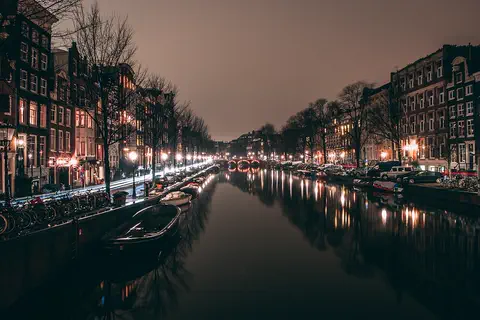
Amsterdam is the capital of the Netherlands. It began as a fishing village beside a dam on the Amstel River, which gave the city its name. Today about 942,000 people live among its rings of canals, hundreds of bridges, houseboats and bicycles.
-
 Watch
City
Athens
Athens is the capital of Greece and one of the oldest cities in the world. Above it rises the Acropolis, a rocky hill crowned by the marble Parthenon, built about 2,500 years ago. Ancient Athens was home to early democracy, great thinkers and theater.
-
 Watch
City
Barcelona
Barcelona, the capital of Catalonia in northeastern Spain, lies on the Mediterranean between mountains and the sea. It is famous for the buildings of the architect Antoni Gaudí, including the Sagrada Família, a giant church begun in 1882. About 1.7 million people live in the city (2025).
-
 Watch
City
Belgrade
Belgrade, the capital of Serbia, stands where the Sava River flows into the Danube. Its name, Beograd, means "white city", probably because of the white limestone walls of its old fortress above the rivers. At the 2022 census, about 1.2 million people lived in the city itself and about 1.7 million in the wider City of Belgrade.
For parents & teachers
What children will learn
- Locate Dublin at the mouth of the River Liffey on Ireland's east coast.
- Explain how a Viking town grew into a capital city.
- Name some of Dublin's landmarks, writers and traditions.
- Read monthly rainfall numbers and describe a climate with no dry season.
Recommended ages: 3 to 17 · About 15 minutes
Talk about it
- Dublin's name comes from a 'black pool.' What might your town's name mean?
- Weavers who came from France helped Dublin grow. How do newcomers change a city?
- James Joyce wrote a whole book about one day. What would a book about one day in your town include?
Try at home or in class
- Decorate the first letter of your name like a page from an old handwritten manuscript.
- Keep a rain diary for two weeks and compare it with Dublin's 10 to 13 rainy days a month.
Key vocabulary: capital, Vikings, quay, Georgian, manuscript, hurling, craic
Where these facts come from
- Wikidata , Wikimedia Foundation (CC0 1.0)
- Natural Earth vector data , Natural Earth (NACIS) (Public domain)
- Dublin , Encyclopaedia Britannica
- Dublin: People , Encyclopaedia Britannica
- Dublin: Cultural life , Encyclopaedia Britannica
- Dublin: History , Encyclopaedia Britannica
- History of Trinity College Dublin , Trinity College Dublin
- The Old Library , The Library of Trinity College Dublin
- Dublin: climatological information , World Meteorological Organization, World Weather Information Service
- Wikimedia Commons , Wikimedia Foundation (Per file (public domain, CC0, CC BY or CC BY-SA); see each media record)
Checked, not yet human-reviewed. Last updated October 27, 2026. Spotted a mistake? Tell us.