 Country
Asia
Kuwait
Kuwait is a small, hot desert country by the sea. Its big city grew from a little fort by a deep bay.
Kuwait is a small desert country at the top of the Persian Gulf, between Iraq and Saudi Arabia. It grew from a trading town on Kuwait Bay into a modern country after oil was found. About 4.9 million people live there, most of them in and around Kuwait City.
Kuwait, a small emirate in the northwestern corner of the Persian Gulf, lies in one of the driest deserts on Earth beside the deep harbor of Kuwait Bay. Founded as a trading settlement in the 18th century and ruled by the Al Sabah since 1756, it grew wealthy on oil after 1938; it had about 4.9 million people in 2025 (World Bank), about two-thirds of them foreign workers.
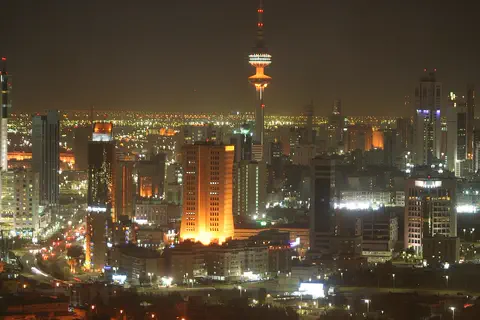
Photo: Snap® from Kuwait, Kuwait, CC BY 2.0, via Wikimedia Commons
Discover Kuwait
Kuwait is a small country in Asia.
It is very hot and dry. It is next to the sea. The capital city is also called Kuwait.
Kuwait is a small country in the northwest corner of the Persian Gulf, a little bigger than the U.S. state of Hawaii. Most of it is desert, one of the driest on Earth, but its coast has Kuwait Bay, a deep, sheltered harbor.
In the 1700s, families from the Arabian desert started a trading post on the bay. The name Kuwait comes from a word meaning a small fort. Today, most people live in and around Kuwait City, the capital. About 4.9 million people lived in Kuwait in 2025.
Kuwait is a small emirate between Iraq and Saudi Arabia in a section of one of the driest, least hospitable deserts on Earth, slightly larger than Hawaii. Its shore includes Kuwait Bay, a deep harbor where Bedouin from the interior founded a trading post in the 18th century; the name derives from the Arabic diminutive of the Hindustani kut, fort.
Since the Al Sabah family established a sheikhdom in 1756, Kuwait's fortunes have been linked to foreign commerce, and the fort grew into Kuwait City, a metropolis of skyscrapers, apartment blocks and mosques that holds most of the population, making Kuwait one of the world's most urbanized countries. The World Bank put the population at 4,865,298 in 2025; about two-thirds are expatriate workers, now mostly from South and Southeast Asia.
Kuwait City and the islands
Kuwait City has tall towers and busy streets.
Long ago, it was a small town with a mud wall. Today, its old gates still stand. Little islands lie out in the sea.
Kuwait City grew from a small trading town by the sea. From 1918 to 1954 a mud wall curved around the old town, and when the city grew, the wall was taken down but its gates were kept to remember the early years.
The Kuwait Towers hold water tanks and a restaurant with a turning viewing deck. The Seif Palace, first built in 1910, is known for its Islamic architecture. Sadu House is a museum where people learn Bedouin weaving. Out in the bay, the island of Failaka has had people living on it since prehistoric times.
The old town of Kuwait, only about 13 km², faced a sheltered harbor and was bounded on the landward side from 1918 to 1954 by a semicircular mud wall; its typical dwelling was the courtyard house. After the oil boom the wall was demolished, its gates preserved, and planners laid out new suburbs. Kuwaiti citizens now live at low density across the suburbs, while many non-Kuwaitis live in apartments in the old city and in Hawalli and Al-Salimiyyah.
The Kuwait Towers contain two water reservoirs and a restaurant with a revolving viewing platform. The Seif Palace, built in 1910 and much renovated, is an official residence of the ruling family. The National Museum was looted and burned during the Iraqi occupation and has only partly reopened, raising the importance of the private Tareq Rajab Museum. Of Kuwait's nine islands, Bubiyan and Al-Warbah are the largest and are uninhabited, while Failaka, near the entrance of Kuwait Bay, has been populated since prehistoric times.
Desert, heat and sandstorms
Kuwait is a flat, sandy desert.
Summers are very, very hot. It rains a little in winter. Then the desert can turn green for a short time.
Kuwait is mostly flat or gently rolling desert, with a few low hills. It has no rivers or lakes that last all year. After winter rains, low places in the desert fill with water, and long ago Bedouin herders brought their camels there to drink.
Summer days are usually about 44 °C and can get even hotter. Only 25 to 180 millimeters of rain fall in a year, mostly from October to April. If enough rain falls, the desert turns green from mid-March to April. In June and July, a wind called the shamal whips up sandstorms.
Kuwait's relief is flat or gently undulating, broken by low hills and shallow depressions, rising from sea level in the east to the western corner; the Al-Zawr Escarpment on the northwestern shore of Kuwait Bay reaches 145 m. There is no permanent surface water: wadis are short and end in interior basins, which fill after winter rain and were once key watering places for Bedouin camel herds. True soils scarcely exist, and salinity is high.
Between April and September daytime temperatures ordinarily reach 44 °C and occasionally approach 54 °C; winter is milder, with occasional frost inland but never on the coast. Annual rainfall is 25–180 mm, chiefly from October to April, though a cloudburst can bring more than 50 mm in a day. The northwesterly shamal of June and July raises dramatic sandstorms. Britannica notes that the Persian Gulf War destroyed much of the desert's hard surface crust, increasing wind-blown sand and the number of dunes.

Animals and plants of Kuwait
Few big animals can live in Kuwait's hot desert.
Foxes and lizards find ways to survive. Small bushes grow in the sand. Salt-loving plants grow by the sea.
Kuwait's harsh climate means only a few mammals live there, such as the occasional fox. Lizards do better: the monitor lizard and the plant-eating dab lizard live in the desert. This sand cat was photographed in Kuwait.
Most plants are scrub and low bushes, with grass that sprouts only in spring. Along the marshy coast grow halophytes, plants that can live in salty ground. Around Kuwait City, a new green belt is watered by irrigation, and crops grow at oases such as Al-Jahra, where there is water.
Britannica notes that the harsh climate allows only a few mammals, such as the occasional fox, and lists among reptiles the rare, venomous sand viper (Cerastes vipera) and the monitor and vegetarian dab lizards (Uromastix). The photo shows a sand cat recorded in Kuwait.
Vegetation is mostly scrub and low bushes with ephemeral spring grass, and halophytes grow on the coastal marshes; cultivation and irrigation are found only in the new green belt of Kuwait City and in oases such as Al-Jahra at the western end of Kuwait Bay. If rainfall is enough, the desert greens from mid-March to the end of April.
People, languages and food
About 4.9 million people live in Kuwait.
People speak Arabic, and many speak English too. Many people come from other countries to work. Rice with fish or meat is a favorite meal.
About two out of every three people in Kuwait are workers from other countries, many from South and Southeast Asia. Arabic is the official language, English is taught in public schools, and Hindi, Urdu and Persian are widely spoken too.
A traditional meal is spiced rice topped with meat, fish or shellfish from the Gulf, and fava-bean ful, falafel and hummus are everyday foods. Many men meet regularly at a diwaniyyah, a get-together for talking and refreshments. Bedouin weaving on a loom called a sadu is still taught, and camel and horse racing and soccer are popular.
Kuwaiti citizens, defined as those able to prove Kuwaiti ancestry before 1920, are a minority; about two-thirds of residents are expatriate workers, formerly from other Arab states but now mostly from South and Southeast Asia, without citizenship rights. Arabic is the official language, with Kuwaitis speaking Gulf Arabic and learning Modern Standard Arabic at school; English is the second language in public schools. Citizens are almost entirely Muslim, mostly Sunni, with about one-third Shi'a.
The diwaniyyah, a regular gathering usually in a tent or separate room, is central to traditional social life. Ful, falafel and hummus are staples, and the traditional meal is spiced rice with meat, fish or Gulf shellfish. Bedouin sadu weaving is kept alive at Sadu House. Camel and horse racing remain popular, and football and golf are widely played; Kuwait first competed at the Summer Olympics in 1968.
A trading town becomes an oil state
Long ago, families from the desert built a small trading town by the sea.
People fished and dived for pearls. Later, oil was found. In 1961, Kuwait became its own country.
In the early 1700s, families from the Arabian desert moved to the bay and started a trading town. In 1756 they chose a leader from the Sabah family, which still rules Kuwait. The town traded by sea and by camel caravan and relied on the pearl banks of the Gulf.
In 1899 Kuwait made a treaty with Britain, and it later became a British protectorate. Oil was discovered in 1938, and Kuwait City grew quickly into a modern city. On June 19, 1961, Kuwait became fully independent.
At about the beginning of the 18th century the Banu Utub, families of the Anizah tribe, migrated from the interior; in 1756 they appointed a sheikh from the Al Sabah, founding the autonomous sheikhdom. Through the 19th century Kuwait thrived as an independent trading community, relying on Gulf pearl banks and long-distance sea and caravan trade. Ottoman threats led Mubarak the Great to sign an 1899 treaty giving Britain control of foreign affairs, and Kuwait became a British protectorate after World War I began. Oil was discovered in 1938, and Britain recognized Kuwait's independence on June 19, 1961.
Kuwait co-founded the Gulf Cooperation Council in 1981. On August 2, 1990, Iraq invaded and occupied Kuwait; a UN-authorized coalition led by the United States and Saudi Arabia liberated it by late February 1991, and the retreating troops looted the country and set fire to most of its oil wells. Elections to the National Assembly followed in 1992. Women won the right to vote in 2005, and in 2009 four women became the first elected to parliament.
Kuwait on the map
Find Kuwait on the globe.
It is at the very top of the Persian Gulf. Iraq and Saudi Arabia are its neighbors. It is small, but it has a long coast.
Kuwait sits at the northwest tip of the Persian Gulf. Iraq is to the west and north, Saudi Arabia is to the south, and the Gulf is to the east.
Kuwait Bay cuts deep into the coast, with Kuwait City on its southern shore and the oasis of Al-Jahra at its western end. Nine islands belong to Kuwait, including Failaka near the mouth of the bay.
Kuwait is bounded by Iraq to the west and north, the Persian Gulf to the east and Saudi Arabia to the south. A 5,700 km² area along the Gulf was shared with Saudi Arabia as a Neutral Zone until a boundary was agreed in 1969; each country now administers half, and they still share oil revenues from the whole area equally.
The border with Iraq was formally delimited by a United Nations commission in 1992 under a 1991 Security Council resolution. Kuwait City lies on the southern shore of Kuwait Bay, with Failaka near the bay's entrance and the large, uninhabited islands of Bubiyan and Al-Warbah to the north.
- Neighbors
- Iraq and Saudi Arabia
- Islands
- nine; Bubiyan and Al-Warbah are the largest
- Old shared Neutral Zone with Saudi Arabia
- about 5,700 km², divided in 1969
- People (2025)
- 4,865,298
Amazing facts
-
Kuwait's name means a small fort.
The name Kuwait comes from a word meaning a small fort, because the city grew from a little fort by the bay.
The name Kuwait derives from the Arabic diminutive of the Hindustani kut, fort; the small fort grew into Kuwait City.
-
Kuwait has no rivers.
Kuwait has no rivers or lakes that last all year; rainwater soon dries up or sinks into desert basins.
Kuwait has no permanent surface water; its wadis end in interior basins, and most rain is lost to evaporation.
-
The Kuwait Towers hold water.
The Kuwait Towers in Kuwait City hold water tanks, and one has a restaurant with a viewing deck that turns.
The Kuwait Towers contain two water reservoirs and a restaurant with a revolving viewing platform.
-
Men in Kuwait often meet at a gathering called a diwaniyyah.
A diwaniyyah is a regular gathering of men, often in a tent or a special room, where people meet to talk, have refreshments and play games.
Britannica places the diwaniyyah, a regular gathering usually held in a tent or separate room of the house, at the heart of traditional Kuwaiti culture.
Words to know
- emirate
- a country or state ruled by an emir
- bay
- a part of the sea that curves into the land
- sandstorm
- a strong wind that carries clouds of sand
- oasis
- a place in a desert where water lets plants grow
- halophyte
- a plant that can grow in salty ground
- protectorate
- a place controlled and defended by a more powerful country
Discovery challenge
-
What is the capital city of Kuwait?
Which city, on the southern shore of Kuwait Bay, is the capital?
Which city holds most of Kuwait's population, making it one of the world's most urbanized countries?
- Kuwait City
- Manama
- Al-Jahra
Show the answer
Kuwait City
Kuwait City is the capital of Kuwait.
Kuwait City lies on the southern shore of Kuwait Bay.
Kuwait City grew from a small fort into the metropolis that holds most of the population.
-
How hot are summer days in Kuwait?
About how hot are ordinary summer days in Kuwait?
What temperature do Kuwait's dry-season days ordinarily reach?
- About 44 °C
- About 10 °C
- Below freezing
Show the answer
About 44 °C
Summers are very hot, about 44 °C.
Summer days usually reach about 44 °C, and sometimes close to 54 °C.
Between April and September daytime highs ordinarily reach 44 °C and occasionally approach 54 °C.
-
What did Kuwait find under the ground in 1938?
What was discovered in Kuwait in 1938 that changed the country?
Which discovery in 1938 transformed Kuwait's economy and capital?
- Gold
- Oil
- Diamonds
Show the answer
Oil
Kuwait found oil.
Oil was discovered in 1938, and Kuwait City grew into a modern city.
Oil, discovered in 1938 and developed after World War II, transformed the walled town into a modern metropolis.
-
Does Kuwait have rivers?
Which is true about water in Kuwait?
Which statement describes Kuwait's surface water?
- It has many big rivers
- It has no rivers or lakes that last all year
- It has a giant lake in the middle
Show the answer
It has no rivers or lakes that last all year
No. Kuwait has no rivers that last all year.
Kuwait has no permanent rivers or lakes; desert basins fill only after rain.
There is no permanent surface water; intermittent wadis end in interior basins.
-
When did Kuwait become its own country?
In which year did Kuwait become fully independent?
In which year did Britain recognize Kuwait's independence, on June 19?
- 1756
- 1938
- 1961
Show the answer
1961
Kuwait became its own country in 1961.
Kuwait became fully independent on June 19, 1961.
Britain recognized independence on June 19, 1961; 1756 marks the Al Sabah sheikhdom and 1938 the discovery of oil.
Animals of Kuwait
-
Watch
Animal
Sand cat
The sand cat is a small wild cat of the deserts of North Africa, Arabia and Central Asia. Its sandy coat hides it on the dunes, its big ears hear prey moving under the sand, and thick fur on the soles of its feet protects it from scorching days and freezing nights.
-
 Watch
Animal
Red fox
The red fox is a small, clever member of the dog family with an orange coat, black legs and a bushy, white-tipped tail. It lives across North America, Europe, Asia and North Africa, more of the world than any other wild land carnivore, and has even moved into big cities.
Explore next
-
 Watch
 Country
Saudi Arabia
Saudi Arabia covers about four-fifths of the Arabian Peninsula. Most of it is dry desert, including the Empty Quarter, the largest sand area in the world. About 35.3 million people lived there in 2024, most of them in cities such as Riyadh, the capital.
-
 Watch
 Country
Iraq
Iraq is a country in the Middle East. Its two great rivers, the Tigris and the Euphrates, water a wide plain that was once called Mesopotamia, where some of the world's earliest cities grew. About 46.1 million people were counted there in 2024, and its capital is Baghdad.
-
 Watch
 Country
Bahrain
Bahrain is a small island country in the Persian Gulf, linked to Saudi Arabia by a long causeway. Long ago it was the center of a trading land called Dilmun, and for centuries its people dived for pearls. About 1.6 million people live there today.
-
Watch
Animal
Sand cat
The sand cat is a small wild cat of the deserts of North Africa, Arabia and Central Asia. Its sandy coat hides it on the dunes, its big ears hear prey moving under the sand, and thick fur on the soles of its feet protects it from scorching days and freezing nights.
-
Watch
Animal
Red fox
The red fox is a small, clever member of the dog family with an orange coat, black legs and a bushy, white-tipped tail. It lives across North America, Europe, Asia and North Africa, more of the world than any other wild land carnivore, and has even moved into big cities.
-
 Watch
 Country
Afghanistan
Afghanistan is a landlocked country in south-central Asia. The high Hindu Kush mountains run across its middle, sandy deserts lie in the southwest, and the capital, Kabul, sits in a valley about 1,800 meters above sea level.
-
 Watch
 Country
Azerbaijan
Azerbaijan is a country on the southern side of the Caucasus Mountains, along the western shore of the Caspian Sea. It has high mountains, wide lowlands and forests, its capital is Baku, and about 10.3 million people lived there in mid-2026.
-
 Watch
 Country
Indonesia
Indonesia is a country of about 17,500 islands in Southeast Asia, spread across the Equator between the Indian and Pacific oceans. It has more than 100 active volcanoes, rainforests full of wildlife, and about 286 million people (2025).
For parents & teachers
What children will learn
- Locate Kuwait at the head of the Persian Gulf, with Iraq and Saudi Arabia.
- Describe how people and plants cope with extreme heat and very little rain.
- Describe the people, languages and daily life of Kuwait without treating them as one culture.
- Outline Kuwait's history from an 18th-century trading town to oil wealth and independence in 1961.
Recommended ages: 3 to 17 · About 15 minutes
Talk about it
- How might life in a city change when oil is discovered nearby?
- What do you think it is like to live in a country where most people came from somewhere else?
- How do you think people stayed cool before air conditioning in very hot places?
Try at home or in class
- Put two cups of water outside, one in the sun and one in the shade, and check after an hour which has less water: evaporation is why Kuwait has no permanent rivers.
- Weave strips of colored paper over and under each other to make a small mat, like the patterns of Bedouin sadu weaving.
Key vocabulary: emirate, bay, sandstorm, oasis, halophyte, protectorate
Where these facts come from
- Wikidata , Wikimedia Foundation (CC0 1.0)
- Natural Earth vector data , Natural Earth (NACIS) (Public domain)
- Kuwait (introduction, land, relief, drainage, soils) , Encyclopaedia Britannica
- Kuwait: Climate (plant and animal life, people, languages, religion, settlement) , Encyclopaedia Britannica
- Kuwait: Cultural life , Encyclopaedia Britannica
- Kuwait: History , Encyclopaedia Britannica
- Kuwait: The Persian Gulf War and its aftermath , Encyclopaedia Britannica
- Population, total: Kuwait , World Bank
- PlayOwl region table, version 1 , PlayOwl (PlayOwl original data)
- flag-icons 7.5.0 , Panayiotis Lipiridis and contributors (MIT)
- Wikimedia Commons , Wikimedia Foundation (Per file (public domain, CC0, CC BY or CC BY-SA); see each media record)
Checked, not yet human-reviewed. Last updated October 27, 2026. Spotted a mistake? Tell us.