
Animal
Sand cat
The sand cat is a small wild cat that lives in the desert. It has sandy fur, big ears and furry feet for walking on hot sand.
The sand cat is a small wild cat of the deserts of North Africa, Arabia and Central Asia. Its sandy coat hides it on the dunes, its big ears hear prey moving under the sand, and thick fur on the soles of its feet protects it from scorching days and freezing nights.
Felis margarita is the only cat found mainly in true desert, from the Sahara to the Arabian Peninsula and the Kyzylkum. Enlarged ear passages and middle-ear chambers, furred soles and the ability to get its water from prey suit it to extreme aridity. It is Least Concern (IUCN, assessed 2014), but rarely seen and poorly known.
Photo: Ranjith-chemmad, CC BY-SA 4.0, via Wikimedia Commons
Meet the sand cat
The sand cat is a wild cat that lives in the desert.
It is small, about the size of a pet cat. Its fur is the color of sand. It has big ears and a wide face.
The sand cat is a small wild cat built for the desert. Its body is only about 39 to 52 centimeters long, and it weighs about 1.35 to 3.4 kilograms.
Its pale, sandy fur hides it on the dunes. It has a broad, flat head, big ears set low on the sides, and a long tail with black rings and a black tip. A reddish stripe runs back from each eye across its cheeks.
Felis margarita belongs to the genus Felis. After the black-footed cat, it is the second smallest member of the genus Felis (IUCN Cat Specialist Group), with a head-and-body length of 39 to 52 centimeters and a weight of 1.35 to 3.4 kilograms.
The coat is pale sandy, finely speckled with black over the shoulders and silvery on the upper flanks; some animals have dark bars on the legs. The tail carries two to eight black rings and a black tip. A dark reddish stripe runs from each eye across the cheek, and the large, black-tipped ears sit wide apart and low on a broad, flattened head.
Quick facts
- Group
- Mammal
- Length
- 39 to 52 cm
- Weight
- 1.35 to 3.4 kg
- Lifespan in the wild
- up to 13 years
Where it lives
Sand cats live in deserts in Africa and Asia.
They like places with sand, rocks and a few small plants. Days are very hot there, and nights can be cold.
Sand cats live in deserts in North Africa, the Arabian Peninsula and Central Asia, in countries such as Algeria, Niger, Saudi Arabia, Oman, Iran and Uzbekistan. They are found in scattered patches, and scientists are not sure whether the gaps are real or just places no one has searched.
The IUCN Cat Specialist Group says the sand cat is the only cat that lives mainly in true desert. It likes sandy and rocky ground with a few plants, where small rodents and birds live. In the Sahara, it can be 58 °C in the shade by day and below freezing at night.
The IUCN's global assessment (assessed 2014, published 2016) describes a wide but patchy, apparently disjunct range across the deserts of North Africa and southwest and Central Asia, from Western Sahara, Algeria, Niger, Chad and Mali through Egypt's Sinai and the Arabian Peninsula to Iraq, Iran, Turkmenistan, Uzbekistan and Kazakhstan. It is unclear whether the gaps are real or reflect a lack of surveys. A breeding population was discovered in Uzbekistan's southern Kyzylkum Desert in 2013, and sand cats were first recorded in Iraq in 2012.
Sand cats prefer sparse vegetation on mixed sandy and rocky ground, and also use gravel plains and lava fields; they have been recorded up to 2,000 meters. Temperatures range from 58 °C in the shade in the Sahara summer to -25 °C in northern winters (IUCN Cat Specialist Group).
Continents
Its habitat

Where can you find this animal?
- Lives here naturally · Countries and seas named by a scientific source
- Sightings recorded · Records of wild sightings (GBIF)
Lives here naturally · Countries and seas named by a scientific source
Patchy records across the deserts of North Africa, the Arabian Peninsula, the Middle East and Central Asia. Sand cats live in only small, scattered parts of each country shown. Possibly extinct in Pakistan and parts of the Middle East, including Yemen; presence uncertain in Morocco and Qatar.
Places: Algeria, Chad, Egypt, Iran, Iraq, Jordan, Kazakhstan, Kuwait and 11 more places.
Source: iucn-red-list · checked October 2026
Sightings recorded · Records of wild sightings (GBIF)
Counts of GBIF records of wild observations (human and machine) and preserved specimens. Records include introduced populations, vagrants, escaped or released animals and misidentifications, so a country with records is not necessarily part of the native range.
Wild sightings have been recorded in Pakistan, Western Sahara, Algeria, Saudi Arabia, Morocco, Egypt, United States, Kuwait and 13 more places.
Source: gbif · checked October 2026
Range maps show where scientists say an animal lives, often country by country. An animal may live in only part of a country shown, and sightings records can include animals that wandered far from home.
What it eats
Sand cats eat small desert animals.
They catch mice, gerbils, small birds, lizards and bugs. They can hear a mouse moving under the sand, and dig it out!
Sand cats are carnivores. They eat mostly small desert rodents such as gerbils, jirds, jerboas and spiny mice. They also catch small birds, lizards, insects and even snakes.
A sand cat hunts at night. Its excellent hearing lets it find animals moving under the sand, and then it digs them out quickly. It can live far from any water, because it gets the water it needs from the animals it eats.
The diet is dominated by small sand-dwelling rodents: spiny mice, jirds, gerbils, jerboas and hamsters. Sand cats also take sandgrouse, larks and partridges, young Cape hares, many reptiles (sandfish, fringe-toed lizards, geckos, spiny-tailed lizards and vipers) and insects, including swarming locusts (IUCN Cat Specialist Group).
Hunting is strictly nocturnal. Acute hearing lets a sand cat detect prey beneath the sand and dig it out rapidly. Surplus meat from larger prey is cached under a layer of sand. Because it can meet its moisture needs from prey, the sand cat can live far from water sources.
Did you know?
Sand cats bury leftover food in the sand.
When a sand cat has more food than it can eat, it covers the leftovers with sand to eat later.
Surplus meat from larger prey is cached under an insulating layer of sand for later.
An amazing body
Sand cats have furry feet.
The fur keeps their paws safe on hot and cold sand. Their big ears hear tiny sounds. White fur inside the ears keeps sand out.
Sand cats have amazing desert gear. Thick fur grows between their toes and covers the soles of their feet, protecting them from hot sand by day and cold sand at night. It also makes their footprints very hard to see.
Their big ears are lined with thick white hair, which probably helps keep blowing sand out. Inside, the passages that carry sound to the eardrum are extra large, so sand cats hear very well, even prey moving underground. In the north, their winter coat can grow up to 6 centimeters long.
Dense dark fur grows between the toes and over the soles, completely covering the pads and insulating the feet against heat and cold. The ear canals and auditory bullae are greatly enlarged compared with other small cats, improving hearing in open country where prey is sparse and often underground; the inside of the ear is covered in thick white hair that probably protects against sand during storms (IUCN Cat Specialist Group).
In northern populations the winter coat can be up to 6 centimeters long with soft woolly underfur, making the cat look much larger. The front paw has five digits and the hind paw four, and the claws are not very sharp, except for the dewclaw.
Growing up
Baby sand cats are called kittens.
A mother usually has about three kittens. They grow up fast. Scientists think they can look after themselves when they are about half a year old.
A mother sand cat is pregnant for about two months. She usually has about three kittens, though there can be from two to eight. When they are born depends on where they live: in the Sahara, kittens are born between January and April.
Young sand cats grow quickly. Scientists think they can live on their own at about six to eight months old, and they are fully grown at 9 to 14 months.
Gestation lasts 59 to 67 days (IUCN Cat Specialist Group). Litters average three kittens and range from two to eight. Birth seasons vary by region: January to April in the Sahara, April in Turkmenistan, September and October in Pakistan, and kittens have been recorded between May and August in Saudi Arabia's Empty Quarter; in captivity births are not seasonal.
Age at independence in the wild is not known, but young grow quickly and are assumed to become independent at about six to eight months. Sexual maturity comes at 9 to 14 months. Sand cats have lived 13 years in captivity (Animal Diversity Web); wild lifespan is not known.
A secret desert life
Sand cats sleep in burrows in the day.
They come out at night to hunt. If they are scared, they crouch down and stay very still, so they are hard to see.
Sand cats are solitary and nocturnal. During the heat of a summer day they rest in burrows, which keeps them cool and saves water. They are good diggers and can make their own burrows, or move into old fox or rodent burrows and make them bigger.
When a sand cat leaves its burrow at night, it first stops and looks around. If something frightens it, it crouches low beside a rock or a tuft of grass and stays perfectly still, so it is very hard to spot. Sand cats travel far: in one study in the Middle East, males moved about 5.4 kilometers a night.
Sand cats are solitary and mainly nocturnal, though some daytime activity has been recorded in Arabia in cooler winters. In summer they rest by day in burrows, often at the base of bushes, to avoid temperature extremes and water loss. They dig their own burrows or enlarge those of desert foxes, rodents and hedgehogs; dens may have several entrances and be used by different cats at different times.
Home ranges are large: about 16 square kilometers for males in one Middle East study, which traveled an average of 5.4 kilometers a night; 19.6 to 50.7 square kilometers in Saudi Arabia; and averages of 275 to 319 square kilometers in Morocco. Threatened sand cats crouch and freeze, and they tend to close their eyes in spotlights, which makes them hard to find. Snakes, large owls, jackals, foxes and wolves prey on them.
Did you know?
A sand cat's feet are covered in fur, like little slippers.
Thick fur covers the soles of a sand cat's feet, which protects them from hot sand and makes its footprints hard to see.
Dense fur completely covers the pads, insulating the feet and leaving faint tracks that make sand cats hard for researchers to follow.
Helping sand cats
Sand cats are hard to find, so people know little about them.
Scientists are working to learn more. Keeping deserts wild and healthy helps sand cats.
The sand cat is listed as Least Concern, but it is rarely seen, and scientists still know very little about how many there are. Some populations, such as those in Arabia, seem to be shrinking.
The biggest danger is damage to desert homes from roads, new towns, farming, off-road driving and too much grazing by camels and goats. Pet and stray cats can spread diseases and compete for food. Scientists are using camera traps to learn more about where sand cats live.
The IUCN assessed the sand cat as Least Concern in 2014 (published 2016, annotated as needing an update), after earlier listings as Near Threatened. Its range is large and the population was conservatively estimated at 27,264 mature individuals, but records are sparse, its ecology poorly known, and local declines are reported, especially on the Arabian Peninsula, where it is regionally Near Threatened and Endangered in the United Arab Emirates.
Threats named by the IUCN Cat Specialist Group include habitat degradation from roads, settlement, agriculture, off-road driving and overgrazing; competition and disease from feral and domestic cats; dogs; accidental trapping, poisoning and fences; and, locally, the pet trade. The species is on CITES Appendix II, and hunting is prohibited in several range countries.
IUCN Red List
How is the sand cat doing in the wild?
- Least Concern (this animal)
- Near Threatened
- Vulnerable
- Endangered
- Critically Endangered
- Extinct in the Wild
- Extinct
Least Concern
Not at risk of disappearing from the wild right now.
Amazing facts
-
A sand cat's feet are covered in fur, like little slippers.
Thick fur covers the soles of a sand cat's feet, which protects them from hot sand and makes its footprints hard to see.
Dense fur completely covers the pads, insulating the feet and leaving faint tracks that make sand cats hard for researchers to follow.
-
Sand cats can get the water they need from their food.
A sand cat can get all the water it needs from the animals it eats, so it can live far from any water.
Moisture from prey meets the sand cat's water needs, allowing it to live far from water sources.
-
If a sand cat is scared, it freezes and stays very still.
A frightened sand cat crouches low and stays perfectly still beside a rock or a tuft of grass, so it is almost impossible to see.
Threatened sand cats crouch and remain motionless, and in spotlights they tend to close their eyes, which makes them hard to detect at night.
-
Sand cats bury leftover food in the sand.
When a sand cat has more food than it can eat, it covers the leftovers with sand to eat later.
Surplus meat from larger prey is cached under an insulating layer of sand for later.
Words to know
- desert
- a very dry place that gets little rain
- nocturnal
- active at night
- burrow
- a hole or tunnel in the ground where an animal lives or rests
- camouflage
- colors or patterns that help an animal blend into its surroundings
- rodent
- a small gnawing mammal, such as a mouse, gerbil or jerboa
- adaptation
- a body part or behavior that helps an animal survive where it lives
Discovery challenge
-
How do a sand cat's feet stay safe on hot sand?
What protects a sand cat's feet from hot and cold sand?
Which adaptation insulates the sand cat's feet?
- Thick fur on the soles
- Wearing shoes
- Never touching the ground
Show the answer
Thick fur on the soles
Fur grows on the bottoms of its feet, like slippers.
Thick fur grows between the toes and covers the soles of the feet.
Dense fur completely covers the pads, insulating against heat and cold.
-
Where does a sand cat get water?
How can sand cats live far from any water?
How do sand cats meet their water needs in the desert?
- They carry water bottles
- From the animals they eat
- From snow
Show the answer
From the animals they eat
They get water from their food.
The animals they eat have enough water in their bodies to keep the cat going.
Moisture from prey can satisfy their requirements, so they can live far from water.
-
When do sand cats hunt?
When do sand cats hunt?
When is the sand cat active as a hunter?
- In the hot middle of the day
- At night
- Only in the rain
Show the answer
At night
They hunt at night, when the desert is cool.
They rest in burrows by day and hunt at night.
Hunting is strictly nocturnal, with some daytime activity recorded in cool Arabian winters.
-
Where do sand cats live?
In what kind of place do sand cats live?
Which habitat is the sand cat's main home?
- Rainforests
- Deserts
- Snowy mountains
Show the answer
Deserts
Sand cats live in deserts.
They live in deserts of North Africa, Arabia and Central Asia.
It is the only cat found primarily in true desert.
Places where you might see it
-
 Watch
 Country
Saudi Arabia
Saudi Arabia covers about four-fifths of the Arabian Peninsula. Most of it is dry desert, including the Empty Quarter, the largest sand area in the world. About 35.3 million people lived there in 2024, most of them in cities such as Riyadh, the capital.
-
 Watch
 Country
Algeria
Algeria is a country in North Africa and the largest country on the whole continent. More than four-fifths of it is the Sahara Desert, so most of its 47 million people (2025) live in the greener north, along the Mediterranean Sea. Its capital is Algiers.
-
 Watch
 Country
Kuwait
Kuwait is a small desert country at the top of the Persian Gulf, between Iraq and Saudi Arabia. It grew from a trading town on Kuwait Bay into a modern country after oil was found. About 4.9 million people live there, most of them in and around Kuwait City.
Explore next
-
 Watch
Animal
Fennec fox
The fennec fox is the smallest member of the dog family. It lives in the Sahara and other deserts of North Africa, sleeps in cool burrows by day, and uses its enormous ears to hear insects moving under the sand at night.
-
 Watch
Animal
Caracal
The caracal is a sleek, reddish-gold wild cat of Africa, the Middle East and Central Asia to India. Its name comes from a Turkish word meaning "black ears", for its black-backed ears with long tufts. It hunts on the ground, but it can leap two meters or more into the air to catch birds.
-
 Watch
Animal
Pallas's cat
Pallas's cat, or the manul, is a small wild cat of the cold, dry grasslands and mountains of Central Asia. Its long, thick fur makes it look bigger than it really is, and its flat face and low, round ears help it peek over rocks without being seen. It hunts pikas and other small animals.
-
Watch
Country
Saudi Arabia
Saudi Arabia covers about four-fifths of the Arabian Peninsula. Most of it is dry desert, including the Empty Quarter, the largest sand area in the world. About 35.3 million people lived there in 2024, most of them in cities such as Riyadh, the capital.
-
Watch
Country
Algeria
Algeria is a country in North Africa and the largest country on the whole continent. More than four-fifths of it is the Sahara Desert, so most of its 47 million people (2025) live in the greener north, along the Mediterranean Sea. Its capital is Algiers.
-
Watch
Country
Kuwait
Kuwait is a small desert country at the top of the Persian Gulf, between Iraq and Saudi Arabia. It grew from a trading town on Kuwait Bay into a modern country after oil was found. About 4.9 million people live there, most of them in and around Kuwait City.
-
 Watch
3D
Animal
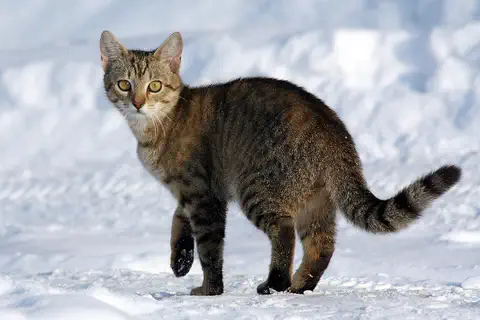
Domestic cat
The domestic cat is one of the world's favorite pets. Cats live with people in homes, farms and towns in almost every country on Earth. Long ago they came from a small wildcat of the Middle East and Africa, and they still have the sharp senses and soft paws of a wild hunter.
-
 Watch
Animal
Aardvark
The aardvark is a shy night digger of African savannas. It sniffs out ant and termite nests, rips them open with its spade-like claws and laps up the insects with a sticky tongue about 30 centimeters long. Its name means 'earth pig' in Afrikaans.
For parents & teachers
What children will learn
- Describe the sand cat's adaptations to desert heat, cold and dryness.
- Explain how the sand cat finds food and water in the desert.
- Locate the sand cat's patchy range across Africa and Asia.
- Understand why scientists still know so little about this species.
Recommended ages: 3 to 17 · About 15 minutes
Talk about it
- Why might fur on the bottom of your feet help on hot sand?
- How would you study an animal that only comes out at night and is very hard to see?
- Why might a cat that never drinks still need its prey to be healthy?
Try at home or in class
- Put a sock over one hand and touch something warm and something cool: how does the fabric change what you feel? Compare it with a sand cat's furry soles.
- Measure 45 centimeters, about a sand cat's body length, and compare it with a pet cat or a stuffed animal.
Key vocabulary: desert, nocturnal, burrow, camouflage, rodent, adaptation
Where these facts come from
- The IUCN Red List of Threatened Species , International Union for Conservation of Nature (IUCN terms of use (no redistribution of Red List data or range maps))
- GBIF Backbone Taxonomy and GBIF Occurrence Search , Global Biodiversity Information Facility (CC0 1.0 (backbone); occurrence counts are facts derived from records under CC0, CC BY and CC BY-NC)
- Felis margarita, global Red List assessment (assessed 2014, published 2016) , IUCN Red List of Threatened Species
- Sand cat (Felis margarita) , IUCN SSC Cat Specialist Group
- Felis margarita (sand cat) , Animal Diversity Web, University of Michigan Museum of Zoology
- Wikidata , Wikimedia Foundation (CC0 1.0)
- Wikimedia Commons , Wikimedia Foundation (Per file: Public domain, CC0, CC BY or CC BY-SA only (credited on each page))
Checked, not yet human-reviewed. Last updated October 28, 2026. Spotted a mistake? Tell us.