
 Country
Africa
Seychelles
Seychelles is a country of islands in the Indian Ocean. Giant tortoises live on one of its islands. Some palm trees there have enormous seeds.
Seychelles is a group of about 115 islands in the western Indian Ocean, far east of Kenya. Some islands are tall and made of granite; others are low, flat coral islands. Aldabra Atoll holds the world's largest population of giant tortoises. The National Bureau of Statistics estimated about 122,000 people at the end of 2024.
Seychelles is an island republic of about 115 islands between 4° and 11° S, some 1,600 km east of Kenya: the granitic Mahé group and more than 70 outer coralline islands. Uninhabited until French settlement in the 18th century, it became British in 1814 and independent in 1976. Two of its places, Aldabra Atoll and Vallée de Mai, are World Heritage Sites. The National Bureau of Statistics estimated 122,038 people at the end of 2024.
Photo: Simisa, CC BY-SA 3.0, via Wikimedia Commons
Discover Seychelles
Seychelles is made of many islands.
They are in the warm Indian Ocean. People speak Creole, English and French. The capital city is Victoria.
Seychelles is a country of about 115 islands in the western Indian Ocean. The main islands are about 1,600 kilometers east of Kenya and about 1,100 kilometers northeast of Madagascar. Nobody lived on the islands until settlers came in the 1700s.
Most people speak Creole, also called Seselwa, and English and French are national languages too. More than four out of five people live on Mahé, the biggest island, where the capital, Victoria, stands. The National Bureau of Statistics estimated about 122,000 people at the end of 2024.
Britannica places Seychelles between latitudes 4° and 11° S and longitudes 46° and 56° E, its major islands about 1,600 km east of Kenya and 1,100 km northeast of Madagascar. The islands were uninhabited before French colonization, and the population today is largely of mixed descent.
The 2022 census's provisional results counted 100,477 residents, up from 90,945 in 2010; the National Bureau of Statistics estimated 122,038 people living in the country on December 31, 2024, Seychellois and non-Seychellois together (101,093 of them Seychellois). Under the constitution Creole (Seselwa), English and French are national languages. Wikidata gives a land area of 459 km². The currency is the Seychelles rupee.
Victoria, Mahé and Praslin
Victoria is the capital city.
It is on the island of Mahé. The photo shows a bus in Victoria. On Praslin there is a forest of special palm trees.
Victoria, the capital, is on the northeast coast of Mahé. It is the country's only port and its only big town. The photo shows a bus on a street in Victoria. Mahé also has the highest point, Morne Seychellois, 905 meters high.
On the island of Praslin is the Vallée de Mai, a forest of ancient palm trees and a World Heritage Site. Nearby Cousin Island is a nature reserve for land birds. Far to the southwest lies Aldabra, a huge ring of coral islands.
Victoria, on Mahé's northeast coast, is the sole port and the only town of significant size, home to more than one-fourth of Mahé's people; more than four-fifths of all Seychellois live on Mahé. Morne Seychellois (905 m) is the highest point.
UNESCO inscribed the Vallée de Mai on Praslin in 1983: a 19.5 ha palm forest largely unchanged since prehistoric times, inside the 300 ha Praslin National Park. Cousin Island holds a sanctuary for land birds such as the Seychelles brush warbler. Aldabra Atoll, inscribed in 1982, lies far to the southwest near 46° E.

Granite islands and coral atolls
Some islands are tall and rocky.
Others are low and flat, made of coral. It is warm all year. Coco de mer palms grow huge seeds.
Seychelles has two kinds of islands. More than 40 are granite islands with hills in the middle, green forests and white beaches. More than 70 are flat coral islands rising only a little above the sea, and most have no fresh water.
It is warm and humid all year, from about 30 °C in the afternoon to about 20 °C at night. About 80 kinds of plants grow nowhere else, including the coco de mer palm, whose seed is the largest seed of any plant. Aldabra Atoll is four coral islands around a shallow lagoon.
The Mahé group has more than 40 central, mountainous granitic islands with narrow coastal strips and central hills; the outer group has more than 70 flat coralline islands with raised reefs at various stages, mostly waterless and few inhabited. The climate is tropical oceanic: afternoons in the low 30s °C, nights in the low 20s °C, humidity high; on Mahé rain ranges from about 2,300 mm at sea level to 3,560 mm on the slopes.
Of about 200 plant species, some 80 are endemic, including screw pines, jellyfish trees, latanier palms and the coco de mer, found on only two islands. UNESCO calls the coco de mer the bearer of the largest seed in the plant kingdom. Aldabra is four coral limestone islands enclosing a large shallow lagoon, ringed by a fringing reef, and UNESCO counts it among the largest atolls in the world.
Giant tortoises, rare birds and reef fish
Giant tortoises live on Aldabra.
About 180,000 of them live there! Rare birds, fruit bats and many fish live in Seychelles too.
Aldabra Atoll is home to the largest population of giant tortoises in the world: a survey published in 2026 estimated about 180,000. Being so far from people has kept the atoll wild. Aldabra also has a flightless bird, the white-throated rail.
Around the islands swim more than 900 kinds of fish and green sea turtles. Birds such as the Seychelles bulbul and the Seychelles swiftlet, which nests in caves, live nowhere else, and two kinds of bats are found only here. The tortoise in the photo lives on an island in Tanzania.
UNESCO credits Aldabra's isolation with keeping the world's largest population of giant tortoises; a survey led by the Seychelles Islands Foundation and the University of Exeter, reported in October 2026, estimated about 180,000, the highest figure ever recorded for the species, where an herbivore unusually tops the land food chain; it also has two endemic birds, the Aldabra brush warbler and Aldabra drongo, and the white-throated rail, the last remaining flightless bird of the western Indian Ocean.
Britannica lists more than 900 identified fish species, green sea turtles and giant tortoises, and endemics including the Seychelles bulbul, cave-dwelling Seychelles swiftlet, tree frogs, caecilians, Seychelles wolf snakes and tiger chameleons; the fruit bat Pteropus seychellensis and the Seychelles sheath-tailed bat are endemic mammals. Tenrecs were introduced from Madagascar. The tortoise photo was taken on Changuu Island, Tanzania.

Creole islands
People in Seychelles have families from many places.
Most people speak Creole. Many visitors come to the islands. Tuna is canned there.
The first settlers were French colonists and the enslaved Africans they brought. Later, people came from France, China, India and Malaysia, and many families have mixed roots. Most people speak Creole at home.
The economy depends heavily on tourism. Fishing matters too, and canned tuna is an important product. Farmers grow coconuts, cinnamon, vanilla and tea, though much food is brought in from other countries. More than three-fourths of people are Roman Catholic.
French colonists and the enslaved Africans they brought were joined in the 19th century by deportees from France and later, in smaller numbers, by people from China, India and Malaya; widespread intermarriage produced a population of mixed descent. Creole (Seselwa) is the mother tongue of most Seychellois, and more than three-fourths of people are Roman Catholic, with Anglican, other Christian, Hindu and Muslim communities. About one-fifth of people are under 15, and life expectancy is well above the global average.
The economy depends heavily on services, especially tourism. A modern fishing industry makes canned tuna a key export, alongside copra, frozen fish and cinnamon; vanilla, tea and limes are grown, though soils are poor and food is largely imported.
Empty islands to a republic
Long ago, nobody lived on these islands.
Later, people from France settled there. Then Britain ruled. In 1976 Seychelles became its own country.
Traders from the Persian Gulf knew of the islands centuries ago, but nobody lived there. The first recorded landing was by an English ship in 1609. France claimed the islands in 1756, and French settlers brought enslaved Africans to work on farms.
Britain took over in 1810 and ruled for more than 150 years. Slavery ended in the 1830s. Seychelles became independent in 1976, and since the early 1990s several parties have taken part in elections.
Persian Gulf traders knew the islands, but the first recorded landing on the uninhabited archipelago was by a British East India Company expedition in 1609. Lazare Picault explored it in 1742 and 1744, and France annexed it in 1756. Britain took it in 1810, and the Treaty of Paris ceded it in 1814; after abolition in the 1830s, planters turned from cotton to coconut, vanilla and cinnamon. Seychelles was governed from Mauritius until it became a separate crown colony in 1903.
Self-government came in 1975 and independence within the Commonwealth in 1976. France-Albert René took power in a 1977 coup, and a 1979 constitution made a one-party state; multiparty politics and a new constitution returned in the early 1990s. A 2016 amendment limited presidents to two consecutive terms.
Seychelles on the map
Find Seychelles on the globe.
Look in the Indian Ocean, east of Africa. Tiny islands are scattered across the blue sea.
Seychelles is in the western Indian Ocean, south of the equator. The main islands are about 1,600 kilometers east of Kenya, and Madagascar is to the southwest.
The islands are spread out across a big area of ocean. The granite islands, with Mahé and Praslin, are in the middle, and the coral islands, like Aldabra, are farther away. Seychelles has no land borders.
The islands lie between 4° and 11° S and 46° and 56° E: the granitic Mahé group in the north-central part of that box, the coralline outer islands scattered to the south and west, with Aldabra near the western edge, northwest of Madagascar.
Wikidata gives a land area of only 459 km², and Britannica counts Seychelles among the world's smallest countries.
- Islands
- about 115
- Distance from Kenya
- about 1,600 km
- Giant tortoises on Aldabra
- about 180,000 (2026 survey)
- People (2024 estimate)
- 122,038
Amazing facts
-
The coco de mer palm has the biggest seed of any plant.
The coco de mer palm of Seychelles makes the largest seed in the plant kingdom.
UNESCO describes the coco de mer, dominant in the Vallée de Mai, as the bearer of the largest seed in the plant kingdom.
-
On Aldabra, a tortoise is the top land animal.
On Aldabra, the biggest land animal at the top of the food chain is a plant-eater: the giant tortoise.
UNESCO notes that, unusually, the top of Aldabra's land food chain is occupied by an herbivore, the giant tortoise.
-
Aldabra has a bird that cannot fly.
The white-throated rail of Aldabra cannot fly.
UNESCO calls Aldabra's white-throated rail the last remaining flightless bird of the western Indian Ocean.
-
Nobody lived in Seychelles when the first ships came.
The islands were uninhabited when the first recorded landing took place in 1609.
The first recorded landing on the uninhabited islands was made in 1609 by a British East India Company expedition; France annexed them in 1756.
Words to know
- atoll
- a ring of coral islands around a lagoon
- granite
- a hard rock made deep underground from cooled magma
- endemic
- found naturally in one place and nowhere else
- lagoon
- a shallow body of water cut off from the open sea by a reef or islands
- Creole
- a language that grew from a mix of languages; in Seychelles it is called Seselwa
- flightless
- not able to fly
Discovery challenge
-
Which big animal lives on Aldabra?
About 180,000 of which animal live on Aldabra Atoll?
Aldabra holds the world's largest population of which reptile?
- The giant tortoise
- The polar bear
- The camel
Show the answer
The giant tortoise
Giant tortoises live on Aldabra.
Giant tortoises, about 180,000 of them (2026 estimate).
The Aldabra giant tortoise, about 180,000 in a 2026 survey.
-
What is the capital city of Seychelles?
Which town on Mahé is the capital of Seychelles?
Which town is the sole port and capital of Seychelles?
- Nairobi
- Victoria
- Port Louis
Show the answer
Victoria
Victoria is the capital.
Victoria, on Mahé.
Victoria, on Mahé's northeast coast.
-
Which palm tree has a giant seed?
Which palm makes the largest seed in the plant kingdom?
Which endemic palm of the Vallée de Mai bears the largest seed in the plant kingdom?
- The date palm
- The coconut palm
- The coco de mer
Show the answer
The coco de mer
The coco de mer has the giant seed.
The coco de mer, which grows on only two islands.
The coco de mer, protected in the Vallée de Mai on Praslin.
-
Which language do most people in Seychelles speak at home?
What is the mother tongue of most Seychellois?
Which national language, also called Seselwa, is most Seychellois' mother tongue?
- Creole
- Spanish
- Japanese
Show the answer
Creole
Most people speak Creole.
Creole, also called Seselwa.
Creole (Seselwa); English and French are also national languages.
Places to discover in Seychelles
Animals of Seychelles
-
Watch
Animal
Aldabra giant tortoise
The Aldabra giant tortoise is one of the largest land tortoises on Earth. Wild ones live on Aldabra Atoll, a ring of coral islands in the Indian Ocean, where about 180,000 of them graze, browse and shape the land like elephants do in Africa. They can live for more than 100 years.
-
 Watch
Animal
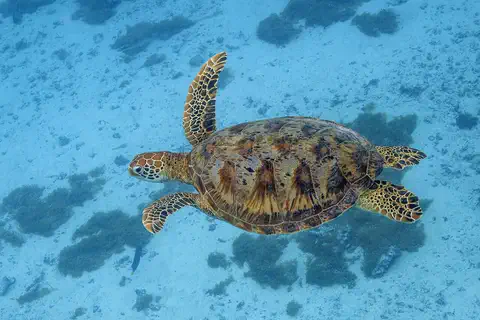
Green sea turtle
The green sea turtle is the largest sea turtle with a hard shell. It lives in warm seas around the world and, unlike other sea turtles, grown-ups eat mostly seagrass and algae. Females swim hundreds or even thousands of kilometers to lay their eggs on the beaches where they hatched long ago.
Explore next
-
Watch
Natural wonder
Aldabra Atoll
Aldabra Atoll is a ring of four main coral islands around a shallow lagoon, far out in the Indian Ocean. It is part of Seychelles, more than 1,000 kilometers from the main island, Mahé. So few people have lived there that its wildlife has been left mostly alone, including the largest population of giant tortoises in the world.
-
 Watch
 Country
Mauritius
Mauritius is a volcanic island east of Madagascar, almost completely surrounded by coral reefs. It was once home to the dodo, a flightless bird that died out by 1681. Today its people have roots in India, Africa, Europe and China, and most speak Creole. The 2022 census counted 1,233,097 people.
-
 Watch
 Country
Madagascar
Madagascar is the fourth-largest island in the world, in the Indian Ocean off southeastern Africa. It split from other land more than 60 million years ago, so many of its plants and animals, such as its lemurs, live nowhere else. About 32.7 million people lived there in 2025.
-
 Watch
 Country
Kenya
Kenya is a country in East Africa, crossed by the equator. It has the snow-capped Mount Kenya, the deep Great Rift Valley, Lake Victoria and a long Indian Ocean coast, and about 54 million people live there, many of them speaking Swahili.
-
Watch
Animal
Aldabra giant tortoise
The Aldabra giant tortoise is one of the largest land tortoises on Earth. Wild ones live on Aldabra Atoll, a ring of coral islands in the Indian Ocean, where about 180,000 of them graze, browse and shape the land like elephants do in Africa. They can live for more than 100 years.
-
Watch
Animal
Green sea turtle
The green sea turtle is the largest sea turtle with a hard shell. It lives in warm seas around the world and, unlike other sea turtles, grown-ups eat mostly seagrass and algae. Females swim hundreds or even thousands of kilometers to lay their eggs on the beaches where they hatched long ago.
-
 Watch
 Country
Réunion
Réunion is a volcanic island in the western Indian Ocean, about 680 kilometers east of Madagascar. It is a French overseas department and region. Its peaks, giant bowl-shaped valleys and cliffs are a World Heritage Site, and 889,679 people lived there on January 1, 2023.
-
 Watch
 Country
Democratic Republic of the Congo
The Democratic Republic of the Congo, or DR Congo, is the second-largest country in Africa. The mighty Congo River curves through its rainforests, volcanoes rise in the east, and its capital, Kinshasa, is a center of music, fashion and popular culture.
For parents & teachers
What children will learn
- Locate Seychelles and tell granite islands from coral islands.
- Explain why Aldabra Atoll and the Vallée de Mai are protected as world heritage.
- Describe how Seychelles' people and languages came from many places.
- Outline the history from uninhabited islands to independence in 1976.
Recommended ages: 3 to 17 · About 15 minutes
Talk about it
- Why might animals on a faraway atoll stay safer than animals on busy islands?
- What would you need to bring if you moved to an island where nobody had ever lived?
- Why do people protect a plant like the coco de mer from having its seeds taken?
Try at home or in class
- Make an atoll model: put a ring of sand or modeling clay in a shallow dish of water and add little 'islands' around the lagoon.
- Compare seeds from the kitchen (a bean, an avocado pit, a seed from a fruit) and line them up by size.
Key vocabulary: atoll, granite, endemic, lagoon, Creole, flightless
Where these facts come from
- Wikidata , Wikimedia Foundation (CC0 1.0)
- Natural Earth vector data , Natural Earth (NACIS) (Public domain)
- UNESCO World Heritage List , UNESCO World Heritage Centre (Linked as a reference; site facts come from Wikidata)
- Seychelles (introduction, land, climate, plant and animal life) , Encyclopaedia Britannica
- Seychelles: People (languages, religion, economy) , Encyclopaedia Britannica
- Seychelles: History , Encyclopaedia Britannica
- Aldabra Atoll , UNESCO World Heritage Centre
- Vallée de Mai Nature Reserve , UNESCO World Heritage Centre
- Seychelles' population surpasses 100,000 mark (2022 census provisional results) , Seychelles Nation
- Seychelles sees small population growth in 2024 (NBS estimate for December 31, 2024) , Seychelles Nation, reporting the National Bureau of Statistics
- Once near extinction, these giant tortoises now outnumber people in the Seychelles, survey finds , CNN (via KRDO)
- PlayOwl region table, version 1 , PlayOwl (PlayOwl original data)
- flag-icons 7.5.0 , Panayiotis Lipiridis and contributors (MIT)
Checked, not yet human-reviewed. Last updated November 1, 2026. Spotted a mistake? Tell us.