
Animal
Aldabra giant tortoise
The Aldabra giant tortoise is one of the biggest tortoises in the world. It lives on a faraway island in the Indian Ocean and munches grass all day.
The Aldabra giant tortoise is one of the largest land tortoises on Earth. Wild ones live on Aldabra Atoll, a ring of coral islands in the Indian Ocean, where more than 100,000 of them graze, browse and shape the land like elephants do in Africa. They can live for more than 100 years.
Aldabrachelys gigantea is the last survivor of a group of giant tortoises that once lived on many western Indian Ocean islands. Its wild stronghold, Aldabra Atoll in the Seychelles, holds the world's largest giant tortoise population, in which the tortoise is the dominant plant-eater. It is listed as Vulnerable in an IUCN assessment from 1996.
Photo: Diego Delso, CC BY-SA 4.0, via Wikimedia Commons
Meet the Aldabra giant tortoise
The Aldabra giant tortoise is a very big tortoise.
It has a high, round shell and a long neck. A big one is much, much heavier than a grown-up. It moves slowly and eats plants.
The Aldabra giant tortoise is one of the largest land tortoises in the world. A big male's shell can be 1.2 meters long, and he can weigh up to 250 kilograms.
Its shell is dark gray to black and shaped like a high dome. It has a long neck, a small pointed head and thick, elephant-like back legs.
Aldabrachelys gigantea (long placed in Geochelone, as in the IUCN's listing) is one of the largest living land tortoises. Smithsonian's National Zoo gives shell lengths up to 1.22 meters for males and 91 centimeters for females, and weights up to about 250 and 159 kilograms; a 305-kilogram animal is the largest free-roaming tortoise it reports on record.
The highly domed carapace is dark gray to black. Unlike other giant tortoises, it usually has a small visible neck plate (nuchal scute) at the front of the shell. Males are much larger than females, with longer, thicker tails and a concave plastron, the lower shell.
Quick facts
- Group
- Reptile
- Length
- 0.91 to 1.22 m
- Weight
- 159 to 250 kg
Where it lives
Wild Aldabra tortoises live on Aldabra, a group of coral islands in the Indian Ocean.
The islands are hot and rocky, with grassy patches, bushes and mangroves.
Wild Aldabra tortoises live on Aldabra Atoll, part of the island country of Seychelles, north-west of Madagascar in the Indian Ocean. An atoll is a ring of coral islands around a shallow lagoon.
On Aldabra the tortoises live in scrub, mangrove swamps and coastal dunes, and most of all in grassy areas called platins. People have also taken tortoises to other islands, including Mauritius and Réunion. Aldabra is so far from everywhere that it has stayed mostly wild, and it is now a World Heritage Site.
Aldabra is a raised coral atoll of four main islands enclosing a shallow lagoon; UNESCO inscribed it as a World Heritage Site in 1982, and it is managed by the Seychelles Islands Foundation. UNESCO calls it the tortoise's only remaining natural habitat and the world's largest giant tortoise population.
On the atoll, tortoises use scrub, mangrove, coastal dunes and especially grasslands known as platins (Smithsonian's National Zoo). Populations have been introduced elsewhere, including Mauritius and Réunion. The IUCN's 1996 country list also names Madagascar and Tanzania; in Tanzania, Changuu Island holds a cared-for group descended from tortoises brought from the Seychelles. This page maps only the native range.
Continent
Its habitat

Where can you find this animal?
- Lives here naturally · Countries and seas named by a scientific source
- Sightings recorded · Records of wild sightings (GBIF)
Lives here naturally · Countries and seas named by a scientific source
Wild Aldabra tortoises live on Aldabra Atoll, in the Seychelles, in the western Indian Ocean. The atoll and the Seychelles are too small to show on this map, so the ocean is shaded instead. Introduced populations live on other islands, including Mauritius and Réunion.
Places: Indian Ocean.
Source: https://nationalzoo.si.edu/animals/aldabra-tortoise · checked October 2026
Sightings recorded · Records of wild sightings (GBIF)
Counts of GBIF records of wild observations (human and machine) and preserved specimens. Records include introduced populations, vagrants, escaped or released animals and misidentifications, so a country with records is not necessarily part of the native range.
Wild sightings have been recorded in Tanzania, Japan, Kenya, Germany, Denmark, France, Madagascar, United States and 10 more places.
Source: gbif · checked October 2026
Range maps show where scientists say an animal lives, often country by country. An animal may live in only part of a country shown, and sightings records can include animals that wandered far from home.
What it eats
Aldabra tortoises eat plants.
They munch on grass and leaves. They can even push over small bushes to reach the tasty leaves on top.
Aldabra tortoises are grazers and browsers. They eat mostly grasses and the leaves of woody plants, stretching their long necks to reach higher food. They sometimes knock over small trees and shrubs to get at the leaves.
They can go without food or water for long periods. Now and then they will also eat meat if they find it. Seeds they swallow pass through their bodies and become food for many other animals.
Aldabra tortoises graze and browse, feeding mainly on grasses and woody plants, and can go without food or water for long periods; they occasionally eat meat, including carcasses (Smithsonian's National Zoo). Their long necks help them gather food.
On Aldabra the tortoise is the main consumer of vegetation, a role the Smithsonian compares to elephants in Africa and Asia: tortoises knock over small trees and shrubs and noticeably alter the habitat, and seeds that pass through their guts become food for many other species. UNESCO notes that the top of the atoll's land food chain is, unusually, a plant-eater, and that some plants there have evolved in response to tortoise grazing.
Did you know?
More than 100,000 giant tortoises live on Aldabra.
Aldabra Atoll is home to more than 100,000 giant tortoises, the biggest group of giant tortoises in the world.
UNESCO describes Aldabra's population of over 100,000 as the world's largest giant tortoise population, and entirely self-sustaining.
A walking fortress
The tortoise's shell is like a strong house it carries everywhere.
Its legs are thick, with tough, scaly skin. Its head is small and pointed.
The Aldabra tortoise's top shell, the carapace, is high and domed. At the front, just above the neck, most Aldabra tortoises have a small extra shell plate that other giant tortoises don't have.
The back legs are round and pillar-like, like an elephant's, and covered in thick, bony scales. The toes are short. The long neck helps the tortoise reach food.
The carapace is thick and highly domed, typically with a small nuchal scute visible above the neck, a feature absent in other giant tortoises. Males have a concave plastron that aids in mating, and longer, thicker tails than females.
The hind limbs are cylindrical and columnar, like an elephant's, armored with thick and often bony scales; the toes are short and two-jointed. The head is relatively small, pointed and covered in scales, and the long neck helps with food gathering. Tortoises wallow in mud, which the Smithsonian says protects them from mosquitoes.
A very long life
The mother tortoise digs a hole and lays her eggs in it.
The eggs are as big as tennis balls. After about four months, tiny baby tortoises hatch. Tortoises keep growing all their lives.
Aldabra tortoises breed from February to May. The female digs a nest in the ground and lays 9 to 25 round eggs, each about the size of a tennis ball, and then buries them. After about four months, the babies hatch, but usually only 3 to 5 from a nest survive to hatch.
Tortoises keep growing their whole lives, and they can live a very long time: Smithsonian's National Zoo says more than 100 years. Its two adults, Chyna and Rulon, are thought to be between 80 and 100 years old.
The breeding season runs from February to May. Females carry eggs for about ten weeks, then lay and bury clutches of 9 to 25 tennis-ball-sized eggs, sometimes nesting twice in a season; typically only three to five viable young come from a clutch, and incubation lasts about four months (Smithsonian's National Zoo). Breeding depends on crowding: in high-density populations females may lay only four or five eggs every few years, but in low-density populations several clutches a year.
Growth continues for life. Exact ages are hard to prove because tortoises outlive the people studying them and records are often missing; the Smithsonian says Aldabra tortoises can reach more than 100 years, and estimates its own pair at 80 to 100 years old.
Slow and social
Aldabra tortoises like to be together.
They sleep a lot, and they love a cool mud bath. Some tortoises even learn to know the people who care for them.
Aldabra tortoises are among the more social kinds of tortoise, and on Aldabra many of them gather in the grassy platins. They spend a lot of time resting: giant tortoises sleep about 18 hours a day on average, though this varies a lot.
They wallow in mud to protect themselves from mosquitoes. Males sometimes fight each other over territory and mates, and a male makes a deep, trumpeting call when mating. In zoos, tortoises can learn to recognize their keepers.
Aldabras are among the more social tortoise species, and the highest densities on the atoll are in the platin grasslands. Giant tortoises sleep an average of about 18 hours in 24, with wide individual variation (Smithsonian's National Zoo).
Males fight for breeding rights and territory. In courtship the male repeatedly knocks his shell against the female's, and he gives a deep, trumpeting call when mating. Mud wallowing helps protect against mosquitoes. In human care, tortoises can quickly learn to identify their keepers.
Did you know?
Aldabra tortoises push over small trees to eat the leaves.
Like elephants, Aldabra tortoises push over small trees and shrubs to reach the leaves, changing the land around them.
As the atoll's main consumers of vegetation, tortoises fill a role the Smithsonian compares to elephants, knocking over shrubs and small trees as they feed.
The last of the giants
Long ago, many islands had giant tortoises.
Now wild ones live only on Aldabra. People protect Aldabra, so the tortoises can live there safely.
Long ago, giant tortoises lived on many islands in the Indian Ocean. Sailors hunted them, and rats, cats and pigs that people brought ate their eggs and babies. There were at least 18 kinds of tortoise there, and all of them died out except the Aldabra tortoise.
Today Aldabra is protected and hard to reach, and more than 100,000 tortoises live there. The IUCN listed the species as Vulnerable in 1996. Keeping out invasive animals and protecting the atoll help keep it safe.
Smithsonian's National Zoo describes the Aldabra tortoise as the remnant of at least 18 Indian Ocean tortoise species, the rest driven extinct by sailors' hunting and by rats, cats and pigs eating eggs and hatchlings. The species is on CITES Appendix II.
The IUCN's only assessment, from 1996 and flagged as 'needs updating', lists it as Vulnerable under criterion D2 (a very restricted area), with no population estimate. UNESCO reports a self-sustaining population of over 100,000 on Aldabra (its short description gives about 152,000) and names invasive alien species, climate change and oil spills as threats to the atoll. Remoteness, legal protection and controlled tourism have kept Aldabra almost intact.
IUCN Red List
How is the aldabra giant tortoise doing in the wild?
- Least Concern
- Near Threatened
- Vulnerable (this animal)
- Endangered
- Critically Endangered
- Extinct in the Wild
- Extinct
Vulnerable
At high risk of disappearing from the wild.
Amazing facts
-
An Aldabra tortoise egg is about as big as a tennis ball.
Aldabra tortoise eggs are about the size of tennis balls, and a female can lay 9 to 25 of them in one nest.
Clutches of 9 to 25 tennis-ball-sized eggs typically produce only three to five viable young.
-
Giant tortoises sleep for most of the day.
Giant tortoises sleep about 18 hours a day on average.
Smithsonian's National Zoo reports an average of about 18 hours of sleep per 24 hours, varying widely between individuals.
-
Aldabra tortoises push over small trees to eat the leaves.
Like elephants, Aldabra tortoises push over small trees and shrubs to reach the leaves, changing the land around them.
As the atoll's main consumers of vegetation, tortoises fill a role the Smithsonian compares to elephants, knocking over shrubs and small trees as they feed.
-
More than 100,000 giant tortoises live on Aldabra.
Aldabra Atoll is home to more than 100,000 giant tortoises, the biggest group of giant tortoises in the world.
UNESCO describes Aldabra's population of over 100,000 as the world's largest giant tortoise population, and entirely self-sustaining.
Words to know
- tortoise
- a turtle that lives on land
- atoll
- a ring of coral islands around a shallow lagoon
- carapace
- the top part of a turtle's or tortoise's shell
- scute
- a hard plate on a turtle's or tortoise's shell
- browse
- to eat leaves and twigs from bushes and trees
- vulnerable
- at risk of becoming endangered
Discovery challenge
-
What do Aldabra tortoises eat?
What do Aldabra giant tortoises mostly eat?
What forms most of the Aldabra tortoise's diet?
- Fish
- Grass and leaves
- Rocks
Show the answer
Grass and leaves
They eat plants: grass and leaves.
They graze on grasses and browse on the leaves of woody plants.
Mainly grasses and woody plants, with occasional meat or carrion.
-
Where do wild Aldabra tortoises live?
Where do wild Aldabra giant tortoises live?
Where is the Aldabra tortoise's native stronghold?
- On a coral atoll in the Indian Ocean
- In the Arctic snow
- In a rainforest in South America
Show the answer
On a coral atoll in the Indian Ocean
They live on Aldabra, coral islands in the Indian Ocean.
They live on Aldabra Atoll, part of the Seychelles in the Indian Ocean.
Aldabra Atoll, Seychelles, which UNESCO calls its only remaining natural habitat.
-
How big is an Aldabra tortoise egg?
About how big is an Aldabra giant tortoise egg?
Which object is an Aldabra tortoise egg closest to in size?
- A grain of rice
- A tennis ball
- A car tire
Show the answer
A tennis ball
It is about as big as a tennis ball.
The eggs are about the size of tennis balls.
The Smithsonian describes the eggs as about the size of tennis balls.
-
How long can Aldabra tortoises live?
How long can Aldabra giant tortoises live, according to Smithsonian's National Zoo?
What lifespan does Smithsonian's National Zoo report for Aldabra tortoises?
- About 1 year
- About 10 years
- More than 100 years
Show the answer
More than 100 years
They can live more than 100 years!
They can live more than 100 years, though exact ages are hard to prove.
More than 100 years; exact ages are hard to confirm because tortoises outlive researchers and records are incomplete.
Explore next
-
 Watch
Animal
Santa Cruz giant tortoise
The Santa Cruz giant tortoise lives only on the western side of Santa Cruz Island in the Galápagos. It has a big, dome-shaped shell, eats grass, leaves and cactus, walks between the dry lowlands and the misty highlands, and can live for well over a century.
-
 Watch
Animal
Desert tortoise
The desert tortoise, also called the Mojave desert tortoise, lives in the deserts of the south-western United States. It spends most of its life in underground burrows, stores water in its body, and can live for 50 years or more. Sadly, it is now critically endangered.
-
 Watch
Animal
Green sea turtle
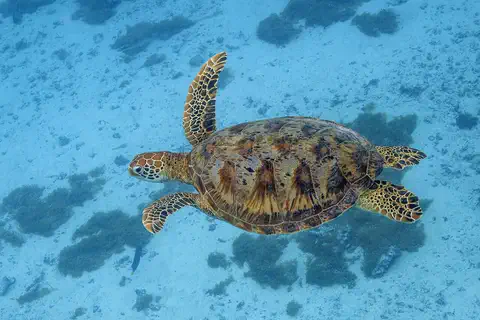
The green sea turtle is the largest sea turtle with a hard shell. It lives in warm seas around the world and, unlike other sea turtles, grown-ups eat mostly seagrass and algae. Females swim hundreds or even thousands of kilometers to lay their eggs on the beaches where they hatched long ago.
-
 Watch
Animal
Alligator snapping turtle
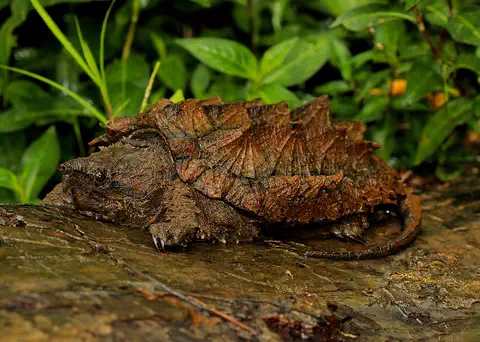
The alligator snapping turtle is the largest freshwater turtle in the United States. It lies still on the bottom of rivers and lakes with its mouth open, wiggling a worm-like lure on its tongue to trick fish into swimming close. Its numbers have fallen, and it is now endangered.
-
 Watch
3D
Animal
American alligator
The American alligator is a large, armored reptile of the swamps, marshes and lakes of the southeastern United States. Alligator mothers guard their nests and carry their babies to the water, and the holes alligators dig help many other animals survive dry seasons.
-
 Watch
Animal
American crocodile
The American crocodile is a large reptile of warm coasts and mangrove swamps, from the southern tip of Florida through Mexico, Central America, the Caribbean and northern South America. It is shy, it basks in the sun to warm up, and mother crocodiles carry their babies to the water.
-
 Watch
Animal
Black mamba
The black mamba is a long, slender, very fast snake of the savannas and rocky hills of sub-Saharan Africa. It is gray to brown, gets its name from its inky-black mouth, hunts small mammals by day, and is shy: it would almost always rather slip away from people. It is also highly venomous, so it is a snake to admire from far away.
-
 Watch
Animal
Boa constrictor
The boa constrictor is a large, heavy snake of South America. Of all the boas, it lives in the greatest variety of places, from rainforests to dry scrub and farms. It catches food by squeezing, it has no venom, and mothers give birth to live babies.
For parents & teachers
What children will learn
- Describe the Aldabra giant tortoise's shell, legs and size.
- Explain what an atoll is and where Aldabra is.
- Explain how a large plant-eater can shape its habitat.
- Understand why so many island tortoises disappeared and how Aldabra is protected.
Recommended ages: 3 to 17 · About 15 minutes
Talk about it
- Why might animals on a remote island be safer than those on islands people visit often?
- How is a giant tortoise like an elephant, even though one is a reptile and one is a mammal?
- Why is it hard to know exactly how old a tortoise is?
Try at home or in class
- Measure 1.2 meters on the floor with tape to see how long a big male's shell can be, and lie down next to it.
- Weigh a tennis ball on a kitchen scale and imagine a nest of 25 of them.
Key vocabulary: tortoise, atoll, carapace, scute, browse, vulnerable
Where these facts come from
- The IUCN Red List of Threatened Species , International Union for Conservation of Nature (IUCN terms of use (no redistribution of Red List data or range maps))
- GBIF Backbone Taxonomy and GBIF Occurrence Search , Global Biodiversity Information Facility (CC0 1.0 (backbone); occurrence counts are facts derived from records under CC0, CC BY and CC BY-NC)
- Geochelone gigantea, Red List assessment 1996 , IUCN Red List of Threatened Species
- Aldabra tortoise , Smithsonian's National Zoo and Conservation Biology Institute
- Aldabra Atoll , UNESCO World Heritage Centre
- Visiting the giant tortoises on Prison Island , The Citizen (Tanzania)
- Wikidata , Wikimedia Foundation (CC0 1.0)
- Wikimedia Commons , Wikimedia Foundation (Per file: Public domain, CC0, CC BY or CC BY-SA only (credited on each page))
Checked, not yet human-reviewed. Last updated October 27, 2026. Spotted a mistake? Tell us.