Animal
European bee-eater
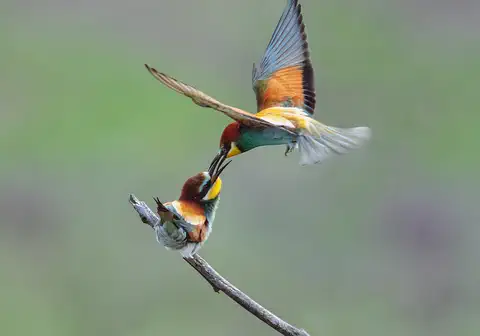
The European bee-eater is a bird with bright colors: yellow, blue, green and chestnut. It catches bees and other flying insects in the air.
The European bee-eater is one of the most colorful birds in Europe. It catches bees, dragonflies and other flying insects in midair, knocks out the stings on a branch, and digs a long tunnel in a sandy bank for its nest. Every autumn it flies to Africa for the winter.
Merops apiaster is a migratory insectivore of the bee-eater family (Meropidae) that breeds from southern and central Europe and North Africa to western and central Asia and winters almost entirely in Africa. It hunts flying insects, mainly bees and wasps, from perches, nests colonially in burrows it digs in earth banks, and is listed as Least Concern by the IUCN (2024).
Photo: Петро Катеринич, CC BY 4.0, via Wikimedia Commons
Meet the European bee-eater
The European bee-eater is a very colorful bird.
It has a yellow throat, a blue-green tummy and a chestnut head. It has a long, thin, pointy beak. It catches flying bugs, like bees, in the air.
The European bee-eater looks as if someone painted it with every color in the box: a chestnut cap, a bright yellow throat, a black stripe through the eye, a blue-green belly and wings flashing orange, green and blue.
It is about as long as a school ruler and lighter than a tennis ball. As its name says, it eats bees, along with dragonflies and other flying insects, which it catches in midair. It spends summer in Europe and Asia and winter in Africa.
Merops apiaster is a mid-sized insectivore about 27 to 30 centimeters long, with a wingspan of 44 to 49 centimeters and a weight of 44 to 78 grams (Animal Diversity Web). It is a bird (class Aves) of the bee-eater family, Meropidae, in the order Coraciiformes, which also contains the kingfishers and rollers.
Adults have a dark, slightly down-curved bill, a chestnut crown and nape, a yellow throat, a black eye-stripe, blue-green underparts and a red iris; the sexes look alike but differ slightly in the color of some wing feathers. The IUCN's 2024 assessment estimates a very preliminary global population of 18.4 to 28 million mature individuals.
Quick facts
- Group
- Bird
- Length
- 0.27 to 0.3 m
- Wingspan
- 0.44 to 0.49 m
- Weight
- 0.04 to 0.08 kg
Two homes a year
Bee-eaters have a summer home and a winter home.
In summer they live in Europe and Asia. In winter they fly far away to Africa, where it is warm.
European bee-eaters are migrants. They nest in warm, open country in southern and central Europe, North Africa and western and central Asia, and they fly south to spend the winter in Africa.
They like sunny places with plenty of flying insects: river valleys, meadows, pastures, farmland with scattered trees, and sandy riverbanks where they can dig their nests. In Africa they also live in savannas and along lakeshores.
The IUCN's 2024 assessment lists breeding populations from Portugal and Spain across southern and central Europe to Kazakhstan, China, Pakistan and India, and wintering almost entirely in Africa; some birds pass through Arabia on migration, and Sri Lanka holds non-breeding birds. Europe holds about 40 percent of the species' global range.
In Europe it uses broad river valleys, pasture and farmland with shelter-belts and scattered trees, meadows, steppe, olive groves and scrub; in Africa it also uses savanna, lakeshores and farmland. Animal Diversity Web notes that nesting sites can be very specific: steep, exposed banks along rivers or in gravel and sand pits.
Continents
Its habitats


Where can you find this animal?
- Migration route · Countries and seas named by a scientific source
- Lives here naturally · Countries and seas named by a scientific source
- Sightings recorded · Records of wild sightings (GBIF)
Migration route · Countries and seas named by a scientific source
Countries the IUCN lists for birds passing through on migration (Bahrain and Gibraltar are also listed but are too small to show).
Places: Kuwait, Qatar, Saudi Arabia, South Sudan and Yemen.
Source: iucn-red-list · checked October 2026
Lives here naturally · Countries and seas named by a scientific source
Breeds in southern and central Europe, North Africa and western and central Asia, and winters almost entirely in Africa south of the Sahara. These are the countries the IUCN lists for breeding, resident and non-breeding birds; in many northern countries only a few pairs breed.
Places: Afghanistan, Albania, Armenia, Austria, Azerbaijan, Belarus, Belgium, Bosnia & Herz. and 93 more places.
Source: iucn-red-list · checked October 2026
Sightings recorded · Records of wild sightings (GBIF)
Counts of GBIF records of wild observations (human and machine) and preserved specimens. Records include introduced populations, vagrants, escaped or released animals and misidentifications, so a country with records is not necessarily part of the native range.
Wild sightings have been recorded in Spain, South Africa, France, Portugal, Türkiye, Greece, Italy, Bulgaria and 113 more places.
Source: gbif · checked October 2026
Range maps show where scientists say an animal lives, often country by country. An animal may live in only part of a country shown, and sightings records can include animals that wandered far from home.
A bee-catching expert
Bee-eaters catch bugs while flying.
They sit on a branch and watch. When a bee flies by, zoom! They catch it and fly back to the branch.
A bee-eater hunts from a lookout perch, such as a bare branch. When it spots an insect, it darts out, grabs it in its beak in midair and flies back to the perch.
Bees and wasps can sting, so the bee-eater has a clever trick. It hits the insect against the branch, then rubs and knocks the sting out before tossing the insect up and swallowing it. Besides bees, it eats dragonflies and many other flying insects.
The diet is mostly flying insects, chiefly Hymenoptera (bees and wasps), but also dragonflies and other flyers; the IUCN describes the species as hunting from perches. Animal Diversity Web describes the handling: the bird grasps prey by the midsection, returns to the perch, and beats it against the perch until it stops moving; with stinging insects it strikes the sting end against the perch to remove the sting before tossing the prey up and swallowing it.
Because bee-eaters are drawn to places with many managed honey bees, they have been treated as pests by some beekeepers. The IUCN notes that the species was killed as an apiary pest in the past in Moldova, Hungary, Russia and Azerbaijan.
Did you know?
There are millions of bee-eaters.
Scientists think there may be between 18 and 28 million grown-up European bee-eaters in the world.
The IUCN's 2024 assessment gives a very preliminary global estimate of 18.4 to 28 million mature individuals, scaled up from European counts.
Colors, beak and wings
The bee-eater's beak is long and thin, like tweezers.
It flies fast and turns quickly in the air. Its feathers are yellow, blue, green and chestnut.
A bee-eater's long, slightly curved beak works like a pair of tweezers. It can snatch a buzzing insect out of the air and hold it tight.
It is a quick, agile flier, perfect for chasing insects through the air. Males and females look almost the same; you need a close look at the colors on the wings to tell them apart. Adults have red eyes, and young birds have duller, grayish eyes.
Animal Diversity Web describes a dark, thick, slightly down-curved bill, and a bird that is quick and agile on the wing, catching its prey in flight.
Plumage is similar in both sexes: a white patch above the bill, a dark eye-stripe, a yellow chin and throat, blue underparts, a chestnut crown and nape fading on the back, and a mostly blue tail. Males have chestnut median and greater wing coverts; females have greener coverts. Adults have a vivid red iris, while juveniles have a grayish olive-red iris.
Nests in a tunnel
Bee-eaters dig a long tunnel in a sandy bank.
At the end of the tunnel, the mother lays white eggs. Both parents feed the chicks. Sometimes a helper bird feeds them too!
In spring, bee-eaters fly back from Africa. A pair digs a tunnel about 1 meter long into a sandy cliff or steep riverbank, and the female lays her eggs inside.
Both parents keep the eggs warm for about three weeks. The chicks hatch with no feathers and closed eyes, and the parents bring them insects. About one pair in five has a helper, often a young male relative, who helps feed the chicks. The young leave the nest at about four weeks old.
In central Europe most birds return in late April or early May. Pairs are monogamous, often re-pairing year to year, and both sexes excavate a burrow around 1 meter deep, usually in an earthen cliff, a riverbank or a sand pit (IUCN, Animal Diversity Web). Clutches run from four to ten eggs according to the IUCN; the British Trust for Ornithology gives a typical six to seven and an incubation of about 20 days, shared by both parents.
Chicks are altricial and fledge at about four weeks; Animal Diversity Web reports that roughly 20 percent of pairs have one to four helpers, probably close relatives, and that young become independent at one to two months and can breed in their first year. The oldest wild bird it reports lived 5.9 years.
Colonies and long journeys
Many bee-eaters live close together.
They call 'preep, preep' to each other. When it gets cold, they all fly to Africa.
Bee-eaters often nest in colonies, with many tunnels close together in the same sandy bank. They are noisy neighbors, calling to each other with a bubbly 'preep, preep'. With so many birds around, there are plenty of eyes to spot danger, and they warn each other with calls.
At the end of summer they set off on a long migration to Africa, and in spring they fly all the way back to nest again.
Bee-eaters are diurnal and spend most of the day foraging from perches. They nest colonially or singly; Animal Diversity Web notes one study in which nest success fell as colony size grew. Their limited repertoire is built on variations of a 'preep' call, given in rapid, bubbly series in groups, and they use calls to warn of danger and mob predators.
The species is a full migrant (IUCN 2024). Old burrows are reused by other animals, and digging loosens soil; for these reasons Animal Diversity Web calls the bee-eater an ecosystem engineer of dry landscapes.
Did you know?
Some bee-eater families have a helper who feeds the chicks.
About one bee-eater pair in five gets help from extra birds, often a young male relative, who bring food to the chicks.
Roughly 20 percent of nesting pairs have one to four helpers, probably close relatives, that assist with incubation and feeding (Animal Diversity Web).
Keeping bee-eaters safe
There are many bee-eaters in the world.
They need lots of insects to eat and sandy banks for their nests. People can help by keeping wild places and riverbanks safe.
European bee-eaters are not endangered. The IUCN lists them as Least Concern because they live across a huge area and there are millions of them.
Still, some things make life harder for them: bug sprays that reduce the insects they eat, rivers straightened into channels so the steep sandy banks disappear, and hunting in a few places. Keeping riverbanks and sand pits safe for nesting helps them.
BirdLife International's 2024 assessment for the IUCN Red List classes the species as Least Concern, with an extremely large range and population and a trend considered likely to be stable; the European population was judged relatively stable over three generations.
Local declines may come from pesticides reducing insect prey, loss of riverbank nest sites as rivers are channeled, intensive monoculture farming and development of wild land; the assessment also notes shooting in Malta and Cyprus. The assessment suggests that nest sites, not food, may limit populations, and that providing small bare sand cliffs could help. The species is listed on Appendix II of the Bonn Convention (CMS) and the Bern Convention.
IUCN Red List
How is the european bee-eater doing in the wild?
- Least Concern (this animal)
- Near Threatened
- Vulnerable
- Endangered
- Critically Endangered
- Extinct in the Wild
- Extinct
Least Concern
Not at risk of disappearing from the wild right now.
See the IUCN Red List assessment · The IUCN Red List of Threatened Species 2021.3
Amazing facts
-
Bee-eaters knock the sting out of a bee before they eat it.
Before eating a bee or wasp, a bee-eater beats it on a branch and knocks out the sting.
With stinging prey, the bird strikes the insect's sting end against its perch to remove the sting before swallowing, as Animal Diversity Web describes.
-
Some bee-eater families have a helper who feeds the chicks.
About one bee-eater pair in five gets help from extra birds, often a young male relative, who bring food to the chicks.
Roughly 20 percent of nesting pairs have one to four helpers, probably close relatives, that assist with incubation and feeding (Animal Diversity Web).
-
Bee-eaters dig tunnels longer than a grown-up's arm.
A bee-eater nest tunnel can be about 1 meter long, dug into a sandy bank by both parents.
Burrows about 1 meter deep are dug by both sexes, usually in earthen cliffs, riverbanks or sand pits; old burrows are later used by other species.
-
There are millions of bee-eaters.
Scientists think there may be between 18 and 28 million grown-up European bee-eaters in the world.
The IUCN's 2024 assessment gives a very preliminary global estimate of 18.4 to 28 million mature individuals, scaled up from European counts.
Words to know
- migration
- a long journey animals make each year between two homes
- colony
- a group of animals of one kind that nest close together
- burrow
- a tunnel dug in the ground or a bank, used as a home or nest
- insectivore
- an animal that eats mainly insects
- perch
- a branch, wire or other place where a bird sits
- helper
- an extra bird, often a relative, that helps parents raise their chicks
Discovery challenge
-
What does a bee-eater do before it eats a bee?
What does a bee-eater do to a bee before swallowing it?
How does a bee-eater deal with stinging prey before swallowing it?
- Knocks the sting out on a branch
- Gives it to a flower
- Puts it in water
Show the answer
Knocks the sting out on a branch
It bangs the bee on a branch to get the sting out.
It carries the bee to its perch and knocks and rubs it on the branch until the sting comes out.
The prey is beaten against the perch and its sting end struck to remove the sting, then tossed up and swallowed.
-
Where do bee-eaters make their nests?
Where does a European bee-eater lay its eggs?
What kind of nest does the European bee-eater use?
- In a tunnel in a sandy bank
- On top of the water
- In a cup of mud on a house
Show the answer
In a tunnel in a sandy bank
They dig a tunnel in a sandy bank.
Both parents dig a tunnel about a meter long into a sandy cliff or riverbank and lay the eggs at the end.
A burrow about 1 meter deep, usually in an earthen cliff, riverbank or sand pit, excavated by both sexes, often in colonies.
-
Where do bee-eaters go in winter?
Where do European bee-eaters spend the winter?
Where does the IUCN say the species spends the winter?
- Antarctica
- Africa
- Australia
Show the answer
Africa
They fly to Africa, where it is warm.
They migrate south and spend the winter in Africa.
Almost entirely within Africa, using savanna, lakeshores and farmland.
-
How does a bee-eater catch its food?
How does a bee-eater usually hunt?
Which hunting method does the European bee-eater mainly use?
- It digs for worms
- It catches insects in the air
- It catches fish underwater
Show the answer
It catches insects in the air
It flies out and catches bugs in the air.
It watches from a perch, flies out to grab an insect in midair and returns to the perch.
It hunts flying insects from perches, catching them in flight and returning to the perch to subdue them.
Places where you might see it
-
 Watch
 Country
Spain
Spain covers most of the Iberian Peninsula in southwestern Europe. Its middle is a high, flat plateau, the Pyrenees mountains stand between it and France, and almost 50 million people live there, with Madrid as the capital.
-
 Watch
 Country
South Africa
South Africa is the southernmost country in Africa, with the Atlantic Ocean on one side and the Indian Ocean on the other. A high plateau covers most of it, about 63.5 million people (2026) live there, and it has 12 official languages and three capital cities.
Explore next
-
 Watch
Animal
Lilac-breasted roller
The lilac-breasted roller is a dazzling bird of the open woodlands and savannas of eastern and southern Africa. It sits on high perches watching for insects, swoops down to catch them, and gets its name from the rolling, tumbling flights it makes in the breeding season.
-
 Watch
3D
Animal
Common kingfisher
The common kingfisher is a small, dazzling blue and orange bird of rivers, canals and lakes across Europe, Asia and North Africa. It watches from a perch, then dives headfirst into the water to catch small fish with its dagger-shaped bill.
-
 Watch
3D
Animal
Western honey bee
The western honey bee lives in big families called colonies, with one queen and many workers. Workers collect nectar and pollen from flowers, turn nectar into honey, and tell each other where food is by dancing. As they travel, they pollinate many plants, including crops people eat.
-
Watch
Country
Spain
Spain covers most of the Iberian Peninsula in southwestern Europe. Its middle is a high, flat plateau, the Pyrenees mountains stand between it and France, and almost 50 million people live there, with Madrid as the capital.
-
Watch
Country
South Africa
South Africa is the southernmost country in Africa, with the Atlantic Ocean on one side and the Indian Ocean on the other. A high plateau covers most of it, about 63.5 million people (2026) live there, and it has 12 official languages and three capital cities.
-
 Watch
Animal
Adélie penguin
The Adélie penguin is a medium-sized penguin, about 70 centimeters tall, with a black back, a white front and a bright white ring around each eye. It breeds in summer on rocky, ice-free ground all around Antarctica, building nests of pebbles, and spends the winter far out at sea among the pack ice.
-
 Watch
Animal
African fish eagle
The African fish eagle is a big eagle of Africa's lakes, rivers and coasts, with a white head, chest and tail and a chestnut-brown body. It snatches fish from the surface of the water, and its loud, ringing call is one of the best-known sounds of Africa.
-
 Watch
Animal
African penguin
The African penguin is a penguin of warm, sunny coasts. It lives only in South Africa and Namibia, nests in burrows and under bushes, and hunts sardines and anchovies in the cold sea. Its numbers have fallen so far that it is now Critically Endangered, and people are working hard to protect it.
For parents & teachers
What children will learn
- Describe how the European bee-eater catches flying insects and makes stinging prey safe to eat.
- Explain why bee-eaters migrate between Europe or Asia and Africa.
- Describe colonial burrow nesting and the role of helpers.
- Name some threats to bee-eaters and ways people can help.
Recommended ages: 3 to 17 · About 12 minutes
Talk about it
- Why might a bird that eats flying insects need to leave Europe in winter?
- How could living in a colony help bee-eaters, and how could it make life harder?
- Beekeepers and bee-eaters both want bees. How could they share the countryside?
Try at home or in class
- Use kitchen tongs to pick up small paper balls tossed gently in the air to feel how a long beak works like tweezers.
- On a world map or globe, trace a route from Spain to southern Africa and measure about how far a bee-eater might fly.
Key vocabulary: migration, colony, burrow, insectivore, perch, helper
Where these facts come from
- The IUCN Red List of Threatened Species , International Union for Conservation of Nature (IUCN terms of use (no redistribution of Red List data or range maps))
- GBIF Backbone Taxonomy and GBIF Occurrence Search , Global Biodiversity Information Facility (CC0 1.0 (backbone); occurrence counts are facts derived from records under CC0, CC BY and CC BY-NC)
- Merops apiaster (European Bee-eater), 2024 global assessment , IUCN Red List of Threatened Species (BirdLife International)
- Merops apiaster (European bee-eater) , Animal Diversity Web, University of Michigan Museum of Zoology
- Bee-eater BirdFacts , British Trust for Ornithology
- Wikidata , Wikimedia Foundation (CC0 1.0)
- Wikimedia Commons , Wikimedia Foundation (Per file: Public domain, CC0, CC BY or CC BY-SA only (credited on each page))
Checked, not yet human-reviewed. Last updated October 28, 2026. Spotted a mistake? Tell us.