Animal
Greater flamingo
The greater flamingo is a tall bird with long pink legs and a bent pink bill. It feeds with its head upside down in the water.
The greater flamingo is the tallest and heaviest flamingo, standing up to about 1.45 meters tall. It lives in salty lagoons and lakes across Africa, southern Europe, the Middle East and South Asia. It feeds by holding its bent bill upside down in the water and filtering out tiny animals, and it gets its pink color from what it eats.
Phoenicopterus roseus is the largest flamingo, a colonial filter feeder of saline and alkaline wetlands in Africa, southern Europe and southwest and South Asia. It breeds at relatively few sites but disperses widely; Mediterranean colonies form a single interbreeding population. The IUCN lists it as Least Concern with an increasing trend (assessed 2018). It is a separate species from the American flamingo.
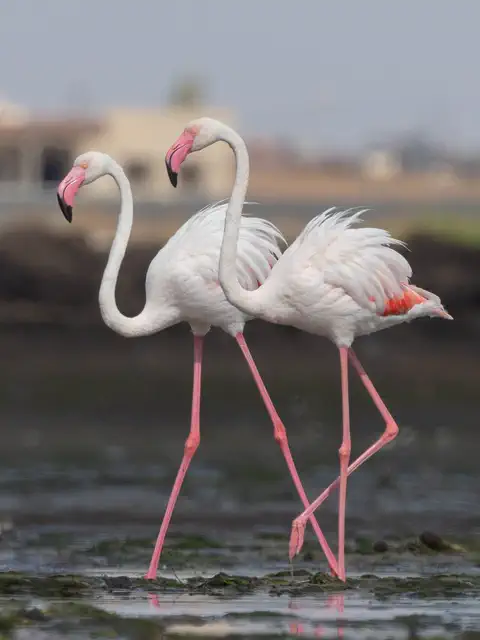
Photo: El Golli Mohamed, CC BY-SA 4.0, via Wikimedia Commons
Meet the greater flamingo
The greater flamingo is a very tall bird.
It has a long, curvy neck, long, thin legs and a bent bill. In our photo, its feathers are pale pink and its bill is pink with a black tip.
The greater flamingo is the biggest of the six kinds of flamingo. San Diego Zoo Wildlife Alliance says it is the tallest, at 120 to 145 centimeters, and the heaviest, at 2.1 to 4.1 kilograms. Males are larger than females.
Like all flamingos, it has long legs, a long neck and a strongly bent bill. The two greater flamingos in the photo on this page look very pale, almost white, with pink legs, pink bills tipped in black and bright red-pink feathers on the wings.
Phoenicopterus roseus is the largest flamingo: San Diego Zoo Wildlife Alliance gives heights of 120 to 145 centimeters and weights of 2.1 to 4.1 kilograms, and Animal Diversity Web a wingspan of 140 to 170 centimeters. Males are larger.
The IUCN treats the greater flamingo of the Old World and the American flamingo of the Caribbean as separate species. San Diego Zoo still calls the American flamingo a subspecies of the greater flamingo, and describes it as the brightest; the greater flamingo in the photo is much paler, with color concentrated in the bill, legs and wing feathers.
Quick facts
- Group
- Bird
- Height
- 1.2 to 1.45 m
- Wingspan
- 1.4 to 1.7 m
- Weight
- 2.1 to 4.1 kg
- Lifespan in the wild
- 20 to 30 years
Where it lives
Greater flamingos live in Africa, Europe and Asia.
They live in shallow, salty lakes and lagoons. They stand in the water on their long legs.
Greater flamingos live across a huge area: Africa, southern Europe, the Middle East and South Asia, including countries such as Spain, France, Italy, Türkiye, Iran, India, Kenya and South Africa.
They live in shallow water that is very salty or very alkaline, such as lagoons, salt marshes, lakes and muddy shores. Some live by the sea, and some live high in the mountains, up to 4,500 meters above sea level. Flamingos travel a lot, moving from place to place to find good feeding spots.
The IUCN's global assessment lists the species as extant across Africa, southern Europe and southwest, central and South Asia, with breeding noted in countries from Mauritania and Senegal to South Africa, Botswana, Namibia, Egypt and Kazakhstan, and non-breeding birds in places such as Portugal, Iraq and Bahrain.
Animal Diversity Web describes shallow, highly saline or alkaline waters (pH up to 11) at elevations from sea level to 4,500 meters, including lagoons, estuaries, salt marshes and rice fields. A Tour du Valat study notes that the species breeds at a very limited number of sites but disperses widely, and that Mediterranean colonies form a single interbreeding population.
Continents
Its habitat

Where can you find this animal?
- Lives here naturally · Countries and seas named by a scientific source
- Sightings recorded · Records of wild sightings (GBIF)
- Visits for part of the year · Countries and seas named by a scientific source
Lives here naturally · Countries and seas named by a scientific source
Shallow salty and alkaline wetlands of Africa, southern Europe, the Middle East and southwest, central and South Asia. Gibraltar and Mayotte are also in the range but have no separate map shape. In Russia only the south of European Russia is meant, and in most countries flamingos live at a few wetlands only.
Places: Cyprus, Iran, Tunisia, Afghanistan, Algeria, Botswana, Egypt, Kazakhstan and 44 more places.
Source: iucn-red-list · checked October 2026
Sightings recorded · Records of wild sightings (GBIF)
Counts of GBIF records of wild observations (human and machine) and preserved specimens. Records include introduced populations, vagrants, escaped or released animals and misidentifications, so a country with records is not necessarily part of the native range.
Wild sightings have been recorded in Spain, France, Portugal, India, South Africa, UAE, Italy, Greece and 99 more places.
Source: gbif · checked October 2026
Visits for part of the year · Countries and seas named by a scientific source
Countries where the IUCN lists greater flamingos outside the breeding season or on passage. Bahrain is also listed but has no separate map shape.
Places: Iraq, Jordan, N. Macedonia, Palestine, Portugal, Slovenia, Lebanon and Sudan.
Source: iucn-red-list · checked October 2026
Range maps show where scientists say an animal lives, often country by country. An animal may live in only part of a country shown, and sightings records can include animals that wandered far from home.
Eating upside down
A flamingo eats with its head upside down!
It sucks in muddy water. Tiny combs in its bill catch little animals to eat.
A flamingo eats in a very unusual way. It bends its long neck down and holds its bill upside down in the water. Then it sucks in water and mud at the front of the bill and pumps it out at the sides. Tiny comb-like plates inside, called lamellae, trap food.
Greater flamingos mostly eat small animals from the muddy bottom, such as brine shrimp, brine flies, other crustaceans and mollusks, plus some algae. Their pink color comes from carotenoid pigments in that food.
Flamingos are filter feeders. With the head inverted, the bird draws water and mud in at the bill tip and pumps it out at the sides, where comb-like lamellae trap prey. San Diego Zoo notes that the larger greater and Chilean flamingos feed mostly on invertebrates such as brine flies, shrimps and mollusks taken from bottom mud, while smaller species filter finer particles such as algae.
Animal Diversity Web adds algae, diatoms, crustaceans, insect larvae and brine shrimp. Carotenoid pigments in this diet give the plumage its pink tones, and captive flamingos need pigment added to their food to stay pink.

Long legs and one-legged naps
Flamingos often stand on one leg.
Nobody knows for sure why. Their long legs let them walk in deep water.
Long legs let flamingos wade into deeper water than most other birds. They often stand on one leg, and scientists are still not sure why. Tucking a leg up may save body heat, but flamingos do it in hot places too, so it may simply be comfortable.
To take off, a flamingo runs a few steps, usually into the wind. In the air it flies with its long neck stretched out in front and its legs trailing behind.
Very long legs allow wading in deeper water than most birds. San Diego Zoo notes that the reason for one-legged standing is unknown: a tucked leg loses less heat, but the posture is also seen in hot climates, and it may simply be comfortable.
Take-off requires a short run to build airspeed, usually into the wind. In flight the neck is stretched forward and the legs trail behind, wing beats are rapid and almost continuous, and flocks fly in close formation, showing the red or pink and black wing coloration shared by all flamingos.
Mud nests and flamingo milk
Flamingo parents build a nest out of mud. It looks like a little sandcastle.
The mother lays one egg. Mom and dad feed the chick a kind of milk.
Flamingo parents build a nest from mud, a mound up to about 60 centimeters high with a dip on top for one large white egg. Both parents take turns keeping it warm for 27 to 31 days.
The chick hatches with gray fluffy down, about the size of a tennis ball. Both parents feed it crop milk, a special liquid from their throats. After 5 to 12 days on the nest, chicks join a big group called a crèche. They fledge at 65 to 90 days and are grown up at 5 to 6 years.
Pairs build a mud mound, 30 to 60 centimeters high according to San Diego Zoo, with a concave top for a single egg. Both sexes incubate for 27 to 31 days, according to Animal Diversity Web. Chicks hatch with gray down and a straight bill that curves as they grow.
Both parents feed crop milk secreted in the upper digestive tract, and feeding drains their own pink color for a time. Chicks gather in crèches watched by a few adults, and parents find their own chick by its call. Fledging takes 65 to 90 days, and Animal Diversity Web gives sexual maturity at 5 to 6 years for this species (San Diego Zoo gives 3 to 5 years for flamingos in general); ADW also notes that partners may change between years.
Life in a flock
Flamingos like to be together in big groups.
They march and dance together before they make nests. They are very noisy!
Greater flamingos are extremely social. They live and travel in flocks that can number in the thousands, moving from wetland to wetland to find food and water at the right depth.
Before breeding, the whole flock performs group displays. They march together, turn at the same moment, stretch their necks and flick their heads from side to side. These dances help the flock breed at the same time. Flamingos are loud, too, with a noisy, cackling call.
The species is highly social and nomadic, traveling in flocks of up to thousands without fixed home ranges, and moving as water levels change to find suitable feeding conditions; it sometimes flocks with lesser flamingos.
Animal Diversity Web describes synchronized group displays, including marching, simultaneous turning, head-flagging and wing-saluting, which stimulate breeding hormones across the flock so that birds nest together. Calls are a loud cackle, and research indicates that greater flamingos can tell calls apart by their timing and frequency patterns.
Did you know?
A baby flamingo has a straight bill.
Flamingo chicks hatch with a straight bill. It only bends into the adult shape as they grow up.
The bill of the chick is straight at first and develops the adult's curve by the end of the fledging period.
Flamingos today
There are many greater flamingos, and their numbers are growing.
They need clean, safe wetlands. People help by protecting the lakes and lagoons where they live.
The greater flamingo is listed as Least Concern, and its numbers are increasing. But flamingos depend on a small number of breeding sites, so protecting those wetlands matters a lot.
Pollution is one problem. Animal Diversity Web reports that waste from mining can make salty crusts build up on flamingos' legs, and that some flamingos are poisoned by swallowing lead from bullets.
The IUCN's global assessment (assessed 2018, published 2019) lists Phoenicopterus roseus as Least Concern with an increasing population trend. Because the species breeds at a very limited number of sites, the condition of those wetlands is important.
Animal Diversity Web names water pollution, soda ash from mining that builds up on the legs and can immobilize birds, and lead poisoning from ingested bullet fragments as sources of mortality; eggs and young are also taken by predators. Adults have few predators because of their size.
IUCN Red List
How is the greater flamingo doing in the wild?
- Least Concern (this animal)
- Near Threatened
- Vulnerable
- Endangered
- Critically Endangered
- Extinct in the Wild
- Extinct
Least Concern
Not at risk of disappearing from the wild right now.
See the IUCN Red List assessment · The IUCN Red List of Threatened Species 2021.3
Amazing facts
-
A flamingo's pink color comes from its food.
Flamingos are pink because of carotenoid pigments in the algae and small animals they eat, the same kind of pigment that makes carrots orange.
Dietary carotenoids produce the pink plumage; zoo flamingos are given pigment in their food to keep their color.
-
Flamingo parents feed their chicks a kind of milk.
Both flamingo parents feed their chick crop milk, a liquid made in their throats, like pigeons do.
Crop milk from the upper digestive tract is fed by both parents; flamingos share this trait with pigeons and doves.
-
A baby flamingo has a straight bill.
Flamingo chicks hatch with a straight bill. It only bends into the adult shape as they grow up.
The bill of the chick is straight at first and develops the adult's curve by the end of the fledging period.
-
Nobody knows for sure why flamingos stand on one leg.
Scientists are still not sure why flamingos stand on one leg. It may save heat, or it may just be comfortable.
One-legged standing may reduce heat loss, but it also occurs in hot climates, so its function is still debated.
Words to know
- filter feeder
- an animal that strains tiny food out of water
- lamellae
- tiny comb-like plates inside a flamingo's bill that trap food
- carotenoid
- a natural colored pigment, like the one that makes carrots orange
- crop milk
- a liquid some birds make in their throats to feed their chicks
- crèche
- a large group of young birds looked after together
- lagoon
- a shallow body of water, often salty, separated from the sea
Discovery challenge
-
How does a flamingo hold its head when it eats?
How does a flamingo hold its bill when it feeds?
In what position is the flamingo's bill held during filter feeding?
- Upside down in the water
- Up in the air
- Tucked under its wing
Show the answer
Upside down in the water
It eats with its head upside down in the water!
It holds its bill upside down and pumps water out through tiny combs that trap food.
Inverted, drawing water in at the tip and expelling it laterally through the lamellae.
-
What makes a flamingo pink?
Where does a flamingo's pink color come from?
What is the source of the flamingo's pink pigmentation?
- Its food
- The sun
- Pink rain
Show the answer
Its food
Its food makes it pink.
Carotenoid pigments in the algae and small animals it eats make it pink.
Dietary carotenoids; without them, as in poorly fed captive birds, flamingos lose their color.
-
What do flamingos build their nests from?
What is a flamingo nest made of?
What material forms the greater flamingo's nest mound?
- Mud
- Sticks
- Snow
Show the answer
Mud
They build a mud nest that looks like a little sandcastle.
A mound of mud up to about 60 centimeters high, with a dip on top for one egg.
A mud mound 30 to 60 centimeters high with a concave top for the single egg.
-
Which is the tallest kind of flamingo?
Which flamingo is the tallest and heaviest?
Which species is the largest flamingo?
- The greater flamingo
- The lesser flamingo
- The Chilean flamingo
Show the answer
The greater flamingo
The greater flamingo is the tallest.
The greater flamingo stands 120 to 145 centimeters tall; the lesser flamingo is the smallest.
The greater flamingo (120 to 145 centimeters, 2.1 to 4.1 kilograms); the lesser flamingo is the smallest.
Places where you might see it
-
 Watch
 Country
Spain
Spain covers most of the Iberian Peninsula in southwestern Europe. Its middle is a high, flat plateau, the Pyrenees mountains stand between it and France, and almost 50 million people live there, with Madrid as the capital.
-
 Watch
 Country
India
India is a huge country in South Asia, shaped like a big triangle pointing into the Indian Ocean. The Himalayas rise along its north, heavy monsoon rains arrive every summer, and about 1.46 billion people (2025) live there, speaking hundreds of languages.
-
 Watch
 Country
Tunisia
Tunisia is a small country in North Africa, with the Mediterranean Sea to the north and east. Its green, rainy north turns into dry steppes and then Sahara desert in the south, and about 12 million people lived there in 2024, many of them in the capital, Tunis.
Explore next
-
 Watch
Animal
American flamingo
The American flamingo is a tall, bright pink wading bird of the Caribbean. It gets its color from pigments in the tiny water animals and algae it eats, and it feeds by filtering water through its bent bill with its head upside down. Flamingos live and nest in huge, noisy groups.
-
 Watch
3D
Animal
Lesser flamingo
The lesser flamingo is the smallest flamingo. Millions live on salty, soda-rich lakes in Africa and India, where they sweep their upside-down bills through the water to filter out tiny algae, which help give them their pink color.
-
Watch
Country
Spain
Spain covers most of the Iberian Peninsula in southwestern Europe. Its middle is a high, flat plateau, the Pyrenees mountains stand between it and France, and almost 50 million people live there, with Madrid as the capital.
-
Watch
Country
India
India is a huge country in South Asia, shaped like a big triangle pointing into the Indian Ocean. The Himalayas rise along its north, heavy monsoon rains arrive every summer, and about 1.46 billion people (2025) live there, speaking hundreds of languages.
-
Watch
Country
Tunisia
Tunisia is a small country in North Africa, with the Mediterranean Sea to the north and east. Its green, rainy north turns into dry steppes and then Sahara desert in the south, and about 12 million people lived there in 2024, many of them in the capital, Tunis.
-
 Watch
Animal
Adélie penguin
The Adélie penguin is a medium-sized penguin, about 70 centimeters tall, with a black back, a white front and a bright white ring around each eye. It breeds in summer on rocky, ice-free ground all around Antarctica, building nests of pebbles, and spends the winter far out at sea among the pack ice.
-
 Watch
Animal
African fish eagle
The African fish eagle is a big eagle of Africa's lakes, rivers and coasts, with a white head, chest and tail and a chestnut-brown body. It snatches fish from the surface of the water, and its loud, ringing call is one of the best-known sounds of Africa.
-
 Watch
Animal
African penguin
The African penguin is a penguin of warm, sunny coasts. It lives only in South Africa and Namibia, nests in burrows and under bushes, and hunts sardines and anchovies in the cold sea. Its numbers have fallen so far that it is now Critically Endangered, and people are working hard to protect it.
For parents & teachers
What children will learn
- Describe how flamingos filter food with an upside-down bill.
- Explain that a flamingo's pink color comes from its diet.
- Describe the flamingo life cycle, from mud nest to crèche.
- Recognize that the greater flamingo and the American flamingo are different species living in different parts of the world.
Recommended ages: 3 to 17 · About 15 minutes
Talk about it
- Why might a salty lagoon be a good place for a flamingo to feed?
- What other animals change color because of what they eat?
- Why might a bird that breeds at only a few places need those places protected?
Try at home or in class
- Make a filter: pour water with rice grains through a comb or sieve and see what gets trapped, like a flamingo's lamellae.
- Try standing on one leg for a minute, then talk about whether it feels restful or tiring.
Key vocabulary: filter feeder, lamellae, carotenoid, crop milk, crèche, lagoon
Where these facts come from
- The IUCN Red List of Threatened Species , International Union for Conservation of Nature (IUCN terms of use (no redistribution of Red List data or range maps))
- GBIF Backbone Taxonomy and GBIF Occurrence Search , Global Biodiversity Information Facility (CC0 1.0 (backbone); occurrence counts are facts derived from records under CC0, CC BY and CC BY-NC)
- Wikidata , Wikimedia Foundation (CC0 1.0)
- Phoenicopterus roseus (Greater Flamingo), Red List global assessment 2018 , IUCN Red List of Threatened Species
- Flamingo , San Diego Zoo Wildlife Alliance
- Phoenicopterus roseus (greater flamingo) , Animal Diversity Web, University of Michigan Museum of Zoology
- Greater flamingo colonies around the Mediterranean form a single interbreeding population and share a common history (Geraci et al.) , Tour du Valat
- Wikimedia Commons , Wikimedia Foundation (Per file: Public domain, CC0, CC BY or CC BY-SA only (credited on each page))
Checked, not yet human-reviewed. Last updated October 28, 2026. Spotted a mistake? Tell us.
Picture credits
- Photo: El Golli Mohamed, CC BY-SA 4.0, via Wikimedia Commons · source · license
- Photo: This Photo was taken by Timothy A. Gonsalves. Feel free to use my photos, but please mention me as the author. I would much appreciate if you send me an email tagooty@yahoo.com or write on my talk pag, CC BY-SA 4.0, via Wikimedia Commons · source · license