Life around the world Europe
Getting around Amsterdam by bicycle
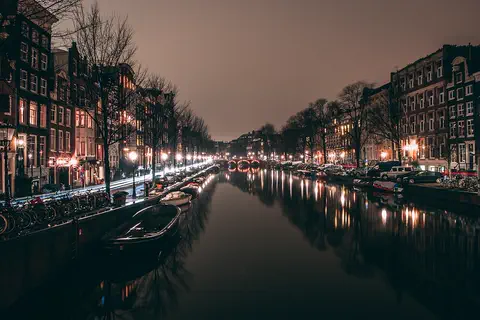
Amsterdam is a city full of canals and bridges. Lots of people there ride bikes. They ride to work, to school and to the shops.
Amsterdam, the capital of the Netherlands, is flat and crossed by canals. In 2017, about 35 out of every 100 weekday trips made by people who live there were by bicycle, more than by car, bus, tram or metro. The city has added thousands of bike parking places, including a garage under the water by Central Station.
Amsterdam's own statistics office found that in 2017 the bicycle carried 35 percent of residents' weekday trips, against 19 percent by car and 19 percent by public transport, while car trips had fallen from over 520,000 a weekday in 2005-2008 to 324,000. Parking is the pressure point: in 2023 a 7,000-space garage opened beneath the water in front of Central Station.
Photo: GillyBerlin, CC BY 2.0, via Wikimedia Commons
A city of canals and bikes
Amsterdam is the capital city of the Netherlands.
The land there is flat and low. Canals of water run between the streets. Many people ride bikes along the canals and over the bridges.
Amsterdam is the capital of the Netherlands, in the west of the country. It sits on flat, low-lying land on the south bank of the IJ, a wide arm of water, and parts of the city are below sea level. Its name comes from a dam built on the Amstel River.
The old inner city is split by canals into about 90 islands, and the city has about 1,300 bridges and viaducts. In this topic we look at how people who live in Amsterdam use their bicycles, and how the city makes room to park them.
Amsterdam began as a medieval settlement on dikes along the Amstel where it met the IJ, an inland arm of the former Zuiderzee; the Amstel was dammed to control flooding, which gave the city its name. Britannica describes it as lying in a flat and low-lying area, with parts below sea level, some on land reclaimed from the sea, marshes or lakes. Statistics Netherlands (CBS) counted 941,927 residents on 1 January 2026.
Canals divide the inner city into some 90 "islands," and the municipality has about 1,300 bridges and viaducts. The figures below come mostly from the city's own research office (OIS), whose 2019 State of the City report describes travel in 2017, and from news reports of the bicycle garage that opened in January 2023.
How Amsterdammers get around
In Amsterdam, the bike is the most used way to travel.
People also walk, drive cars and take trams and trains. But more trips are made by bike than any other way.
Amsterdam's research office counts how people who live in the city travel on weekdays. In 2017, about 35 out of every 100 of their trips were made by bicycle. Walking made up 24, cars 19 and public transport, such as trams, buses, the metro and trains, another 19.
Car trips by residents had dropped a lot: from more than 520,000 a weekday in 2005 to 2008, to 324,000 in 2017. Most trips happened between 5 and 6 in the evening, but most bike trips happened in the morning, between 8 and 9.
OIS uses the term modal split for the share of trips made by each means of travel. For Amsterdam residents on weekdays in 2017, it was: bicycle 35 percent, walking 24 percent, car 19 percent, public transport 19 percent and moped or light moped 2 percent. It was the first time in decades that residents used a car for less than a fifth of their trips; car trips fell from more than 520,000 a weekday in 2005-2008 to 324,000 in 2017.
The picture changes with who is counted. Including visitors and commuters (but not tourists), trips to, from and within the city were split almost evenly in 2017: car 27, bicycle 26 and public transport 25 percent. On that measure, OIS says, the car's share had fallen sharply since the 1990s while cycling grew strongly, though it had been fairly steady in recent years. Dutch visitors made 46 percent of their weekday trips by car and only 5 percent by bike. Most residents' trips took place between 17:00 and 18:00, but most bicycle trips between 8:00 and 9:00.
Different districts, different habits
Amsterdam has many parts, called districts.
In some districts, people bike the most. In others, people drive or take the train more. Every place is a little different.
Not every part of Amsterdam travels the same way. In 2017, the bicycle was the most popular way to get around in the districts of Centrum, Oost, West and Zuid, where people used it for most of their trips (not counting walks).
In Noord and Nieuw-West, the car was used most. In Zuidoost, people made more trips by public transport than by bike. Age mattered too: older residents made more trips by car than by bike, and pupils and students used public transport more than middle-aged people did.
OIS breaks the 2017 figures down by stadsdeel (city district). In Centrum, Oost, West and Zuid, residents used the bicycle for a majority of their trips, walking excluded. In Noord and Nieuw-West the car was the most used means of travel, and Zuidoost was the only district where residents made more trips by public transport than by bicycle.
The report also notes differences by age and education: among older residents the car's share was higher than the bicycle's, young people (especially pupils and students) used public transport more often than middle-aged Amsterdammers, and residents with more formal education were proportionally more likely to cycle. The report presents these as patterns in survey data; it does not give reasons for them.
More than 900,000 bikes
There are lots and lots of bikes in Amsterdam.
Most people over 12 have a bike of their own. Some bikes have a small motor to help with pedaling.
More than half of Amsterdammers said in 2017 that they cycle often: 54 percent, while 22 percent said they never cycle. Owning a bike also became more common. Among residents aged 12 and over, 75 percent owned a bike in 2011 and 80 percent in 2017. That added up to more than 900,000 bikes in the city.
Electric bikes, which have a small motor to help the rider, were growing fast. In 2013, 2 percent of Amsterdammers had one; by 2017 it was 8 percent. About 10 percent of tourists rode a bike during their stay.
In the 2017 survey, 54 percent of residents said they cycle often, 16 percent sometimes and 6 percent rarely, while 22 percent never cycle or cannot. Bicycle ownership among residents aged 12 and over rose from 75 percent in 2011 to 80 percent in 2017, which OIS puts at more than 900,000 bicycles in the city that year. E-bike ownership rose from 2 percent of residents in 2013 to 8 percent in 2017, and 10 percent of tourists cycled during their visit.
Shared bikes grew as well. The national railway's OV-fiets rental bikes recorded about 404,000 rides from Amsterdam Centraal in 2017 and more than 483,000 in 2018, a 20 percent rise; OIS reports that no station in the Netherlands had more. In 2018 there were 2,500 OV-fietsen at locations around the city.
Parking under the water
So many bikes need lots of places to park.
Near the big train station, there is a bike garage under the water. Boats can sail right over the parked bikes!
With so many bikes, finding a parking place can be hard, especially near train stations and in the city center. In 2017, 57 percent of Amsterdammers said there was too little room to park bikes.
The city has been building more. Between 2012 and 2016 it added 16,000 bike parking places, 11,000 of them at stations. In January 2023, a garage for 7,000 bikes opened under the water in front of Central Station. To build it, the water was pumped out of the harbor basin. It is open day and night, the first 24 hours are free, and it is linked underground to the metro and the station hall.
Parking is the system's pinch point. In 2017 residents rated bike parking in their own neighborhood 5.5 out of 10 (down from 5.8 in 2015), with Centrum lowest at 5.1, and 57 percent said there was too little space. OIS names station areas, the center and nearby neighborhoods with narrow sidewalks as the hardest places. The Meerjarenplan Fiets 2012-2016 (multi-year bicycle plan) added 16,000 parking places, 11,000 of them at stations, and its 2017-2022 successor prioritized hotspots such as Centraal Station and the Rembrandtplein area.
The Stationsplein garage, opened in January 2023 with 7,000 spaces, was built by pumping the water out of the Open Havenfront basin in front of Centraal Station; the municipality said that tour boats would literally sail above the bicycles. NL Times reported that it is open 24 hours a day, that the first 24 hours are free, and that it links underground to the metro and the station hall.
Amazing facts
-
In Amsterdam, boats can sail over a garage full of bikes.
Amsterdam's Stationsplein bike garage was built under a harbor basin; the city said tour boats would sail right above the parked bikes.
To build the 7,000-space Stationsplein garage, opened in January 2023, the water of the Open Havenfront was pumped out; the municipality said tour boats would literally sail above the bicycles.
-
Amsterdam has about 1,300 bridges.
Canals split old Amsterdam into about 90 islands, and the city has about 1,300 bridges and viaducts.
Britannica counts some 90 canal-bounded "islands" in the inner city and approximately 1,300 bridges and viaducts in the municipality.
-
The name Amsterdam comes from a dam on a river.
Amsterdam is named after a dam built on the Amstel River to stop floods.
The settlement grew on dikes along the Amstel where it met the IJ; the Amstel was dammed to control flooding, and the city's name derives from that Amstel dam.
-
In 2018, more people rented a station bike at Amsterdam Central than at any other station in the Netherlands.
In 2018, people took more than 483,000 rides on rental OV-fiets bikes from Amsterdam Centraal, more than at any other station in the Netherlands.
OV-fiets rides from Amsterdam Centraal rose from about 404,000 in 2017 to more than 483,000 in 2018 (+20 percent); OIS reports that no station in the Netherlands saw more.
Words to know
- canal
- a waterway dug by people, for boats or to carry water
- modal split
- how all the trips in a place are shared between walking, cycling, cars and public transport
- public transport
- buses, trams, metro trains and trains that anyone can ride
- e-bike
- a bicycle with a small electric motor that helps the rider pedal
- district
- one part of a city; Amsterdam's are called stadsdelen
- below sea level
- lower than the level of the nearby sea
Discovery challenge
-
In 2017, how many trips by people in Amsterdam were by bike?
In 2017, about how many of every 100 weekday trips by Amsterdam residents were made by bike?
In OIS's 2017 modal split for Amsterdam residents on weekdays, roughly what share of trips was by bicycle?
- About 1 out of 10
- About 1 out of 3
- About 9 out of 10
Show the answer
About 1 out of 3
About 1 out of every 3 trips was by bike.
About 35 out of every 100 trips, which is about 1 in 3, were by bike: more than by car or public transport.
35 percent by bicycle, against 24 percent walking and 19 percent each by car and public transport.
-
How many bikes fit in the garage under the water?
How many bikes can the Stationsplein garage, opened in 2023, hold?
What capacity did the Stationsplein bicycle garage have when it opened in January 2023?
- About 700
- About 7,000
- About 70,000
Show the answer
About 7,000
It holds about 7,000 bikes.
The garage under the harbor basin in front of Central Station has room for 7,000 bikes.
7,000 spaces, built under the pumped-out Open Havenfront and linked underground to the metro and station hall.
-
Where was the big new bike garage built?
Where was Amsterdam's Stationsplein bike garage built?
Where was the Stationsplein garage built, according to the municipality?
- Under the water in front of the station
- On the roof of a tall tower
- Inside an old windmill
Show the answer
Under the water in front of the station
It is under the water, and boats sail over it.
Builders pumped the water out of the harbor basin in front of Central Station and built the garage beneath it.
Beneath the Open Havenfront basin, which was pumped out for construction; the city said tour boats would sail above the bicycles.
-
Canals cut old Amsterdam into islands. About how many?
Amsterdam's canals divide the old inner city into about how many islands?
According to Britannica, the canal network divides Amsterdam's inner city into some how many islands?
- About 9
- About 90
- About 900
Show the answer
About 90
There are about 90 islands.
About 90 islands, joined by many of the city's 1,300 bridges and viaducts.
Some 90 islands; the municipality contains approximately 1,300 bridges and viaducts.
Explore next
-
 Watch
 Country
Netherlands
The Netherlands is a small, flat country in northwestern Europe on the North Sea. Its name means low-lying country: more than a quarter of it lies below sea level, protected by dunes and dikes. About 18.2 million people lived there in 2026, and its capital is Amsterdam, a city of canals.
-
Watch
City
Amsterdam
Amsterdam is the capital of the Netherlands. It began as a fishing village beside a dam on the Amstel River, which gave the city its name. Today about 942,000 people live among its rings of canals, hundreds of bridges, houseboats and bicycles.
-
 Watch
Life around the world
A day on the London Underground
The London Underground, or the Tube, began in 1863 as the world's first underground railway. In the year 2025/26, people made about 1.2 billion journeys on its 11 lines. Its famous map, first sketched by Harry Beck in 1931, shows how stations connect rather than how far apart they are.
-
 Watch
Life around the world
Water buses of Venice, Italy
Venice is spread over 118 small islands in a lagoon in northern Italy. Cars cannot drive into the old city, so people walk over its 400 or so bridges or take a vaporetto, a public water bus. The canals also carry water taxis, gondolas, and boats for fruit, garbage, ambulances and police.
-
 Watch
Life around the world
A school day in Helsinki, Finland
In Helsinki, Finland's capital, a lesson usually lasts 45 minutes, and pupils spend recess in the school yard. Every pupil gets a free warm lunch each school day. The 2026-2027 school year began on 12 August, and from 2026 every school is making a plan to help children move more.
-
 Watch
Life around the world
The polar night in Tromsø, Norway
Tromsø lies far north of the Arctic Circle. From about 26 November to 17 January the sun stays below the horizon all day, a time called mørketid in Norwegian, the dark time. Around midday there are still a few hours of twilight. People wear reflectors on dark roads, and a study found that people farther north in Norway tended to feel more positive about winter.
For parents & teachers
What children will learn
- Describe where Amsterdam is and what its land and canals are like.
- Read a modal split and compare how people in Amsterdam traveled in 2017.
- Explain why bike parking is a challenge in a busy city and one way Amsterdam met it.
- Understand that different parts of one city travel in different ways.
Recommended ages: 4 to 12 · About 12 minutes
Talk about it
- How do people in your family get to school and work? What would your town's modal split look like?
- Why might people in one district of a city drive more than people in another?
- Where would you put 7,000 bikes in your town if there were no room on the streets?
Try at home or in class
- Do a traffic count: with a grown-up, sit somewhere safe for 10 minutes and tally walkers, bikes, cars and buses, then make a bar chart.
- Draw a map of your route to school and mark where a bike could be parked at each end.
Key vocabulary: canal, modal split, public transport, e-bike, district, below sea level
Where these facts come from
- Staat van de Stad Amsterdam X (2019), chapter 6: Mobiliteit , Gemeente Amsterdam, Onderzoek, Informatie en Statistiek (OIS)
- Video: Amsterdam's largest bike garage to open at Central Station under canal; 7,000 spots , NL Times
- Amsterdam , Encyclopaedia Britannica
- Where can we ride our bikes? (The Netherlands in numbers 2023) , Statistics Netherlands (CBS)
- Population dynamics; month and year, by region (table 37230ned): Amsterdam , Statistics Netherlands (CBS) StatLine
- Amsterdam's underwater bike garage opens with 7,000 spaces (31 January 2023) , Bicycle Network
Checked, not yet human-reviewed. Last updated October 24, 2026. Spotted a mistake? Tell us.