
Life around the world Europe
Water buses of Venice, Italy
Venice is a city built on lots of little islands. There are no cars in the old city. People walk over bridges or ride water buses along the canals.
Venice is spread over 118 small islands in a lagoon in northern Italy. Cars cannot drive into the old city, so people walk over its 400 or so bridges or take a vaporetto, a public water bus. The canals also carry water taxis, gondolas, and boats for fruit, garbage, ambulances and police.
Venice's historic center, on 118 islets in a 70,176-hectare lagoon, bans automobiles beyond the parking areas at Piazzale Roma and on the Lido. The municipal operator ACTV runs vaporetti; gondolas, water taxis and service boats share the canals. UNESCO names wave motion from motor boats among the main causes of damage to buildings.
Photo: Martin Falbisoner, CC BY-SA 4.0, via Wikimedia Commons
A city on the water
Venice is a city in Italy, built on many small islands.
Canals of water run between the houses, like streets. People get around by boat and on foot.
Venice is a city in northern Italy, at the top of the Adriatic Sea. It sits in a shallow lagoon, a body of seawater sheltered behind a line of sandbanks. UNESCO says the city was founded in the 5th century and is spread over 118 small islands.
The islands are joined into one city, and the water between them became canals: the wide Grand Canal, the Giudecca Canal and many small canals called rii. In this topic we see how people get around a city where the streets are made of water.
Venice and its Lagoon became a UNESCO World Heritage site in 1987. UNESCO describes a city founded in the 5th century AD on 118 small islands, in a lagoon of 70,176.4 hectares, that became a major maritime power in the 10th century. When the islands were joined into one urban system, what remained of the original landscape became canals, such as the Giudecca Canal, St Mark's Canal and the Grand Canal, plus a network of small rii, which UNESCO calls the arteries of a city on water.
Britannica describes the Laguna Veneta as crescent-shaped, stretching about 51 km (32 miles) from Jesolo to beyond Chioggia, protected by sandbanks (lidi) with three gaps that let through the roughly 1-meter tides and the city's shipping. The tides also flush the canals twice a day.

A walking city
Cars cannot drive into old Venice.
They stop at big parking places at the edge. Then people walk along the canals and over hundreds of bridges.
Venice is a walking city. Apart from the big parking areas at Piazzale Roma and on the Lido, cars are not allowed. You can reach any point on foot along the canal banks, paved streets and squares, crossing about 400 bridges, though you may meet a few dead ends on the way.
Only four bridges cross the Grand Canal. The Rialto Bridge, from about 1590, stands at its most dramatic bend. The others are the Accademia Bridge, from the 1930s, the marble Scalzi Bridge at the railway station, from 1932, and the Constitution Bridge, opened in 2008.
Britannica explains that the city's framework of canals and narrow streets has kept automobiles out, and that apart from the large parking lots at Piazzale Roma (Rome Square) and on the Lido they are banned. Any point can be reached on foot, by canal banks, paved streets and neighborhood squares and over some 400 canal bridges, many of them old arched marble bridges, though many were replaced by wrought iron in the 19th century.
The Grand Canal has four bridges: the Rialto (Antonio da Ponte, c. 1590), the wooden, steel-reinforced Accademia (1930s, replacing a 19th-century Austrian bridge), the marble Scalzi at the station (1932) and the Constitution Bridge by Santiago Calatrava (2008), which links the station to Piazzale Roma.
Riding the vaporetto
A vaporetto is a water bus.
It stops at stops along the canals, and people climb on and off. It also goes out to other islands.
Venice's public buses float. They are called vaporetti (one is a vaporetto), water buses run by ACTV, the city's public transport company. They carry passengers along the city's canals and out across the lagoon to other islands.
ACTV sells two kinds of tickets, at different prices, for its water services: ordinary tickets for occasional passengers, and the Carta Venezia rate for regular passengers who hold a Venezia Unica card set up for the boats. When there is fog, or when the tide rises more than 95 centimeters, the water bus service changes to a special plan agreed with the city.
Britannica describes the vaporetti as public water buses run by the municipal transport system, sharing the canals with private motor-launch taxis and specialized craft. The service is run as AVM/Actv; AVM (Azienda Veneziana della Mobilità), which has its registered office on the island of Tronchetto, is directed and coordinated by the Municipality of Venice.
The AVM/Actv fares page states that two types of ticket, at different prices, exist for waterborne services: ordinary one-off tickets for occasional passengers, and tickets and passes at the Carta Venezia rate for holders of a Venezia Unica card enabled for the water network. Some boat services, including Alilaguna and the casino shuttle, are not covered by Actv tickets. Its timetable page says that in fog, or with high water above +95 cm, waterborne services are modified according to a plan agreed with the Municipality of Venice in the service contract.
Gondolas, barges and ambulance boats
Lots of other boats use the canals too.
There are water taxis and long black gondolas. Some boats carry fruit and vegetables. There are even ambulance and police boats!
The best-known boat in Venice is the gondola, a long, sleek, black boat rowed by a gondolier. Only several hundred are left today, and many visitors pay to ride one. A few gondolas still work as ferries, carrying people across the Grand Canal.
Most boats on the canals have motors. Besides the water buses, there are water taxis, barges carrying fruit and vegetables, garbage barges, ambulance and police boats, and boats full of travelers' luggage.
Britannica notes that only several hundred gondolas remain, keelless boats long outnumbered by other vessels; their sleek shape and black paintwork have made them a symbol of the city. A number still serve as ferries across the Grand Canal, though Britannica judges that the cost of maintenance makes their eventual disappearance likely.
The working water traffic is motorized: vaporetti, private motor-launch taxis, produce barges, garbage barges, ambulance and police launches and baggage boats. That traffic has a cost. UNESCO's statement of value says that, together with more frequent and higher tides, the wave motion caused by motor boats is one of the main causes of deterioration and damage to building structures and urban areas, and that it erodes the lagoon's seabed and salt marshes.
Living in the historic center
Fewer people live in old Venice than before.
In 2025, fewer than 48,000 people lived there. Many more people visit every year.
The old city of Venice, its historic districts called sestieri plus the island of Giudecca, has fewer residents than it used to. City figures reported by the Italian newspaper Il Post show more than 62,000 people in 2005, 55,589 in 2015 and 48,489 at the end of 2024. In August 2025, the count dropped below 48,000.
The wider municipality of Venice, which includes towns on the mainland, is much bigger: Italy's statistics office, ISTAT, counted 249,490 residents on 1 January 2025.
Il Post (September 2025) reported that the historic center (the sestieri and Giudecca, excluding other lagoon islands and the mainland) fell below 48,000 residents, with 47,995 on 21 August 2025 according to the Venessia.com counter, which processes municipal data; the city's statistics office series runs from more than 62,000 (2005) to 55,589 (2015), over 52,000 (2020) and 48,489 (end of 2024).
Britannica gives the city's 2022 population as 254,661 and attributes the shrinking center to poor social amenities and high rents. ISTAT counted 249,490 residents in the municipality on 1 January 2025. The two counts differ in area: the municipality includes Mestre and the rest of the mainland, while the shrinking count covers only the historic islands.
Amazing facts
-
In Venice, even ambulances are boats.
Venice's canals carry ambulance and police boats, garbage barges and boats full of luggage, as well as water buses.
Britannica lists produce barges, garbage barges, ambulance and police launches and tourists' baggage boats among the specialized craft on Venice's canals.
-
The tide washes Venice's canals twice a day.
Twice a day, the tide flows in and out of Venice's lagoon and flushes the city's canals.
Britannica notes the lagoon has served as a natural sewerage system, with the tides flushing the city's canals twice daily.
-
The newest bridge over the Grand Canal opened in 2008.
The Constitution Bridge, designed by Santiago Calatrava, opened in 2008 and links the railway station to Piazzale Roma.
Of the Grand Canal's four bridges, the Constitution Bridge (Calatrava, 2008) is the newest; the Rialto, by Antonio da Ponte, dates from about 1590.
-
Venice is spread over 118 small islands.
UNESCO says Venice was founded in the 5th century and is spread over 118 small islands.
UNESCO's World Heritage listing (1987) describes Venice as founded in the 5th century AD on 118 small islands in a lagoon of 70,176.4 hectares.
Words to know
- lagoon
- shallow seawater cut off from the open sea by a strip of land or sandbanks
- canal
- a waterway made or shaped by people, used for boats
- vaporetto
- a public water bus in Venice (more than one are vaporetti)
- gondola
- a long, narrow, black rowing boat that is a symbol of Venice
- tide
- the rise and fall of the sea, usually twice a day
- historic center
- the oldest part of a city, here the islands of old Venice
Discovery challenge
-
What are the water buses in Venice called?
What is the name for Venice's public water buses?
What are the public water buses run by Venice's municipal transport operator called?
- Vaporetti
- Gondolas
- Trams
Show the answer
Vaporetti
They are called vaporetti. One is a vaporetto.
Vaporetti are the public water buses. Gondolas are boats rowed by a gondolier, and trams are not boats at all.
Vaporetti, operated by ACTV; gondolas are keelless rowing boats, a few of which serve as Grand Canal ferries.
-
How many bridges cross the Grand Canal?
How many bridges cross Venice's Grand Canal?
How many bridges span the Grand Canal, according to Britannica?
- 4
- 40
- 400
Show the answer
4
Just four! The whole city has about 400 bridges, but only four cross the big canal.
Four: the Rialto, Accademia, Scalzi and Constitution bridges. About 400 bridges cross the smaller canals.
Four: Rialto (c. 1590), Accademia (1930s), Scalzi (1932) and Constitution (2008). Some 400 is the city-wide total.
-
Where do cars have to stop in Venice?
Where can cars park in Venice?
Apart from which areas are automobiles banned from Venice?
- At big parking areas at the edge of the city
- Outside every house
- Along the Grand Canal
Show the answer
At big parking areas at the edge of the city
Cars stop at big parking places at the edge. Then people walk or take a boat.
At the big parking areas at Piazzale Roma and on the Lido. Beyond them, the city is for walking and boats.
The large parking lots at Piazzale Roma (Rome Square) and on the Lido.
-
Venice is built on islands. About how many?
How many small islands is Venice spread over, according to UNESCO?
UNESCO's description of Venice and its Lagoon says the city is spread over how many small islands?
- 18
- 118
- 1,118
Show the answer
118
About 118 little islands, joined by bridges.
118 small islands, with canals between them.
118 small islands, in a lagoon of 70,176.4 hectares.
Explore next
-
 Watch
 Country
Italy
Italy is a country in southern Europe on a long peninsula that reaches into the Mediterranean Sea, often described as shaped like a boot. The Alps rise in the north, the Apennine mountains run down its length, and about 58.9 million people (2026) live there. Its capital is Rome.
-
Watch
City
Venice
Venice, in northern Italy, is spread over 118 small islands in a shallow lagoon off the Adriatic Sea. There are no cars in the old city: people walk or travel by boat along its canals, past palaces and over about 400 bridges. High tides sometimes flood its squares, so giant gates now protect the lagoon.
-
 Watch
Life around the world
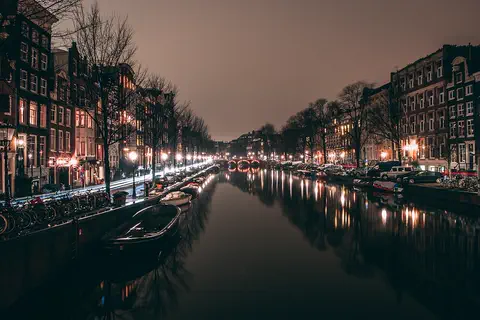
Getting around Amsterdam by bicycle
Amsterdam, the capital of the Netherlands, is flat and crossed by canals. In 2017, about 35 out of every 100 weekday trips made by people who live there were by bicycle, more than by car, bus, tram or metro. The city has added thousands of bike parking places, including a garage under the water by Central Station.
-
Watch
City
Amsterdam
Amsterdam is the capital of the Netherlands. It began as a fishing village beside a dam on the Amstel River, which gave the city its name. Today about 942,000 people live among its rings of canals, hundreds of bridges, houseboats and bicycles.
-
 Watch
Life around the world
A school day in Helsinki, Finland
In Helsinki, Finland's capital, a lesson usually lasts 45 minutes, and pupils spend recess in the school yard. Every pupil gets a free warm lunch each school day. The 2026-2027 school year began on 12 August, and from 2026 every school is making a plan to help children move more.
-
 Watch
Life around the world
The polar night in Tromsø, Norway
Tromsø lies far north of the Arctic Circle. From about 26 November to 17 January the sun stays below the horizon all day, a time called mørketid in Norwegian, the dark time. Around midday there are still a few hours of twilight. People wear reflectors on dark roads, and a study found that people farther north in Norway tended to feel more positive about winter.
-
 Watch
Life around the world
A day on the London Underground
The London Underground, or the Tube, began in 1863 as the world's first underground railway. In the year 2025/26, people made about 1.2 billion journeys on its 11 lines. Its famous map, first sketched by Harry Beck in 1931, shows how stations connect rather than how far apart they are.
For parents & teachers
What children will learn
- Describe how people get around a city with no cars, using boats and walking.
- Explain what a lagoon is and how tides affect Venice.
- Compare public transport on water with buses and trains on land.
- Discuss how traffic and population change affect a historic city.
Recommended ages: 4 to 12 · About 12 minutes
Talk about it
- What would your trip to school be like if the streets were canals?
- Why might a city decide to keep cars out of its oldest streets?
- How could boat waves damage old buildings, and what might help?
Try at home or in class
- Make a canal city in a baking tray of water: use sponges or blocks for islands, craft sticks for bridges and a cork for a vaporetto.
- Make waves: push a toy boat fast and slow along a tray of water with sand banks at the sides, and watch which wears the sand away more.
Key vocabulary: lagoon, canal, vaporetto, gondola, tide, historic center
Where these facts come from
- Venice and its Lagoon (World Heritage List, 394) , UNESCO World Heritage Centre
- Venice: Canal boats and bridges , Encyclopaedia Britannica
- Venice: Lagoon and tides , Encyclopaedia Britannica
- Venice , Encyclopaedia Britannica
- Fares , AVM / ACTV (Venice public transport)
- Water bus service timetable , AVM / ACTV (Venice public transport)
- Popolazione residente al 1° gennaio (POSAS): Venezia, 1 January 2025 , ISTAT (Italian National Institute of Statistics)
- Gli abitanti del centro storico di Venezia continuano a diminuire: ora sono meno di 48mila (8 September 2025) , Il Post
Checked, not yet human-reviewed. Last updated October 24, 2026. Spotted a mistake? Tell us.