Life around the world Asia
Lunchbox delivery in Mumbai
In Mumbai, India, special helpers called dabbawalas carry lunchboxes. They take home-cooked food to offices by train and bicycle. A painted code shows where each box goes.
Every working day, Mumbai's dabbawalas collect home-cooked lunches in metal tiffin boxes, carry them by bicycle, on foot and on the city's local trains, and deliver them to offices by lunchtime. Colored letters, numbers and symbols painted on each box tell them where it goes, and the empty boxes travel home in the afternoon.
Mumbai's dabbawalas work in small groups led by mukadams and deliver home-cooked lunches by relay: collection by bicycle, sorting at stations, transport on suburban trains and final delivery by about 12:30 p.m. In the 2000s about 5,000 of them carried about 200,000 lunches a day; in 2026 a dabbawala association counted about 3,000 carrying more than 50,000. A painted code of colors, letters and numbers routes each tiffin.
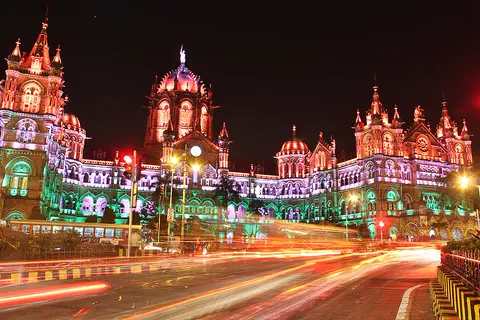
Photo: Ronakshah1990, CC BY-SA 4.0, via Wikimedia Commons
Good morning, Mumbai
Mumbai is a huge city by the sea in India.
Millions of people go to work there every day. Many of them get a lunch cooked at home. Someone has to carry it all the way to them!
Mumbai is the capital of Maharashtra state, on India's west coast beside the Arabian Sea. It is India's most populous city and its financial and business center. In 2011, more than 18 million people lived in the Mumbai urban area.
The old city stands on Bombay Island, which was once seven small islands joined together. In this topic we meet the dabbawalas, who carry lunches cooked at home to people at work all over the city.
Mumbai, capital of Maharashtra, is India's principal port on the Arabian Sea and its financial hub. Britannica gives the city's 2011 census population as 12,478,447 and the urban agglomeration as 18,414,288. The original city occupies Bombay Island, formed since the 17th century by joining seven islets through drainage, reclamation and causeways; it later expanded north onto the island of Salsette.
The Fort area in the south is occupied chiefly by public and commercial offices, while Greater Mumbai has spread north across Salsette. The dabbawalas' routes run along the suburban railway between them, from stations such as Virar and Borivali to Churchgate. This topic follows Sara Roncaglia's ethnography Feeding the City (2013, based on fieldwork in 2007) and the dabbawala association's own account.

Who are the dabbawalas?
Dabbawala means "one who carries boxes."
Dabbawalas work in teams. Each team has a leader. Together they carry thousands and thousands of lunchboxes every day.
A dabba is a lunchbox, often called a tiffin, and a dabbawala is a person who carries it. In the 2000s, about 5,000 dabbawalas delivered about 200,000 home-cooked lunches every day to people at work and to students. Since the COVID-19 pandemic, when many people began working from home, there are fewer: in 2026 a dabbawala association said about 3,000 dabbawalas deliver more than 50,000 lunchboxes a day.
The dabbawalas belong to an association. They work in small groups, each led by a leader called a mukadam, and each area of the city is organized around a railway station. Many dabbawalas come from villages in the Pune district, a few hours away. The association describes them as dressed in white with a traditional Gandhi cap.
At the time of her 2007 fieldwork, Roncaglia describes the Nutan Mumbai Tiffin Box Suppliers Charity Trust as an association of about 5,000 members, who are partners rather than employees, distributing some 200,000 home-cooked lunchboxes a day to workers and students. In June 2026 Ramdas Karvande, president of the Mumbai Tiffin Box Suppliers Association, said the workforce had fallen to about 3,000 from nearly 5,000 before the COVID-19 pandemic, delivering more than 50,000 lunchboxes a day, as working from home and food-delivery apps cut demand. An executive committee of thirteen members, elected every five years, oversees the system; about 800 mukadams lead teams of five or ten dabbawalas; and each area, defined by a railway station such as Borivali, Kandivali, Malad, Andheri or Thane, has a director who works on trains and platforms rather than in an office.
Office-holders keep delivering: the president Roncaglia interviewed held his own delivery contract. Many dabbawalas come from the same rural area of Pune district, about three hours away, and are recruited through village and family networks. Roncaglia notes that most could read and write little or not at all, which is why the delivery code matters so much.
A lunchbox's journey
In the morning, a family cooks lunch and packs the box.
A dabbawala picks it up and takes it to the train. Another dabbawala carries it to the office. After lunch, the empty box goes home again.
A lunchbox's day runs like clockwork. At about 8:20 a.m. a family leaves the packed dabba by the door, and a dabbawala collects it. By about 9:30 it reaches the nearest railway station, where boxes are sorted by destination and loaded onto a train.
If a box must change lines, it is handed to another dabbawala. At about 12:15 the boxes are loaded onto bicycles and baskets for the last stretch, and they arrive at offices at about 12:30 p.m. In the afternoon, the empty boxes make the same trip home. The service runs every day except Sunday.
Roncaglia reproduces the association's schedule. 8:20 a.m.: the supplier-customer leaves the dabba outside the door; 8:25: pickup; 8:35: loading onto a basket or bicycle with others from the area; 9:25: arrival at the station collection area; 9:30: sorting by destination; 9:40: boarding the compartment at the head of the train; 10:15: arrival at major junctions, where dabbas changing lines pass by relay to another dabbawala; 11:00: change of trains; 11:45: arrival at the destination station; 12:15: loading for the final leg; 12:30: delivery to the receiver-customer. At about 1:30 p.m. the empties are collected and the route runs in reverse.
One dabbawala describes collecting at least forty tiffins on four streets, starting at 8:30 a.m. so as to be at the station by 10:30 for a 10:38 train he can never risk missing; if he is late, he runs faster up the stairs, pedals harder or takes a fast train. The same circular route repeats every day of the week except Sunday.
The painted code
Each lunchbox has little marks painted on top.
There are colors, letters and numbers. The marks tell the dabbawalas where the box must go. They can read the code even without reading words.
A lunchbox changes hands several times a day, so every box needs a label. Instead of writing addresses, the dabbawalas paint a short code of four or five colored symbols on each box.
In one system described by the association's president, the color shows which group the box belongs to, a letter shows which dabbawala picks it up, and a number shows the destination area. For example, the big Churchgate station area is numbered from one to ten, and eleven means Marine Lines. Another mark shows the building and the floor.
Because dabbas change hands several times and most carriers have little formal literacy, the network depends on identification marks, usually four or five colored symbols painted on each container. Groups have freedom to design their own, so styles vary: some draw on symbols from their home regions, others use Devanagari letters or simple geometric shapes.
Raghunath Medge, the association's president, told Roncaglia how the system evolved: early on, cords of seven different colors indicated the district of origin; later, plus and minus signs, dots, arrows, triangles and squares; then a newer code with a color for each group, a letter for each member, and numbers for destinations, since his network served seventy-two delivery destinations. Churchgate, a large area, is numbered one to ten and Marine Lines eleven. At the Vile Parle sorting point, members divide the containers by number, and a final mark gives the building and floor.
By train, bicycle and on foot
Dabbawalas carry the lunchboxes on big wooden trays and in baskets.
Some ride bicycles. Then they load the boxes onto Mumbai's busy trains. They have to load the boxes very fast!
The dabbawalas' network follows Mumbai's suburban railway lines. Lunchboxes are carried to the nearest station by bicycle or in wooden baskets. There, another team loads them into the compartment at the front of the train.
The trains are crowded and stop for only about thirty seconds, so the heavy baskets must be loaded very quickly. In the early days, dabbawalas carried trays on their heads and walked, because they had no bicycles.
Railway stations are the nodes of the system. After collection, dabbas go to the nearest station by bicycle or in wooden baskets; a second group from the same line loads them onto trains, using the goods compartment at the head of the train, which, though there is no formal agreement with the railways, is left for dabbawalas and people carrying bulky goods. The baskets must be loaded in the roughly thirty seconds a train stops at the platform, through crowds of commuters.
Older dabbawalas recall carrying trays on their heads on foot before bicycles were used; in Roncaglia's fieldwork, the wooden basket was still a key tool and the bicycle had been in use for only about a decade. By 2026, some dabbawalas also used e-bikes and scooters. Heavy rain in the monsoon can still cause gridlock and make on-time delivery impossible, one dabbawala said.
How it began
More than 100 years ago, one man carried one lunch to an office.
Other people wanted lunch delivered too. So he gathered helpers into a team. The team grew and grew.
The dabbawalas say their service began in about 1890. A young man named Mahadeo Havaji Bachche, from the Pune district, was asked by a banker to collect his lunch from his home in Grant Road and carry it to his office.
More people wanted the same service, so Bachche organized a team, starting with about 100 dabbawalas. A cooperative was formed in 1954, and in 1984 it registered as the Nutan Mumbai Tiffin Box Suppliers Charity Trust.
The founding story, told by the association and recorded by Roncaglia, places the start in about 1890: toward the end of the 1880s, a Parsee banker hired Havji Madhu Bacche, a young man from Pune district, to collect his tiffin from his home in Grant Road and deliver it to his office on Ballard Pier. Roncaglia notes that informal lunch delivery already existed; 1890 marks when Bacche began organizing it. The association's site credits Mahadeo Havaji Bachche with starting the team-delivery format with 100 dabbawalas.
A rudimentary cooperative was set up in 1954, and the Nutan Mumbai Tiffin Box Suppliers Charity Trust was registered under that name in 1984. Medge's account mentions an early carrier taking twenty or twenty-five tiffins from Girgaon to VT Station, today Chhatrapati Shivaji Maharaj Terminus. Spellings of the founder's name differ between sources.
Amazing facts
-
Sometimes people tuck a little surprise into a lunchbox.
Families sometimes slip money, train tickets, a forgotten pen or even eyeglasses into the lunchbox for the dabbawala to carry.
A dabbawala told Roncaglia that customers trust them enough to put money, train tickets, pens, eyeglasses and medicines inside the tiffin, and that the carriers never touch the food.
-
Mumbai used to be seven little islands.
Mumbai's old city stands on Bombay Island, which was made by joining seven small islands together.
Since the 17th century, the seven islets off the Konkan coast have been joined by drainage, reclamation, causeways and breakwaters to form Bombay Island.
-
Long ago, there were no bicycles for the dabbawalas.
Older dabbawalas remember carrying lunchbox trays on their heads and walking, before bicycles were used.
In Roncaglia's 2007 fieldwork, the bicycle had been in use for only about ten years; older dabbawalas remembered carrying trays on their heads and walking.
-
The lunchbox code once used colored strings.
Before painted codes, dabbawalas tied cords of seven different colors to lunchboxes to show where they came from.
The association's president recalled that early dabbas were marked with cords in seven colors, each indicating the district of origin, before painted symbols replaced them.
Words to know
- dabba
- a lunchbox; in Mumbai, often a stacked metal tiffin box
- dabbawala
- a person who collects and delivers lunchboxes
- tiffin
- a packed lunch, or the metal container it is carried in
- mukadam
- a group leader in charge of a team of dabbawalas
- relay
- passing something from one person to the next to finish a journey
- code
- a set of signs or symbols that stand for information
Discovery challenge
-
What does a dabbawala carry?
What do Mumbai's dabbawalas deliver every working day?
What does the dabbawala association deliver to Mumbai's workers and students?
- Home-cooked lunchboxes
- Letters and parcels
- Newspapers
Show the answer
Home-cooked lunchboxes
Dabbawalas carry lunchboxes full of home-cooked food.
They collect home-cooked lunches, more than 50,000 a day in 2026, and deliver them to offices and students.
In Roncaglia's 2007 fieldwork, about 5,000 dabbawalas distributed about 200,000 home-cooked lunchboxes daily, then returned the empties; in 2026 a dabbawala association gave about 3,000 dabbawalas and more than 50,000 lunchboxes.
-
How do the lunchboxes travel across Mumbai?
How do lunchboxes travel from homes to offices across Mumbai?
Which combination of transport do the dabbawalas use in their relay?
- By bicycle, on foot and by train
- By airplane
- By boat only
Show the answer
By bicycle, on foot and by train
They go by bicycle, on foot and on trains.
Boxes go to the station by bicycle or in baskets, ride suburban trains, and are carried on to the offices.
Collection by bicycle or basket, transport in the head compartment of suburban trains, relay at junctions and final delivery by bicycle or on foot.
-
How do dabbawalas know where each lunchbox goes?
How do dabbawalas know where each lunchbox must go?
What system lets dabbawalas route each tiffin correctly without written addresses?
- Colored marks, letters and numbers painted on it
- A computer chip inside the box
- They guess
Show the answer
Colored marks, letters and numbers painted on it
Painted marks on the box show the way.
Four or five painted marks show the group, the collector, the delivery area, and the building and floor.
A painted code of colors, letters and numbers, adapted by each group, identifies group, carrier, destination and floor.
-
When does lunch reach the office?
At about what time do the lunchboxes reach the offices?
According to the association's schedule, at what time are dabbas delivered to the receiver-customer?
- About 12:30 p.m.
- About 6:00 a.m.
- About 9:00 p.m.
Show the answer
About 12:30 p.m.
Lunch arrives at lunchtime, at about half past twelve.
Lunchboxes arrive at about 12:30 p.m., and the empties go home in the afternoon.
The schedule gives 12:30 for delivery, with the empty dabbas collected from about 1:30 p.m.
Explore next
-
 Watch
 Country
India
India is a huge country in South Asia, shaped like a big triangle pointing into the Indian Ocean. The Himalayas rise along its north, heavy monsoon rains arrive every summer, and about 1.46 billion people (2025) live there, speaking hundreds of languages.
-
Watch
City
Mumbai
Mumbai, once called Bombay, is a giant port city on India's west coast, by the Arabian Sea. It grew on seven small islands that were joined into one, and it is India's main center of business and banking. At the 2011 census, more than 12 million people lived in the city and more than 18 million in its urban area.
-
 Watch
Life around the world
Riding the Shinkansen from Tokyo to Osaka
The Tokaido Shinkansen, Japan's first bullet train line, opened in 1964 between Tokyo and Osaka. Today its trains reach 285 km/h, the fastest take 2 hours 21 minutes from Tokyo to Shin-Osaka, and in fiscal year 2023 the average delay was just 1.6 minutes per train.
-
Watch
Life around the world
A school day in Tokyo
In Tokyo, many children walk to their local school in neighborhood groups. Lessons are 45 minutes long in elementary school. At lunchtime, pupils set and clear the table in their classroom, and they share the job of cleaning their school. The school year starts in April.
-
 Watch
Life around the world
Breakfast noodles in Hanoi
Pho is a soup of rice noodles, meat and a fragrant broth, and in Vietnam it is mostly eaten for breakfast. In Hanoi, near where pho is thought to have begun, cooks focus on a clear broth simmered with bones, meat, ginger, shallots and spices, served at street stalls from early morning.
-
 Watch
Life around the world
Lunch at a Singapore hawker center
A hawker center is a building full of small food stalls, each cooking its own dishes, with shared tables in the middle. Singapore built them to move street cooks indoors, and today they are where people from Chinese, Malay, Indian and other communities eat side by side. UNESCO calls them community dining rooms.
- Watch Life around the world Living root bridges of Meghalaya In the hills of Meghalaya, in northeast India, Khasi and Jaintia villagers guide the hanging roots of rubber fig trees across streams on bamboo frames. Over many years the roots take hold, thicken and grow together into living bridges that can carry people across rivers swollen by monsoon rain.
-
 Watch
Life around the world
Living in a vertical city: Hong Kong
Hong Kong is hilly, and only about a quarter of its land is built on. Its 7.5 million people live close together, many in apartment buildings. A long chain of outdoor escalators climbs one hillside, ferries cross Victoria Harbour, and trains carry millions of passengers every day.
For parents & teachers
What children will learn
- Describe how Mumbai's dabbawalas deliver home-cooked lunches by relay.
- Explain how a simple visual code can carry information without written words.
- Read a timetable and follow a journey step by step.
- Understand how a city's railways shape the way people work and move.
Recommended ages: 4 to 12 · About 12 minutes
Talk about it
- Why might a code made of colors and numbers work better than written addresses for the dabbawalas?
- What could go wrong in the relay, and how do the dabbawalas plan for it?
- Who brings things to your home or school? How do they know where to go?
Try at home or in class
- Invent your own lunchbox code: give each family member a color, each room a number and each shelf a letter, then deliver 'lunchboxes' using only the code.
- Run a relay delivery game with three helpers, each carrying a box to the next person, and time how long it takes.
Key vocabulary: dabba, dabbawala, tiffin, mukadam, relay, code
Where these facts come from
- Feeding the City: Work and Food Culture of the Mumbai Dabbawalas (Sara Roncaglia, 2013; CC BY-ND 3.0) , Open Book Publishers, Cambridge
- Feeding the City (repository record and abstract) , Heidelberg University Library, FID4SA repository
- Mumbai Dabbawala (association website) , Mumbai Dabbawala
- The dabbawalas who once fed Mumbai now battle changing times (8 June 2026) , The Pioneer
- Mumbai , Encyclopaedia Britannica
Checked, not yet human-reviewed. Last updated October 27, 2026. Spotted a mistake? Tell us.