
 Country
Asia
India
India is a big country in South Asia. It has snowy mountains, a rainy season, tigers and peacocks.
India is a huge country in South Asia, shaped like a big triangle pointing into the Indian Ocean. The Himalayas rise along its north, heavy monsoon rains arrive every summer, and about 1.46 billion people (2025) live there, speaking hundreds of languages.
India occupies most of South Asia: a peninsula between the Arabian Sea and the Bay of Bengal, walled off from the rest of Asia by the Himalayas, which are still rising as the Indian-Australian Plate pushes under the Eurasian Plate. It is the seventh-largest country by area, and with about 1.46 billion people (World Bank, 2025) it became the world's most populous country in 2023, according to United Nations estimates.
Photo: © Yann Forget, CC BY-SA 4.0, via Wikimedia Commons
Discover India
India is a very big country in Asia.
The sea is on two sides of it. Very tall, snowy mountains stand in the north. The capital city is called New Delhi. Lots and lots of people live in India.
India fills most of South Asia. Much of it is a peninsula, a piece of land with water on three sides: the Arabian Sea to the west and the Bay of Bengal to the east. In the north, the Himalayas form a huge wall of mountains between India and the rest of Asia.
India is the seventh-largest country in the world by area. It is made up of 28 states and 8 union territories, and its capital is New Delhi. About 1.46 billion people lived there in 2025, more than in any other country, and they speak hundreds of different languages.
India, officially the Republic of India (Bharat in Hindi), occupies the greater part of South Asia. Together with Bangladesh and most of Pakistan it forms a subcontinent, set apart from the rest of Asia by the Himalayas and neighboring ranges. Much of its territory is a peninsula between the Arabian Sea and the Bay of Bengal, which meet at Cape Comorin (Kanniyakumari), the southern tip of the mainland. At 3,287,263 square kilometers, it is the seventh-largest country in the world.
India is a federal republic of 28 states and eight union territories, with its capital at New Delhi. The World Bank put its population at about 1.46 billion in 2025, and Britannica reports that United Nations estimates made India the world's most populous country in 2023. Britannica describes the population as highly diverse, with thousands of ethnic groups and hundreds of languages.
Cities and famous places
New Delhi is India's capital city.
Mumbai is a big city by the sea. Its huge railway station looks like a palace. The Taj Mahal is made of white marble. It has a big round dome.
New Delhi was built in the 20th century, just south of the old city of Delhi, to be the center of India's government. In Delhi stands the Red Fort, a palace fort with walls of red sandstone, built for the Mughal emperor Shah Jahan. India's independence was first celebrated there.
In Agra, the white marble Taj Mahal sits beside the Yamuna River in a huge garden. Emperor Shah Jahan built it between 1632 and 1648 in memory of his wife, Mumtaz Mahal. In Mumbai, on the Arabian Sea, the grand Chhatrapati Shivaji Terminus railway station, built over 10 years from 1878, is used by more than three million travelers every day.
New Delhi was built in the 20th century just south of the historic hub of Old Delhi as India's administrative center. Delhi's Red Fort Complex, a World Heritage Site since 2007, shows the final flourishing of Mughal architecture, which UNESCO describes as a fusion of Islamic, Persian, Timurid and Hindu traditions; it was where Indian independence was first celebrated, and still is. The Qutb Minar, a red and buff sandstone minaret built between 1199 and 1503, is the tallest masonry tower in India at 72.5 meters.
The Taj Mahal in Agra (inscribed 1983) was built by the Mughal emperor Shah Jahan in memory of his wife Mumtaz Mahal, from 1632 to 1648. Masons, stone-cutters, inlayers, calligraphers and dome builders came from across the empire and from Central Asia and Iran, and Ustad Ahmad Lahori was the main architect. In Mumbai, Chhatrapati Shivaji Terminus (formerly Victoria Terminus, inscribed 2004), designed by F. W. Stevens and built from 1878, blends Victorian Gothic Revival with Indian traditional architecture; British architects worked with Indian craftsmen on it.

Mountains, monsoons and plains
The Himalayas are in the north of India.
Some of the tallest mountains in the world are there. In summer, big rains come. This rainy time is called the monsoon. In the far west there is a big, sandy desert.
Millions of years ago, the land that is now India slowly drifted north and crashed into the rest of Asia. Slices of rock were pushed up onto India's northern edge and became much of the Himalayas. The push still goes on, so the mountains are still rising and earthquakes are common. India's highest point is Kanchenjunga, 8,586 meters tall, on the border with Nepal.
South of the mountains lies the wide Indo-Gangetic Plain, filled with mud and sand that streams carried down from the mountains. Farther south is the Deccan, a high, old plateau. Most of India's rain comes with the monsoon, from about mid-June to early October, when winds blow in from the Indian Ocean carrying wet air.
India's landmass forms the northwestern part of the Indian-Australian Plate, which drifted north after breaking away from the supercontinent Gondwana. It collided with the Eurasian Plate about 50 million years ago and was thrust beneath it at a low angle; that subduction continues, so the Himalayas are still rising and earthquakes are common. Kanchenjunga (8,586 m), on the Nepal-Sikkim border, is the world's third-highest peak and India's highest point.
South of the Himalayas is the Indo-Gangetic Plain, and beyond it the Deccan plateau, mostly 300 to 750 meters high and the oldest, most stable land in India. Britannica calls India the world's most pronounced example of a monsoon climate: in the southwest monsoon, from about mid-June to early October, moist winds from the Indian Ocean bring about three-fourths of the year's rain. The Western Ghats, a 1,600 km chain of mountains along the west coast, intercept those winds; UNESCO counts them among the world's eight 'hottest hotspots' of biological diversity, with Sri Lanka.

Animals of India
The Bengal tiger is India's national animal.
It has orange fur with black stripes. Big gray rhinos live in tall grass. Peacocks have bright, beautiful feathers. Herds of elephants live in the forests too.
The Bengal tiger is India's national animal. Tigers live in forests in many parts of India and in the Sundarbans, the biggest mangrove forest in the world, where they can swim long distances. Special tiger reserves have helped their numbers grow to several thousand.
India is home to almost half of all the Asian elephants in the world. In Kaziranga National Park in Assam, one-horned rhinoceroses graze on wet grasslands; the park helped save them when they were almost gone. The peacock is India's national bird, and the long-snouted gharial lives in big rivers such as the Ganges.
India lies in the Oriental biogeographic region, and Britannica counts more than 1,200 bird species, roughly one-eighth of the world's. The endangered Bengal tiger is the national animal; once near extinction in India, tigers have increased to several thousand, largely thanks to the reserves of Project Tiger. In the Sundarbans (inscribed 1987), the largest mangrove forest in the world and the only one inhabited by tigers, they live an almost amphibious life, swimming long distances.
Kaziranga National Park (inscribed 1985), on the Brahmaputra floodplain in Assam, saved the Indian one-horned rhinoceros from the brink of extinction around 1900 and now holds the species' largest population. The Smithsonian notes that almost half of the world's Asian elephants live in India, though poaching, crop protection incidents and road accidents kill about 200 elephants there each year. The Indian peafowl is the national bird, and the gharial (Gavialis gangeticus), a long-snouted crocodilian, lives in large rivers including the Ganges and Brahmaputra and their tributaries.

People, languages and food
More people live in India than in any other country.
People speak many different languages. Hindi and English help people from different places talk. Many meals have rice or other grains, lentils and spices.
About 1.46 billion people lived in India in 2025. They speak hundreds of languages. Hindi is used in one form or another by about two-thirds of people, and English links people across the country. Many states have their own official languages, such as Tamil, Bengali or Marathi.
India does not have just one kind of food. Lentils, called dal, and grains are part of many meals. In the south, rice is eaten with sambhar, a stew of lentils and vegetables. In the north, many dishes use milk, ghee and paneer cheese. Across India, food is often eaten by hand.
India's population was about 1.46 billion in 2025 (World Bank), and in 2018 about two-thirds of people lived in rural areas. Its languages come from four main families, Indo-Iranian, Dravidian, Austroasiatic and Tibeto-Burman, plus a few isolates. Hindi and English are the official languages of the national government, and 22 scheduled languages have official recognition in the states. Hindi is used in some form by about two-thirds of the population, Dravidian languages such as Tamil, Telugu, Kannada and Malayalam by about one-fourth, mostly in the south; English, although a mother tongue for few, is the most widely used lingua franca.
India has no official religion. Most people follow Hinduism, and Muslims, Christians, Sikhs, Buddhists and Jains together make up a significant share. Britannica stresses that India has no single cuisine: dal may be the closest thing to a national dish, rice is the staple in the south and northeast, dairy such as ghee and paneer is common in the north, and Gujarat's food is mostly vegetarian.

A long history
People have lived in India for a very, very long time.
Long ago, people built big cities by the Indus River. Later, emperors built forts and the Taj Mahal. In 1947, India became free to rule itself.
More than 4,000 years ago, people in the northwest of the subcontinent built planned cities with drains and bathrooms, along the Indus River. Over the centuries, many kingdoms rose and fell. People carved whole temples out of rock at Ellora. The Mughal Empire began in 1526, and its emperor Shah Jahan built the Taj Mahal and the Red Fort.
From 1858, Britain ruled India directly. Leaders such as Mahatma Gandhi and Jawaharlal Nehru led a movement for independence, and British rule ended in August 1947. The land was divided into two countries, India and Pakistan. Today India's people elect their government.
Archaeology shows that the Indus civilization, with its planned cities, drains and standardized weights, dominated the northwest of the subcontinent from about 2600 to 2000 BCE; a second great phase of city life grew in the Ganges basin in the 1st millennium BCE. Hinduism, Buddhism and Jainism all have roots in India. At Ellora (inscribed 1983), followers of Buddhism, Brahmanism and Jainism carved 34 rock-cut caves between about the 6th and 12th centuries; the Kailasa temple, Cave 16, is the largest monolithic temple.
Islam reached the subcontinent from the northwest from the early 8th century, and by the 13th century much of it was under Muslim rule; the Mughal Empire lasted from 1526 to 1761. After Vasco da Gama arrived by sea in 1498, European sea power grew in the region, and direct British administration began in 1858. The Indian Independence Movement, led by figures such as Mahatma Gandhi and Jawaharlal Nehru, ended British rule on August 14-15, 1947, and the subcontinent was partitioned into India, with a Hindu majority, and Pakistan, with a Muslim majority; East Pakistan later became Bangladesh. India is now a multiparty federal republic with a parliament of two houses.

India on the map
Find India on the globe.
It is in Asia, below the tall Himalayas. It looks like a big triangle. The sea is on its east and west sides.
India is in South Asia. Its southern half is a big triangle of land pointing into the Indian Ocean, with the Arabian Sea on the west and the Bay of Bengal on the east. The very tip is called Cape Comorin.
India shares land borders with six countries: Pakistan to the northwest; Nepal, China and Bhutan to the north; and Myanmar and Bangladesh to the east. The island country of Sri Lanka lies just 65 kilometers off its southeast coast. India also has groups of islands, such as the Andaman and Nicobar Islands in the Bay of Bengal.
Roughly one-third of India's frontier is coastline. Britannica describes its land boundaries with Pakistan to the northwest; Nepal, China and Bhutan to the north; Myanmar to the east; and Bangladesh, which India surrounds on the north, east and west. Sri Lanka lies about 65 km off the southeast coast across the Palk Strait and the Gulf of Mannar. Two union territories are made up entirely of islands: Lakshadweep in the Arabian Sea and the Andaman and Nicobar Islands between the Bay of Bengal and the Andaman Sea.
Some of India's borders are disputed. Britannica describes Kashmir, in the far north, as a region India and Pakistan have disputed since the 1947 partition: India administers its southern and southeastern parts (Jammu and Kashmir, and Ladakh), Pakistan its northern and western parts, and China has controlled the northeastern part of Ladakh since 1962.
- Area
- 3,287,263 km² (seventh-largest country)
- Land neighbors
- 6: Pakistan, Nepal, China, Bhutan, Myanmar and Bangladesh
- States and union territories
- 28 states and 8 union territories
- Highest point
- Kanchenjunga, 8,586 m
Amazing facts
-
Tigers live in a forest that grows in the sea.
The Sundarbans is the biggest mangrove forest in the world, and the only one where tigers live. The tigers there swim long distances.
UNESCO describes the Sundarbans as the largest mangrove forest in the world and the only one inhabited by the tiger; its tigers have adapted to an almost amphibious life.
-
India has more than 1,200 kinds of birds.
More than 1,200 kinds of birds live in India. That is about one in every eight bird species in the world.
Britannica counts more than 1,200 bird species and perhaps 2,000 subspecies in India, roughly one-eighth of the world's bird species, thanks to habitats from alpine tundra to mangroves.
-
The Himalaya mountains are still growing.
The plate that carries India is still pushing into Asia, so the Himalayas are still rising.
Because the Indian peninsula is still subducting against the Eurasian Plate, the Himalayas remain tectonically active: they are still rising, and earthquakes are common.
-
Lots of elephants live in India.
Almost half of all the Asian elephants in the world live in India.
The Smithsonian's National Zoo reports that India has by far the largest Asian elephant population of any country, almost half of the world total.
-
One train station in Mumbai is busy, busy, busy.
More than three million travelers use Mumbai's Chhatrapati Shivaji Terminus railway station every day.
Chhatrapati Shivaji Terminus, built from 1878 and inscribed by UNESCO in 2004, is used by more than three million commuters daily.
Words to know
- subcontinent
- a large area of land that is part of a continent but set apart from the rest of it
- peninsula
- a piece of land with water on three sides
- monsoon
- a seasonal change of winds that brings a long rainy season
- plateau
- a large area of high, fairly flat land
- mangrove
- a tree or shrub that grows in salty water along tropical coasts
- lingua franca
- a language people use to talk when their first languages are different
- World Heritage Site
- a place UNESCO lists as important to all people, to be protected
Discovery challenge
-
What is the capital city of India?
Which city is the capital of India?
Which city, built in the 20th century beside Old Delhi, is India's capital?
- New Delhi
- Mumbai
- Kolkata
Show the answer
New Delhi
New Delhi is the capital of India.
New Delhi is the capital. Mumbai and Kolkata are big cities by the sea.
New Delhi was built in the 20th century just south of Old Delhi to serve as India's administrative center.
-
What do we call India's big rainy season?
What is the rainy season that soaks India from about June to October called?
What is the name of the seasonal wind reversal that brings India about three-fourths of its yearly rain?
- The monsoon
- The blizzard
- The drought
Show the answer
The monsoon
The monsoon brings lots of rain in summer.
During the monsoon, winds from the Indian Ocean carry wet air over India and heavy rain falls.
In the southwest monsoon, from about mid-June to early October, moist winds from the Indian Ocean usually bring about three-fourths of India's annual precipitation.
-
Which is the tallest mountain in India?
Which mountain is India's highest point?
Which peak, 8,586 meters high on the Nepal-Sikkim border, is India's highest point?
- Kanchenjunga
- Mount Everest
- Mount Fuji
Show the answer
Kanchenjunga
Kanchenjunga is the tallest mountain in India.
Kanchenjunga, 8,586 meters tall, is India's highest mountain. Mount Everest is taller, but it is on the border of China and Nepal.
Kanchenjunga is the world's third-highest peak and India's highest point; Everest lies on the China-Nepal border.
-
Which animal is India's national animal?
Which animal is the national animal of India?
Which endangered animal, helped by the reserves of Project Tiger, is India's national animal?
- Bengal tiger
- Indian peafowl
- Asian elephant
Show the answer
Bengal tiger
The Bengal tiger is India's national animal. The peacock is the national bird.
The Bengal tiger is India's national animal, and the peacock, or Indian peafowl, is its national bird.
The endangered Bengal tiger is the national animal; India's tigers have recovered to several thousand, largely thanks to Project Tiger reserves.
-
What was the Taj Mahal built to be?
What did Emperor Shah Jahan build the Taj Mahal to be?
Shah Jahan had the Taj Mahal built from 1632 to 1648. What kind of building is it?
- A tomb in memory of the emperor's wife
- A railway station
- A fort for soldiers
Show the answer
A tomb in memory of the emperor's wife
The emperor built it to remember his wife.
Shah Jahan built the Taj Mahal in memory of his wife, Mumtaz Mahal. It stands in a huge garden beside the Yamuna River.
UNESCO records that Shah Jahan built the Taj Mahal in memory of his wife Mumtaz Mahal; the tomb stands at one end of a vast Mughal garden on the Yamuna.
Places to discover in India
-
 Watch
City
Mumbai
Mumbai, once called Bombay, is a giant port city on India's west coast, by the Arabian Sea. It grew on seven small islands that were joined into one, and it is India's main center of business and banking. At the 2011 census, more than 12 million people lived in the city and more than 18 million in its urban area.
-
 Watch
Landmark
Agra Fort
Agra Fort is a huge red sandstone fortress beside the Yamuna River in Agra, India. The Mughal emperor Akbar began it in 1565. Its walls, about 2.5 kilometers around, protect palaces, halls and mosques added by later emperors. It was both an army base and a royal home.
-
 Watch
Landmark
Fatehpur Sikri
Fatehpur Sikri, the "City of Victory," was built on a ridge near Agra, India, by the Mughal emperor Akbar from 1571. It was his capital until 1585. Its red sandstone palaces, halls and great mosque still stand, and its gateway, the Buland Darwaza, is 40 meters tall.
-
 Watch
Landmark
Harmandir Sahib (Golden Temple)
Harmandir Sahib, often called the Golden Temple, is the most important gurdwara, or place of worship, for Sikhs. It stands on a small island in a pool in Amritsar, India, and a marble causeway leads out to it. Its upper stories are covered in gilded copper, and its free kitchen serves meals to about 100,000 people a day.
-
Watch
Landmark
Taj Mahal
The Taj Mahal is a white marble tomb in Agra, India, beside the Yamuna River. The Mughal emperor Shah Jahan had it built in memory of his wife, Mumtaz Mahal. More than 20,000 workers spent about 22 years on the tomb, its gardens, a mosque and a great gateway.
-
 Watch
Natural wonder
Himalayas
The Himalayas are a giant wall of mountains in Asia, between the high Plateau of Tibet and the plains of India. They hold the highest mountains in the world, including Mount Everest. They rose when the land carrying India crashed into Asia, and their snow and ice feed great rivers such as the Ganges and the Indus.
-
 Watch
Natural wonder
Ganges
The Ganges, called the Ganga in India, flows about 2,510 kilometers from a glacier in the Himalayas across the plains of northern India to the Bay of Bengal, through India and Bangladesh. Its basin is home to hundreds of millions of people who farm, fish and travel on it. For many Hindus it is the holiest of rivers. Near the sea it builds a giant delta with the Brahmaputra.
-
 Watch
Natural wonder
Ajanta Caves
The Ajanta Caves are about 30 halls and rooms carved by hand into a curving cliff above the Waghora River in western India. Buddhist communities made them in two big phases, starting more than 2,000 years ago. Their wall paintings and stone carvings are some of the most famous ancient art in India, and they have been a UNESCO World Heritage Site since 1983.
-
 Watch
Natural wonder
Sundarbans
The Sundarbans is a vast mangrove forest where the Ganges and Brahmaputra rivers meet the Bay of Bengal. It is shared by Bangladesh and India. Twice a day the tides flood its muddy islands, and its trees are made to live in salty water. It is one of the last homes of the Bengal tiger, and both countries protect it as a World Heritage Site.
-
 Watch
Natural wonder
Kaziranga National Park
Kaziranga National Park lies beside the great Brahmaputra River in Assam, in northeastern India. Every year the river floods parts of the park, keeping its tall grasslands, marshes and pools alive. It is home to the world's largest population of greater one-horned rhinoceroses, more than 2,600 in 2024, which grew from only a handful about a hundred years earlier.
Animals of India
-
Watch
3D
Animal
Tiger
The tiger is a huge cat with orange fur and dark stripes that help it hide in tall grass and forest shadows. It lives alone, hunts deer and wild pigs, and loves to swim. Wild tigers live only in Asia, and they are endangered.
-
 Watch
3D
Animal
Asian elephant
The Asian elephant is the largest land animal in Asia. It is a little smaller than its African cousins, with smaller ears, a head shaped like two domes and a trunk with one finger-like tip. It lives in forests and grassy clearings in 13 countries of South and Southeast Asia.
-
 Watch
Animal
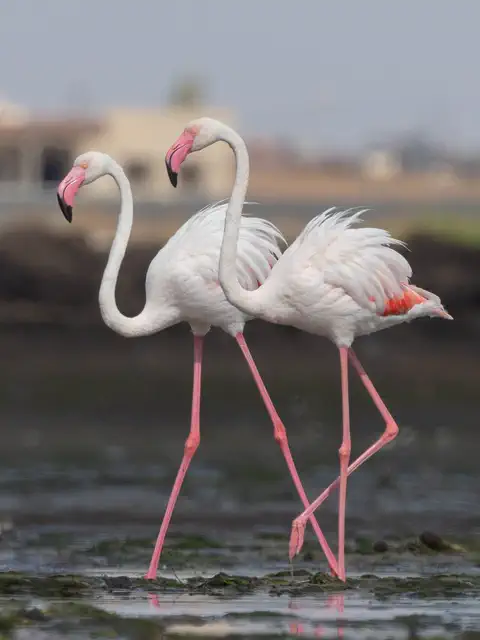
Greater flamingo
The greater flamingo is the tallest and heaviest flamingo, standing up to about 1.45 meters tall. It lives in salty lagoons and lakes across Africa, southern Europe, the Middle East and South Asia. It feeds by holding its bent bill upside down in the water and filtering out tiny animals, and it gets its pink color from what it eats.
-
 Watch
3D
Animal
Indian peafowl
The Indian peafowl is a large bird of the pheasant family from South Asia. Males, called peacocks, have a bright blue neck and a long train of shimmering feathers decorated with eyespots, which they spread into a giant fan to impress females, called peahens. It is the national bird of India.
-
 Watch
Animal
Great hornbill
The great hornbill is a very large bird of Asia's forests, with a long tail, broad black-and-white wings and an enormous curved yellow bill topped by a helmet called a casque. It eats mostly figs, and the female seals herself inside a tree hole to raise her chick.
-
 Watch
3D
Animal
Lesser flamingo
The lesser flamingo is the smallest flamingo. Millions live on salty, soda-rich lakes in Africa and India, where they sweep their upside-down bills through the water to filter out tiny algae, which help give them their pink color.
-
 Watch
Animal
Atlas moth
The atlas moth is one of the largest moths in the world, with wings up to about 24 centimeters across. It lives in tropical and subtropical forests of southern and Southeast Asia. Its caterpillars eat a lot and spin silk cocoons, and the adults cannot eat at all: they live for only about a week.
-
 Watch
Animal
Honey badger
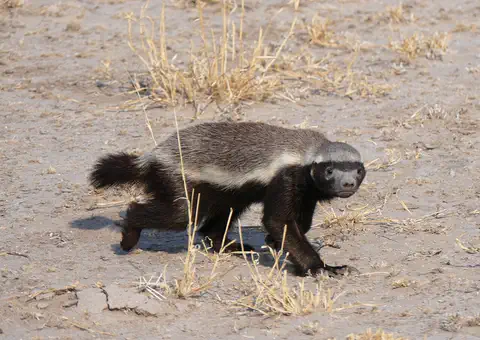
The honey badger, or ratel, is a stocky member of the weasel family that lives across Africa, the Middle East and India. Its gray or white back and black underside make it easy to spot. It digs with huge front claws, travels far to find food, and breaks into bees' nests for honey and bee grubs.
-
 Watch
Animal
Clouded leopard
The clouded leopard is a forest cat of mainland Southeast Asia and the Himalayan foothills. It is named for the cloud-shaped patches on its coat, and it is an amazing climber that can creep headfirst down a tree trunk. It is Vulnerable, and fewer of them are left each year.
-
 Watch
Animal
Leopard gecko
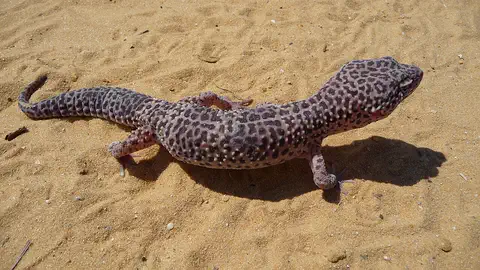
The leopard gecko is a spotted lizard from the rocky deserts and dry grasslands of Pakistan, Afghanistan, northwestern India and Nepal. It hunts insects and scorpions at night, stores fat in its thick tail, and has real eyelids. It is also one of the most popular pet lizards in the world.
-
 Watch
Animal
Fishing cat
The fishing cat is a stocky, spotted wild cat of the wetlands of South and Southeast Asia. It is an excellent swimmer and diver, and fish are its main food. It lives in marshes, swamps, mangroves and along rivers, and it is Vulnerable because so many of these wetlands are being lost.
-
 Watch
Animal
Sloth bear
The sloth bear is a shaggy, black bear of the forests and grasslands of India, Nepal and Sri Lanka. It is a bear that specializes in eating termites and ants: it digs open their nests with long claws and sucks them up through a gap in its front teeth. Mother sloth bears carry their cubs on their backs.
Explore next
-
Watch
Natural wonder
Himalayas
The Himalayas are a giant wall of mountains in Asia, between the high Plateau of Tibet and the plains of India. They hold the highest mountains in the world, including Mount Everest. They rose when the land carrying India crashed into Asia, and their snow and ice feed great rivers such as the Ganges and the Indus.
-
Watch
Landmark
Taj Mahal
The Taj Mahal is a white marble tomb in Agra, India, beside the Yamuna River. The Mughal emperor Shah Jahan had it built in memory of his wife, Mumtaz Mahal. More than 20,000 workers spent about 22 years on the tomb, its gardens, a mosque and a great gateway.
-
Watch
City
Mumbai
Mumbai, once called Bombay, is a giant port city on India's west coast, by the Arabian Sea. It grew on seven small islands that were joined into one, and it is India's main center of business and banking. At the 2011 census, more than 12 million people lived in the city and more than 18 million in its urban area.
-
Watch
Natural wonder
Sundarbans
The Sundarbans is a vast mangrove forest where the Ganges and Brahmaputra rivers meet the Bay of Bengal. It is shared by Bangladesh and India. Twice a day the tides flood its muddy islands, and its trees are made to live in salty water. It is one of the last homes of the Bengal tiger, and both countries protect it as a World Heritage Site.
-
Watch
3D
Animal
Tiger
The tiger is a huge cat with orange fur and dark stripes that help it hide in tall grass and forest shadows. It lives alone, hunts deer and wild pigs, and loves to swim. Wild tigers live only in Asia, and they are endangered.
-
Watch
3D
Animal
Asian elephant
The Asian elephant is the largest land animal in Asia. It is a little smaller than its African cousins, with smaller ears, a head shaped like two domes and a trunk with one finger-like tip. It lives in forests and grassy clearings in 13 countries of South and Southeast Asia.
- Watch Geography Monsoons A monsoon is a seasonal change in the direction of a region's strongest winds. In South Asia, the summer monsoon blows warm, wet air in from the Indian Ocean and brings months of heavy rain, while the winter monsoon blows dry air from the land. About three-quarters of India's yearly rain falls in the monsoon season, so farms, wells, rivers and power stations all depend on it.
-
Watch
Animal
Greater flamingo
The greater flamingo is the tallest and heaviest flamingo, standing up to about 1.45 meters tall. It lives in salty lagoons and lakes across Africa, southern Europe, the Middle East and South Asia. It feeds by holding its bent bill upside down in the water and filtering out tiny animals, and it gets its pink color from what it eats.
For parents & teachers
What children will learn
- Locate India and name its seas, its neighbors and the Himalayas.
- Explain how a colliding plate built the Himalayas and how the monsoon brings India's rain.
- Describe some of India's wildlife, languages and foods without treating them as one single culture.
- Outline India's history from the Indus cities to independence in 1947.
Recommended ages: 3 to 17 · About 15 minutes
Talk about it
- Why do you think farmers in India watch for the monsoon every year?
- India has hundreds of languages. How might people who speak different languages work and learn together?
- Kaziranga helped save the one-horned rhinoceros. What could a park near you protect?
Try at home or in class
- Lay a towel flat and slowly push one end toward the other: watch it fold up into ridges, like the Himalayas forming as India pushes into Asia.
- Keep a rain chart for a month and compare it with India's monsoon, when about three-fourths of the year's rain falls in a few months.
Key vocabulary: subcontinent, peninsula, monsoon, plateau, mangrove, lingua franca, World Heritage Site
Where these facts come from
- Wikidata , Wikimedia Foundation (CC0 1.0)
- Natural Earth vector data , Natural Earth (NACIS) (Public domain)
- UNESCO World Heritage List , UNESCO World Heritage Centre (Linked as a reference; site facts come from Wikidata)
- Population, total (SP.POP.TOTL): India, Australia, China , World Bank
- India , Encyclopaedia Britannica
- India: The Himalayas , Encyclopaedia Britannica
- India: The Deccan , Encyclopaedia Britannica
- India: Soils and Climate (The monsoons) , Encyclopaedia Britannica
- India: Plant and animal life , Encyclopaedia Britannica
- India: Indo-European languages (Languages) , Encyclopaedia Britannica
- India: Daily life and social customs (Cuisine) , Encyclopaedia Britannica
- India: The Indus civilization , Encyclopaedia Britannica
- Kashmir , Encyclopaedia Britannica
- Taj Mahal , UNESCO World Heritage Centre
- Red Fort Complex , UNESCO World Heritage Centre
- Qutb Minar and its Monuments, Delhi , UNESCO World Heritage Centre
- Ellora Caves , UNESCO World Heritage Centre
- Chhatrapati Shivaji Terminus (formerly Victoria Terminus) , UNESCO World Heritage Centre
- Kaziranga National Park , UNESCO World Heritage Centre
- Sundarbans National Park , UNESCO World Heritage Centre
- Western Ghats , UNESCO World Heritage Centre
- Asian elephant , Smithsonian's National Zoo and Conservation Biology Institute
- Mahatma Gandhi , Encyclopaedia Britannica
- Jawaharlal Nehru , Encyclopaedia Britannica
- PlayOwl region table, version 1 , PlayOwl (PlayOwl original data)
- flag-icons 7.5.0 , Panayiotis Lipiridis and contributors (MIT)
- Wikimedia Commons , Wikimedia Foundation (Per file (public domain, CC0, CC BY or CC BY-SA); see each media record)
Checked, not yet human-reviewed. Last updated October 24, 2026. Spotted a mistake? Tell us.
Picture credits
- Photo: © Yann Forget, CC BY-SA 4.0, via Wikimedia Commons · source · license
- Photo: Rajeeb Dutta, CC BY-SA 4.0, via Wikimedia Commons · source · license
- Photo: My Discovery, CC BY 2.0, via Wikimedia Commons · source · license
- Photo: Charles J. Sharp, CC BY-SA 4.0, via Wikimedia Commons · source · license
- Photo: Marcin Białek, CC BY-SA 3.0, via Wikimedia Commons · source · license
- Photo: © Vyacheslav Argenberg, CC BY 4.0, via Wikimedia Commons · source · license
- Photo: sushmita balasubramani, CC BY 2.0, via Wikimedia Commons · source · license
- Photo: Kingshuk Mondal, CC BY 4.0, via Wikimedia Commons · source · license
- Photo: Dr. Raju Kasambe, CC BY-SA 4.0, via Wikimedia Commons · source · license
- Photo: Yathin S Krishnappa, CC BY-SA 3.0, via Wikimedia Commons · source · license
- Photo: © Giles Laurent, gileslaurent.com, License CC BY-SA, CC BY-SA 4.0, via Wikimedia Commons · source · license
- Photo: Charles J. Sharp, CC BY-SA 4.0, via Wikimedia Commons · source · license
- Photo: IM3847, CC BY-SA 4.0, via Wikimedia Commons · source · license
- Photo: Ronakshah1990, CC BY-SA 4.0, via Wikimedia Commons · source · license