Life around the world Asia
Living in a vertical city: Hong Kong
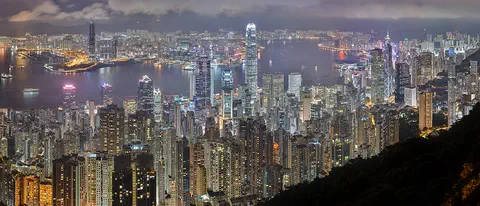
Hong Kong is a city of steep hills and tall towers. Many families live high up in apartment buildings. People ride escalators up the hills and ferries across the harbor.
Hong Kong is hilly, and only about a quarter of its land is built on. Its 7.5 million people live close together, many in apartment buildings. A long chain of outdoor escalators climbs one hillside, ferries cross Victoria Harbour, and trains carry millions of passengers every day.
Hong Kong's rugged terrain leaves lowland on less than a fifth of its land, and built-up areas cover about 25 percent, with most of the rest in country parks and conservation areas. Its 7.52 million people (mid-2026) live largely in flats, 44.7 percent in public housing (2024), and move by rail, ferry and hillside escalators.
Photo: Base64, retouched by CarolSpears, CC BY-SA 3.0, via Wikimedia Commons
A city that grows upward
Hong Kong is a busy city by the sea in southern China.
It has islands, hills and a big harbor. The buildings are very tall. At night, their lights sparkle across the water.
Hong Kong is a special administrative region of China, on the south coast beside the mouth of the Pearl River. It is made up of Hong Kong Island, the Kowloon Peninsula, the New Territories and about 230 smaller islands.
About 7.5 million people lived there in mid-2026. Tall towers crowd its harbor shore. In this topic we find out how people live and get around in a city of steep hills and water.
Hong Kong, a special administrative region of China since 1 July 1997, lies east of the Pearl River estuary. It comprises Hong Kong Island, the southern Kowloon Peninsula, Stonecutters Island and the New Territories with some 230 offshore islands. Hong Kong Island and its islets cover only about 81 km² and urban Kowloon about 47 km²; the New Territories make up more than 90 percent of the total.
The Census and Statistics Department's provisional estimate put the population at 7,518,300 at mid-2026, up 0.3 percent in a year, as a net inflow of residents outweighed a natural decrease (29,700 births and 50,100 deaths). This topic uses figures from Hong Kong's Development Bureau, Housing Authority, Transport Department and MTR Corporation, with Britannica for geography.
So little flat land
Hong Kong has lots of steep, green hills.
There is not much flat land. Many people live close together in tall buildings. A tall tower fits many homes on a small piece of ground.
Most of Hong Kong is hills and mountains. Its highest peak, Tai Mo Shan, rises to 957 meters, and Victoria Peak towers over the harbor at 552 meters. Flat land, such as river valleys and land built out into the sea, covers less than a fifth of the territory.
Hong Kong's government says built-up areas, the city's towns and new towns, cover only about 25 percent of its land. Most of the rest is country parks and nature areas. The government calls Hong Kong a compact, high-density city. Britannica puts its density at about 6,800 people per square kilometer (2026), one of the most densely populated places in the world.
Britannica describes a partially submerged, dissected upland rising abruptly to over 900 m, its ridges running northeast to southwest from Tai Mo Shan (957 m) to Lantau Peak (934 m); Victoria Peak (552 m) and Mount Parker shelter the harbor. Lowlands, including floodplains, river valleys and reclaimed land, occupy less than one-fifth of the land, and the urban area on both sides of the harbor occupies only about a tenth of the level area, extended by ongoing reclamation.
The Development Bureau states that built-up areas, including the urban areas and new towns, take up only 25 percent of Hong Kong's land and will rise to about 30 percent once the Hong Kong 2030+ strategy is fully realized, with the vast majority of the remaining land within country parks and other conservation areas. The bureau describes the aim as developing Hong Kong's compact, high-density city into a more livable one, making optimal use of limited land.
Homes in the sky
Many families in Hong Kong live in flats.
A flat is a home on one floor of a big building. Some buildings have many, many floors. Lots of families live in one building.
Most people in Hong Kong live in flats, or apartments, inside residential buildings. Some flats are owned or rented privately, and many are public housing built by the government.
In 2024, about 44.7 percent of Hong Kong's people lived in public housing: 29.4 percent in public rental flats and 15.3 percent in flats sold at subsidized prices. About 54.6 percent lived in private housing. By March 2025, Hong Kong had about 1.33 million public housing flats.
The Hong Kong Housing Authority's Housing in Figures 2025 gives the population by type of housing in 2024: public housing 44.7 percent, made up of 29.4 percent in public rental housing and 15.3 percent in subsidized sale flats; private housing 54.6 percent; and temporary housing 0.7 percent. The shares have barely moved in a decade: public rental housing held 29.2 percent in 2014.
Most people in the Housing Authority's public housing live in the New Territories. In 2024, 57.8 percent of the population in the Housing Authority's public housing lived in the New Territories, 33.8 percent in Kowloon and 8.4 percent on Hong Kong Island. The public rental stock stood at about 871,000 flats, within some 1.33 million public housing flats, as of March 2025.
An escalator up the hill
Some Hong Kong streets are very steep.
So the city built a long chain of escalators up one hill! In the morning they go down. Later in the day they go up.
On Hong Kong Island, the streets climb steeply from Central, near the harbor, up to the Mid-Levels, on the slopes below Victoria Peak. In 1993, the city opened the Central to Mid-Levels Escalator and Walkway System, a covered chain of 16 escalators and 3 moving walkways.
It runs from Queen's Road Central up to Conduit Road. Each morning, from 6 to 10 a.m., it runs downhill. From 10 a.m. to midnight it runs uphill. In late 2024, people made about 99,000 trips on it every day.
The Transport Department describes the Central to Mid-Levels Escalator and Walkway System, opened in 1993, as covered walkways with 16 reversible one-way escalators and 3 reversible one-way travelators, starting at Queen's Road Central, passing through narrow streets and ending at Conduit Road. It runs one-way downhill from 6:00 to 10:00 a.m. and uphill from 10:00 a.m. to midnight.
The system carried about 99,000 pedestrian trips a day in late 2024 and is managed by the Electrical and Mechanical Services Department.
Ferries and trains
Hong Kong has lots of water.
Ferries cross the harbor. Trains carry people all over the city. Millions of people ride the trains every day.
Victoria Harbour separates Hong Kong Island from Kowloon. The Star Ferry carries commuters between them, and its company calls the crossing an inexpensive, reliable part of the city's transport.
Most long trips are by train. In 2025, the MTR railway and its buses carried about 1.96 billion passengers, an average of 5.71 million on each weekday. The MTR carries about half of all passengers on Hong Kong's main public transport.
Victoria Harbour divides the two halves of the urban area. The Star Ferry describes its crossings between Hong Kong Island and Kowloon as an important part of the commuter system, inexpensive and reliable, and in 2026 it invited tenders to build an electric ferry.
Rail carries most journeys. MTR Corporation reports 1,958.5 million passengers on its rail and bus services in 2025, with average weekday patronage of 5.71 million, 4.71 million of them on domestic services. Its share of the franchised public transport market was 50.2 percent, and it carried 72.9 percent of cross-harbor traffic.
Green hills next to the towers
Hong Kong is not all buildings.
Big green parks cover many of its hills. The hills are very steep. From the top, you can see the towers far below.
Much of Hong Kong is green. Most of the land that is not built up is country parks and other areas protected for nature, and the government plans to keep it that way as the city grows.
Steep hills rise behind the towers. Tai Mo Shan, the highest peak, reaches 957 meters, and Lantau Peak, on Lantau Island, 934 meters. Hong Kong also has about 230 islands around its coast.
The Development Bureau's goal is to strike a balance between development and conservation, keeping the vast majority of non-built-up land within country parks and other nature conservation areas even as built-up land grows from about 25 to about 30 percent under Hong Kong 2030+.
Britannica notes that Hong Kong's soils are generally acidic and of low fertility, except for alluvial soils around Deep Bay where rice and, later, vegetables have been farmed, and that hill soils develop a rich topsoil under forest but become thin and nutrient-poor when exposed, suffering severe sheet and gully erosion.
Amazing facts
-
An escalator in Hong Kong changes direction every day.
The Central to Mid-Levels escalators run downhill in the morning rush and uphill for the rest of the day.
The system runs one-way downhill from 6:00 to 10:00 a.m. and one-way uphill from 10:00 a.m. to midnight.
-
Hong Kong has more than two hundred islands.
Besides Hong Kong Island, Hong Kong includes about 230 large and small offshore islands, Lantau among them.
The New Territories include some 230 large and small offshore islands, leased from China for 99 years from 1898 to 1997.
-
Millions of people ride Hong Kong's trains every day.
On an average weekday in 2025, about 5.71 million passengers used MTR trains and buses.
MTR's average weekday patronage rose 1.3 percent to 5.71 million in 2025; total rail and bus patronage reached 1,958.5 million.
-
Hong Kong's tallest mountain is almost a kilometer high.
Tai Mo Shan, Hong Kong's highest peak, rises to 957 meters.
Mount Tai Mo (Tai Mo Shan), at 957 m, is the territory's highest peak; Lantau Peak reaches 934 m and Victoria Peak 552 m.
Words to know
- flat
- an apartment: a home on one floor of a larger building
- high-rise
- a tall building with many floors
- public housing
- homes built or run by the government, often rented at low cost
- reclamation
- making new land by filling in part of the sea or a wetland
- harbor
- a sheltered area of water where ships and ferries can stop safely
- density
- how crowded a place is, such as how many people live on each piece of land
Discovery challenge
-
How much of Hong Kong's land is covered by buildings and towns?
About how much of Hong Kong's land is built up?
What share of Hong Kong's land does the Development Bureau say built-up areas currently take up?
- About a quarter
- Almost all of it
- None of it
Show the answer
About a quarter
Only about a quarter. The rest is mostly green hills and parks.
Built-up areas cover about 25 percent; most of the rest is country parks and nature areas.
About 25 percent, planned to reach about 30 percent under Hong Kong 2030+, with most remaining land in country parks and conservation areas.
-
Which way does the long hill escalator go early in the morning?
Which way does the Central to Mid-Levels escalator run from 6 to 10 a.m.?
In which direction does the Central to Mid-Levels system run between 6:00 and 10:00 a.m.?
- Downhill
- Uphill
- It is switched off
Show the answer
Downhill
It goes down the hill in the morning.
It runs downhill from 6 to 10 a.m., then uphill until midnight.
Downhill 6:00 to 10:00 a.m., then uphill from 10:00 a.m. to midnight (Transport Department).
-
How many people in Hong Kong live in public housing?
In 2024, about what share of Hong Kong's people lived in public housing?
What share of the population did Housing in Figures 2025 put in public housing in 2024?
- Almost half (about 45 percent)
- Very few (about 5 percent)
- Nearly everyone (about 95 percent)
Show the answer
Almost half (about 45 percent)
Almost half of the people live in homes built by the government.
About 44.7 percent lived in public housing in 2024, and about 54.6 percent in private housing.
44.7 percent: 29.4 percent in public rental housing and 15.3 percent in subsidized sale flats.
-
What does the Star Ferry cross?
Which body of water does the Star Ferry cross between Hong Kong Island and Kowloon?
The Star Ferry's commuter crossings link Hong Kong Island and Kowloon across which waterway?
- Victoria Harbour
- The Pacific Ocean
- A desert lake
Show the answer
Victoria Harbour
The Star Ferry crosses Victoria Harbour.
It crosses Victoria Harbour between Hong Kong Island and Kowloon.
Its crossings of Victoria Harbour are, in the company's words, an important part of the commuter system between the island and Kowloon.
Explore next
-
Watch
City
Hong Kong
Hong Kong, on the south coast of China, grew around one of the world's great natural harbors. It was a British colony for 156 years and has been a special administrative region of China since 1997. About 7.5 million people lived there in mid-2026.
- Watch Geography Population density Population density tells you how crowded a place is. You find it by dividing the number of people by the area of land they live on, usually as people per square kilometer. Among countries, World Bank figures for 2024 range from more than 18,000 people per square kilometer in Monaco to about 2 in Mongolia. People cluster where there is water, farmland and work, and leave harsh places almost empty.
-
 Watch
Life around the world
A school day in Tokyo
In Tokyo, many children walk to their local school in neighborhood groups. Lessons are 45 minutes long in elementary school. At lunchtime, pupils set and clear the table in their classroom, and they share the job of cleaning their school. The school year starts in April.
-
Watch
Life around the world
Riding the Shinkansen from Tokyo to Osaka
The Tokaido Shinkansen, Japan's first bullet train line, opened in 1964 between Tokyo and Osaka. Today its trains reach 285 km/h, the fastest take 2 hours 21 minutes from Tokyo to Shin-Osaka, and in fiscal year 2023 the average delay was just 1.6 minutes per train.
-
 Watch
Life around the world
Breakfast noodles in Hanoi
Pho is a soup of rice noodles, meat and a fragrant broth, and in Vietnam it is mostly eaten for breakfast. In Hanoi, near where pho is thought to have begun, cooks focus on a clear broth simmered with bones, meat, ginger, shallots and spices, served at street stalls from early morning.
-
 Watch
Life around the world
Lunch at a Singapore hawker center
A hawker center is a building full of small food stalls, each cooking its own dishes, with shared tables in the middle. Singapore built them to move street cooks indoors, and today they are where people from Chinese, Malay, Indian and other communities eat side by side. UNESCO calls them community dining rooms.
-
 Watch
Life around the world
Lunchbox delivery in Mumbai
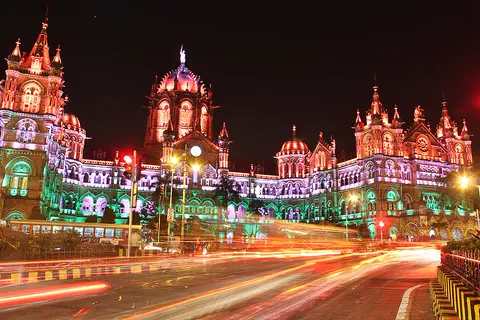
Every working day, Mumbai's dabbawalas collect home-cooked lunches in metal tiffin boxes, carry them by bicycle, on foot and on the city's local trains, and deliver them to offices by lunchtime. Colored letters, numbers and symbols painted on each box tell them where it goes, and the empty boxes travel home in the afternoon.
- Watch Life around the world Living root bridges of Meghalaya In the hills of Meghalaya, in northeast India, Khasi and Jaintia villagers guide the hanging roots of rubber fig trees across streams on bamboo frames. Over many years the roots take hold, thicken and grow together into living bridges that can carry people across rivers swollen by monsoon rain.
For parents & teachers
What children will learn
- Describe how hills, little flat land and housing shape life in Hong Kong.
- Read simple land-use and housing statistics.
- Describe how escalators, ferries and trains help people move around a hilly city.
- Discuss the balance between building homes and protecting green land.
Recommended ages: 4 to 12 · About 12 minutes
Talk about it
- Would you like to live on a high floor of a tall building? What would be good or hard about it?
- Why might a city keep its hills as parks instead of building on them?
- How do people in your town get up hills or across water?
Try at home or in class
- Use the same 20 building blocks to make a low, wide 'town' and then a tall tower: compare how much floor space each covers.
- Draw a cross-section of a hillside with towers at the bottom, an escalator up the slope and a park at the top.
Key vocabulary: flat, high-rise, public housing, reclamation, harbor, density
Where these facts come from
- Provisional figure of Hong Kong population at mid-2026 (press release, 18 August 2026) , Census and Statistics Department, Hong Kong SAR Government
- Welcome Message from the Secretary for Development , Development Bureau, Hong Kong SAR Government
- Housing in Figures 2025 , Hong Kong Housing Authority
- Central to Mid-Levels Escalator and Walkway System , Transport Department, Hong Kong SAR Government
- Annual Report 2025: Hong Kong Transport Services , MTR Corporation
- Star Ferry , The "Star" Ferry Company, Limited
- Hong Kong , Encyclopaedia Britannica
- Hong Kong: Settlement patterns , Encyclopaedia Britannica
Checked, not yet human-reviewed. Last updated October 24, 2026. Spotted a mistake? Tell us.