
Landmark Asia
Dome of the Rock
The Dome of the Rock is a building with a shining gold dome in Jerusalem. It has eight sides. Its walls are covered with beautiful patterns.
The Dome of the Rock stands on a wide raised plaza in the Old City of Jerusalem. It was finished in 691 or 692, about 1,330 years ago, which makes it the oldest Islamic monument still standing. Its eight walls are covered in marble and mosaics, and its gilded dome, about 20 meters across, covers a large rock that is deeply important to Muslims.
Built by the Umayyad caliph Abd al-Malik and dated by its own inscription to 72 AH (691 to 692 CE), the Dome of the Rock is, Britannica says, the oldest extant Islamic monument. An octagon with a gilded dome on a drum over a ring of 16 piers and columns, it rises over an exposed rock near the center of the plaza known to Muslims as al-Haram al-Sharif and to Jews as the Temple Mount.
Photo: Andrew Shiva / Wikipedia, CC BY-SA 4.0, via Wikimedia Commons
Discover the Dome of the Rock
The Dome of the Rock is in Jerusalem, a very old city on hills.
It stands on a big, flat plaza. Its dome shines like gold in the sun. Its eight walls are blue, white and full of patterns. It is very important to Muslims, and the plaza is very important to Jews too.
The Dome of the Rock stands near the center of a wide raised plaza in the Old City of Jerusalem, the walled oldest part of the city. Muslims call the plaza al-Haram al-Sharif, 'the Noble Sanctuary'. Jews call it the Temple Mount, because the ancient Jewish Temple once stood there.
The building is a shrine, a holy place built around something special: here, a large rock. UNESCO counts it among the 220 historic monuments of the Old City, and says it stands out among them.
Britannica describes the Dome of the Rock as a shrine near the center of a flat, elevated plaza known to Muslims as al-Haram al-Sharif ('The Noble Sanctuary') and to Jews as the Temple Mount, the site of the Temple of Jerusalem. Al-Aqsa Mosque stands at the plaza's southern end, and the name Al-Aqsa is often extended to the whole plaza, including the Dome of the Rock.
UNESCO inscribed the Old City of Jerusalem and its Walls in 1981 and notes that among its 220 historic monuments the Dome of the Rock stands out, a 7th-century building decorated with geometric and floral motifs. The Old City has been on the List of World Heritage in Danger since 1982.
- Completed
- 691 to 692 (72 AH, dated by its inscription)
- Built by
- the Umayyad caliph Abd al-Malik
- Dome
- about 20 m (65 ft) across, gilded
- World Heritage Site
- Old City of Jerusalem and its Walls, 1981
The oldest Islamic monument
The Dome of the Rock was built a very long time ago.
A ruler called Abd al-Malik had it made, more than 1,300 years ago. It is the oldest Islamic building still standing in the world.
The Dome of the Rock was built by Abd al-Malik, a caliph of the Umayyad family. A caliph was a ruler of the Muslim world. An inscription inside the building gives its date in the Islamic calendar, the year 72, which is 691 or 692 in the calendar used in most countries today.
Britannica calls it the oldest Islamic monument still standing. In the early 700s, in the time of Abd al-Malik's son, the caliph al-Walid I, Al-Aqsa Mosque was built at the southern end of the same plaza.
An inscription within the building dates it to 72 AH (691 to 692 CE), generally taken as the completion date; Britannica calls it the oldest extant Islamic monument. It was built by the Umayyad caliph Abd al-Malik ibn Marwan, whose son al-Walid I (reigned 705 to 715), Britannica notes, had mosques built at Medina and Jerusalem.
Britannica places the building's structure and ornament within the Byzantine architectural tradition, while seeing its construction as an early stage in the emergence of a distinct Islamic visual style. Britannica's main entry dates it to the late 7th century, and its account of the building's history gives the inscription's date of 72 AH as the generally accepted completion date. Later Islamic dynasties renovated the decoration several times, but the original structure survives.
An octagon under a golden dome
The building has eight sides, all the same.
In the middle, a big round dome sits on a ring of pillars. Under the dome is a large rock. Steps lead down to a little cave under the rock.
The outside walls form an octagon, a shape with eight equal sides. Each side is about 18 meters wide and 11 meters high, with many windows.
Inside, a ring of 16 pillars and columns holds up a tall drum, a round wall, and on top sits the gilded wooden dome, about 20 meters across. Around this ring runs a second, eight-sided ring of 24 pillars and columns, making a walkway around the middle. Under the dome, part of the rock is uncovered and protected by a railing, and a stairway leads down to a natural cave beneath it.
Britannica describes an octagonal base topped by a gilded wooden central dome about 65 ft (20 m) in diameter, mounted on an elevated drum above a circle of 16 piers and columns. Around this circle runs an octagonal arcade of 24 piers and columns. The outer walls also form an octagon, each of the eight sides about 60 ft (18 m) wide and 36 ft (11 m) high, and both the dome and the walls contain many windows.
Beneath the dome a portion of the rock is exposed and protected by a railing; a stairway leads to a natural cave below the rock's surface.
Mosaics, marble and writing
The walls are covered in marble and tiny colored pieces called mosaics.
The mosaics show plants, jewels, crowns and beautiful writing. There are no pictures of people or animals at all.
Inside and out, the Dome of the Rock is decorated with marble, mosaics and metal plaques. A mosaic is a picture made from many small pieces of colored glass or stone.
The mosaics were made with the same skills used in Byzantine buildings of the time, but they show no people or animals. Instead, they show Arabic writing, plant patterns, and pictures of jewels and crowns. Long lines of Arabic writing with religious words run around the arcade inside. UNESCO describes the decoration as beautiful geometric and floral patterns.
Britannica notes marble, mosaics and metal plaques inside and out. The mosaics resemble in technique those of Byzantine public buildings and churches but exclude any human or animal forms, combining Arabic script and vegetal patterns with images of jewels and crowns; Arabic religious inscriptions run around the octagonal arcade, and an inscription in the building carries the 72 AH date.
UNESCO singles out the building's geometric and floral motifs. Britannica sees in this combination of Byzantine technique and Islamic ornament an early stage of a distinct Islamic visual style.
- Outer walls
- 8 sides, each about 18 m wide and 11 m high
- Inner ring
- 16 piers and columns
- Octagonal arcade
- 24 piers and columns
A shrine important to many
Many people care about this place.
For Muslims, the rock under the dome is very special. For Jews, the plaza is very special too. It is a place to treat with care and respect.
The Dome of the Rock is an Islamic shrine. In Muslim tradition, the rock is linked with the Prophet Muhammad's journey into heaven, called the Mi'raj. For Jews, the plaza is the Temple Mount, where the ancient Temple of Jerusalem stood. UNESCO notes that Jews, Christians and Muslims all link the site with Abraham.
The plaza is looked after by an Islamic trust, called a waqf. UNESCO lists the Old City of Jerusalem as a World Heritage Site, and has listed it as in danger since 1982.
Britannica records that, according to Muslims, the rock beneath the dome is the spot from which the Prophet Muhammad was taken up into heaven (the Mi'raj), and that the nearby Al-Aqsa Mosque is associated with his Night Journey (the Isra). For Jews, the plaza is the Temple Mount, site of the Temple of Jerusalem. UNESCO describes Jerusalem as a holy city of Judaism, Christianity and Islam and notes that all three recognize the site of the Dome as associated with Abraham.
Britannica notes that the plaza is under the custodianship of an Islamic trust (waqf) maintained by the Hashemite dynasty of Jordan, and that it has become a point of tension in modern times. UNESCO has listed the Old City of Jerusalem and its Walls as World Heritage in Danger since 1982.
Amazing facts
-
The building tells us its own date!
An inscription inside the building gives the year it was made: 72 in the Islamic calendar, which is 691 or 692.
An inscription dates the building to 72 AH (691 to 692 CE), generally taken as its completion date.
-
There is a little cave under the rock.
Under the dome, a stairway leads down to a natural cave beneath the rock.
A stairway descends to a natural cave beneath the exposed surface of the rock.
-
The mosaics have no people or animals in them.
The mosaics show plants, jewels, crowns and Arabic writing, but no people or animals.
The mosaics exclude human and animal forms, using Arabic script, vegetal patterns, jewels and crowns.
-
The dome is made of wood covered in gold.
The famous golden dome is a wooden dome covered in gilding, about 20 meters across.
The central dome is a gilded wooden structure about 20 m in diameter.
Words to know
- shrine
- a holy place, often built around something special
- octagon
- a shape with eight sides
- mosaic
- a picture or pattern made from many small pieces of colored glass or stone
- caliph
- a ruler of the Muslim world in early Islamic times
- gilded
- covered with a thin layer of gold
- inscription
- words carved or written on a building or object
Discovery challenge
-
How many sides does the Dome of the Rock have?
How many sides do the outer walls of the Dome of the Rock have?
What shape do the outer walls of the Dome of the Rock form?
- Four sides, a square
- Eight sides, an octagon
- Three sides, a triangle
Show the answer
Eight sides, an octagon
Eight sides! That shape is called an octagon.
Eight sides, each about 18 meters wide: an octagon.
An octagon, each side about 18 m wide and 11 m high.
-
What color is the dome?
What covers the famous dome of the Dome of the Rock?
What finish covers the wooden central dome?
- Gold
- Green grass
- Red tiles
Show the answer
Gold
Gold! It shines in the sun.
It is gilded, covered with a thin layer of gold.
Gilding, over a wooden dome about 20 m across.
-
What do the mosaics show?
What do the Dome of the Rock's mosaics show?
Which subjects make up the mosaics, which exclude human and animal forms?
- People and animals
- Plants, jewels, crowns and writing
- Ships and maps
Show the answer
Plants, jewels, crowns and writing
Plants, jewels, crowns and beautiful writing!
Plants, jewels, crowns and Arabic writing, but no people or animals.
Arabic script, vegetal patterns, jewels and crowns.
-
About how old is the Dome of the Rock?
About how old is the Dome of the Rock?
When was the Dome of the Rock completed, according to its inscription?
- About 100 years
- About 1,330 years
- About 5,000 years
Show the answer
About 1,330 years
About 1,330 years! It is very, very old.
It was finished in 691 or 692, about 1,330 years ago.
In 72 AH, 691 to 692 CE, about 1,330 years ago.
Nearby places
-
 Watch
Landmark
Western Wall
The Western Wall, in the Old City of Jerusalem, is the only remaining part of the huge wall that once held up the platform of the ancient Jewish Temple. More than 2,000 years old, it is a place of prayer and pilgrimage for Jewish people, and visitors come from all over the world.
-
 Watch
Landmark
Al-Aqsa Mosque
Al-Aqsa Mosque stands at the southern end of a huge raised plaza in the Old City of Jerusalem. Built in the early 700s, it has a silver-gray dome, and the golden Dome of the Rock stands nearby. The plaza is important to Muslims and to Jews.
-
 Watch
City
Jerusalem
Jerusalem is one of the oldest cities in the world, built on hills in the Middle East. Inside the walls of its Old City stand places that are deeply important to Jews, Christians and Muslims, and pilgrims and visitors come from all over the world.
-
 Watch
Natural wonder
Dead Sea
The Dead Sea is a salt lake in the Middle East, with Jordan on its eastern shore and the Palestinian West Bank along part of its western shore. Its surface lies far below sea level, about 435 meters down in 2019, and its water is nearly ten times saltier than the ocean, so swimmers bob on top without trying.
-
 Watch
Natural wonder
Negev
The Negev is a dry region in the Middle East, shaped like a triangle with its point at the Red Sea. Its name comes from a Hebrew word meaning to dry. It has huge craters called makhteshim, carved by erosion, ancient towns on an old incense trade route, and farms watered by pipelines.
-
 Watch
Landmark
Petra
Petra, in southern Jordan, was the capital of the Nabataeans, who grew rich from trade in incense and spices. Many of its tombs and monuments are carved straight into red sandstone cliffs, and a narrow gorge called the Siq leads to its most famous facade, the Treasury.
-
 Watch
City
Damascus
Damascus, the capital of Syria, grew beside a river in a green oasis at the edge of the desert. People have lived there for thousands of years, and many scholars think it may be the oldest city in the world that has been lived in all the time. Its walled Old City, with its Great Mosque, markets and courtyard houses, is a UNESCO World Heritage Site.
-
Watch
Landmark
Umayyad Mosque
The Umayyad Mosque, also called the Great Mosque of Damascus, was built between 705 and 715 by the ruler al-Walid I. Britannica calls it the earliest stone mosque still standing. It is one of the largest mosques in the world, with a vast courtyard, a long prayer hall and walls that once shone with mosaics.
Explore next
-
Watch
City
Jerusalem
Jerusalem is one of the oldest cities in the world, built on hills in the Middle East. Inside the walls of its Old City stand places that are deeply important to Jews, Christians and Muslims, and pilgrims and visitors come from all over the world.
-
Watch
Landmark
Al-Aqsa Mosque
Al-Aqsa Mosque stands at the southern end of a huge raised plaza in the Old City of Jerusalem. Built in the early 700s, it has a silver-gray dome, and the golden Dome of the Rock stands nearby. The plaza is important to Muslims and to Jews.
-
 Watch
Landmark
Hagia Sophia
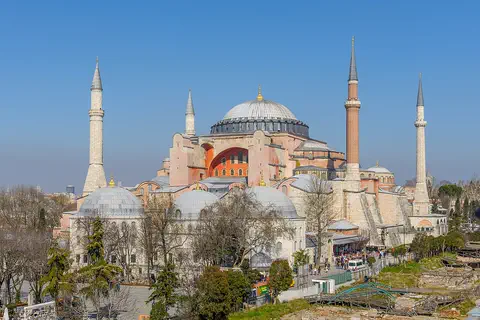
Hagia Sophia in Istanbul was built in under six years, from 532 to 537, for the emperor Justinian. Its enormous dome seems to float on a ring of 40 windows. Over almost 1,500 years it has been a church, a mosque and a museum, and since 2020 it has been a mosque.
-
 Watch
Landmark
Sultan Ahmed Mosque
The Sultan Ahmed Mosque in Istanbul was built between 1609 and about 1616 for the Ottoman ruler Sultan Ahmed I. Its central dome is ringed by half-domes and smaller domes, and six slender minarets rise around it. Many people call it the Blue Mosque because of the blue and green tiles and painted decoration inside. It is still a working mosque, where Muslims come to pray.
-
 Watch
Landmark
Samarra
Samarra, on the Tigris River in Iraq, was the capital of the Abbasid caliphs, rulers of a huge Islamic empire, from 836 to 892. In that short time they built enormous mosques, palaces, canals and even racecourses. Because the city was left so early, its plan survives, and its Great Mosque still has a famous spiral minaret.
-
Watch
Landmark
Western Wall
The Western Wall, in the Old City of Jerusalem, is the only remaining part of the huge wall that once held up the platform of the ancient Jewish Temple. More than 2,000 years old, it is a place of prayer and pilgrimage for Jewish people, and visitors come from all over the world.
- Watch Geography What is a World Heritage Site? World Heritage Sites are places so important that they belong, in a way, to everyone. Under a 1972 agreement, countries nominate their most outstanding places, experts check them, and a UNESCO committee decides. By 2026 the list held 1,273 sites: cultural places like the Taj Mahal, natural places like the Galápagos, and mixed ones like Machu Picchu.
-
 Watch
Landmark
Prophet's Mosque
The Prophet's Mosque in Medina, Saudi Arabia, began as the simple home and courtyard of the Prophet Muhammad, who helped build it after he came to Medina in 622. Rebuilt and enlarged many times, it now has a famous green dome over Muhammad's tomb, ten minarets and room for up to a million worshippers at the busiest times.
For parents & teachers
What children will learn
- Locate the Dome of the Rock in the Old City of Jerusalem and describe its octagonal plan and gilded dome.
- Explain that it is the oldest Islamic monument still standing, completed in 691 to 692.
- Describe its mosaics and why they show writing and plants rather than people or animals.
- Recognize that the plaza is important to more than one faith and is known by different names.
Recommended ages: 3 to 17 · About 15 minutes
Talk about it
- The same plaza has two names, al-Haram al-Sharif and the Temple Mount. Why might people use different names for one place?
- The mosaics use writing and patterns instead of pictures of people. How can writing be a kind of art?
- How can we show respect for places that are important to other people's faiths?
Try at home or in class
- Fold a paper square into an octagon (cut off the corners) and decorate it with a repeating plant pattern, like the Dome of the Rock's walls.
- Make a small mosaic by gluing paper squares of different colors onto card to form a pattern of leaves or stars.
Key vocabulary: shrine, octagon, mosaic, caliph, gilded, inscription
Where these facts come from
- Wikidata , Wikimedia Foundation (CC0 1.0)
- Dome of the Rock , Encyclopaedia Britannica
- Dome of the Rock: Historical context and construction , Encyclopaedia Britannica
- Al-Aqsa Mosque , Encyclopaedia Britannica
- al-Walid I , Encyclopaedia Britannica
- Old City of Jerusalem and its Walls , UNESCO World Heritage Centre
- Wikimedia Commons , Wikimedia Foundation (Per file (public domain, CC0, CC BY or CC BY-SA); see each media record)
Checked, not yet human-reviewed. Last updated October 27, 2026. Spotted a mistake? Tell us.