
Landmark Asia
Western Wall
The Western Wall is a very old stone wall in Jerusalem. It is a special place where many Jewish people come to pray. A big open square lies in front of it.
The Western Wall, in the Old City of Jerusalem, is the only remaining part of the huge wall that once held up the platform of the ancient Jewish Temple. More than 2,000 years old, it is a place of prayer and pilgrimage for Jewish people, and visitors come from all over the world.
The Western Wall (ha-Kotel ha-Ma'aravi) is the sole surviving section of the retaining wall around the Temple Mount, site of the First and Second Temples. Part of the walled Old City of Jerusalem, a World Heritage Site since 1981, it has been a center of Jewish prayer and pilgrimage for many centuries.
Photo: Ludvig14, CC BY-SA 4.0, via Wikimedia Commons
Discover the Western Wall
The Western Wall is in Jerusalem, a very old city.
It is made of big, pale stones stacked high. Many Jewish people come here to pray. Some push little notes into the cracks between the stones.
The Western Wall stands in the Old City of Jerusalem, the walled oldest part of the city. Above it rises a wide, raised platform that Jews call the Temple Mount, because the ancient Jewish Temple stood there. Muslims call the same platform al-Haram al-Sharif, and it holds the Dome of the Rock and Al-Aqsa Mosque.
The wall was built to hold up the side of that platform. Today it is a place of prayer and pilgrimage that is sacred to Jewish people. The part you can see is about 50 meters long and 20 meters high, and more of it lies hidden underground.
Britannica describes the Western Wall as a place of prayer and pilgrimage sacred to the Jewish people and the only remains of the retaining wall surrounding the Temple Mount (Har Ha-Bayit), the site of the First and Second Temples. The same raised platform is known to Muslims as al-Haram al-Sharif, "the Noble Sanctuary," holding the Dome of the Rock and Al-Aqsa Mosque.
As seen today, the wall measures about 50 m (160 ft) long and about 20 m (60 ft) high, but it extends much deeper into the earth. It stands within the Old City of Jerusalem, which UNESCO inscribed in 1981 as a holy city for Judaism, Christianity and Islam, counting 220 historic monuments, and which it has listed as World Heritage in Danger since 1982.
- Where
- The Old City of Jerusalem, below the Temple Mount
- Size seen today
- about 50 m long, about 20 m high
- What it is
- The last part of the Temple Mount's retaining wall
- World Heritage
- Old City of Jerusalem and its Walls (1981)
A wall from the time of the Temple
Long, long ago, a great temple stood on the hill above the wall.
The temple was destroyed a very long time ago. But this part of the wall around it is still standing. People have come to pray here for many hundreds of years.
About 2,000 years ago, King Herod the Great rebuilt the Jewish Temple in Jerusalem. His builders made the hilltop platform around it twice as big and surrounded it with a strong wall. In the year 70, Roman soldiers destroyed the Temple, but this western part of the wall survived.
Jewish people have prayed here since the early Byzantine period, many centuries ago. European travelers who saw people mourning the lost Temple here called it the "Wailing Wall." Many people today call it the Kotel.
The First Temple was destroyed by the Babylonians in 587 to 586 BCE; the Second Temple was completed in 515 BCE. Britannica's article on the Temple of Jerusalem records that Herod the Great began rebuilding it in 20 BCE, in work that lasted 46 years: the area of the Temple Mount was doubled and surrounded by a retaining wall with gates. The Romans destroyed the Second Temple in 70 CE. Britannica's Western Wall article dates the wall to about the 2nd century BCE, with upper sections added later.
Jewish devotions at the wall date from the early Byzantine period. Britannica notes that Arab and Jewish sources agree that after the Arab capture of Jerusalem in 638, Jews led the new rulers to the Temple yard and helped clear away debris. The name "Wailing Wall" was coined by European travelers. Because the wall is part of the larger wall enclosing the Dome of the Rock and Al-Aqsa Mosque, Britannica notes, control of it and access to it have often been disputed.
Holding up a mountain of stone
The wall was built to hold up the side of a big, flat hilltop.
Builders stacked huge blocks of limestone, one row on top of another. Later, more rows were added on top.
The Western Wall is a retaining wall. That means it holds back and supports a mass of earth and stone behind it, like the side of a giant box. Herod's builders made the platform on top much bigger, so they needed very strong walls all around it.
The wall is built of limestone blocks. The lower rows are the oldest, and the upper rows were added much later. The wall also goes down far below today's ground level, so what visitors see is only the top part.
As a retaining wall, the Western Wall supported the enlarged platform of Herod's Temple Mount, whose area, Britannica says, was doubled; the Temple itself was raised, enlarged and faced with white stone. The wall is of limestone (Wikidata). Britannica's Western Wall article notes that its upper sections were added at a later date, and that below the visible face the wall extends much deeper into the earth.
The Old City around it is itself layered: Britannica describes the present city wall, built in 1538 to 1540 by the Ottoman sultan Suleyman the Magnificent, as standing largely on earlier foundations, chiefly Crusader but in places Byzantine, Herodian and even Hasmonean.
The plaza, the prayer area and the notes
In front of the wall is a big open square called a plaza.
People stand close to the wall to pray. Many write a wish or a prayer on a little paper. Then they push it into a crack in the wall.
A large open plaza spreads out in front of the wall. Right beside the wall is the prayer area, where people stand close to the ancient stones.
For a long time, people have followed a custom of writing wishes or prayers on slips of paper and pushing them into the cracks between the stones. The plaza also has room for very large gatherings.
Britannica describes the long-standing custom of pushing slips of paper bearing wishes or prayers into the wall's cracks, and notes that Jews pray there lamenting the destruction of the Temple and for its restoration. The open plaza in front of the wall holds large gatherings; the photograph shows the prayer area along the foot of the wall and the open plaza behind it.
UNESCO's description of the Old City names the wall alongside the Dome of the Rock and the Church of the Holy Sepulchre, writing that the Wailing Wall delimits the quarters of the different religious communities.
- Built as
- A retaining wall for the Temple Mount platform
- Visible length
- about 50 m (160 ft)
- Visible height
- about 20 m (60 ft)
- Material
- Limestone
The Western Wall today
Today, many people come to the wall.
Some come to pray. Others come to look and learn about its long history.
People come to the Western Wall to pray, and visitors come to see it and learn its history. Sometimes very large gatherings fill the plaza.
It is part of the Old City of Jerusalem, which UNESCO made a World Heritage Site in 1981 because it is a holy city for Judaism, Christianity and Islam. Since 1982, UNESCO has also listed the Old City as World Heritage in Danger, meaning its old buildings need special care.
The wall remains, in Britannica's words, a place of prayer and pilgrimage sacred to the Jewish people, and a site of large public gatherings. It forms part of the larger wall around the platform that holds the Dome of the Rock and Al-Aqsa Mosque.
UNESCO inscribed the Old City of Jerusalem and its Walls in 1981 and has listed it as World Heritage in Danger since 1982. Britannica describes the Old City as continuously inhabited for almost 5,000 years, a walled quadrilateral about 900 m on each side, with Armenian, Christian, Jewish and Muslim quarters.
Amazing facts
-
People push little paper notes into the cracks of the wall.
It has long been a custom to write wishes or prayers on slips of paper and push them into the wall's cracks.
Slips of paper bearing wishes or prayers are pushed into the wall's cracks, a long-standing custom.
-
Much of the wall is hidden underground.
The part you can see is about 20 meters high, but the wall goes much deeper into the ground.
The exposed face is about 20 m high, but the wall extends much deeper into the earth.
-
King Herod made the hilltop twice as big.
Herod's builders doubled the size of the Temple Mount platform and worked for 46 years.
Herod's rebuilding, begun in 20 BCE, lasted 46 years and doubled the area of the Temple Mount.
-
The name "Wailing Wall" came from travelers.
European travelers who saw people mourning the lost Temple here gave it the name "Wailing Wall."
"Wailing Wall" and similar terms were coined by European travelers who witnessed mourning vigils at the wall.
Words to know
- retaining wall
- a strong wall that holds back earth or stone behind it
- temple
- a building used for worship
- pilgrimage
- a journey to a place that is important to a person's religion
- plaza
- a large open public square
- limestone
- a pale rock that can be cut into building blocks
- Old City
- the oldest part of Jerusalem, inside its ancient walls
Discovery challenge
-
Which city is the Western Wall in?
In which city's Old City does the Western Wall stand?
In which walled Old City, a World Heritage Site since 1981, does the Western Wall stand?
- Rome
- Jerusalem
- Cairo
Show the answer
Jerusalem
Jerusalem! It is a very old city.
The Western Wall is in the Old City of Jerusalem.
The Old City of Jerusalem and its Walls, inscribed by UNESCO in 1981.
-
What job did the wall do?
What was the Western Wall built to do?
What structural role did the Western Wall play in Herod's Temple Mount?
- Hold up the side of a big platform
- Keep out the sea
- Hold up a bridge
Show the answer
Hold up the side of a big platform
It held up the side of the big, flat hilltop.
It is a retaining wall that held up the side of the Temple Mount platform.
A retaining wall around the enlarged Temple Mount; the Western Wall is its only surviving section.
-
What do many people push into the cracks?
What custom do many visitors follow at the wall?
Which long-standing custom involves the wall's cracks?
- Coins
- Paper notes
- Flowers
Show the answer
Paper notes
Little paper notes with wishes or prayers.
People write wishes or prayers on slips of paper and push them into the cracks.
Slips of paper bearing wishes or prayers are placed in the cracks.
-
About how tall is the part of the wall we can see?
About how high is the part of the Western Wall that you can see today?
What height does Britannica give for the wall's exposed face?
- About 2 meters
- About 20 meters
- About 200 meters
Show the answer
About 20 meters
About 20 meters. And more is hidden underground!
About 20 meters high and 50 meters long, with more below the ground.
About 20 m (60 ft) high and 50 m (160 ft) long; it extends much deeper into the earth.
Nearby places
-
 Watch
Landmark
Dome of the Rock
The Dome of the Rock stands on a wide raised plaza in the Old City of Jerusalem. It was finished in 691 or 692, about 1,330 years ago, which makes it the oldest Islamic monument still standing. Its eight walls are covered in marble and mosaics, and its gilded dome, about 20 meters across, covers a large rock that is deeply important to Muslims.
-
 Watch
Landmark
Al-Aqsa Mosque
Al-Aqsa Mosque stands at the southern end of a huge raised plaza in the Old City of Jerusalem. Built in the early 700s, it has a silver-gray dome, and the golden Dome of the Rock stands nearby. The plaza is important to Muslims and to Jews.
-
 Watch
City
Jerusalem
Jerusalem is one of the oldest cities in the world, built on hills in the Middle East. Inside the walls of its Old City stand places that are deeply important to Jews, Christians and Muslims, and pilgrims and visitors come from all over the world.
-
 Watch
Natural wonder
Dead Sea
The Dead Sea is a salt lake in the Middle East, with Jordan on its eastern shore and the Palestinian West Bank along part of its western shore. Its surface lies far below sea level, about 435 meters down in 2019, and its water is nearly ten times saltier than the ocean, so swimmers bob on top without trying.
-
 Watch
Natural wonder
Negev
The Negev is a dry region in the Middle East, shaped like a triangle with its point at the Red Sea. Its name comes from a Hebrew word meaning to dry. It has huge craters called makhteshim, carved by erosion, ancient towns on an old incense trade route, and farms watered by pipelines.
-
 Watch
Landmark
Petra
Petra, in southern Jordan, was the capital of the Nabataeans, who grew rich from trade in incense and spices. Many of its tombs and monuments are carved straight into red sandstone cliffs, and a narrow gorge called the Siq leads to its most famous facade, the Treasury.
-
 Watch
City
Damascus
Damascus, the capital of Syria, grew beside a river in a green oasis at the edge of the desert. People have lived there for thousands of years, and many scholars think it may be the oldest city in the world that has been lived in all the time. Its walled Old City, with its Great Mosque, markets and courtyard houses, is a UNESCO World Heritage Site.
-
Watch
Landmark
Umayyad Mosque
The Umayyad Mosque, also called the Great Mosque of Damascus, was built between 705 and 715 by the ruler al-Walid I. Britannica calls it the earliest stone mosque still standing. It is one of the largest mosques in the world, with a vast courtyard, a long prayer hall and walls that once shone with mosaics.
Experiments to try
Explore next
-
Watch
City
Jerusalem
Jerusalem is one of the oldest cities in the world, built on hills in the Middle East. Inside the walls of its Old City stand places that are deeply important to Jews, Christians and Muslims, and pilgrims and visitors come from all over the world.
-
Watch
Landmark
Dome of the Rock
The Dome of the Rock stands on a wide raised plaza in the Old City of Jerusalem. It was finished in 691 or 692, about 1,330 years ago, which makes it the oldest Islamic monument still standing. Its eight walls are covered in marble and mosaics, and its gilded dome, about 20 meters across, covers a large rock that is deeply important to Muslims.
-
Watch
Landmark
Al-Aqsa Mosque
Al-Aqsa Mosque stands at the southern end of a huge raised plaza in the Old City of Jerusalem. Built in the early 700s, it has a silver-gray dome, and the golden Dome of the Rock stands nearby. The plaza is important to Muslims and to Jews.
- Watch Geography What is a World Heritage Site? World Heritage Sites are places so important that they belong, in a way, to everyone. Under a 1972 agreement, countries nominate their most outstanding places, experts check them, and a UNESCO committee decides. By 2026 the list held 1,273 sites: cultural places like the Taj Mahal, natural places like the Galápagos, and mixed ones like Machu Picchu.
- Watch Try it What If? Lab What if buildings had different foundations? A building's whole weight presses down through its foundation onto the ground. A wide foundation spreads that weight out, like snowshoes on snow. In our model, a 200-tonne building on sand is safe on a 40-square-meter footing. Shrink the footing to 8 square meters and it presses five times harder, more than the sand can take, so the building would sink and could crack or tilt.
-
 Watch
Landmark
Agra Fort
Agra Fort is a huge red sandstone fortress beside the Yamuna River in Agra, India. The Mughal emperor Akbar began it in 1565. Its walls, about 2.5 kilometers around, protect palaces, halls and mosques added by later emperors. It was both an army base and a royal home.
-
 Watch
Landmark
Al-Masjid al-Haram
Al-Masjid al-Haram, the Great Mosque of Mecca in Saudi Arabia, was built around the Kaaba, a cube-shaped building that Muslims face when they pray. It is the most important place of pilgrimage in Islam. In 2026, 1,707,301 pilgrims came to Mecca for the hajj, and the mosque can hold up to about one million worshippers.
-
 Watch
Landmark
Angkor
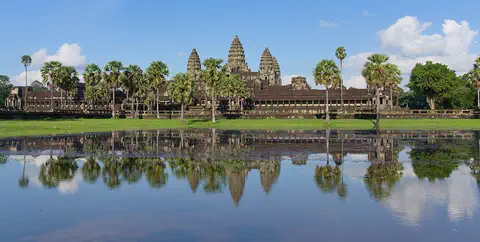
Angkor, in northwestern Cambodia, was the capital of the Khmer Empire from the 9th to the 15th century. Its kings built city after city here, with scores of temples, such as Angkor Wat and the Bayon, and giant reservoirs and canals to water the rice fields. Today it covers about 400 square kilometers, and more than 100,000 people live in villages inside it.
For parents & teachers
What children will learn
- Locate the Old City of Jerusalem and describe the Western Wall as the last part of the Temple Mount's retaining wall.
- Explain what a retaining wall does and how Herod's builders enlarged the platform.
- Describe the wall as a place of prayer and pilgrimage and its custom of written notes.
- Discuss how one place can be important to several religions and why visitors are asked to be respectful.
Recommended ages: 3 to 17 · About 15 minutes
Talk about it
- Why do you think a wall that is more than 2,000 years old is still standing?
- Jerusalem is a holy city for Judaism, Christianity and Islam. How can people show respect when visiting places that are special to others?
- People leave written wishes in the wall. Where else do people leave messages, and why?
Try at home or in class
- Build a slope of damp sand, then hold it up with a wall of blocks: see how a retaining wall keeps the sand from sliding.
- Measure 20 meters on a sidewalk or field with a tape measure or by counting steps, and imagine a wall that tall.
Key vocabulary: retaining wall, temple, pilgrimage, plaza, limestone, Old City
Where these facts come from
- Wikidata , Wikimedia Foundation (CC0 1.0)
- Western Wall , Encyclopaedia Britannica
- Temple of Jerusalem , Encyclopaedia Britannica
- Jerusalem , Encyclopaedia Britannica
- Jerusalem: Landscape , Encyclopaedia Britannica
- Old City of Jerusalem and its Walls , UNESCO World Heritage Centre
- Wikimedia Commons , Wikimedia Foundation (Per file (public domain, CC0, CC BY or CC BY-SA); see each media record)
Checked, not yet human-reviewed. Last updated October 28, 2026. Spotted a mistake? Tell us.