
Landmark Asia
Al-Aqsa Mosque
Al-Aqsa Mosque is an old mosque in Jerusalem. It has a silver-gray dome and a big stone porch with arches. It stands on a wide stone plaza.
Al-Aqsa Mosque stands at the southern end of a huge raised plaza in the Old City of Jerusalem. Built in the early 700s, it has a silver-gray dome, and the golden Dome of the Rock stands nearby. The plaza is important to Muslims and to Jews.
Al-Aqsa Mosque, built in the early 8th century, stands at the southern end of the raised platform that Muslims call al-Haram al-Sharif and Jews call the Temple Mount, in the Old City of Jerusalem, a UNESCO World Heritage Site since 1981. Britannica reports that the plaza is under the custodianship of an Islamic trust (waqf) maintained by Jordan's Hashemite dynasty.
Photo: Andrew Shiva / Wikipedia, CC BY-SA 4.0, via Wikimedia Commons
Discover Al-Aqsa Mosque
Al-Aqsa Mosque is in Jerusalem, a very old city. A mosque is a building where Muslims pray.
It stands on a big, flat stone plaza. It has a silver-gray dome on top. In front, there is a long porch with big arches.
Al-Aqsa Mosque stands in the Old City of Jerusalem, the walled oldest part of the city. It is at the southern end of a wide raised platform. Muslims call this platform al-Haram al-Sharif, "the Noble Sanctuary." Jews call it the Temple Mount, because the ancient Jewish Temple once stood there.
The main building, with its silver-gray dome, is the one in the photo. People often use the name Al-Aqsa for the whole plaza too, which also holds the golden Dome of the Rock. The plaza is important to Muslims and to Jews, and the Old City is a UNESCO World Heritage Site.
The mosque occupies the southern end of the raised platform that dominates the Old City, known to Muslims as al-Haram al-Sharif ("the Noble Sanctuary") and in Hebrew as Har Ha-Bayit, the Temple Mount, the site of the First and Second Temples. Britannica notes that the term Al-Aqsa Mosque is often extended to the whole plaza, which also holds the Dome of the Rock; the prayer hall in the photograph is often called the Qibli Mosque.
In Islamic tradition the mosque is linked with the Prophet Muhammad's Night Journey; the plaza also holds significance for Jews as the site of the Temple, and the adjacent Western Wall has long been a place of Jewish pilgrimage. UNESCO inscribed the Old City of Jerusalem and its Walls in 1981, counting 220 historic monuments, and has listed it as World Heritage in Danger since 1982.
- Where
- The Old City of Jerusalem
- Built
- early 8th century
- Dome
- silver-gray
- UNESCO World Heritage
- Old City of Jerusalem and its Walls, 1981
Built in the early 700s
Al-Aqsa Mosque was built long, long ago, about 1,300 years ago.
It was built close to another famous building with a golden dome, the Dome of the Rock. Both stand on the same big plaza.
Al-Aqsa Mosque was built in the early 700s, about 1,300 years ago, during the time of the Umayyad caliphs. A caliph was a ruler of the Muslim world. The caliph al-Walid I, who ruled from 705 to 715, is known for the mosques built during his reign, including one in Jerusalem.
Just before that, his father, the caliph Abd al-Malik, had built the Dome of the Rock on the same plaza; it was finished in 691 or 692. Both buildings date from the time of the Umayyad caliphs, about 1,300 years ago.
Britannica dates the silver-domed mosque to the early 8th century; Wikidata gives a construction date of about 710. That falls within the reign of the Umayyad caliph al-Walid I (705 to 715), whom Britannica describes as best known for the mosques built in his reign, including mosques at Medina and Jerusalem. His father, Abd al-Malik, built the nearby Dome of the Rock, completed in 691 to 692 and described by Britannica as the oldest extant Islamic monument.
Britannica notes that parts of the platform's original supporting walls still stand on three sides, and that the Old City around it is believed to have been inhabited continuously for almost 5,000 years.
Stone, arches and a silver dome
The mosque is made of pale stone.
On top is a round dome. In front is a porch with tall pointed arches, where people can walk in. The windows have arches too.
The mosque is built of pale stone. Its dome looks silver-gray, and Britannica calls it the "silver-domed" mosque. Along the front runs a porch of tall pointed arches, and the long side walls have rows of arched windows.
The mosque sits on a huge raised platform, held up by massive old supporting walls. The Old City around it is surrounded by walls too, and forms a rough square about 900 meters on each side.
The building visible in the photograph combines a long stone prayer hall with a dome over its southern end and a porch of pointed arches across the north front, facing the plaza; side walls carry tiers of arched windows. Britannica's description of the mosque as "silver-domed" contrasts it with the "gold-capped" Dome of the Rock.
The platform beneath is a raised plaza: parts of its original supporting walls survive on three sides. The Old City it dominates is, according to Britannica, a walled quadrilateral about 900 m (3,000 ft) on each side, believed to have been inhabited continuously for almost 5,000 years.
The plaza and the Dome of the Rock
The big plaza has more than one building.
In the middle stands the Dome of the Rock, with its shining golden dome. It has eight sides, like a stop sign. Al-Aqsa Mosque is at one end of the plaza.
The plaza is a wide, flat space with trees, small domed buildings and arches. Near its center stands the Dome of the Rock, finished in 691 or 692. It has eight sides and a gilded dome about 20 meters across, and its walls are covered in marble and mosaics, pictures made of small colored pieces.
Al-Aqsa Mosque stands at the southern end of the plaza. From the air, you can see both buildings together, with the walled Old City all around.
The Dome of the Rock, near the center of the platform, has an octagonal plan whose sides are each about 18 m wide and 11 m high, beneath a gilded wooden dome about 20 m in diameter carried on a drum over a ring of 16 piers and columns. Its mosaics, Britannica notes, use Arabic script and plant patterns and no human or animal figures.
Al-Aqsa Mosque closes the southern end of the platform. Between them, the plaza holds smaller domed structures, arcades and trees. Seen from the air, the platform stands out as a vast open rectangle within the dense streets of the Old City.
- Dome of the Rock completed
- 691 to 692
- Dome of the Rock's dome
- about 20 m (65 ft) across
- Old City walls
- about 900 m on each side
- Historic monuments in the Old City
- 220

Who looks after it
Al-Aqsa Mosque is a place where Muslims pray.
A group of people called a waqf looks after the mosque and the plaza. It keeps the old buildings cared for.
Al-Aqsa Mosque is still a working mosque where Muslims come to pray. The mosque and its plaza are looked after by an Islamic trust, called a waqf, which is supported by the royal family of Jordan.
UNESCO protects the Old City of Jerusalem and its walls as a World Heritage Site and has listed it as World Heritage "in danger" since 1982.
Britannica explains the present arrangement: since 1967 the plaza has been under the custodianship of an Islamic trust (waqf) maintained by Jordan's Hashemite dynasty.
UNESCO has included the Old City of Jerusalem and its Walls on the List of World Heritage in Danger since 1982, the year after its inscription. The mosque remains an active place of worship.
Amazing facts
-
Jerusalem's Old City has walls all the way around it.
Jerusalem's Old City is surrounded by walls and forms a rough square about 900 meters on each side.
The Old City is a walled quadrilateral about 900 m (3,000 ft) on each side, believed to have been inhabited continuously for almost 5,000 years.
-
The Dome of the Rock nearby has a golden dome with eight sides below it.
The Dome of the Rock, on the same plaza, has eight sides and a gilded dome about 20 meters across.
The Dome of the Rock's gilded wooden dome, about 20 m in diameter, rises on a drum over an octagon whose sides are each about 18 m wide.
-
People often call the whole plaza Al-Aqsa.
The name Al-Aqsa Mosque is often used for the whole plaza, not just the building with the silver dome.
The term Al-Aqsa Mosque is often extended to the entire plaza, known formally as al-Haram al-Sharif.
-
UNESCO counts 220 old monuments in Jerusalem's Old City.
UNESCO counts 220 historic monuments inside Jerusalem's Old City, a World Heritage Site since 1981.
UNESCO's listing of the Old City of Jerusalem and its Walls (1981) counts 220 historic monuments and has been on the Danger list since 1982.
Words to know
- mosque
- a building where Muslims pray together
- dome
- a round roof shaped like half of a ball
- plaza
- a wide open space in a town, often paved with stone
- waqf
- an Islamic trust that owns and looks after property, such as a mosque, for the community
- caliph
- a ruler of the early Muslim world
- Old City
- the oldest part of a city, often inside ancient walls
Discovery challenge
-
Which city is Al-Aqsa Mosque in?
In which city does Al-Aqsa Mosque stand?
In which city's walled Old City does Al-Aqsa Mosque stand?
- Jerusalem
- Mecca
- Cairo
Show the answer
Jerusalem
Jerusalem! It is a very old city.
It stands in the Old City of Jerusalem, at the southern end of a great plaza.
Jerusalem: the mosque stands at the southern end of the Old City's raised platform.
-
What color is the mosque's dome?
What color is the dome of Al-Aqsa Mosque?
Britannica contrasts Al-Aqsa's dome with the gold-capped Dome of the Rock. What color is Al-Aqsa's?
- Gold
- Silver-gray
- Bright red
Show the answer
Silver-gray
Silver-gray! The golden dome belongs to a different building.
Al-Aqsa's dome is silver-gray. The golden dome nearby belongs to the Dome of the Rock.
Silver: Britannica calls it the 'silver-domed' Al-Aqsa Mosque, beside the 'gold-capped' Dome of the Rock.
-
Which building with a golden dome stands on the same plaza?
Which famous building with a golden dome stands on the same plaza as Al-Aqsa Mosque?
Which octagonal building, completed in 691 to 692, stands near the center of the same platform?
- The Taj Mahal
- The Dome of the Rock
- Hagia Sophia
Show the answer
The Dome of the Rock
The Dome of the Rock! Its dome shines gold.
The Dome of the Rock, finished in 691 or 692, stands near the middle of the plaza.
The Dome of the Rock, built by Abd al-Malik, father of al-Walid I.
-
When was Al-Aqsa Mosque built?
When was Al-Aqsa Mosque built?
To which period does Britannica date the building of Al-Aqsa Mosque?
- About 100 years ago
- In the early 700s
- About 3,000 years ago
Show the answer
In the early 700s
In the early 700s. That is about 1,300 years ago!
It was built in the early 700s, during the time of the Umayyad caliphs.
The early 8th century, within the reign of the Umayyad caliph al-Walid I (705 to 715).
Nearby places
-
 Watch
Landmark
Western Wall
The Western Wall, in the Old City of Jerusalem, is the only remaining part of the huge wall that once held up the platform of the ancient Jewish Temple. More than 2,000 years old, it is a place of prayer and pilgrimage for Jewish people, and visitors come from all over the world.
-
Watch
Landmark
Dome of the Rock
The Dome of the Rock stands on a wide raised plaza in the Old City of Jerusalem. It was finished in 691 or 692, about 1,330 years ago, which makes it the oldest Islamic monument still standing. Its eight walls are covered in marble and mosaics, and its gilded dome, about 20 meters across, covers a large rock that is deeply important to Muslims.
-
 Watch
City
Jerusalem
Jerusalem is one of the oldest cities in the world, built on hills in the Middle East. Inside the walls of its Old City stand places that are deeply important to Jews, Christians and Muslims, and pilgrims and visitors come from all over the world.
-
 Watch
Natural wonder
Dead Sea
The Dead Sea is a salt lake in the Middle East, with Jordan on its eastern shore and the Palestinian West Bank along part of its western shore. Its surface lies far below sea level, about 435 meters down in 2019, and its water is nearly ten times saltier than the ocean, so swimmers bob on top without trying.
-
 Watch
Natural wonder
Negev
The Negev is a dry region in the Middle East, shaped like a triangle with its point at the Red Sea. Its name comes from a Hebrew word meaning to dry. It has huge craters called makhteshim, carved by erosion, ancient towns on an old incense trade route, and farms watered by pipelines.
-
 Watch
Landmark
Petra
Petra, in southern Jordan, was the capital of the Nabataeans, who grew rich from trade in incense and spices. Many of its tombs and monuments are carved straight into red sandstone cliffs, and a narrow gorge called the Siq leads to its most famous facade, the Treasury.
-
 Watch
City
Damascus
Damascus, the capital of Syria, grew beside a river in a green oasis at the edge of the desert. People have lived there for thousands of years, and many scholars think it may be the oldest city in the world that has been lived in all the time. Its walled Old City, with its Great Mosque, markets and courtyard houses, is a UNESCO World Heritage Site.
-
Watch
Landmark
Umayyad Mosque
The Umayyad Mosque, also called the Great Mosque of Damascus, was built between 705 and 715 by the ruler al-Walid I. Britannica calls it the earliest stone mosque still standing. It is one of the largest mosques in the world, with a vast courtyard, a long prayer hall and walls that once shone with mosaics.
Explore next
-
Watch
City
Jerusalem
Jerusalem is one of the oldest cities in the world, built on hills in the Middle East. Inside the walls of its Old City stand places that are deeply important to Jews, Christians and Muslims, and pilgrims and visitors come from all over the world.
-
Watch
Landmark
Dome of the Rock
The Dome of the Rock stands on a wide raised plaza in the Old City of Jerusalem. It was finished in 691 or 692, about 1,330 years ago, which makes it the oldest Islamic monument still standing. Its eight walls are covered in marble and mosaics, and its gilded dome, about 20 meters across, covers a large rock that is deeply important to Muslims.
-
Watch
Landmark
Western Wall
The Western Wall, in the Old City of Jerusalem, is the only remaining part of the huge wall that once held up the platform of the ancient Jewish Temple. More than 2,000 years old, it is a place of prayer and pilgrimage for Jewish people, and visitors come from all over the world.
-
 Watch
Landmark
Al-Masjid al-Haram
Al-Masjid al-Haram, the Great Mosque of Mecca in Saudi Arabia, was built around the Kaaba, a cube-shaped building that Muslims face when they pray. It is the most important place of pilgrimage in Islam. In 2026, 1,707,301 pilgrims came to Mecca for the hajj, and the mosque can hold up to about one million worshippers.
-
 Watch
Landmark
Prophet's Mosque
The Prophet's Mosque in Medina, Saudi Arabia, began as the simple home and courtyard of the Prophet Muhammad, who helped build it after he came to Medina in 622. Rebuilt and enlarged many times, it now has a famous green dome over Muhammad's tomb, ten minarets and room for up to a million worshippers at the busiest times.
-
 Watch
Landmark
Hagia Sophia
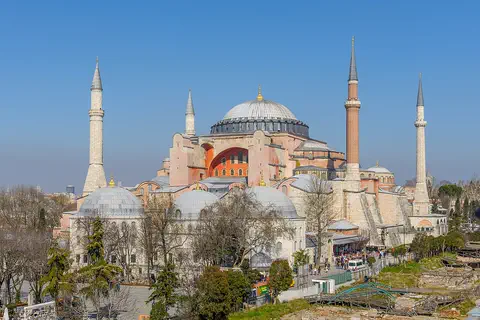
Hagia Sophia in Istanbul was built in under six years, from 532 to 537, for the emperor Justinian. Its enormous dome seems to float on a ring of 40 windows. Over almost 1,500 years it has been a church, a mosque and a museum, and since 2020 it has been a mosque.
-
 Watch
Landmark
Agra Fort
Agra Fort is a huge red sandstone fortress beside the Yamuna River in Agra, India. The Mughal emperor Akbar began it in 1565. Its walls, about 2.5 kilometers around, protect palaces, halls and mosques added by later emperors. It was both an army base and a royal home.
-
 Watch
Landmark
Angkor
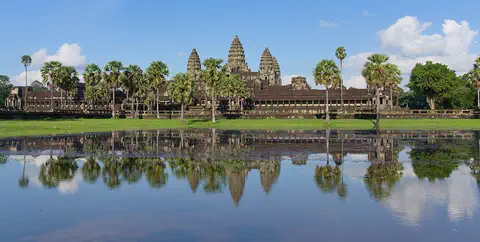
Angkor, in northwestern Cambodia, was the capital of the Khmer Empire from the 9th to the 15th century. Its kings built city after city here, with scores of temples, such as Angkor Wat and the Bayon, and giant reservoirs and canals to water the rice fields. Today it covers about 400 square kilometers, and more than 100,000 people live in villages inside it.
For parents & teachers
What children will learn
- Locate Jerusalem's Old City and describe Al-Aqsa Mosque as a building: its dome, arched porch and place on a great plaza.
- Explain that the plaza is important to more than one faith, using respectful, neutral words.
- Describe who looks after the mosque today, as Britannica states it.
Recommended ages: 3 to 17 · About 15 minutes
Talk about it
- Some places are important to people of more than one religion. How can visitors show respect at such places?
- The Old City has been lived in for almost 5,000 years. What clues might an old building give about the people who built it?
- Why do you think UNESCO protects whole old cities, not just single buildings?
Try at home or in class
- Draw the Old City as a square about 900 meters on each side, then measure a 9-meter line outside and imagine it 100 times longer.
- Make a dome from half an orange peel or a paper bowl, and compare how a dome and a flat roof cover a room.
Key vocabulary: mosque, dome, plaza, waqf, caliph, Old City
Where these facts come from
- Wikidata , Wikimedia Foundation (CC0 1.0)
- Al-Aqsa Mosque , Encyclopaedia Britannica
- Jerusalem: Landscape , Encyclopaedia Britannica
- Dome of the Rock , Encyclopaedia Britannica
- al-Walid I , Encyclopaedia Britannica
- Old City of Jerusalem and its Walls , UNESCO World Heritage Centre
- Wikimedia Commons , Wikimedia Foundation (Per file (public domain, CC0, CC BY or CC BY-SA); see each media record)
Checked, not yet human-reviewed. Last updated October 28, 2026. Spotted a mistake? Tell us.