
Landmark Asia
Sultan Ahmed Mosque
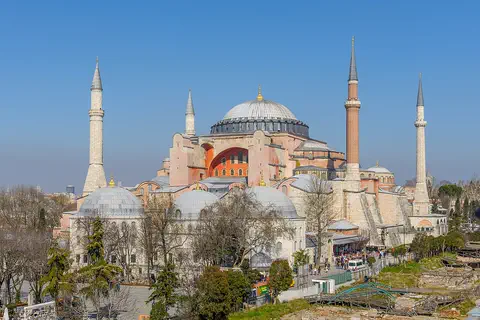
The Sultan Ahmed Mosque is a huge mosque in Istanbul, in Turkey. It has big round domes and six tall, thin towers. Inside, the walls are covered with blue and green tiles.
The Sultan Ahmed Mosque in Istanbul was built between 1609 and about 1616 for the Ottoman ruler Sultan Ahmed I. Its central dome is ringed by half-domes and smaller domes, and six slender minarets rise around it. Many people call it the Blue Mosque because of the blue and green tiles and painted decoration inside. It is still a working mosque, where Muslims come to pray.
Commissioned by Sultan Ahmed I and designed by Sedefkar Mehmed Aga, the Sultan Ahmed Mosque (1609 to 1616 or 1617) faces Hagia Sophia on Istanbul's historic peninsula. Its central dome amid cascading semi-domes, six minarets and Iznik tile work make it a highlight of UNESCO's Historic Areas of Istanbul; a major restoration ended in 2023.
Photo: Moonik, CC BY-SA 3.0, via Wikimedia Commons
Discover the Sultan Ahmed Mosque
The Sultan Ahmed Mosque is in Istanbul, a big city in Turkey.
A mosque is a building where Muslims pray. This one has a giant dome and many smaller domes. Six tall, thin towers stand around it. People also call it the Blue Mosque.
The Sultan Ahmed Mosque stands on Istanbul's historic peninsula, right across from the great domed building of Hagia Sophia. A mosque is a place where Muslims gather to pray, and this one has been in use for more than 400 years.
It was built for Sultan Ahmed I, ruler of the Ottoman Empire, by the architect Sedefkar Mehmed Aga. Its six minarets, the tall towers around a mosque, make it easy to spot on the skyline. Many people, especially visitors from Europe, call it the Blue Mosque, because of the blue and green tiles and painted patterns inside.
The mosque occupies a site on Istanbul's historic peninsula directly across from Hagia Sophia. Hurriyet Daily News dates it to 1609 to 1617, built on the order of Ottoman Sultan Ahmed I by the architect Sedefkar Mehmed Aga; Britannica gives 1609 to 1616. The name 'Blue Mosque', Hurriyet notes, is used mainly by Europeans, after the green and blue Iznik tiles and the blue painted decoration of its domes.
UNESCO names the 17th-century Blue Mosque among the monuments that shape Istanbul's skyline, alongside Hagia Sophia, the Topkapi Palace and Sinan's mosques, within the World Heritage Site 'Historic Areas of Istanbul', inscribed in 1985. It remains a working mosque that also welcomes visitors.
- Built
- 1609 to 1616 (some sources say 1617)
- Ordered by
- Sultan Ahmed I
- Architect
- Sedefkar Mehmed Aga
- Minarets
- 6
A young sultan's mosque
Long ago, a young ruler called Sultan Ahmed wanted a great mosque.
An architect named Mehmed Aga designed it. Workers built it in about seven years. Sadly, the sultan died soon after it was finished.
Sultan Ahmed I, ruler of the Ottoman Empire, ordered a grand new mosque, and building began in 1609. It was placed right opposite Hagia Sophia, which suggests the sultan wanted it to rival that famous building.
The mosque was finished around 1616. Sultan Ahmed had little time to enjoy it: he died soon after, and he is buried just outside its walls. Four centuries later, in 2017, a huge restoration began. The facade, minarets, courtyard, tiles and stonework were repaired, and the mosque reopened on April 21, 2023.
Britannica dates the building to 1609 to 1616, credits Sedefkar Mehmed Aga with its fine proportions and suggests that its position opposite Hagia Sophia shows Ahmed I meant it to rival the former cathedral. Ahmed I died shortly after its completion and is buried in a mausoleum just outside the mosque's walls. Hurriyet gives the completion as 1617.
In July 2017 Turkey's Directorate General of Foundations signed what officials called the mosque's largest restoration, sponsored by a private company: cleaning the facade, consolidating stone and marble, restoring the minarets, conserving the Iznik tiles, renewing the roof covering, reviving the painted decoration on wood and plaster, and conserving the floors and the interlocking woodwork called kundekari. The Fatih Municipality reported the reopening of the restored mosque on April 21, 2023.
Domes upon domes
The mosque has one big dome in the middle.
Around it are four half-domes, like big shells. Around those are even smaller domes. It looks like a hill of domes! Lots of windows let in the light.
Over the middle of the prayer hall rises a dome 23.5 meters across and 43 meters high. Four huge pillars hold it up, and half-domes and smaller domes step down around it like a cascade.
More than 250 stained-glass windows let daylight pour in, and there is room inside for about 10,000 worshipers. Outside, each minaret has small balconies around it.
Britannica gives the central dome as 23.5 m (77 ft) in diameter and 43 m (141 ft) high, supported by four large pillars and surrounded by cascading smaller domes; more than 250 stained-glass windows light the interior, which holds about 10,000 worshipers. The carved marble minbar (pulpit) is placed so that the imam can be heard anywhere in the mosque. Wikidata lists the building's height as 64 m and its length as 82 m.
Go Turkiye, the official tourism site, mentions arched stained-glass windows and a wrought-iron chandelier at the entrance to the prayer hall. Each minaret carries balconies (serefe); Britannica notes that six minarets, rather than the standard four, are one of the building's best-known features.
Tiles, courtyard and painted domes
Inside, the walls are covered with shiny tiles.
The tiles show flowers, trees and patterns. Outside is a big, airy courtyard.
The mosque is famous for its tiles from Iznik, a town in Turkey known for fine pottery. More than 20,000 handmade tiles line the inside, decorated with flowers, trees and patterns, mostly in blue and green.
Above the tiles, the walls and domes are painted with patterns, mostly in blue. Outside the prayer hall is a large, airy courtyard where visitors can stroll before going in.
Britannica counts more than 20,000 handmade Iznik tiles lining the interior, richly decorated with flowers, trees and abstract patterns, with painted motifs, generally blue, on the walls above them. Hurriyet describes the tiles as green and blue, and the half-domes and central dome as adorned mainly with blue pen work.
The 2017 restoration conserved the tiles, the pen work, the marble floors of the inner court and the kundekari woodwork. Go Turkiye recommends the airy courtyard as part of a visit, and Britannica notes that the mosque is open to tourists when it is not in use for worship.
- Central dome
- 23.5 m across, 43 m high
- Windows
- more than 250, of stained glass
- Iznik tiles inside
- more than 20,000, made by hand
Visiting a working mosque
People still come to pray in the mosque.
Visitors are welcome to look inside too. It is a calm and peaceful place. Next to the mosque is the tomb of Sultan Ahmed.
The Sultan Ahmed Mosque is still a working mosque, where Muslims come to pray five times a day, and it welcomes visitors from around the world when it is not in use for prayer. The Fatih Municipality describes it as hosting millions of local and foreign visitors.
Go Turkiye, the official tourism site, calls it an active place of worship that visitors can see for themselves. Next to the mosque, a tomb building holds the graves of Sultan Ahmed I and his wife Kosem Sultan.
The mosque functions both as a place of worship and as one of Istanbul's most visited landmarks; the Fatih Municipality described it in 2023 as hosting millions of local and foreign tourists. Go Turkiye notes that the tombs of Ahmed I and his wife Kosem Sultan stand in a mausoleum beside the mosque.
Its setting matters too: UNESCO's description of Istanbul highlights the city's skyline of domes and minarets, built up over centuries by Byzantine and Ottoman architects, in which the Sultan Ahmed Mosque and Hagia Sophia face each other across a public square.
Amazing facts
-
The mosque has six minarets.
The mosque has six minarets, while most mosques have no more than four.
Britannica notes the mosque's six minarets, rather than the standard four.
-
More than 250 colored glass windows let the light in.
More than 250 stained-glass windows fill the mosque with daylight.
More than 250 stained-glass windows light the interior.
-
Sultan Ahmed is buried right next to his mosque.
Sultan Ahmed I died soon after his mosque was finished. He is buried in a tomb just outside its walls.
Ahmed I died shortly after the mosque's completion and is buried in a mausoleum just outside its walls.
-
The mosque was repaired for about six years.
A great restoration began in 2017, and the mosque reopened on April 21, 2023.
The restoration agreed in July 2017 ended with the mosque's reopening on April 21, 2023.
Words to know
- mosque
- a building where Muslims pray
- minaret
- a tall, thin tower beside a mosque
- dome
- a round roof shaped like half a ball
- sultan
- a title for a ruler in some Muslim countries, including the Ottoman Empire
- Iznik tiles
- painted ceramic tiles made in the town of Iznik, in Turkey
- restoration
- careful work to repair an old building and bring back how it looked
Discovery challenge
-
How many tall towers does the mosque have?
How many minarets does the Sultan Ahmed Mosque have?
How many minarets does the mosque have, instead of the standard four?
- 2
- 4
- 6
Show the answer
6
Six! The photo shows five, and one is hidden.
Six minarets, the tall, thin towers around a mosque.
Six, rather than the standard four, each ringed with balconies.
-
Why do people call it the Blue Mosque?
Why is the Sultan Ahmed Mosque often called the Blue Mosque?
What gives the mosque its popular name, the Blue Mosque?
- It is painted blue outside
- Its blue and green tiles and painting inside
- It stands in the sea
Show the answer
Its blue and green tiles and painting inside
The tiles inside are blue and green!
Its Iznik tiles and the painted patterns on its domes are mostly blue and green.
Its green and blue Iznik tiles and blue pen work on the domes, a name used mainly by Europeans.
-
Which ruler wanted the mosque built?
Which Ottoman ruler ordered the mosque?
On whose order did Sedefkar Mehmed Aga build the mosque from 1609?
- Sultan Ahmed I
- Emperor Justinian
- Queen Victoria
Show the answer
Sultan Ahmed I
Sultan Ahmed! The mosque is named after him.
Sultan Ahmed I of the Ottoman Empire.
Sultan Ahmed I, who died shortly after its completion.
-
Which famous domed building is right across from the mosque?
Which famous building stands across from the Sultan Ahmed Mosque?
Which 6th-century domed building faces the mosque on the historic peninsula?
- The Eiffel Tower
- Hagia Sophia
- The Taj Mahal
Show the answer
Hagia Sophia
Hagia Sophia! It has a giant dome too.
Hagia Sophia, another great domed building of Istanbul.
Hagia Sophia, designed by Anthemios of Tralles and Isidoros of Miletus in 532 to 537.
Nearby places
-
 Watch
Landmark
Hagia Sophia
Hagia Sophia in Istanbul was built in under six years, from 532 to 537, for the emperor Justinian. Its enormous dome seems to float on a ring of 40 windows. Over almost 1,500 years it has been a church, a mosque and a museum, and since 2020 it has been a mosque.
-
 Watch
Landmark
Topkapı Palace
Topkapı Palace sits on a point of land where the Bosphorus Strait meets the sea in Istanbul. Sultan Mehmed II built it between 1460 and 1478, and for nearly 400 years it was the home of the Ottoman sultans and the center of their government. In 1924 it became a museum.
-
 Watch
City
Istanbul
Istanbul is the biggest city in Türkiye, built on both sides of the Bosporus, the narrow strait between Europe and Asia. Once called Byzantium and then Constantinople, it was the capital of two great empires. About 15.7 million people lived in Istanbul province in 2023.
-
 Watch
Natural wonder
Pamukkale
Pamukkale, in southwestern Türkiye, is a hillside of bright white terraces and pools built by warm spring water. The water is full of a dissolved mineral called calcium carbonate, and as it flows over the slope it leaves the mineral behind as a rock called travertine. Its name means "cotton castle". On top stand the ruins of Hierapolis, an ancient spa town.
-
 Watch
City
Ankara
Ankara is the capital of Türkiye, in the interior of Anatolia, about 200 kilometers from the Black Sea. People have lived here since the Stone Age, and Romans, Byzantines, Seljuks and Ottomans all left buildings behind. It became the capital in 1923, and today it is a city of government, universities and museums.
-
 Watch
Landmark
Temple of Artemis at Ephesus
The Temple of Artemis at Ephesus was one of the Seven Wonders of the ancient world. It was rebuilt several times, and its 6th-century BCE version was more than 300 feet long. After a fire in 356 BCE it was built again just as big. Today only scattered stones and one column remain.
-
 Watch
Landmark
Ephesus
Ephesus was a great Greek and Roman city on the west coast of what is now Türkiye. Its ruins include ancient streets, a theater for nearly 25,000 people and the Library of Celsus, whose two-story front has been rebuilt. Archaeologists have been digging there since 1895.
-
 Watch
City
Bucharest
Bucharest, the capital of Romania, lies on a wide plain beside the Dâmbovița River. First written about in 1459, it became the capital of Walachia in 1659 and of Romania in 1862. Today it is a city of broad boulevards, a huge parliament palace, the Romanian Athenaeum concert hall and an open-air Village Museum.
Explore next
-
 Watch
 Country
Türkiye (Turkey)
Türkiye, also called Turkey, lies partly in Asia and partly in Europe. A narrow waterway called the Bosporus runs through its biggest city, Istanbul, and its land is mostly mountains and high plains. About 86 million people live there.
-
Watch
City
Istanbul
Istanbul is the biggest city in Türkiye, built on both sides of the Bosporus, the narrow strait between Europe and Asia. Once called Byzantium and then Constantinople, it was the capital of two great empires. About 15.7 million people lived in Istanbul province in 2023.
-
Watch
Landmark
Hagia Sophia
Hagia Sophia in Istanbul was built in under six years, from 532 to 537, for the emperor Justinian. Its enormous dome seems to float on a ring of 40 windows. Over almost 1,500 years it has been a church, a mosque and a museum, and since 2020 it has been a mosque.
-
 Watch
Landmark
Alhambra
The Alhambra is a palace and fortress above the city of Granada, in Spain. The Nasrid rulers built most of it between 1238 and 1358. It is famous for its courtyards, fountains, carved plaster and tiles, and the gardens of the Generalife next door.
-
 Watch
Landmark
Dome of the Rock
The Dome of the Rock stands on a wide raised plaza in the Old City of Jerusalem. It was finished in 691 or 692, about 1,330 years ago, which makes it the oldest Islamic monument still standing. Its eight walls are covered in marble and mosaics, and its gilded dome, about 20 meters across, covers a large rock that is deeply important to Muslims.
-
 Watch
Landmark
Taj Mahal
The Taj Mahal is a white marble tomb in Agra, India, beside the Yamuna River. The Mughal emperor Shah Jahan had it built in memory of his wife, Mumtaz Mahal. More than 20,000 workers spent about 22 years on the tomb, its gardens, a mosque and a great gateway.
- Watch Geography What is a World Heritage Site? World Heritage Sites are places so important that they belong, in a way, to everyone. Under a 1972 agreement, countries nominate their most outstanding places, experts check them, and a UNESCO committee decides. By 2026 the list held 1,273 sites: cultural places like the Taj Mahal, natural places like the Galápagos, and mixed ones like Machu Picchu.
-
 Watch
Landmark
Prophet's Mosque
The Prophet's Mosque in Medina, Saudi Arabia, began as the simple home and courtyard of the Prophet Muhammad, who helped build it after he came to Medina in 622. Rebuilt and enlarged many times, it now has a famous green dome over Muhammad's tomb, ten minarets and room for up to a million worshippers at the busiest times.
For parents & teachers
What children will learn
- Locate Istanbul and describe the Sultan Ahmed Mosque as a working mosque and a historic building.
- Describe how the central dome rests on half-domes and smaller domes.
- Recognize Iznik tiles and the flower patterns used to decorate them.
- Discuss how visitors show respect at a place of worship.
Recommended ages: 3 to 17 · About 15 minutes
Talk about it
- Why do you think the builders put the great dome on half-domes instead of on four straight walls?
- The mosque is a place of prayer and a famous sight. How can a building serve both purposes well?
- Tulips, roses and cypress trees appear on the tiles. Why might artists choose flowers and trees for decoration?
Try at home or in class
- Cut an orange or a ball shape from paper in half for a dome, then support it with four half-cups as 'half-domes' and see how the weight spreads.
- Design a square tile on paper with a repeating flower pattern in blue and green, then put four copies together to see the pattern grow.
Key vocabulary: mosque, minaret, dome, sultan, Iznik tiles, restoration
Where these facts come from
- Wikidata , Wikimedia Foundation (CC0 1.0)
- Historic Areas of Istanbul , UNESCO World Heritage Centre
- Istanbul's Blue Mosque undergoes largest restoration ever (July 2017) , Hurriyet Daily News
- The Sultanahmet (Blue) Mosque has been re-opened (April 21, 2023) , Fatih Municipality, Istanbul
- Blue Mosque , Encyclopaedia Britannica
- Blue Mosque (Sultanahmet Camii) , Go Turkiye (official tourism portal of Turkiye)
- Wikimedia Commons , Wikimedia Foundation (Per file (public domain, CC0, CC BY or CC BY-SA); see each media record)
Checked, not yet human-reviewed. Last updated October 27, 2026. Spotted a mistake? Tell us.