
Landmark Asia
Gelati Monastery
Gelati Monastery is a group of old stone buildings on a green hill in Georgia. Long ago, it was also a school for learning!
Gelati Monastery stands on a wooded hill near the city of Kutaisi, in the country of Georgia. King David IV, called the Builder, began it in 1106. It was more than a monastery: it was also a center of science and education, with its own academy.
Gelati Monastery, about 11 km northeast of Kutaisi above the Tskaltsitela River, reflects the 'golden age' of medieval Georgia. Begun by King David IV 'the Builder' in 1106, its main church was completed in 1130, and more churches were added in the 13th and early 14th centuries. UNESCO calls it the masterpiece of the architecture of Georgia's Golden Age; it was inscribed on the World Heritage List in 1994.
Photo: Ihor Burliai, CC BY-SA 3.0, via Wikimedia Commons
Discover Gelati
Gelati is in Georgia, a country in the Caucasus Mountains.
Its stone buildings stand together on a green hill, inside a high wall, with forest all around.
Gelati Monastery stands on a wooded hill above the Tskaltsitela River, about 11 kilometers northeast of the city of Kutaisi in Georgia. It lies on the lower southern slopes of the Caucasus mountains.
A high wall surrounds the monastery. Inside are three churches with domes, a bell tower and an academy building, where people once studied.
UNESCO places Gelati on the lower southern slopes of the mountains of the Northern Caucasus, on a wooded hill near Kutaisi, the capital of King David IV. The Georgian Encyclopedia locates it 11 km northeast of Kutaisi in the valley of the Tskaltsitela River.
The complex, enclosed by a high wall, includes three domed churches, a bell tower, an academy building and a porch. UNESCO notes that its almost completely intact surroundings show how the builders meant architecture and landscape to work together.
- Where
- near Kutaisi, Imereti, Georgia
- Begun
- 1106
- Founder
- King David IV 'the Builder'
- World Heritage
- inscribed 1994
A king's monastery and academy
A king named David began building Gelati more than 900 years ago.
Learned teachers and writers came here to study, write and translate books.
In 1106, King David IV, called the Builder, began building the monastery near his capital, Kutaisi. The main church was finished in 1130, under his son Demetre. More churches were added in the 1200s and early 1300s.
King David gathered learned scholars at Gelati's academy. They translated and wrote books, and Gelati became one of the most important centers of culture in old Georgia.
UNESCO dates Gelati to Georgia's 'golden age', a time of political strength and economic growth between the reigns of David IV (1089–1125) and Queen Tamar (1184–1213). David began the monastery in 1106; the main church was completed in 1130 under his son Demetre, and further churches followed in the 13th and early 14th centuries.
The Academy was one of the most important centers of culture in ancient Georgia. David gathered scholars there such as Ioane Petritsi, a philosopher known for his translations of Proclus. The Georgian Encyclopedia notes that Gelati was called 'another Athens'. The monastery was closed in 1923 and served as a branch of the Kutaisi history museum until 1988.
Smooth stone and a tall dome
The main church has a tall round tower on its roof, with a pointed top. This is its dome.
Its walls are made of big, smooth blocks of stone.
UNESCO calls Gelati the best representative of Georgia's Golden Age style of building. Its walls are faced with large, smoothly cut stone blocks, its shapes are carefully balanced, and its outside walls are decorated with blind arches: arches built onto a wall with no opening inside.
The main church measures about 35 by 35 meters, and inside it rises 33.5 meters high. Sixteen windows ring the drum under its dome.
Under criterion (iv), UNESCO calls Gelati the masterpiece of Georgian Golden Age architecture: full facing of smoothly hewn large blocks, perfectly balanced proportions and exterior decoration of blind arches. Its main church is one of the most important examples of the cross-in-square plan, and Gelati is one of the largest medieval monasteries of its kind.
The Georgian Encyclopedia gives the main church as 35.5 by 35.0 meters, 33.5 meters high inside, with three projecting apses on the east and 16 windows in the drum of the dome. The rectangular academy building, about 300 square meters, had stone benches along its walls and large windows.
Paintings and mosaics
Inside, the walls are covered with old paintings in many colors.
There is also a mosaic, a picture made of many tiny colored pieces, on a golden background.
Inside, the churches are decorated with wall paintings made between the 1100s and the 1600s. Among them are more than 40 portraits of kings, queens and church leaders.
The main church also has a mosaic from the 1100s, with a golden background. UNESCO says it is the only medieval building in its wider region that still has well-preserved mosaic decoration.
UNESCO records mural paintings from the 12th to the 17th centuries and a 12th-century mosaic in the apse of the main church. It calls the main church the only medieval monument in the larger historic region of eastern Asia Minor and the Caucasus that still has well-preserved mosaic decoration, comparable with the best Byzantine mosaics.
It also holds Georgia's largest ensemble of middle Byzantine, late Byzantine and post-Byzantine paintings, including more than 40 portraits of kings, queens and high clerics. For years many paintings were in poor condition; UNESCO notes that repairing the roofs slowed the damage and allowed restoration to begin.
- Main church finished
- 1130
- Main church, inside height
- 33.5 m
- Windows in the dome's drum
- 16
Domes on a green hill
In this photo, a big stone church with a pointed dome stands on green grass. A very tall dark tree grows on the left!
This photo was taken on 18 April 2013, on a cloudy day. The main church, built of golden-brown stone, rises in the middle, topped by its dome. On the right stands a round tower with open arches and a pointed roof, and a smaller domed building peeks out behind on the left.
A paved path crosses the lawn, and a very tall evergreen tree stands on the left, with green forest on the hill behind.
The photograph (18 April 2013, by Ihor Burliai) shows the main church across a lawn: its stepped roofs and blind arches, the tall drum and conical dome, a round arcaded tower with a tiled conical roof on the right, and a smaller domed building behind on the left, with a tall conifer and wooded hillside.
The Academy building, roofless when Gelati was inscribed in 1994, was re-roofed in 2009. UNESCO kept Gelati on its List of World Heritage in Danger from 2010 to 2017.
Amazing facts
-
Gelati was not just a monastery. It was also a school where people studied and wrote books!
Gelati was also a center of science and education, with an academy that was one of the most important centers of culture in old Georgia.
Gelati was a center of science and education; its Academy was one of the most important centers of culture in ancient Georgia.
-
So much learning happened here that people called Gelati 'another Athens'!
Gelati was such a center of learning that it was often called 'another Athens'.
As a center of philosophy and science, Gelati was often referred to as 'another Athens'.
-
The king who began Gelati was called David the Builder!
King David IV, who began Gelati in 1106, is known as 'the Builder'.
Gelati's founder, King David IV (reigned 1089–1125), is known as David 'the Builder'.
Words to know
- monastery
- a group of buildings where monks live and work together
- academy
- a place for study and learning
- dome
- a rounded roof on top of a building
- blind arch
- an arch built onto the face of a wall, with no opening through it
- mosaic
- a picture made from many small pieces of colored stone or glass
- translate
- to put words from one language into another
Discovery challenge
-
Which king began building Gelati?
Which king, known as 'the Builder', began Gelati in 1106?
Which Georgian king began Gelati in 1106 near his capital, Kutaisi?
- King David IV
- King Henry VIII
- King Louis XIV
Show the answer
King David IV
King David, called the Builder!
King David IV 'the Builder'.
David IV 'the Builder'.
-
Besides a monastery, what else was Gelati?
Gelati was also a center of what?
UNESCO says Gelati was not simply a monastery but also a center of what?
- Science and education
- Car racing
- Fishing
Show the answer
Science and education
A place for learning!
Science and education, with its academy.
Science and education: its Academy.
-
In which country is Gelati?
In which country is Gelati Monastery?
Gelati stands near Kutaisi in which country of the Caucasus?
- Georgia
- Portugal
- Japan
Show the answer
Georgia
Georgia!
Georgia.
Georgia.
-
What is a picture made of tiny pieces of colored stone or glass called?
The main church has a rare 12th-century picture made of small colored pieces. What is it called?
UNESCO says the main church is the only medieval monument in its region still keeping well-preserved decoration of which kind?
- Mosaic
- Graffiti
- Photograph
Show the answer
Mosaic
A mosaic!
A mosaic.
Mosaic decoration.
-
In which year did King David begin Gelati?
In which year did building begin at Gelati?
In which year did David IV begin the monastery, finished in its main church in 1130?
- 1106
- 1606
- 1906
Show the answer
1106
1106!
1106.
1106.
Nearby places
-
 Watch
Natural wonder
Mount Elbrus
Mount Elbrus is the highest peak of the Caucasus Mountains, in southwestern Russia. It is an old volcano with two snow-covered tops, the higher one 5,642 meters tall. Twenty-two glaciers cover its slopes and feed rivers below. Whether it counts as Europe's highest mountain depends on where you draw the line between Europe and Asia.
-
 Watch
City
Tbilisi
Tbilisi, the capital of Georgia, lies along the Mtkvari River between mountain ridges. Its name comes from the Georgian word for "warm", after the hot springs that feed its old bathhouses. At the 2024 census, 1,331,485 people lived in the self-governing city.
-
 Watch
Natural wonder
Caucasus Mountains
The Caucasus Mountains stretch between the Black Sea and the Caspian Sea. They rose when an old sea basin closed as plates of Earth's crust pushed together, and today their peaks hold thousands of glaciers, though the ice is shrinking fast. Their western forests are a World Heritage Site where European bison were brought back.
-
 Watch
Landmark
Ani
Ani is the ruin of a medieval city on a plateau in northeast Türkiye (Turkey), above a deep ravine. It grew rich in the 900s and 1000s on a branch of the Silk Roads, a network of old trade routes. Its walls, palaces, religious buildings, houses and caves are now a UNESCO World Heritage Site.
-
 Watch
City
Yerevan
Yerevan is the capital of Armenia, high in a valley on both banks of the Hrazdan River. It grew from the fortress of Erebuni, built in 782 BC. Many buildings are made of rosy tuff, a pinkish stone, and about 1.14 million people lived there in 2025.
-
 Watch
Landmark
Geghard
Geghard is a medieval monastery at the head of the Azat Valley in Armenia, surrounded by tall cliffs. Its main church was built in 1215, and several of its halls were dug out of the solid rock. Its early name, Ayrivank, means 'the Monastery in the Cave'.
-
 Watch
Natural wonder
Mount Ararat
Mount Ararat is a huge volcanic mountain in the far east of Türkiye, close to where Türkiye, Iran and Armenia meet. It has two peaks: Great Ararat, about 5,165 meters high and the tallest mountain in Türkiye, and the smaller, cone-shaped Little Ararat. Snow covers the top all year, and a glacier clings to its north side.
-
 Watch
Landmark
Shaki
Shaki, also spelled Sheki, is a historic town in the forested Caucasus Mountains of Azerbaijan. After a flood of mud destroyed the old town in 1772, people rebuilt it higher up the valley, with houses, gardens, water channels and a khan's palace. Its wealth came from silk, and UNESCO made its historic center a World Heritage Site in 2019.
Explore next
-
 Watch
 Country
Georgia
Georgia is a country at the eastern end of the Black Sea, below the high, icy Greater Caucasus mountains. It has warm, wet coasts, dry eastern plains and old monasteries, and about 3.9 million people lived there at the start of 2026.
-
Watch
Landmark
Geghard
Geghard is a medieval monastery at the head of the Azat Valley in Armenia, surrounded by tall cliffs. Its main church was built in 1215, and several of its halls were dug out of the solid rock. Its early name, Ayrivank, means 'the Monastery in the Cave'.
-
 Watch
Landmark
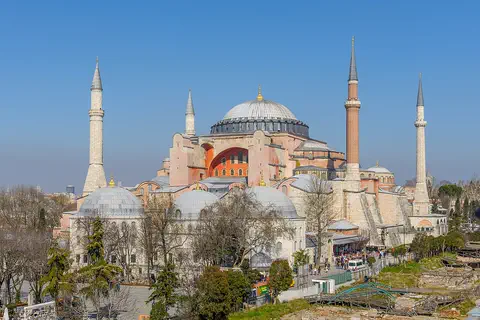
Hagia Sophia
Hagia Sophia in Istanbul was built in under six years, from 532 to 537, for the emperor Justinian. Its enormous dome seems to float on a ring of 40 windows. Over almost 1,500 years it has been a church, a mosque and a museum, and since 2020 it has been a mosque.
-
 Watch
Landmark
Abraj Al Bait
Abraj Al Bait is a group of seven hotel towers in Mecca, Saudi Arabia, beside the city's Great Mosque. In the middle rises the Makkah Royal Clock Tower, 601 meters tall to the tip of its spire, with a huge clock near the top. It was finished in 2012.
-
 Watch
Landmark
Agra Fort
Agra Fort is a huge red sandstone fortress beside the Yamuna River in Agra, India. The Mughal emperor Akbar began it in 1565. Its walls, about 2.5 kilometers around, protect palaces, halls and mosques added by later emperors. It was both an army base and a royal home.
-
 Watch
Landmark
Akashi Kaikyō Bridge
The Akashi Kaikyō Bridge is a suspension bridge almost 4 kilometers long that crosses the Akashi Strait between Kobe and Awaji Island in Japan. Its middle span is 1,991 meters. When it opened in 1998, it was the longest suspension bridge in the world.
-
 Watch
Landmark
Al Zubarah
Al Zubarah is the ruin of a walled town on the coast of Qatar. For about 50 years, in the late 1700s and early 1800s, it was a busy center for pearls and trade. After it was abandoned, desert sand covered and protected its houses, palaces and streets. It became a UNESCO World Heritage Site in 2013.
-
 Watch
Landmark
Al-Aqsa Mosque
Al-Aqsa Mosque stands at the southern end of a huge raised plaza in the Old City of Jerusalem. Built in the early 700s, it has a silver-gray dome, and the golden Dome of the Rock stands nearby. The plaza is important to Muslims and to Jews.
For parents & teachers
What children will learn
- Describe a medieval monastery complex: churches, a bell tower, an academy and a wall.
- Explain how a monastery could also be a place of science, education and translation.
- Recognize features of Georgian medieval building: smooth stone facing, balanced shapes, domes on tall drums and blind arches.
Recommended ages: 4 to 17 · About 15 minutes
Talk about it
- Scholars at Gelati translated books from other languages. Why is translating books important for learning?
- Gelati was built to fit its hillside and forest. Why might builders want a building to fit its landscape?
- Many old paintings at Gelati needed repairs after the roofs leaked. How can people protect old art?
Try at home or in class
- Make a paper mosaic: cut colored paper into small squares and glue them onto a gold or yellow background to make a picture.
- Draw a wall with a row of blind arches, then draw the same wall with real arched windows. What is different?
Key vocabulary: monastery, academy, dome, blind arch, mosaic, translate
Where these facts come from
- Wikidata , Wikimedia Foundation (CC0 1.0)
- Gelati Monastery (World Heritage List) , UNESCO World Heritage Centre
- Gelati Monastery , Georgian Encyclopedia (Georgian National Academy of Sciences)
- File:Gelati Monastery 1.jpg , Wikimedia Commons
- UNESCO World Heritage List , UNESCO World Heritage Centre (Linked as a reference; site facts come from Wikidata)
- Wikimedia Commons , Wikimedia Foundation (Per file (public domain, CC0, CC BY or CC BY-SA); see each media record)
Checked, not yet human-reviewed. Last updated November 1, 2026. Spotted a mistake? Tell us.