
Landmark Asia
Shaki
Shaki is an old town in Azerbaijan, in green mountains. Long ago, people there raised silkworms to make silk. A ruler called a khan built a beautiful palace there.
Shaki, also spelled Sheki, is a historic town in the forested Caucasus Mountains of Azerbaijan. After a flood of mud destroyed the old town in 1772, people rebuilt it higher up the valley, with houses, gardens, water channels and a khan's palace. Its wealth came from silk, and UNESCO made its historic center a World Heritage Site in 2019.
Sheki, at the foot of the Greater Caucasus, was rebuilt after a mudflow in 1772 as a planned 'garden city' of houses with high-pitched roofs, irrigated plots and water channels. Capital of the Sheki Khanate (from 1743) until Russian rule, it grew rich on silkworm breeding and the cocoon trade; UNESCO inscribed its historic center and the Khan's Palace in 2019.
Photo: Sefer azeri, CC0 1.0, via Wikimedia Commons
Discover Shaki
Shaki is a town in Azerbaijan, a country in Asia.
It sits in a green valley below tall mountains covered in forest. Its old houses have tall, pointed roofs. Each house has its own garden.
Shaki is a town in north-central Azerbaijan, on the southern slopes of the Greater Caucasus Mountains. A river, the Gurjana, divides the old town in two: the older northern part climbs the mountainside and the southern part spreads into the river valley.
The historic center is famous for its traditional houses with high, sloping roofs, deep porches called verandas, and gardens. A palace built for the town's rulers, the khans, stands in the northeast. UNESCO calls Shaki an extraordinary example of a planned garden city, surrounded by forested mountains.
Britannica places Şäki on the southern slopes of the Greater Caucasus in north-central Azerbaijan, calls it one of the oldest cities in Azerbaijan, and notes it was a trading center on the road to Dagestan. UNESCO describes a forested valley setting, with the Gurjana River dividing an older northern part on the mountain from a southern part in the valley.
The World Heritage property, the Historic Centre of Sheki with the Khan's Palace, covers 120.5 ha with a 146 ha buffer zone and was inscribed in 2019 under criteria (ii) and (v). UNESCO singles out its traditional ensemble of houses with high saddle roofs, deep verandas and gardens, and calls it an extraordinary example of a planned productive 'garden city'.
- Country
- Azerbaijan
- Setting
- Southern slopes of the Greater Caucasus
- Historic center rebuilt
- after a mudflow in 1772
- World Heritage Site
- 2019 (120.5 ha)
A town that moved
People have lived around Shaki for a very long time.
Long ago, a huge flood of mud destroyed the old town. So the people built a new town higher up the valley. That new town is the one we see today.
UNESCO says the town's history goes back to the 500s BCE, more than 2,500 years ago. It sat near important trade routes, so many peoples and rulers passed through.
In 1743 Shaki became the capital of a khanate, a small state ruled by a khan. Then, in 1772, a mudflow, a fast river of mud and rocks, destroyed the old town. People rebuilt it on higher ground in a valley to the east. The khanate was handed over to Russia in 1805, and the last khan died in 1819.
UNESCO traces the town's origins to the 6th century BCE. Trade routes brought many influences: Christianity arrived as early as the 1st century CE and Islam in the 7th, and the region came under the Safavids, Ottomans and Qajars until the 18th century. In 1743 Sheki became the first and most powerful of a series of khanates in the Caucasus, a new administrative system for the region.
After a mud flood in 1772, the town was rebuilt on higher ground in a mountain valley east of the earlier site; the narrow valley has kept its overall plan ever since, with growth inside the original building plots. Britannica records that the khanate was ceded to Russia in 1805 and that the last khan died in 1819; Russian rule followed in the 19th century.
Houses built for silkworms
In Shaki, people raised silkworms.
Silkworms spin cocoons, and silk thread is made from them. People kept the silkworms up in their big, airy attics. That is why the houses have tall roofs!
For hundreds of years, Shaki earned its living from silk. Families raised silkworms, caterpillars that spin cocoons of silk thread, and traders sold the cocoons and raw silk far away. Shaki was a stop on the Silk Road, the old trade routes between Asia and Europe.
The houses were built with steep, high roofs so that silkworms could be raised in the big, airy attics underneath. After 1772, the silk trade paid for new caravanserais, inns for traveling merchants, as well as shops, fountains, mosques and public baths. One caravanserai and some shops are still used for trade today.
UNESCO describes silkworm breeding, the trade in cocoons and raw silk and related crafts as Sheki's main economy since ancient times, favored by its climate, and links the town's form to that silk economy. Houses were given high-pitched roofs so that silkworms could be bred in the spacious, airy attics.
Wide commercial links, mainly in silk products, led to a burst of building in the short period after 1772: caravanserais, shops, public fountains, mosques, public baths and storage buildings. One caravanserai and some shops are still used by local people for trade. The Khan's Palace and many merchant houses, UNESCO says, reflect the wealth generated by sericulture and the cocoon trade from the late 18th to the 19th century.
The Khan's Palace and a garden city
The khans built a beautiful palace in Shaki.
Its rooms are beautifully decorated. Water flows through little channels to houses and gardens all over town.
The Khan's Palace, in the northeast of the town, gives the World Heritage Site part of its name. UNESCO calls it an outstanding example of the mix of cultures that shaped Shaki. Rich merchants' houses share its features: decorated rooms, fireplaces called bukharas and a local kind of window called shabaka.
Shaki is also a garden city. Mountain streams were turned into a network of channels that carry water to houses and gardens, and once drove mills. Each house stands at one side of its own cultivated plot.
UNESCO names the Khan's Palace an outstanding example of Sheki's cultural mix, echoed in merchant-house interiors with fireplaces (bukharas), decoration and a vernacular window type (shabaka); the fortress, palace and caravanserais reflect the town's administrative and commercial role. Britannica also lists the palace, mosques and baths among its historic buildings.
The urban pattern follows water management: streams in the catchment of the Kish River were turned over time into a network of channels, separating spring, rain and torrent water, that runs to houses, productive gardens and mills, and structures the neighborhoods (mehelle). Each cultivated plot has a house on one side. Of 2,755 houses in the property and buffer zone, 1,933 (71.6%) keep their authentic character.
- Houses in the property and buffer zone
- 2,755
- Houses keeping their old character
- 1,933 (71.6%)
- Protected since
- 1967
Keeping old Shaki alive
Today, families still live in the old houses.
Neighbors help look after their town. A council of older people gives advice. Careful rules now guide how old houses are mended.
Shaki's old center has been protected by law since 1967, and in 2019 UNESCO listed it as a World Heritage Site. Most of the old houses are still homes, and some old public buildings are still used the way they always were.
The town also keeps old ways of caring for itself: each neighborhood has representatives, and a council of elders helps make decisions. UNESCO warns that some new buildings and poor repairs threaten the old town, so a restoration manual now guides how houses should be fixed.
The historic center has been protected since 1967 within the Yukhari Bash State Historical and Architectural Reserve (283 ha) and is managed by the State Tourism Agency's Reserves Management Centre. UNESCO notes that traditional mechanisms for upkeep survive through neighborhood representatives and a council of elders, and asks that they be given a stronger role.
Threats include new construction, modified houses, buildings in critical condition and the use of modern materials. An Action Plan on Conservation and Rehabilitation and a Restoration Manual set standards for traditional materials, and UNESCO asks for a conservation master plan, a management plan, monitoring and a tourism strategy that limits new tourist facilities.
Amazing facts
-
Shaki's houses have tall roofs so silkworms had room to live.
Shaki's houses were built with high roofs so that silkworms could be raised in the airy attics.
High-pitched roofs gave Sheki's houses spacious, airy attics for breeding silkworms.
-
The whole town was rebuilt after a flood of mud.
After a mudflow destroyed the old town in 1772, people built a new town on higher ground to the east.
The present historic center dates from the rebuilding after the mud flood of 1772, on higher ground east of the earlier site.
-
Water channels carry water to every garden in old Shaki.
Mountain streams were turned into channels that bring water to houses, gardens and mills all over town.
UNESCO calls Sheki a planned productive garden city whose hydraulic system drove mills and irrigated plots.
Words to know
- khan
- a title for a ruler in parts of Central Asia and the Caucasus
- khanate
- a land ruled by a khan
- silkworm
- a caterpillar that spins a cocoon of silk thread
- mudflow
- a fast-moving river of mud, rocks and water
- caravanserai
- an inn with a courtyard where traveling traders and their animals could rest
- veranda
- a roofed porch along the outside of a house
Discovery challenge
-
What did people in Shaki raise to make silk?
Which animals did Shaki's families raise in their attics?
Breeding which animal shaped Sheki's high-roofed houses?
- Silkworms
- Sheep
- Bees
Show the answer
Silkworms
Silkworms! They spin cocoons of silk.
Silkworms, raised in the big, airy attics under the high roofs.
Silkworms; sericulture and the cocoon trade were the town's main economy.
-
What destroyed the old town of Shaki?
What destroyed the old town in 1772?
What disaster in 1772 led to the rebuilding of Sheki on higher ground?
- A flood of mud
- A volcano
- A snowstorm
Show the answer
A flood of mud
A flood of mud! Then people built a new town.
A mudflow. The town was rebuilt on higher ground to the east.
A mud flood; the new town was built in a valley east of the old site.
-
Which country is Shaki in?
In which country is Shaki?
In which country does Sheki lie, on the southern slopes of the Greater Caucasus?
- Azerbaijan
- Japan
- Peru
Show the answer
Azerbaijan
Azerbaijan! It has tall mountains.
Azerbaijan, in the Caucasus Mountains.
Azerbaijan, in its north-central region.
-
Who lived in Shaki's famous palace?
For whom was Shaki's famous palace built?
Which rulers' palace is named in the World Heritage property's title?
- The khans
- Roman emperors
- Egyptian pharaohs
Show the answer
The khans
The khans! They ruled the town.
The khans, who ruled the Sheki Khanate from 1743.
The khans: the property is the Historic Centre of Sheki with the Khan's Palace.
Nearby places
-
 Watch
City
Tbilisi
Tbilisi, the capital of Georgia, lies along the Mtkvari River between mountain ridges. Its name comes from the Georgian word for "warm", after the hot springs that feed its old bathhouses. At the 2024 census, 1,331,485 people lived in the self-governing city.
-
 Watch
City
Baku
Baku, the capital of Azerbaijan, curves around a bay on the Caspian Sea, the world's largest inland body of water. Its old walled town, with the Maiden Tower and a palace of the Shirvan shahs, is a World Heritage Site, and oil has made the city important for more than 150 years.
-
 Watch
Natural wonder
Mount Ararat
Mount Ararat is a huge volcanic mountain in the far east of Türkiye, close to where Türkiye, Iran and Armenia meet. It has two peaks: Great Ararat, about 5,165 meters high and the tallest mountain in Türkiye, and the smaller, cone-shaped Little Ararat. Snow covers the top all year, and a glacier clings to its north side.
-
 Watch
Natural wonder
Mount Elbrus
Mount Elbrus is the highest peak of the Caucasus Mountains, in southwestern Russia. It is an old volcano with two snow-covered tops, the higher one 5,642 meters tall. Twenty-two glaciers cover its slopes and feed rivers below. Whether it counts as Europe's highest mountain depends on where you draw the line between Europe and Asia.
-
 Watch
Natural wonder
Volga
The Volga is Europe's longest river. It rises in the Valdai Hills northwest of Moscow and flows about 3,530 kilometers to the Caspian Sea, all within Russia. Almost half of Russia's people live in its basin. Big dams now turn much of it into a chain of long lakes, and its huge delta shelters up to 750,000 waterbirds in mild winters.
-
 Watch
Landmark
Nineveh
Nineveh was the biggest city of the Assyrian Empire, on the east bank of the Tigris River in what is now Mosul, Iraq. About 2,700 years ago, King Sennacherib filled it with streets, canals and a palace of at least 80 rooms, and King Ashurbanipal collected a library of clay tablets. In 612 BCE the city was conquered and burned, and it never recovered.
-
 Watch
City
Tehran
Tehran, the capital of Iran, spreads up the slopes of the Alborz Mountains, with snowy peaks to the north and desert to the south. Once a small village, and later a market town known for its pomegranates, it became the capital in 1786. Today it is a huge, modern city with an old roofed bazaar, a palace that is a World Heritage Site and the 435-meter Milad Tower.
-
 Watch
Landmark
Samarra
Samarra, on the Tigris River in Iraq, was the capital of the Abbasid caliphs, rulers of a huge Islamic empire, from 836 to 892. In that short time they built enormous mosques, palaces, canals and even racecourses. Because the city was left so early, its plan survives, and its Great Mosque still has a famous spiral minaret.
Explore next
-
 Watch
 Country
Azerbaijan
Azerbaijan is a country on the southern side of the Caucasus Mountains, along the western shore of the Caspian Sea. It has high mountains, wide lowlands and forests, its capital is Baku, and about 10.3 million people lived there in mid-2026.
-
Watch
City
Baku
Baku, the capital of Azerbaijan, curves around a bay on the Caspian Sea, the world's largest inland body of water. Its old walled town, with the Maiden Tower and a palace of the Shirvan shahs, is a World Heritage Site, and oil has made the city important for more than 150 years.
-
 Watch
Journey
The Silk Road
The Silk Road was not one road but a web of trade routes, about 6,400 kilometers long, linking China with Central Asia and the Mediterranean. For more than 1,500 years, caravans carried silk, tea, spices and glass, and travelers shared ideas, beliefs and inventions.
- Watch Geography What is a World Heritage Site? World Heritage Sites are places so important that they belong, in a way, to everyone. Under a 1972 agreement, countries nominate their most outstanding places, experts check them, and a UNESCO committee decides. By 2026 the list held 1,273 sites: cultural places like the Taj Mahal, natural places like the Galápagos, and mixed ones like Machu Picchu.
-
 Watch
Landmark
Agra Fort
Agra Fort is a huge red sandstone fortress beside the Yamuna River in Agra, India. The Mughal emperor Akbar began it in 1565. Its walls, about 2.5 kilometers around, protect palaces, halls and mosques added by later emperors. It was both an army base and a royal home.
-
 Watch
Landmark
Al-Aqsa Mosque
Al-Aqsa Mosque stands at the southern end of a huge raised plaza in the Old City of Jerusalem. Built in the early 700s, it has a silver-gray dome, and the golden Dome of the Rock stands nearby. The plaza is important to Muslims and to Jews.
-
 Watch
Landmark
Al-Masjid al-Haram
Al-Masjid al-Haram, the Great Mosque of Mecca in Saudi Arabia, was built around the Kaaba, a cube-shaped building that Muslims face when they pray. It is the most important place of pilgrimage in Islam. In 2026, 1,707,301 pilgrims came to Mecca for the hajj, and the mosque can hold up to about one million worshippers.
-
 Watch
Landmark
Angkor
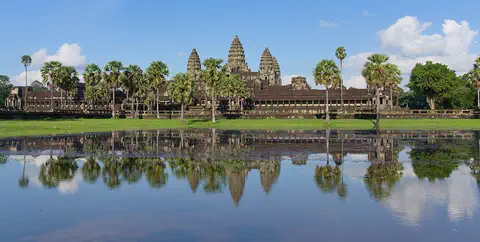
Angkor, in northwestern Cambodia, was the capital of the Khmer Empire from the 9th to the 15th century. Its kings built city after city here, with scores of temples, such as Angkor Wat and the Bayon, and giant reservoirs and canals to water the rice fields. Today it covers about 400 square kilometers, and more than 100,000 people live in villages inside it.
For parents & teachers
What children will learn
- Locate Shaki in the Caucasus Mountains of Azerbaijan.
- Explain how silk farming shaped the town's houses.
- Describe how water channels make Shaki a garden city.
- Discuss how a community helps look after a historic town.
Recommended ages: 3 to 17 · About 15 minutes
Talk about it
- Shaki's houses were built for silkworms in the attic. How does the work people do change the buildings they live in?
- Why do you think people rebuilt their town on higher ground after the mudflow?
- Shaki has a council of elders that helps make decisions. Who helps make decisions in your neighborhood?
Try at home or in class
- Fold a paper house with a tall, steep roof and talk about what could be kept in the attic space.
- Make channels in a tray of sand and pour water in at one end to see how it can be led to different 'gardens'.
Key vocabulary: khan, khanate, silkworm, mudflow, caravanserai, veranda
Where these facts come from
- Wikidata , Wikimedia Foundation (CC0 1.0)
- UNESCO World Heritage List , UNESCO World Heritage Centre (Linked as a reference; site facts come from Wikidata)
- Historic Centre of Sheki with the Khan's Palace , UNESCO World Heritage Centre
- Şäki , Encyclopaedia Britannica
- Wikimedia Commons , Wikimedia Foundation (Per file (public domain, CC0, CC BY or CC BY-SA); see each media record)
Checked, not yet human-reviewed. Last updated October 27, 2026. Spotted a mistake? Tell us.