
Landmark Asia
Agra Fort
Agra Fort is a giant fort made of red stone in Agra, India. Its tall walls go all the way around a city of palaces. Emperors lived there long ago.
Agra Fort is a huge red sandstone fortress beside the Yamuna River in Agra, India. The Mughal emperor Akbar began it in 1565. Its walls, about 2.5 kilometers around, protect palaces, halls and mosques added by later emperors. It was both an army base and a royal home.
Commissioned by Akbar in 1565 on the site of earlier fortifications, Agra Fort is a crescent-shaped red sandstone citadel with 21 m walls and a moat. Shah Jahan and Jahangir added palaces and halls within it, making it, in Britannica's words, a city within a city. It has been a World Heritage Site since 1983.
Photo: Mohd Abul Hasan, CC BY-SA 4.0, via Wikimedia Commons
Discover Agra Fort
Agra Fort is in Agra, a city in India.
It is made of red stone. Its high walls curve around like a giant smile. Inside are palaces, gardens and halls where emperors lived and worked.
Agra Fort stands on the bank of the Yamuna River in the city of Agra, in northern India. It is built of red sandstone and is also known as the Red Fort of Agra. Its walls rise about 21 meters and run about 2.5 kilometers around. A moat surrounds them.
The fort was both an army base and a royal home. When Agra was the capital of the Mughal emperors, the empire was ruled from here. Inside the walls are palaces, audience halls and mosques, so many that it is like a city within a city. The Taj Mahal stands downstream, around a bend in the river.
Britannica describes Agra Fort as a large 16th-century red sandstone fortress on the right bank of the Yamuna, in west-central Uttar Pradesh, which served as military base, royal residence and seat of government while the Mughal capital was at Agra. It is a contemporary of Humayun's Tomb in Delhi, about 200 km to the northwest, and is linked to the Taj Mahal, downstream around a bend of the river, by parkland and gardens.
The walls of the roughly crescent-shaped enclosure run about 2.5 km and rise 21 m (70 ft), surrounded by a moat. UNESCO, which listed the fort in 1983, describes the enclosure as holding the imperial city of the Mughal rulers, with palaces such as the Jahangir Palace and Shah Jahan's Khas Mahal, audience halls such as the Diwan-i-Khas, and two mosques.
- Where
- right bank of the Yamuna River, Agra, Uttar Pradesh, India
- Begun
- 1565, by the emperor Akbar
- Walls
- about 2.5 km around, 21 m high
- World Heritage Site
- 1983
A fortress for three emperors
Long ago, an emperor named Akbar built this fort.
His son and his grandson added beautiful palaces inside. One emperor even had to stay inside the fort for the rest of his life.
The Mughal emperor Akbar ordered the fort in 1565, on a spot where older forts had stood. Building reportedly took eight years. Akbar also built a palace inside for his son, Jahangir.
Later emperors kept adding to the fort, especially Jahangir and his son Shah Jahan, who built marble halls and palaces. In 1658 Shah Jahan's own son, Aurangzeb, became emperor and kept his father confined in the fort until Shah Jahan died in 1666.
Britannica records that Akbar commissioned the fort in 1565, on the site of earlier fortifications, and that construction reportedly took eight years. Akbar built Jahangiri Mahal as a private palace for his son Jahangir; many later structures were added by subsequent Mughal emperors, notably Jahangir and Shah Jahan.
The fort also served as a prison: Aurangzeb, Shah Jahan's son and successor as emperor, had him confined there from 1658 until his death in 1666. Aurangzeb also took the Peacock Throne, which had been kept in the fort's Hall of Private Audience, to Delhi, and the Octagonal Tower near that hall had been the residence of Shah Jahan's wife Mumtaz Mahal.
Walls of red sandstone
The builders used red stone for the high walls.
The walls have round towers and a notched top. A deep ditch called a moat runs around the outside.
Akbar's builders made the fort's great walls from red sandstone. The walls curve around in a rough crescent, like a new moon, and are lined with round towers called bastions. Along the top are battlements, a notched edge of stone.
The walls have two gates. The Delhi Gate, facing west, was the original entrance and is decorated with marble inlay. Today visitors come in through the Amar Singh Gate, facing south, the only way in or out. Inside, the buildings recall Persian and Timurid styles, and some later ones are of white marble.
The enclosure walls are of red sandstone, about 2.5 km in circumference and 21 m high, surrounded by a moat, and the plan is roughly crescent-shaped. Britannica notes two access points: the Delhi Gate, facing west, the original entrance, richly decorated with intricate marble inlays; and the Amar Singh Gate, facing south, now the only way in or out of the complex.
Within, Britannica describes buildings reminiscent of Persian- and Timurid-style architecture forming a city within a city. Shah Jahan's Pearl Mosque is made entirely of white marble, and the Khas Mahal's marble walls were once adorned with flowers depicted in precious gems.
Palaces, halls and a palace of mirrors
Inside the fort are palaces and big halls.
One palace has walls covered with thousands of tiny mirrors! In one hall, the emperor listened to people who came to ask for help.
Inside the walls, Jahangir's Palace is the largest home in the fort. In the Hall of Public Audience, the emperor listened to people's requests and met officials. The Hall of Private Audience was for important visitors, and the famous Peacock Throne was once kept there.
Shah Jahan's Pearl Mosque is made entirely of white marble. The Palace of Mirrors has walls and ceilings set with thousands of small mirrors. Near the Hall of Private Audience rises the Octagonal Tower, where Shah Jahan's wife Mumtaz Mahal lived.
Britannica's list of major buildings: Jahangir's Palace (Jahangiri Mahal), the largest residence in the complex; the Pearl Mosque (Moti Masjid) of Shah Jahan, entirely of white marble; the Hall of Private Audience (Diwan-i-Khas), for distinguished visitors, where the Peacock Throne was kept until Aurangzeb took it to Delhi; and the Octagonal Tower (Musamman Burj), residence of Mumtaz Mahal.
In the Hall of Public Audience (Diwan-i-Am) the emperor heard public petitions and met state officials. The Khas Mahal, the emperor's private palace, had marble walls once adorned with flowers in precious gems; to its northeast, the Palace of Mirrors (Sheesh Mahal) has walls and ceilings inlaid with thousands of small mirrors, in two chambers probably used as baths.
- Largest residence
- Jahangir's Palace (Jahangiri Mahal)
- Pearl Mosque
- white marble, built by Shah Jahan
- Visitors' gate
- Amar Singh Gate, facing south
- Enclosure
- about 2.5 km of walls
Agra Fort today
Today, visitors walk through the big gate and explore the palaces.
Not far away, along the river, is another famous building: the Taj Mahal.
Today Agra Fort is a World Heritage Site, listed by UNESCO in 1983. Visitors cross to the Amar Singh Gate and walk through courtyards, halls and palaces.
The fort and the Taj Mahal are linked by parks and gardens along the Yamuna River. Inside the fort, visitors can see Jahangir's Palace, the white marble Pearl Mosque and the Palace of Mirrors. The Taj Mahal has its own page to explore.
The fort was inscribed on the World Heritage List in 1983 under criterion (iii); UNESCO lists the Taj Mahal as a separate site, and describes the fort's 2.5 km enclosure as holding the imperial city of the Mughal rulers, with palaces, audience halls and two mosques. Visitors enter only by the Amar Singh Gate. Among the buildings inside, Britannica highlights Jahangir's Palace, the Pearl Mosque, the halls of public and private audience, the Khas Mahal and the Palace of Mirrors.
The Taj Mahal lies downstream, around a bend of the Yamuna, linked to the fort by parkland and gardens; its own page covers Shah Jahan's tomb for Mumtaz Mahal.

Amazing facts
-
One palace in the fort is covered with tiny mirrors.
The Palace of Mirrors has thousands of small mirrors set into its walls and ceilings.
The Sheesh Mahal's walls and ceilings are inlaid with thousands of small mirrors.
-
A famous throne shaped like a peacock was kept here.
The famous Peacock Throne was once kept in the fort's Hall of Private Audience, before it was taken to Delhi.
The Peacock Throne was kept in the Diwan-i-Khas until Aurangzeb took it to Delhi.
-
Akbar built a palace for his son inside the fort.
Emperor Akbar built Jahangir's Palace for his son Jahangir. It is the largest home in the fort.
Jahangiri Mahal, built by Akbar as a private palace for his son, is the largest residence in the complex.
-
Only one gate is open for visitors.
The fort has two gates, but today the Amar Singh Gate is the only way in or out.
Of the two gates, only the south-facing Amar Singh Gate is now used; the west-facing Delhi Gate was the original entrance.
Words to know
- fort
- a strong building or group of buildings with walls, made to be defended
- sandstone
- a rock made of sand grains pressed and stuck together
- bastion
- a tower that sticks out from a fort's wall
- battlements
- the notched top edge of a castle or fort wall
- moat
- a deep, wide ditch around a fort's walls
- emperor
- a ruler of an empire, a group of lands under one ruler
Discovery challenge
-
What color is the stone of Agra Fort?
What is Agra Fort mainly built of?
Which stone forms Akbar's walls at Agra Fort?
- Red sandstone
- White snow
- Green glass
Show the answer
Red sandstone
Red! It is made of red sandstone.
Red sandstone, which is why it is also called the Red Fort of Agra.
Red sandstone; later buildings inside by Shah Jahan use white marble.
-
Which emperor started building the fort?
Which Mughal emperor ordered Agra Fort in 1565?
Who commissioned the fort in 1565 on the site of earlier fortifications?
- Akbar
- Napoleon
- Julius Caesar
Show the answer
Akbar
Emperor Akbar!
Akbar, a Mughal emperor; building reportedly took eight years.
Akbar, in 1565; Jahangir and Shah Jahan added much of the interior.
-
What covers the walls of the Palace of Mirrors?
What makes the Palace of Mirrors sparkle?
What is set into the walls and ceilings of the Sheesh Mahal?
- Thousands of small mirrors
- Gold coins
- Seashells
Show the answer
Thousands of small mirrors
Tiny mirrors, thousands of them!
Thousands of small mirrors are set into its walls and ceilings.
Thousands of small inlaid mirrors, in two chambers probably used as baths.
-
Which famous building is near Agra Fort?
Which famous building stands near the fort, along the same river?
Which monument lies downstream of the fort, around a bend of the Yamuna?
- The Taj Mahal
- The Eiffel Tower
- The Colosseum
Show the answer
The Taj Mahal
The Taj Mahal!
The Taj Mahal, linked to the fort by parks and gardens.
The Taj Mahal, joined to the fort by parkland and gardens.
Nearby places
-
Watch
Landmark
Taj Mahal
The Taj Mahal is a white marble tomb in Agra, India, beside the Yamuna River. The Mughal emperor Shah Jahan had it built in memory of his wife, Mumtaz Mahal. More than 20,000 workers spent about 22 years on the tomb, its gardens, a mosque and a great gateway.
-
 Watch
Landmark
Fatehpur Sikri
Fatehpur Sikri, the "City of Victory," was built on a ridge near Agra, India, by the Mughal emperor Akbar from 1571. It was his capital until 1585. Its red sandstone palaces, halls and great mosque still stand, and its gateway, the Buland Darwaza, is 40 meters tall.
-
 Watch
Natural wonder
Ganges
The Ganges, called the Ganga in India, flows about 2,510 kilometers from a glacier in the Himalayas across the plains of northern India to the Bay of Bengal, through India and Bangladesh. Its basin is home to hundreds of millions of people who farm, fish and travel on it. For many Hindus it is the holiest of rivers. Near the sea it builds a giant delta with the Brahmaputra.
-
 Watch
Landmark
Harmandir Sahib (Golden Temple)
Harmandir Sahib, often called the Golden Temple, is the most important gurdwara, or place of worship, for Sikhs. It stands on a small island in a pool in Amritsar, India, and a marble causeway leads out to it. Its upper stories are covered in gilded copper, and its free kitchen serves meals to about 100,000 people a day.
-
 Watch
Natural wonder
Himalayas
The Himalayas are a giant wall of mountains in Asia, between the high Plateau of Tibet and the plains of India. They hold the highest mountains in the world, including Mount Everest. They rose when the land carrying India crashed into Asia, and their snow and ice feed great rivers such as the Ganges and the Indus.
-
 Watch
Natural wonder
Chitwan National Park
Chitwan National Park, in the lowlands of southern Nepal, was Nepal's first national park. Its sal forests, tall grasslands and rivers are home to the second-largest population of greater one-horned rhinoceroses in the world, 694 in 2021, and to Bengal tigers, 145 counted in and around the park in 2026.
-
 Watch
Natural wonder
Ajanta Caves
The Ajanta Caves are about 30 halls and rooms carved by hand into a curving cliff above the Waghora River in western India. Buddhist communities made them in two big phases, starting more than 2,000 years ago. Their wall paintings and stone carvings are some of the most famous ancient art in India, and they have been a UNESCO World Heritage Site since 1983.
-
 Watch
Natural wonder
Mount Everest
Mount Everest, in the Himalayas on the border of Nepal and China, is what Britannica calls the highest mountain in the world. In 2020 China and Nepal announced its height as 8,848.86 meters. It grew as two giant plates of Earth's crust pushed together, and it is still rising a tiny bit each year.
Explore next
-
Watch
 Country
India
India is a huge country in South Asia, shaped like a big triangle pointing into the Indian Ocean. The Himalayas rise along its north, heavy monsoon rains arrive every summer, and about 1.46 billion people (2025) live there, speaking hundreds of languages.
-
Watch
Landmark
Taj Mahal
The Taj Mahal is a white marble tomb in Agra, India, beside the Yamuna River. The Mughal emperor Shah Jahan had it built in memory of his wife, Mumtaz Mahal. More than 20,000 workers spent about 22 years on the tomb, its gardens, a mosque and a great gateway.
-
Watch
Landmark
Fatehpur Sikri
Fatehpur Sikri, the "City of Victory," was built on a ridge near Agra, India, by the Mughal emperor Akbar from 1571. It was his capital until 1585. Its red sandstone palaces, halls and great mosque still stand, and its gateway, the Buland Darwaza, is 40 meters tall.
-
 Watch
Landmark
Topkapı Palace
Topkapı Palace sits on a point of land where the Bosphorus Strait meets the sea in Istanbul. Sultan Mehmed II built it between 1460 and 1478, and for nearly 400 years it was the home of the Ottoman sultans and the center of their government. In 1924 it became a museum.
-
 Watch
Landmark
Al-Aqsa Mosque
Al-Aqsa Mosque stands at the southern end of a huge raised plaza in the Old City of Jerusalem. Built in the early 700s, it has a silver-gray dome, and the golden Dome of the Rock stands nearby. The plaza is important to Muslims and to Jews.
-
 Watch
Landmark
Al-Masjid al-Haram
Al-Masjid al-Haram, the Great Mosque of Mecca in Saudi Arabia, was built around the Kaaba, a cube-shaped building that Muslims face when they pray. It is the most important place of pilgrimage in Islam. In 2026, 1,707,301 pilgrims came to Mecca for the hajj, and the mosque can hold up to about one million worshippers.
-
 Watch
Landmark
Angkor
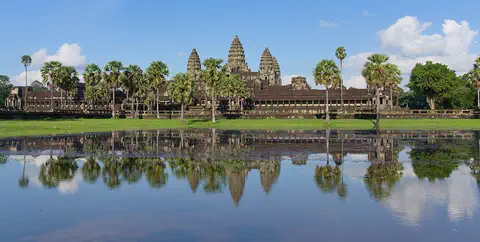
Angkor, in northwestern Cambodia, was the capital of the Khmer Empire from the 9th to the 15th century. Its kings built city after city here, with scores of temples, such as Angkor Wat and the Bayon, and giant reservoirs and canals to water the rice fields. Today it covers about 400 square kilometers, and more than 100,000 people live in villages inside it.
-
Watch
Landmark
Angkor Wat
Angkor Wat, near the town of Siem Reap in Cambodia, was built in the 12th century by the Khmer king Suryavarman II. Britannica (2026) calls it the world's largest religious structure. It was built as a Hindu temple and later became a Buddhist place of worship.
For parents & teachers
What children will learn
- Locate Agra on the Yamuna River and explain that Agra Fort was begun by the Mughal emperor Akbar in 1565.
- Describe how a fort is defended: high walls, bastions, battlements and a moat.
- Name some buildings inside, like Jahangir's Palace and the Palace of Mirrors.
- Connect the fort with the nearby Taj Mahal.
Recommended ages: 3 to 17 · About 15 minutes
Talk about it
- Why do you think the fort was built beside a river?
- The fort was an army base, a royal home and a government center all at once. How might that work?
- Later emperors built in white marble instead of red sandstone. Why might a ruler want a different look?
Try at home or in class
- Build a fort from cardboard with a curved wall, round towers and notched battlements, then add a moat of blue paper.
- Glue small pieces of foil onto a card to make your own mini palace of mirrors, and shine a flashlight on it.
Key vocabulary: fort, sandstone, bastion, battlements, moat, emperor
Where these facts come from
- Wikidata , Wikimedia Foundation (CC0 1.0)
- Agra Fort , Encyclopaedia Britannica
- Agra Fort , UNESCO World Heritage Centre
- UNESCO World Heritage List , UNESCO World Heritage Centre (Linked as a reference; site facts come from Wikidata)
- Wikimedia Commons , Wikimedia Foundation (Per file (public domain, CC0, CC BY or CC BY-SA); see each media record)
Checked, not yet human-reviewed. Last updated October 27, 2026. Spotted a mistake? Tell us.