
Landmark Africa
Great Zimbabwe
Great Zimbabwe is a city of old stone walls in Africa. The Shona people built it long ago. The stones fit together without any cement!
Great Zimbabwe is the ruin of a great stone city in southern Africa, built by the Shona people between about 1100 and 1450. Its walls of granite blocks were laid without mortar. At its height it was the capital of a large state, with more than 10,000 people, and it traded gold for goods from as far away as China.
Built by the Shona between about AD 1100 and 1450, Great Zimbabwe gave its name to the modern country. Its Hill Ruins, Great Enclosure and Valley Ruins, of mortarless granite, testify to the capital of a gold-trading state of over 10,000 people in the 14th century. Archaeology since 1905–1906 has proved its African origin; UNESCO inscribed it in 1986.
Photo: Janice Bell, CC BY-SA 4.0, via Wikimedia Commons
Discover Great Zimbabwe
Great Zimbabwe is in Zimbabwe, a country in southern Africa.
Long ago, it was a big, busy city. Today you can walk among its stone walls. Some walls curve around in a giant ring.
Great Zimbabwe lies about 30 kilometers from the town of Masvingo, in Zimbabwe, at about 1,100 meters above sea level. It was built by the Shona, a Bantu people, between about 1100 and 1450.
The city covered nearly 80 hectares. Its ruins are in three groups: the Hill Ruins on a granite hill, the Great Enclosure below it with its huge curved wall, and the Valley Ruins. The Shona word Zimbabwe means "the house in stone" or "stone houses," and when the modern country became independent in 1980 it took the name Zimbabwe, the name of the old kingdom whose ruins these are.
The monument lies about 30 km from Masvingo, at some 1,100 m, and the protected property covers almost 800 ha; the ancient city itself extended over nearly 80 ha. UNESCO dates it to between 1100 and 1450 AD and divides it into the Hill Ruins, the Great Enclosure and the Valley Ruins.
UNESCO calls the ruins a unique testimony to the Bantu civilization of the Shona between the 11th and 15th centuries, and says the whole Zimbabwean nation identifies with the site and has adopted as its emblem the soapstone bird found there, which may have been a royal totem. UNESCO describes its construction method as unique in African architecture and "unquestionably of Bantu origin." It was inscribed in 1986.
- Where
- about 30 km from Masvingo, Zimbabwe, at about 1,100 m
- Built
- about AD 1100 to 1450, by the Shona
- City area
- nearly 80 hectares (property almost 800 ha)
- World Heritage
- 1986
Capital of a gold-trading state
The Shona people started the city about 900 years ago.
It grew big and rich by trading gold. Later, people moved away to find more food and firewood.
Archaeologists have proved that the Shona founded Great Zimbabwe in the 11th century, the 1000s. By the 14th century it was the main city of a large state that stretched over plateaus rich in gold, and more than 10,000 people lived there.
The city grew wealthy through the gold trade with the east coast of Africa. Archaeologists have found glass beads and pieces of porcelain from China and Persia, and a coin from Kilwa, a trading town on the coast. Around 1450 the people left. The land nearby could no longer grow enough food for so many people, and the trees had been cut down, so firewood was far away.
ICOMOS records that the work of David Randall-MacIver in 1905–1906, confirmed by dated artifacts and carbon-14 analysis, proved that Great Zimbabwe was founded in the 11th century by an Iron Age Bantu population, the Shona, on a sparsely inhabited site. For centuries, some outside writers had claimed that foreigners built it; ICOMOS calls those claims absurd.
In the 14th century it was the principal city of a major state on the gold-rich plateaux, with over 10,000 inhabitants. Its wealth was tied to gold trading and coastal trade centered on Kilwa; excavations found Chinese and Persian glass beads and porcelain and a 14th-century coin from Kilwa. About 1450 the capital was abandoned, ICOMOS says not because of war but because the hinterland could no longer feed the city and deforestation made firewood ever harder to find. The migration benefited Khami.
Walls without mortar
The builders stacked granite stones very carefully.
They used no cement at all! The stones stay up because they fit so well together.
Great Zimbabwe was built of granite, a hard stone found all around the site. On the hill, builders joined the huge natural granite boulders with walls of rough stones to make enclosures, reached by narrow passages.
In the Great Enclosure, they used cut granite blocks laid in neat, even rows, with no mortar to hold them together. In 1552 a Portuguese writer described the walls as being of impressive size, with no mortar that could be seen holding them. Homes inside were huts made of daga, a mix of granite sand and clay.
On the Hill, 13th-century walls of rough granite rubble connect the natural granite masses to form two enclosures reached by narrow, partly covered passages. The Great Enclosure, of the 14th century, uses cut granite blocks laid in regular courses; UNESCO calls the method of construction unique in African architecture, and in 1552 the chronicler João de Barros, reporting traders' accounts, wrote of walls of impressive size that no mortar seemed to hold together.
Dwellings were huts of daga, a pisé of granitic sand and clay. Inside the Great Enclosure, walls divide community areas into family spaces, generally a kitchen, two living huts and a court. The Valley Ruins add brick huts, benches and basins, with chevron and checkered wall decoration.
The Great Enclosure and its tower
The Great Enclosure is a giant ring of stone wall.
Inside is a tall stone tower shaped like a cone. Experts were not sure what it was for!
The Great Enclosure is shaped like an oval. Its outer wall of cut granite is about 7 meters high and about 5.5 meters thick at the bottom, and a pattern of zigzags, called chevrons, runs along the top. Inside, a narrow passage between two walls leads to a cone-shaped stone tower about 11 meters high. In 1985 experts reported that no one knew what the tower was for. A smaller cone-shaped tower stands nearby.
On the hill, archaeologists found six soapstone posts topped with carved birds. A bird like these is now the national emblem of Zimbabwe.
ICOMOS describes the Great Enclosure as an ellipse bounded by a wall of cut granite about 7 m high and 5.5 m thick at the base, topped by a frieze with two rows of chevrons; a second, inner wall was never completed. Between the two walls a narrow passage leads to a conical tower about 11 m high, whose purpose, ICOMOS wrote in 1985, was not known, with a smaller conical tower nearby.
The Hill Ruins are generally considered a royal city: the west enclosure is thought to have been the residence of successive chiefs, and the east enclosure, where six soapstone (steatite) posts topped with birds were found, is considered to have had a ritual purpose. The photo, taken from the hill according to its record, shows the oval wall of the Great Enclosure with trees inside and other stone walls beyond.
- Great Enclosure wall
- about 7 m high and 5.5 m thick at the base
- Conical tower
- about 11 m high; purpose not known (ICOMOS, 1985)
- Soapstone birds
- six, on posts in the Hill Ruins' east enclosure
- Population
- over 10,000 in the 14th century
Great Zimbabwe today
Today, Great Zimbabwe is a national monument.
Visitors walk the paths between the walls. Workers protect the stones and the plants around them.
Great Zimbabwe is a national monument looked after by Zimbabwe's National Museums and Monuments. It has been a UNESCO World Heritage Site since 1986.
The land around the ruins matters too. Keeping the natural setting healthy helps protect the old walls and shows how the city fitted into its landscape. Workers try to control plants that do not belong there, such as a spreading shrub called lantana.
The property is managed by the National Museums and Monuments administration. UNESCO stresses that the natural environment of the Great Zimbabwe Estate matters for the survival of the remains and for understanding the link between buildings and setting; native wildlife has largely been lost to poaching, and the invasive shrub Lantana camara must be kept under control.
ICOMOS also recorded that a UNESCO mission in 1982 had noted damage where stone walls had collapsed from various causes. The site's soapstone bird appears as the emblem of the modern state.
Amazing facts
-
The country Zimbabwe is named after this stone city.
The Shona word Zimbabwe means "the house in stone," and the whole country is named after these ruins.
UNESCO glosses Zimbabwe as "the house in stone" (ICOMOS: "stone houses"); the nation has adopted the site's soapstone bird as its emblem.
-
Experts were not sure what the tall stone tower was for.
Inside the Great Enclosure stands a cone-shaped stone tower about 11 meters high. In 1985 ICOMOS reported that its purpose was not known.
ICOMOS stated in 1985 that the purpose of the 11 m conical tower was not known.
-
A coin from a faraway trading town was found here.
Archaeologists found a 14th-century coin from Kilwa, a trading town on the coast of East Africa.
A 14th-century Arab coin from Kilwa, itself a World Heritage Site, was excavated at Great Zimbabwe.
-
The inside wall of the Great Enclosure was never finished.
The Great Enclosure has a second wall inside the first one, but the builders never finished it.
A second inner wall of the Great Enclosure was never completed; the passage between the two walls leads to the conical tower.
Words to know
- granite
- a very hard rock with tiny speckles
- mortar
- a paste that hardens to stick bricks or stones together
- enclosure
- an area surrounded by a wall or fence
- daga
- a building mix of granite sand and clay used for huts
- chevron
- a V-shaped pattern, like a zigzag
- emblem
- a picture or sign that stands for a country or group
Discovery challenge
-
Who built Great Zimbabwe?
Which people built Great Zimbabwe?
Which Iron Age Bantu population did archaeology prove founded Great Zimbabwe?
- The Shona
- The Romans
- The Vikings
Show the answer
The Shona
The Shona people!
The Shona, between about 1100 and 1450.
The Shona, as Randall-MacIver's 1905–1906 work and carbon-14 dates proved.
-
What holds the stones together?
What holds the stones of the Great Enclosure wall together?
How are the granite blocks of the Great Enclosure laid?
- Careful stacking, no cement
- Glue
- Metal bolts
Show the answer
Careful stacking, no cement
Just careful stacking. No cement!
Nothing but their weight and careful fit: there is no mortar.
In regular courses, without mortar.
-
What did the city trade to get rich?
Which metal made Great Zimbabwe rich?
Trade in which commodity was Great Zimbabwe's wealth associated with?
- Gold
- Iron nails
- Silver spoons
Show the answer
Gold
Gold!
Gold, traded with the east coast of Africa.
Gold, through trade centered on Kilwa.
-
Why did people leave the city?
Why was Great Zimbabwe abandoned around 1450?
What reasons does ICOMOS give for the abandonment of about 1450?
- Not enough food and firewood nearby
- A volcano erupted
- The river flooded it
Show the answer
Not enough food and firewood nearby
There was not enough food and firewood.
The land nearby could not feed so many people, and the trees were cut down.
The hinterland could no longer feed the city, and deforestation made firewood scarce; not war.
Nearby places
-
 Watch
Landmark
Kariba Dam
The Kariba Dam is a curved concrete dam across the Zambezi River, between Zambia and Zimbabwe. It is 128 meters high. It was built between 1956 and 1960, and its lake, Lake Kariba, is 280 kilometers long. Two power stations use the water to make electricity.
-
 Watch
Natural wonder
Victoria Falls
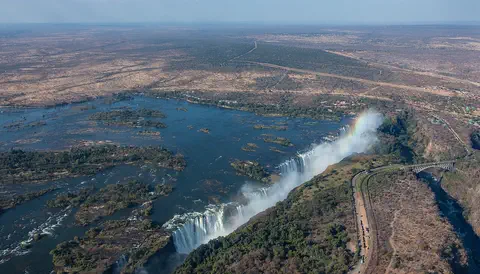
Victoria Falls, on the Zambezi River between Zambia and Zimbabwe, is about 1,708 meters wide and up to 108 meters deep. UNESCO calls it the largest curtain of falling water in the world, and its spray can be seen from tens of kilometers away.
-
 Watch
City
Lusaka
Lusaka is the capital of Zambia, an African country with no coast. Zambia's 2022 census counted 2,212,301 people in the city, by far the most in the country. Lusaka was planned in the 1930s as a new capital and officially opened in 1935.
-
 Watch
City
Maputo
Maputo is the capital of Mozambique, on a bay of the Indian Ocean in the far south of the country. Mozambique's statistics office projected 1,133,200 people in Maputo City in 2023. Until 1976 the city was called Lourenço Marques.
-
 Watch
City
Benoni
Benoni is a town in South Africa, near Johannesburg, in a region called the Witwatersrand. The encyclopedia Larousse names gold mines and electrical-machine making in Benoni. South Africa's 2011 census counted 158,777 people in the town.
-
 Watch
City
Gaborone
Gaborone is the capital of Botswana, in southern Africa. It was built as a new capital in the 1960s, almost ready when Botswana became independent in 1966. Planned for 20,000 people, it counted 246,325 in the 2022 census.
-
 Watch
Landmark
Cradle of Humankind
The Cradle of Humankind is a landscape of grassy hills and limestone caves near Johannesburg, South Africa. Its caves, such as Sterkfontein, Swartkrans and Kromdraai, have held fossils of early human relatives, other animals and stone tools. It became a UNESCO World Heritage Site in 1999.
-
 Watch
City
Johannesburg
Johannesburg is South Africa's most populous city, high on the country's central plateau. It grew very fast after gold was discovered in the Witwatersrand in 1886. Today it is the capital of Gauteng province, and the 2022 census counted 4,803,262 people in the City of Johannesburg.
Explore next
-
Watch
 Country
Zimbabwe
Zimbabwe is a landlocked country in southern Africa, high on a wide plateau between the Zambezi and Limpopo rivers. It shares Victoria Falls with Zambia, and its name is a Shona word meaning "stone houses", the name of the great stone city of Great Zimbabwe.
-
Watch
Natural wonder
Victoria Falls
Victoria Falls, on the Zambezi River between Zambia and Zimbabwe, is about 1,708 meters wide and up to 108 meters deep. UNESCO calls it the largest curtain of falling water in the world, and its spray can be seen from tens of kilometers away.
-
 Watch
Landmark
Great Mosque of Djenné
The Great Mosque of Djenné is a huge earthen building in the old town of Djenné in Mali. It was rebuilt in 1906–1907, and its walls of earth are kept in shape by plastering campaigns every year. It is part of the Old Towns of Djenné World Heritage Site.
-
 Watch
Landmark
Machu Picchu
Machu Picchu is a 15th-century Inca town on a ridge high in the Andes Mountains of Peru. Its stone buildings fit together without mortar, and farm terraces step down the slopes. It was left empty in the 1500s and became known to the outside world in 1911.
-
 Watch
Landmark
Egyptian pyramids
Egypt's pyramids were giant stone tombs for kings. They did not start out pointed: the first, King Djoser's Step Pyramid, was a stack of six giant steps. King Snefru's builders tried again and again, making the Bent Pyramid and then the Red Pyramid, the first planned true pyramid. Soon after came the great pyramids of Giza.
-
 Watch
Landmark
Kasubi Tombs
The Kasubi Tombs stand on Kasubi hill in Kampala, Uganda. The main building, a huge round house with a domed roof of thatch, was built in 1882 as a palace for the Kabaka, the king of Buganda, and became the burial place of four kings. After a fire in 2010 it was rebuilt, and the work was finished in 2023.
-
 Watch
Landmark
Abu Simbel
Abu Simbel is two temples cut into the rock by King Ramesses II of Egypt, around 1264 BCE. Four seated statues of the king, each 21 meters tall, guard the Great Temple. In the 1960s, a new dam was about to flood them, so workers cut them into more than a thousand blocks and rebuilt them higher up.
-
 Watch
Landmark
Aït Benhaddou
Aït Benhaddou is a ksar, a village of earthen buildings inside high walls, on the southern slopes of the High Atlas mountains in Morocco. Its oldest buildings probably date from no earlier than the 1600s. It was a stop on an old trade route to Marrakesh, and it became a UNESCO World Heritage Site in 1987.
For parents & teachers
What children will learn
- Locate Great Zimbabwe and describe it as a Shona city built between about 1100 and 1450.
- Explain how dry-stone walls stand without mortar.
- Understand how archaeology, including carbon-14 dating, proved who built the city.
Recommended ages: 4 to 17 · About 15 minutes
Talk about it
- Why might a city run out of food and firewood if it grows very large?
- For a long time some outsiders refused to believe the Shona built Great Zimbabwe. Why is evidence so important?
- Why do you think Zimbabwe chose a bird from the ruins as its emblem?
Try at home or in class
- Build a small wall of flat stones or wooden blocks without glue. How high can you go before it wobbles?
- Draw a chevron pattern like the one along the top of the Great Enclosure wall.
Key vocabulary: granite, mortar, enclosure, daga, chevron, emblem
Where these facts come from
- Wikidata , Wikimedia Foundation (CC0 1.0)
- Great Zimbabwe National Monument , UNESCO World Heritage Centre
- Advisory Body Evaluation: Great Zimbabwe National Monument (No 364) , ICOMOS, via UNESCO World Heritage Centre
- Zimbabwe , Encyclopædia Universalis (French)
- UNESCO World Heritage List , UNESCO World Heritage Centre (Linked as a reference; site facts come from Wikidata)
- Wikimedia Commons , Wikimedia Foundation (Per file (public domain, CC0, CC BY or CC BY-SA); see each media record)
Checked, not yet human-reviewed. Last updated November 1, 2026. Spotted a mistake? Tell us.