
Natural wonder Africa
Île Saint-Paul
Île Saint-Paul is a tiny volcanic island far out in the Indian Ocean. The sea has flooded the old crater in its middle!
Île Saint-Paul is a small island of only about 8 square kilometers in the southern Indian Ocean. It is a young volcano whose crater collapsed and was flooded by the sea, and albatrosses nest on it.
Île Saint-Paul (about 8 km2), in the French Southern and Antarctic Lands, is a young volcano whose caldera collapsed and was overrun by the sea (ACAP). It is part of UNESCO's French Austral Lands and Seas (2019), and rats and rabbits were eradicated from it in 1997.
Photo: Antoine Lamielle, CC BY-SA 4.0, via Wikimedia Commons
Discover Île Saint-Paul
Île Saint-Paul is a small island. It is far out in the ocean.
In this photo, its flat top and steep cliffs rise from the waves.
Île Saint-Paul is part of the French Southern and Antarctic Lands. It lies in the southern Indian Ocean, 85 kilometers south of Île Amsterdam, and covers only about 8 square kilometers, says the Agreement on the Conservation of Albatrosses and Petrels (ACAP).
This photo by Antoine Lamielle, taken from the sea on 23 November 2020, shows the low, flat-topped island with steep cliffs of red and gray rock layers, dark rough water in front and clouds in a blue sky.
UNESCO: the French Austral Lands and Seas, between the 37th and 50th parallels south, comprise the largest of the rare emerged landmasses of the southern Indian Ocean, among them the Crozet Archipelago, the Kerguelen Islands and Saint-Paul and Amsterdam Islands. ACAP: Saint-Paul is a small island of only eight square kilometers.
The photo (Antoine Lamielle, CC BY-SA 4.0, 23 November 2020; 'the Saint-Paul island seen from the sea, TAAF') shows the island's profile with layered cliffs above a rough sea.
- Area (about)
- 8 km²
- Ocean
- southern Indian Ocean
- Part of a World Heritage Site
- since 2019
A crater full of sea
Île Saint-Paul is the top of a volcano.
Its middle fell in, and the sea flowed into the hole. Now the sea fills the old crater.
ACAP describes Île Saint-Paul as a young volcano. Its caldera, the great bowl at the top of the volcano, collapsed, and the sea flowed in to fill the crater. So the island has a crater full of seawater, with albatrosses nesting on the inside of the crater and on the cliffs along the coast.
In the photo you can see layers of red and gray rock in the cliffs.
ACAP (2013): 'Saint-Paul is a young volcano where the caldera has collapsed allowing the sea to overrun the crater.' Albatrosses nest on the inside of the crater, and others on the island's coastal cliffs.
The photo shows the cliffs' red and gray layers from the sea.
Albatrosses and petrels
Big seabirds called albatrosses nest on the island.
Small seabirds have started coming back too.
Two kinds of albatross breed on Île Saint-Paul, ACAP reports: fewer than 10 pairs of Indian yellow-nosed albatrosses inside the crater, and fewer than 50 pairs of sooty albatrosses on the coastal cliffs.
In 1997, black rats and European rabbits were removed from the island. By 2013, ACAP reported, burrowing seabirds called petrels were slowly coming back, especially MacGillivray's prion, which ACAP calls endemic (found only here).
ACAP: two ACAP-listed species breed: Indian yellow-nosed albatross (Thalassarche carteri, fewer than 10 pairs, inside the crater) and sooty albatross (Phoebetria fusca, fewer than 50 pairs, coastal cliffs). Ship rats and European rabbits were eradicated in 1997; house mice were not eradicated; recent visits (2013) showed burrowing petrels slowly recolonizing, especially the endemic MacGillivray's prion (Pachyptila macgillivrayi).
UNESCO: the wider site has the world's largest populations of king penguins and yellow-nosed albatrosses and 8 endemic species, including the Amsterdam albatross.
A protected ocean wilderness
Nobody lives on these far-away islands.
They are protected so the birds and seals can stay safe.
Île Saint-Paul is part of the French Austral Lands and Seas, which UNESCO added to the World Heritage List in 2019. The site covers more than 166 million hectares of islands and sea and is one of the largest marine protected areas in the world.
UNESCO says the islands are uninhabited and far from centers of human activity, so their wildlife and habitats are almost untouched.
UNESCO (1603; inscribed 2019, criteria vii, ix, x; 166,267,100 ha): one of the largest marine protected areas in the world, over 1,662,000 km2; uninhabited ecosystems with large native populations in quasi-intact habitats; extremely productive waters; managed by the National Nature Reserve of the French Austral Lands and Seas. ACAP's reference list dates the nature reserve to a decree of 3 October 2006.
Safe at sea
The sea around the island is rough.
On a boat, always wear a life jacket.
Île Saint-Paul is uninhabited and lies far out in the open ocean, where the water in the photo is dark and rough.
The CDC says life jackets reduce the risk of drowning while boating, for people of all ages and swimming abilities. Children should wear one for all activities in and around natural water.
UNESCO: the islands are uninhabited and remote from centers of human activity. CDC: life jackets reduce drowning risk while boating for all ages and swimming abilities; children should use them for all activities in and around natural water; supervise children closely.
Amazing facts
-
A seabird called MacGillivray's prion lives only on this island.
MacGillivray's prion, a small burrowing seabird found only here, was slowly coming back by 2013, after rats and rabbits were removed in 1997 (ACAP).
ACAP (2013): burrowing petrels were slowly recolonizing, especially the endemic MacGillivray's prion, although house mice were not eradicated.
-
Some albatrosses build their nests inside the flooded crater.
Indian yellow-nosed albatrosses nest on the inside of the island's crater.
ACAP: a small colony of fewer than 10 pairs of Indian yellow-nosed albatrosses occurs on the inside of the crater.
-
The protected area around these islands is huge!
The World Heritage Site that includes Île Saint-Paul is one of the largest marine protected areas in the world, over 1,662,000 square kilometers.
UNESCO: the French Austral Lands and Seas cover 166,267,100 ha, one of the world's largest marine protected areas.
Words to know
- caldera
- a huge bowl left when a volcano's top collapses
- albatross
- a large seabird with very long wings that glides over the ocean
- petrel
- a seabird of the open ocean; many kinds nest in burrows
- endemic
- found naturally in only one place
- eradicate
- to remove a plant or animal from a place completely
Discovery challenge
-
In which ocean is Île Saint-Paul?
Île Saint-Paul lies in the south of which ocean?
In which ocean do the French Austral Lands and Seas lie, according to UNESCO?
- The Indian Ocean
- The Arctic Ocean
- The Atlantic Ocean
Show the answer
The Indian Ocean
The Indian Ocean.
The southern Indian Ocean.
The southern Indian Ocean (UNESCO).
-
What flowed into the island's old crater?
What filled Île Saint-Paul's crater after its caldera collapsed?
What overran the crater when the caldera collapsed (ACAP)?
- The sea
- Lava
- Ice
Show the answer
The sea
The sea.
The sea.
The sea (ACAP).
-
Which big seabirds nest on the island?
Which large seabirds breed on Île Saint-Paul?
Which two ACAP-listed birds breed on the island?
- Albatrosses
- Flamingos
- Ostriches
Show the answer
Albatrosses
Albatrosses.
Indian yellow-nosed and sooty albatrosses.
Indian yellow-nosed and sooty albatrosses (ACAP).
-
In which year were the rats and rabbits removed?
In which year were black rats and rabbits removed from Île Saint-Paul?
In which year were ship rats and European rabbits eradicated?
- 1997
- 1897
- 2017
Show the answer
1997
1997.
1997.
1997 (ACAP).
-
What should you wear on a boat?
What does the CDC say reduces the risk of drowning while boating?
What does the CDC say children should wear for all activities in and around natural water?
- A life jacket
- A rain hat
- Flippers
Show the answer
A life jacket
A life jacket.
A life jacket.
A life jacket (CDC).
Nearby places
-
 Watch
Natural wonder
Indian Ocean
The Indian Ocean is the third-largest ocean basin, after the Pacific and the Atlantic. Off the coast of East Africa, a current called the Somali Current changes direction with the seasons. Its deepest known point lies in the Java Trench, 7,187 meters down.
-
 Watch
City
Port Louis
Port Louis is the capital and largest port of Mauritius, an island country in the Indian Ocean. It was founded around 1736 as a stopping place for ships sailing between Europe and Asia. The 2022 census counted 140,403 people in the town.
-
 Watch
City
Saint-Denis
Saint-Denis is the main town of Réunion, a volcanic island in the Indian Ocean east of Madagascar. It lies on the island's north coast, between two rivers, with mountains around it. In 2023, 155,634 people lived in its commune, according to France's statistics office.
-
 Watch
Natural wonder
Southern Ocean
The Southern Ocean surrounds Antarctica; the United States defines it as the water from the coast out to 60 degrees south. It is the newest named ocean. A mighty current, the Antarctic Circumpolar Current, flows all the way around the planet here, and in spring and summer the sea fills with tiny algae and krill that feed penguins, seals and whales.
-
 Watch
City
Perth
Perth is the capital of Western Australia, on the north bank of the Swan River. It began as the Swan River Colony in 1829, on the land of the Whadjuk Nyoongar people. The Australian Bureau of Statistics estimated 2,452,765 people in Greater Perth in June 2025.
-
 Watch
City
Antananarivo
Antananarivo, once called Tananarive, is the capital of Madagascar. Madagascar's 2018 census counted 1,274,225 people in the city, almost four times as many as in Toamasina, the next city. It lies about 1,250 meters up in the island's highlands, and rice fields still mark its edges.
-
 Watch
City
Mamoudzou
Mamoudzou is the main town of Mayotte, on the island of Grande-Terre in the Indian Ocean. It faces a huge lagoon ringed by a coral reef, where humpback whales come to have their babies. The census of 2025–2026 counted about 94,600 people in Mamoudzou.
-
 Watch
City
Durban
Durban is a port city on the Indian Ocean coast of South Africa, in KwaZulu-Natal. Universalis calls its harbor the largest port in South Africa. The 2011 census counted 2,786,046 people in the Durban urban area.
Explore next
-
 Watch
Natural wonder
Macquarie Island
Macquarie Island lies in the Southern Ocean, about halfway between Australia and Antarctica. UNESCO says it is the only place on Earth where rocks from deep in the Earth's mantle are being pushed above sea level, and millions of seabirds and penguins come there.
-
 Watch
Natural wonder
Aldabra Atoll
Aldabra Atoll is a ring of four main coral islands around a shallow lagoon, far out in the Indian Ocean. It is part of Seychelles, more than 1,000 kilometers from the main island, Mahé. So few people have lived there that its wildlife has been left mostly alone, including the largest population of giant tortoises in the world.
-
 Watch
 Country
France
France is a country in northwestern Europe, between the Atlantic Ocean and the Mediterranean Sea. It has high mountains such as the Alps and the Pyrenees, long rivers such as the Loire and the Seine, and about 69.1 million people (2026). Its capital is Paris.
- Watch Geography Islands An island is a piece of land surrounded by water that is smaller than a continent. Islands form in different ways: some broke away from continents, some were built by volcanoes on the sea floor, and some were made by corals or by waves piling up sand. Because they are cut off by water, islands often have unusual plants and animals.
-
 Watch
Natural wonder
Victoria Falls
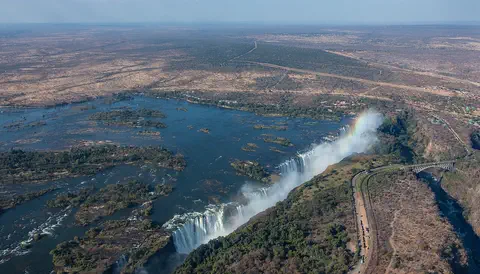
Victoria Falls, on the Zambezi River between Zambia and Zimbabwe, is about 1,708 meters wide and up to 108 meters deep. UNESCO calls it the largest curtain of falling water in the world, and its spray can be seen from tens of kilometers away.
-
 Watch
Natural wonder
Sahara
The Sahara fills almost all of northern Africa. Britannica calls it the largest hot desert in the world: about 4,800 kilometers from east to west and about 8.6 million square kilometers in all. Only about a quarter of it is sand dunes; the rest is gravel plains, rocky plateaus and mountains.
-
 Watch
Natural wonder
Mount Kilimanjaro
Mount Kilimanjaro, in northeastern Tanzania, is what UNESCO calls the highest mountain in Africa: its top is 5,895 meters high. It is a huge volcanic mountain standing alone above the plains, and as you climb it you pass through farms, forest, moorland and high alpine desert to its icy top.
-
 Watch
Natural wonder
Serengeti National Park
Serengeti National Park in northern Tanzania protects 14,763 square kilometers of grassy plains and woodlands. Each year more than a million wildebeest, with zebras and gazelles, travel a great loop across the Serengeti and into Kenya in search of grass and water, followed by lions and other predators.
For parents & teachers
What children will learn
- Locate Île Saint-Paul in the southern Indian Ocean.
- Explain what a caldera is and how the sea can fill one.
- Describe how removing rats and rabbits from an island can help seabirds.
- Explain why remote islands are protected.
Recommended ages: 3 to 17 · About 15 minutes
Talk about it
- Why might rats and rabbits harm seabirds that nest on the ground or in burrows?
- Why do so many seabirds nest on small, remote islands?
- What makes a marine protected area important?
Try at home or in class
- Shape a volcano from sand in a tray, scoop out its top to make a caldera, then cut a gap in one side and pour in water.
- On a world map, find the southern Indian Ocean and Île Saint-Paul, between Africa and Australia.
Key vocabulary: caldera, albatross, petrel, endemic, eradicate
Where these facts come from
- Wikidata , Wikimedia Foundation (CC0 1.0)
- ACAP Breeding Site No. 36: Île Saint-Paul, with its spectacular flooded crater , Agreement on the Conservation of Albatrosses and Petrels (ACAP)
- French Austral Lands and Seas (World Heritage List) , UNESCO World Heritage Centre
- Preventing Drowning , US Centers for Disease Control and Prevention
- Saint-Paul Island seen from the sea (Wikimedia Commons file page) , Wikimedia Commons
- Wikimedia Commons , Wikimedia Foundation (Per file (public domain, CC0, CC BY or CC BY-SA); see each media record)
Checked, not yet human-reviewed. Last updated November 1, 2026. Spotted a mistake? Tell us.