
Natural wonder Australia and Oceania
Mount Kosciuszko
Mount Kosciuszko is the highest mountain on mainland Australia. Its top is rounded, and snow covers it in winter. Long ago, glaciers carved lakes nearby.
Mount Kosciuszko, 2,228 meters high, is the highest mountain on the Australian mainland (Geoscience Australia). It rises from the rolling tablelands of the Snowy Mountains, where glaciers once carved Blue Lake, and rare alpine plants and animals live.
Mount Kosciuszko (2,228 m, Geoscience Australia) tops the Snowy Mountains, part of the Great Dividing Range. Exposure dating shows glaciers advanced on the Kosciuszko massif before about 59,300 years ago and again about 32,000, 19,100 and 16,800 years ago, leaving cirque lakes such as Blue Lake.
Photo: John Wormell, CC BY-SA 4.0, via Wikimedia Commons
Discover Mount Kosciuszko
Mount Kosciuszko is in the southeast of Australia. No mountain on the Australian mainland is higher.
In this photo, you look across grassy hills toward Mount Kosciuszko. Gray rocks sit in front.
Geoscience Australia lists Mount Kosciuszko at 2,228 meters, the highest mountain on the Australian mainland. It stands in the Snowy Mountains of New South Wales, in Kosciuszko National Park. The explorer Paul Strzelecki named it in 1840 after Tadeusz Kosciuszko.
John Wormell took this photo on 9 January 2007 from Mount Townsend, Australia's second-highest peak, looking toward Mount Kosciuszko over rounded, grassy slopes.
Geoscience Australia's list (from its 1993 National Geodetic database and the National Gazetteer) puts Mount Kosciuszko first at 2,228 m, ahead of Mount Townsend (2,209 m) and Mount Twynam (2,195 m); it notes that ranking peaks always involves some judgment. National Geographic Education adds that Strzelecki named the mountain in 1840 after Tadeusz Kosciuszko and that it is sometimes counted among the Seven Summits.
The hero photo, by John Wormell (9 January 2007), is captioned 'View from Mount Townsend towards Mount Kosciuszko': rolling alpine slopes, rocky outcrops and boulders in the foreground.
- Height
- 2,228 m, the highest on the Australian mainland
- Second-highest peak
- Mount Townsend, 2,209 m
- Named
- 1840, by the explorer Paul Strzelecki
Tablelands and old glaciers
The land here is high but rolling, like big, smooth waves.
Long ago, when the world was colder, glaciers slid down the mountains and dug lakes.
Geoscience Australia describes the Snowy Mountains as undulating tablelands: high, gently rolling land. They are part of the Great Dividing Range.
During the last ice ages, glaciers formed in a small area of the southeastern highlands, on the Kosciuszko massif. Scientists at the Australian National University dated rocks they left behind and found glaciers advanced more than once, the last time about 16,800 years ago. Their ice scooped out bowl-shaped hollows that now hold lakes.
Geoscience Australia places the mainland's highest mountains in the Snowy Mountains and the Victorian Alps, part of the Great Dividing Range, and describes the Snowy Mountains as typically undulating tablelands.
Barrows and colleagues (Quaternary Research, 2001) report that Late Pleistocene glaciation of the Australian mainland was restricted to a small area of the southeastern highlands. Using cosmogenic beryllium-10 exposure dating, they found an Early Kosciuszko glaciation (the Snowy River Advance, before 59,300 ± 5,400 years ago) and a Late Kosciuszko glaciation of three progressively smaller advances: 32,000 ± 2,500 (Headley Tarn), 19,100 ± 1,600 (Blue Lake) and 16,800 ± 1,400 years ago (Mt. Twynam).
Blue Lake
Blue Lake sits in a round, bowl-shaped valley that ice dug long ago.
In spring and autumn, the water can mix all the way through the lake.
Blue Lake, in Kosciuszko National Park, is one of only four cirque lakes on mainland Australia, says the New South Wales government. A cirque is a bowl-shaped valley carved by a glacier.
Twice a year, in spring and autumn, the lake's cold and warm layers reach the same temperature and can mix. Blue Lake and Hedley Tarn, a smaller lake just downstream, became a Ramsar wetland of international importance in 1996.
NSW Environment and Heritage describes Blue Lake as one of only 4 cirque lakes on mainland Australia, in an amphitheater-shaped valley formed by glacial erosion. It has a dimictic thermal regime: its layers reach the same temperature in spring and autumn and can mix throughout, which helps regulate the temperature of the water flowing out.
The site, with Hedley Tarn about 400 m downstream, was listed under the Ramsar Convention in 1996 as a rare example of near-natural alpine wetlands, surrounded by alpine herb fields, heaths, fens and bogs.
Life above the treeline
A pygmy possum and a rare frog live in these mountains.
Special plants grow where snow stays late.
Kosciuszko National Park protects rare and endemic plants and animals, including the mountain pygmy possum and the corroboree frog. Around Blue Lake live threatened species such as the alpine tree frog and the anemone buttercup.
On the Main Range, a special plant community called Snowpatch Feldmark grows only where snow lies late. It was listed as critically endangered in 2018: it covers only a small area, and snow in the Snowy Mountains has been getting shallower and lying for less time.
A NSW National Parks education program describes the park as home to rare, endangered and endemic plants and animals, including the mountain pygmy possum and the corroboree frog. The Blue Lake Ramsar site supports the mountain pygmy possum, alpine tree frog and anemone buttercup, and alpine-only plants such as the snow buttercup and snowpatch cushion-plant.
In 2018 the NSW Threatened Species Scientific Committee listed Snowpatch Feldmark as a critically endangered ecological community. It is restricted to late-lying snowpatches, with an extent of occurrence of 104 km², and the committee cites evidence that snow depth and cover duration in the Snowy Mountains have declined since the late 19th century.
Visiting safely
The weather on the mountain can change very fast. Snow can fall at any time.
Check the weather first, and stay with your grown-up.
NSW National Parks says the walk from Thredbo to the summit is 13 kilometers return and takes 4 to 5 hours, with steep bits and many steps. Weather can change quickly in the Snowy Mountains, and snow can fall at any time, so check the forecast and don't set out if bad weather is coming.
In winter the track is buried in snow, and walking it is not recommended. Mobile phone coverage is limited.
NSW National Parks grades the Thredbo-to-summit walk as Grade 3: 13 km return, 4-5 hours, short steep hills and many steps. Its safety messages: weather can change quickly and snow can fall at any time; alpine conditions can be extreme and change rapidly, particularly in winter, when the track is snowbound and walking is not recommended; mobile reception is limited; recreational drones are prohibited.
National Geographic Education notes that a chairlift takes hikers most of the way up, leaving a walk of about 6 km to the summit.
Amazing facts
-
Australia's second-highest mountain is in the same mountains as Mount Kosciuszko. This photo was taken from it!
This photo was taken from Mount Townsend, which Geoscience Australia lists as Australia's second-highest peak at 2,209 meters.
Geoscience Australia's top three are Mount Kosciuszko (2,228 m), Mount Townsend (2,209 m) and Mount Twynam (2,195 m), all in the Snowy Mountains.
-
Blue Lake's water can mix all the way through twice a year.
Blue Lake's warm and cold layers can mix twice a year, in spring and autumn.
Blue Lake is dimictic: its whole water column can mix in both spring and autumn, which helps regulate the temperature of its outflow.
-
A chairlift carries walkers most of the way up.
A chairlift takes hikers most of the way up, and then they walk about 6 kilometers to the top.
National Geographic Education notes that, after the chairlift, the summit is about a 6 km walk, making it one of the easier Seven Summits climbs.
Words to know
- tableland
- a high, wide area of land with a fairly flat or gently rolling top
- cirque
- a bowl-shaped valley high on a mountain, carved by a glacier
- glacier
- a huge mass of ice that slowly moves downhill
- alpine
- having to do with high mountains, especially the area above where trees grow
- critically endangered
- at extremely high risk of disappearing in the wild
Discovery challenge
-
How high is Mount Kosciuszko?
How high is Mount Kosciuszko, according to Geoscience Australia?
What height does Geoscience Australia give for Mount Kosciuszko?
- 2,228 meters
- 228 meters
- 8,848 meters
Show the answer
2,228 meters
2,228 meters.
2,228 meters, the highest on the Australian mainland.
2,228 m (1993 National Geodetic database).
-
What dug the bowl that holds Blue Lake?
What carved the bowl-shaped valley that holds Blue Lake?
Which process formed Blue Lake's amphitheater-shaped valley?
- A glacier
- A volcano
- A river delta
Show the answer
A glacier
A glacier, a slow river of ice.
A glacier. Blue Lake is a cirque lake.
Glacial erosion; Blue Lake is one of four mainland cirque lakes.
-
From which mountain was this photo taken?
This photo was taken from Australia's second-highest peak. Which one?
Which peak does Geoscience Australia list second, at 2,209 m?
- Mount Townsend
- Uluru
- Mount Bogong
Show the answer
Mount Townsend
Mount Townsend.
Mount Townsend, 2,209 meters.
Mount Townsend (2,209 m); Mount Bogong (1,986 m) is Victoria's highest.
-
Which rare animal lives in these mountains?
Which threatened animal lives around Blue Lake?
Which threatened mammal does the Blue Lake Ramsar site support?
- The mountain pygmy possum
- The polar bear
- The penguin
Show the answer
The mountain pygmy possum
The mountain pygmy possum.
The mountain pygmy possum.
The mountain pygmy possum, with the alpine tree frog and anemone buttercup.
-
What can happen to the weather on the mountain?
What does NSW National Parks warn can happen at any time in the Snowy Mountains?
According to NSW National Parks, what can occur at any time on the walk to the summit?
- Snow can fall
- The sun never sets
- Sandstorms blow
Show the answer
Snow can fall
It can snow at any time.
Snow can fall at any time, and the weather can change quickly.
Snow at any time; alpine conditions can be extreme and change rapidly.
Nearby places
-
 Watch
Landmark
National Library of Australia
The National Library of Australia keeps about 10 million items for the whole country. Its main building in Canberra, on the shores of Lake Burley Griffin, opened on 15 August 1968. Tall columns surround it, and its walls are covered in pale marble.
-
 Watch
City
Canberra
Canberra is the capital of Australia. Instead of growing slowly, it was planned: in 1912 Walter Burley Griffin, a city planner from Chicago, won a competition to design it, and the city was named in 1913. Its center is a lake made by damming a river, and Parliament House is built into a hill with grass on its roof.
-
 Watch
Landmark
St Patrick's Cathedral, Melbourne
St Patrick's Cathedral stands on Eastern Hill in East Melbourne. It was designed by the architect William Wardell: building began in 1858, the main church was finished in 1897, and the spires were added in 1936-40. The Victorian Heritage Register calls it the largest Gothic Revival building in Victoria.
-
 Watch
Landmark
Melbourne Museum
Melbourne Museum opened on 21 October 2000 in the Carlton Gardens, Melbourne. Designed by the architects Denton Corker Marshall, it stands just north of the Royal Exhibition Building, a World Heritage Site, and it has welcomed more than 23 million visitors.
-
 Watch
City
Melbourne
Melbourne is the capital of the state of Victoria and Australia's second-largest city, on the Yarra River near Port Phillip Bay. It began in 1835, grew fast in the gold rush of the 1850s, and today has one of the world's biggest tram networks. About 5.4 million people lived in Greater Melbourne in 2025.
-
 Watch
Landmark
National Gallery of Victoria
The National Gallery of Victoria is an art museum on St Kilda Road in Melbourne, Australia. Its building, designed by the architect Roy Grounds, opened in 1968. It has walls of bluestone, a water wall at the front and a Great Hall with a stained-glass ceiling by Leonard French.
-
 Watch
Landmark
Australian Museum
The Australian Museum in Sydney is the nation's first museum, set up in 1827. It stands opposite Hyde Park and holds more than 22 million specimens and objects, from animals and minerals to cultural collections. Its first permanent building opened in 1857, and more wings have been added ever since.
-
 Watch
City
Sydney
Sydney is Australia's largest city and the capital of the state of New South Wales. It surrounds Port Jackson, a harbor of countless bays, on the lands of the Gadigal people of the Eora Nation. The British set up a convict colony here in 1788. Today the Harbour Bridge, the Opera House and its beaches are world famous, and about 5.45 million people lived in Greater Sydney in 2023.
Explore next
-
 Watch
Natural wonder
Great Dividing Range
The Great Dividing Range runs through Australia's Eastern Highlands, which stretch along most of the east coast. It divides rivers that flow inland from rivers that flow to the Pacific Ocean or Bass Strait.
-
 Watch
Natural wonder
Uluru
Uluru is a huge sandstone rock in the desert of central Australia, rising 348 meters above the plain, with a base 9.4 kilometers around. The Anangu are its Traditional Owners, and the national park around it is run by Anangu and Parks Australia together.
-
 Watch
Natural wonder
Aoraki / Mount Cook
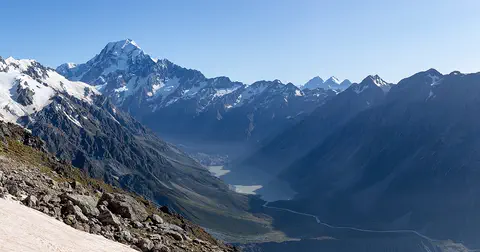
Aoraki / Mount Cook is New Zealand's highest mountain, in the Southern Alps of the South Island. Its name joins its Māori name, Aoraki, with its English name, Mount Cook. The mountain is being pushed up where two of Earth's plates meet, and glaciers carve the valleys around it. In 2013 surveyors measured it at 3,724 meters.
-
 Watch
 Country
Australia
Australia is a country and the smallest continent, surrounded by ocean in the Southern Hemisphere. Much of its middle is dry and flat, most people live near the coast, and its animals include kangaroos, koalas and the platypus, a mammal that lays eggs.
- Watch Geography Glaciers A glacier is a huge mass of ice and snow that slowly flows over land. It forms where more snow falls than melts, year after year, until the snow is squeezed into ice. Pulled by its own weight, it creeps downhill, carving wide valleys and carrying rocks along.
- Watch Geography How mountains form Most mountains are built by moving tectonic plates. When continents collide, rock crumples and folds into ranges like the Himalayas. Where the crust stretches and cracks, blocks of rock tilt up along faults. Volcanoes build mountains from lava and ash. Then erosion slowly wears them all down.
-
 Watch
Natural wonder
Great Barrier Reef
The Great Barrier Reef stretches about 2,300 kilometers along the coast of Queensland, Australia. It is made of about 2,500 separate reefs and more than 900 islands, built by tiny coral animals, and it is home to more than 1,500 kinds of fish.
-
 Watch
Natural wonder
Kakadu National Park
Kakadu, in Australia's Northern Territory, is the country's largest national park. It stretches from a high sandstone cliff called the escarpment down to floodplains, mangroves and the sea. Aboriginal people have lived here for tens of thousands of years, and their rock paintings, some up to 20,000 years old, record their way of life.
For parents & teachers
What children will learn
- Locate Mount Kosciuszko in the Snowy Mountains of southeastern Australia.
- Explain how glaciers carved cirque lakes such as Blue Lake.
- Describe why snowpatch plant communities are at risk.
- Know how to prepare for fast-changing mountain weather.
Recommended ages: 3 to 17 · About 15 minutes
Talk about it
- How can scientists tell when glaciers moved, thousands of years after the ice has gone?
- Why might plants that grow beside late-lying snow be at risk if snow melts sooner?
- Why might the highest mountain in one country be a fairly easy walk?
Try at home or in class
- Fill a clear jar with cold water and gently pour warm, colored water on top: watch the layers, then stir to see them mix, like Blue Lake in spring and autumn.
- Pack an imaginary day-walk bag for the mountains together: warm layers, a rain jacket, water, snacks and a map.
Key vocabulary: tableland, cirque, glacier, alpine, critically endangered
Where these facts come from
- Wikidata , Wikimedia Foundation (CC0 1.0)
- Highest Mountains , Geoscience Australia
- Mount Kosciuszko , National Geographic Education
- Late Pleistocene glaciation of the Kosciuszko Massif, Snowy Mountains, Australia (Barrows et al., 2001) , Australian National University
- Blue Lake , NSW Environment and Heritage
- Snowpatch Feldmark in the Australian Alps Bioregion: critically endangered ecological community listing , NSW Threatened Species Scientific Committee
- Above the Treeline (Kosciuszko Education Centre program) , NSW National Parks and Wildlife Service
- Kosciuszko walk: Thredbo to Mount Kosciuszko (visitor info) , NSW National Parks and Wildlife Service
- File:Kosciuszko Townsend.jpg , Wikimedia Commons
- Natural Earth vector data , Natural Earth (NACIS) (Public domain)
- Wikimedia Commons , Wikimedia Foundation (Per file (public domain, CC0, CC BY or CC BY-SA); see each media record)
Checked, not yet human-reviewed. Last updated November 1, 2026. Spotted a mistake? Tell us.